
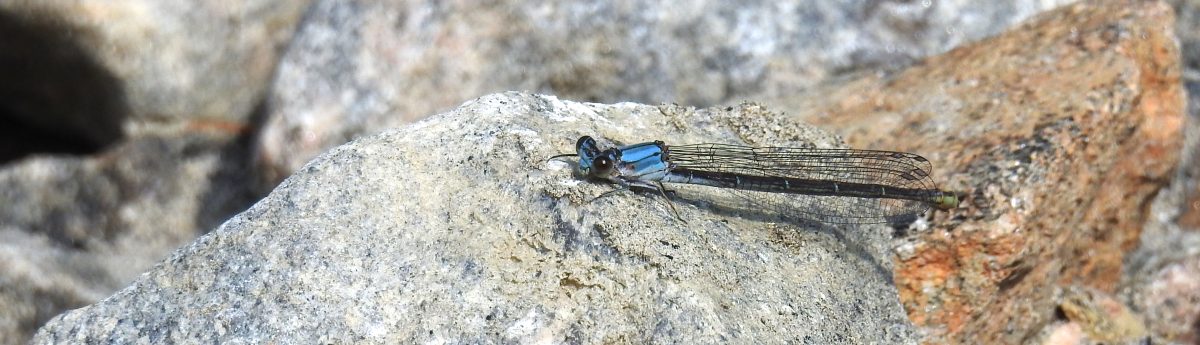
There are 23 species of clubtail found in the Ottawa-Gatineau region, ranging from the very common to the very rare. Two species – the Skillet Clubtail and Extra-striped Snaketail – are known from historical records only. Clubtails are named for the prominent club found in most males and some females, but this feature alone is not diagnostic; some clubtails do not have a club at all, and some species in other families have a club-shaped abdomen. Instead, members of Family Gomphidae are identified by the widely separated eyes. Their bodies are black or brown in colour, with a variety of yellow or green markings along the abdomen – this group emerges with bright yellow spots, dashes or rings along the abdomen which change to olive green as they age. The thorax is usually green or yellow with black stripes. Their eyes range from green to turquoise to blue depending on the species.
There are several different types of clubtail in our area: snaketails, spinylegs, pond clubtails, hanging clubtails, and the king of them all, the Dragonhunter. Most are found at running water: large rivers, small streams, with rocky or sandy bottoms. Only a few – the pond clubtails (genus Arigomphus) and a few members of genus Phanogomphus – are found at ponds, lakes and still water habitats. To optimize your chances of seeing the greatest number of species, visit a variety of places along the Ottawa River or the streams of Gatineau Park.
Status and Flight Season in Ottawa-Gatineau

Examples of Species:
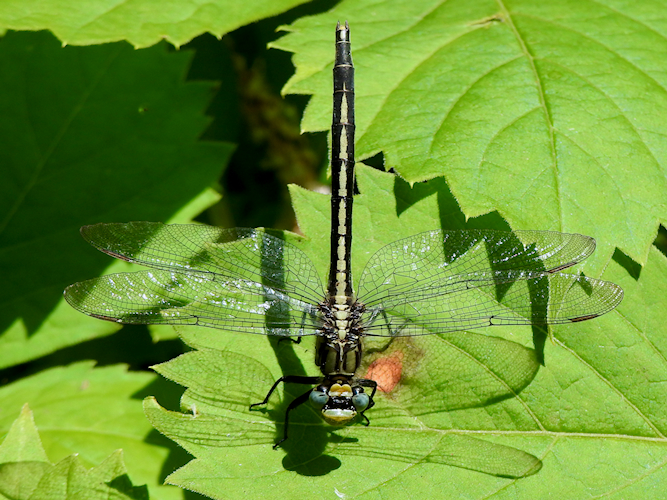
Horned Clubtail (Arigomphus cornutus)
The Horned Clubtail is a common species where it lives near lakes, ponds and slow streams. It lacks a thick club and has strong yellow markings down the length of the abdomen. The eyes are blue and the thorax is mainly yellow and unmarked. Females have a large, bi-lobed occiput between the eyes and the black horns directly beneath it, while males have distinctive branched cerci.
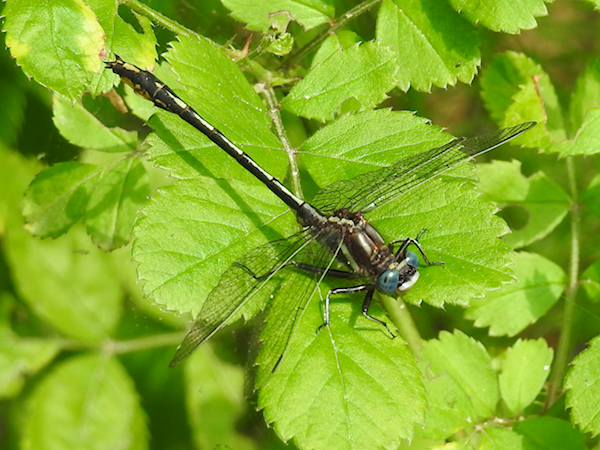
Lancet Clubtail (Phanogomphus exilis)
This is the most abundant small clubtail in our region where it inhabits sandy lakes and wide rivers or streams. It is most easily found along the Ottawa River and along trails in Gatineau Park. Thin yellow stripes run down the length of the abdomen all the way to the final segment; the yellow on segment 9 is usually much more prominent on this species than the similar-looking Dusky and Ashy Clubtail.
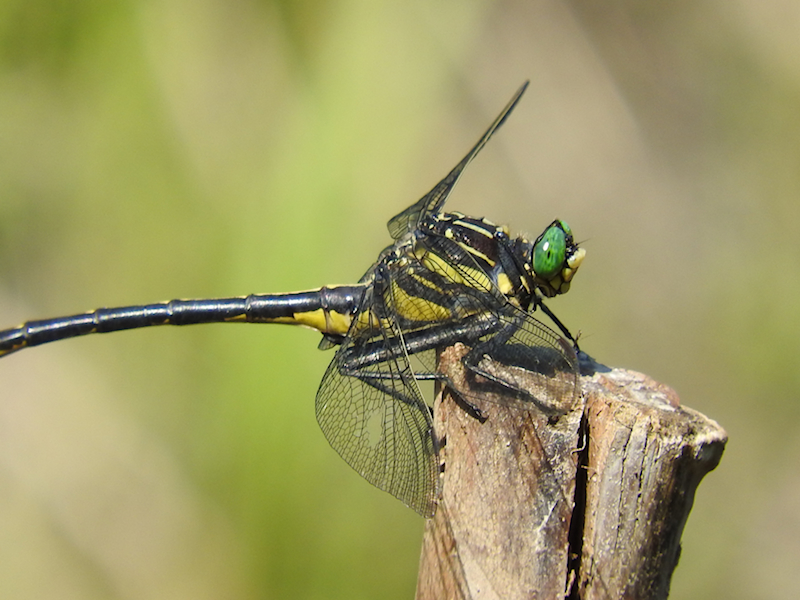
Dragonhunter (Hagenius brevistylus)
The large size, robust thorax and small head with emerald green eyes of this dragonfly are distinctive among the clubtails. In flight its abdomen curls down, giving it the appearance of a sideways “J”. When it perches, it seems to prefer perches that are too small for it. Preferring habitats with running water, it is more easily found in Quebec or natural areas along the Ottawa River.
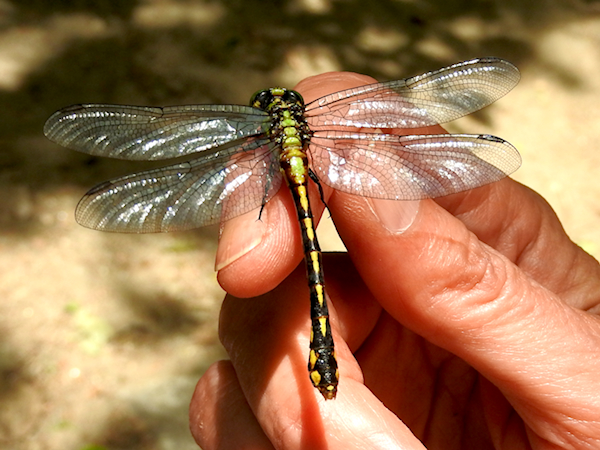
Maine Snaketail (Ophiogomphus mainensis)
Snaketails are bright green clubtails with black and yellow abdomens. They inhabit pristine rocky or gravelly streams with pools and shallow riffles; as such, they are more easily found on the Quebec side of the river. The Maine Snaketail prefers smaller wooded or open streams or rivers where they may be seen perching on rocks.
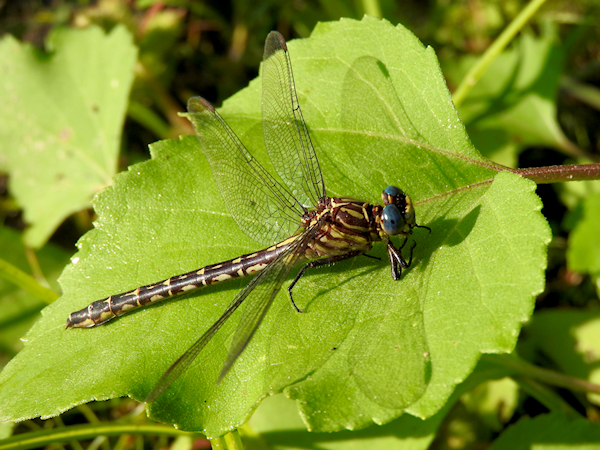
Elusive Clubtail (Stylurus notatus)
This species can be abundant along the Ottawa River during emergence, and then is rarely seen once it reaches maturation. It is believed that adults fly up into the tree canopy to feed, only returning to large rivers to breed – and even when at the water, they patrol far out from the shore as if they don’t wish to be seen. The heavily striped thorax is unusual in our area.
 OdoNotations