
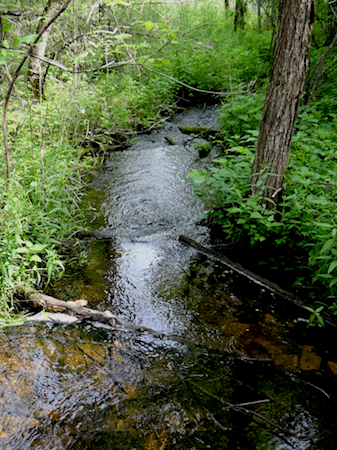
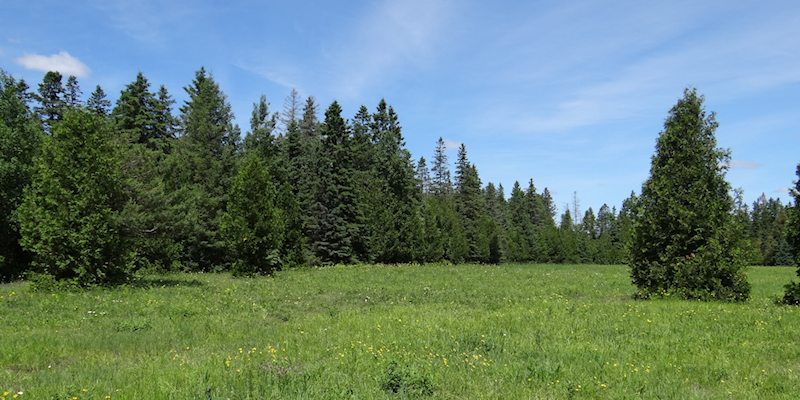
Marlborough Forest is a large natural area in the southwestern corner of Ottawa encompassing forest, alvar, abandoned farmland, marshes, ponds, and even an abandoned 19th century cemetery. The City of Ottawa owns over 8,000 hectares for conservational and recreational use, and despite its name, it is predominantly a large system of wetlands running through a forested area – various swamps, marshes, ponds, streams, creeks and the famous Richmond Fen all make up a large portion of this huge conservation area. The Rideau Trail and several unmaintained road allowances running through the area provide several kilometers of hiking trails, with three parking lots on Roger Stevens Drive east of Dwyer Hill Road and one on Paden Road providing points of entry. Although its biodiversity and mix of habitats make it one of Ottawa’s best places to look for odes, birds, wildflowers, herps, and more, be prepared to share the trails with deer flies, horse flies, mosquitoes, dog-walkers, dirt-bikers, and other small motorized recreational vehicles once the warm weather arrives. However, its distance from any sizable towns or subdivisions and the sheer size of the forest usually mean several uninterrupted hours of peace and quiet….except for the biting bugs, of course.
I usually start visiting Marlborough Forest in mid- to late May for odonates. Roger’s Pond (parking lot E3 on Roger Stevens Drive) has been the site of most of my early-season ode-hunting, until my explorations during the pandemic took me to the trails further west at parking lots E4 and E6. Recently I’ve been exploring some of the additional trails leading into the forest, with varying success in finding new species for my casual Marlborough Forest project which stands – as of summer 2025 – at 54 species, bringing the known total up to 61 species. I am sure this number is under-represented due to the difficulty of accessing much of the interior.
Marlborough Forest Specialties
Emeralds
The main reason I keep going back to Marlborough Forest throughout the summer is to look for emeralds. The four baskettail species are common in late May and early June, particularly along the trail leading to Roger’s Pond. American Emeralds are quite common, and Racket-tailed Emeralds are abundant.
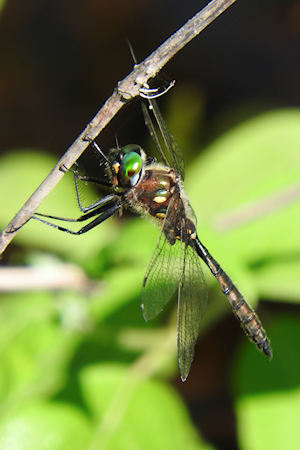
In 2015 I was ode-hunting with Chris Traynor when he noticed an Ebony Boghaunter at Roger’s Pond, and since then I’ve seen two others in Marlborough Forest – one deeper in the woods past Roger’s Pond, and one along the trail heading south from Kettles Road. All three records are from the third week of May.
In June the Brush-tipped Emeralds start flying, and they can be common to scarce depending on the timing of their emergence. I’ve seen them at Roger’s Pond and trails E4 and E6 along Roger Stevens Drive, observing six on one day on June 4, 2023 at trail E4. I’ve seen good numbers in mid-July, and they can fly into early August, so be vigilant for small dark emeralds flying up and down the trails during the summer.
Single sightings of Ocellated Emerald and Kennedy’s Emerald at trails E4 and E6 respectively have led me on a quest to find more of these species in Marlborough Forest, and perhaps other Somatochlora emeralds as well. Given the proximity of the Richmond Fen to these trails, it is possible that some of the other large Somatochlora emeralds are flying in the more remote and inaccessible parts of the forest. Ironically, I discovered a fourth Somatochlora species – Williamson’s Emerald – while going through old photos one winter’s day almost 15 years later!
Other Dragonflies
Harlequin Darners are scarce but regular denizens of the Cedar Grove Nature Trail, often landing on people wearing light-coloured clothing. Lake Darners have turned up here more than once; I caught one zipping around the field next to Roger’s Pond, with more flying up and down the trail just north of the pond.
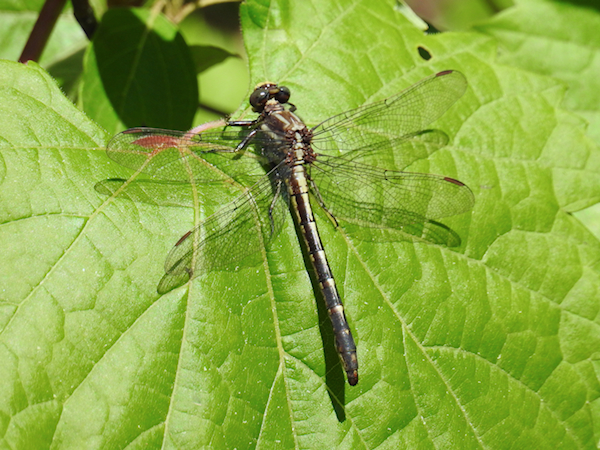
The Roger Stevens trails are also the only place in Ottawa where I have seen Ashy Clubtail, though care must be taken to separate them from the more common Dusky Clubtail. They may be more common than we know, as there are a handful of records on iNaturalist, so future Dusky Clubtails should be caught and examined.
Marlborough Forest is the only place in Ottawa where I’ve seen Twin-spotted Spiketail. I’ve seen them at the creek at the back of Roger’s Pond and the one that crosses the E4 trail, so other streams in the forest may be home to this beautiful species (or even other spiketails).
Uncommon skimmers such as Calico Pennants and Hudsonian Whitefaces turn up occasionally. The Calico Pennant used to be a regular and easily found species at Roger’s Pond; now it seems that it takes repeat visits throughout their flight season in order to find them.
Damselflies
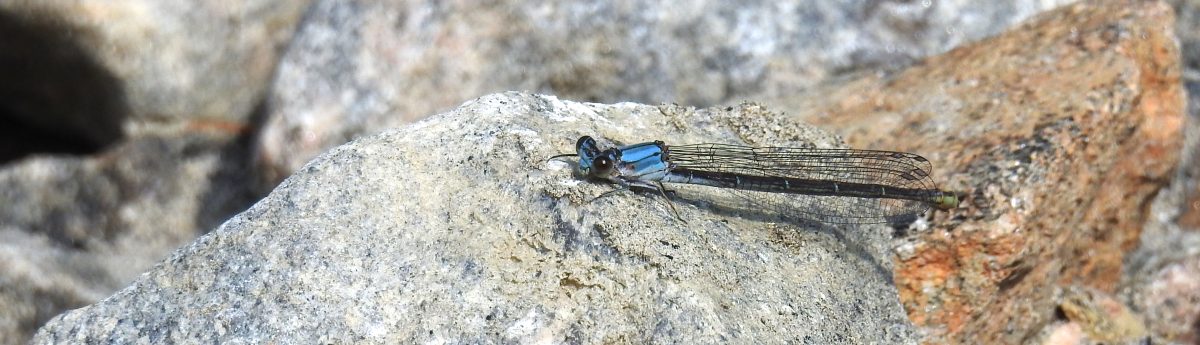
Trails that run close to water are great places to see Aurora Damsels, small black and blue damselflies that lack the usual black shoulder stripes of bluets and hold their wings out to the side like spreadwings. These are the main damselfly attraction for me in Marlborough Forest, as the other species there can be found closer to the city.
 OdoNotations