
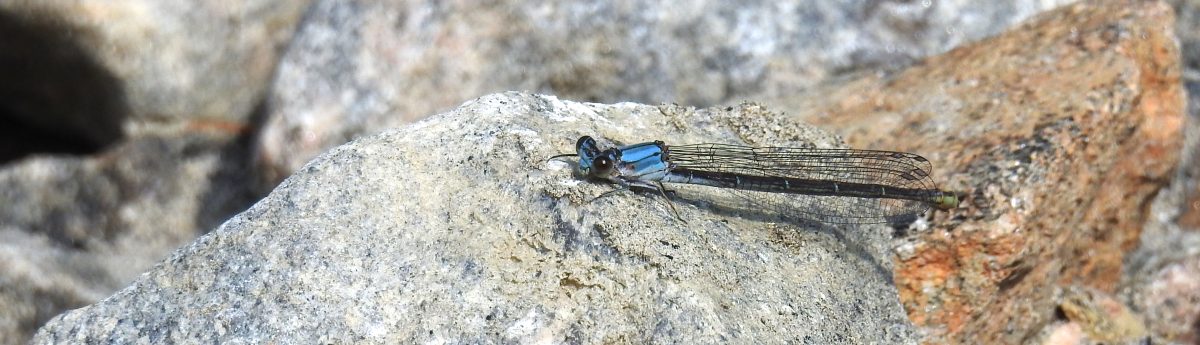
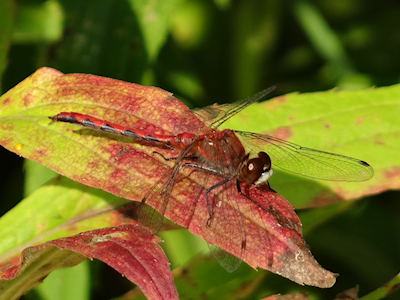
Dragonflies and damselflies, collectively referred to as odonata, or “odes”, are extraordinary creatures. They begin their lives as underwater nymphs, lurking at the bottom of marshes and lakes, rivers and bogs, until the ancient process of transformation propels them onto land where they metamorphose into the winged predators we see flying in the warmer months. The adults come in a variety of colours – candy apple red, powder blue, orange, brown, green and pink, black and yellow, violet and more – with glistening wings that are entirely clear or have stained-glass patterns etched upon their surface. They are deadly predators, with the highest success rate of any predator when it comes to catching what they chase; yet they are friendly and confiding, sometimes landing on humans that wander into their territory.
Summer would not be the same without these colourful insects cruising along the shoreline or perching on a stem in a wildflower meadow. They inhabit rushing creeks and boggy wetlands, isolated country roads and urban storm water ponds, pristine lakes and the smelliest sewage lagoons. Relatively unchanged in structure since they evolved at least 300 million years ago, they can fly forward, backwards, up, down, or even hover in one place. Each of their four wings can move independently, giving them an amazing agility that lends itself to some impressive aerial displays. They eat an astonishing number of prey insects in both their adult and larval forms; the nymphs of smaller species feed on mosquito and other small aquatic larvae, while larger dragonfly nymphs feed on small crustaceans, tadpoles or even minnows! Adult damselflies and dragonflies eat other flying insects which they catch on the wing, including moths, beetles, wasps, deer flies, and even other odonates. They are as beneficial as they are beautiful.
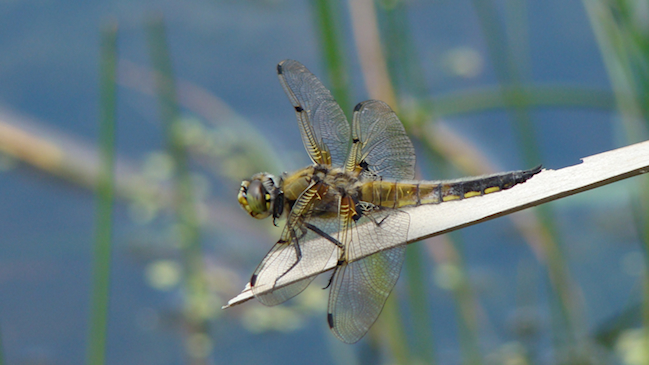
My earliest photo is of a Dot-tailed White Face taken at the Giroux Ponds on May 26, 2007 – a photo which I still have to this day! However, I didn’t become seriously interested in the odonata until a fresh, golden Four-spotted Skimmer landed in front of me while I was birdwatching. I had never given much thought to them before, but the beauty of that dragonfly transfixed me. I asked around, and a local naturalist put me in touch with another local birdwatcher who also happened to study dragonflies, Christina Lewis.
After that I made it a point to photograph the dragonflies I saw while out birding in the warmer months. There was a steep learning curve when it came to learning the three families of damselflies and six families of dragonflies that call our region home, and the Field Guide to the Dragonflies of Damselflies of Algonquin Provincial Park and Surrounding Area by Colin Jones et al. (which includes the Ottawa-Gatineau region) became my bible. Eventually I started going out looking specifically for odes with Chris Lewis and her partner at the time, Bob Bracken. We had some fun times exploring different habitats and looking for rare or migrant species, and over time more and more odonate photos and stories began creeping into my birding blog. Recently I came to the realization that it’s time these marvelous creatures had a dedicated website of their own – this is the result.
About Me
I am a lover of nature whose primary interests are birds, dragonflies, and butterflies. Although I have been birdwatching since 2004, my fascination with the natural world really began in 2006 when I first started taking my camera on my walks with me. I found that when viewed through the lens of a camera, the world became a much more beautiful and fascinating place. I found I was able to capture details not readily apparent in the fleeting glimpses often granted to me, and that sometimes what I thought was one species was actually quite another!
The more I saw, the more I wanted to see. I became an avid birder, and to this day it is the birds that hold the first place in my heart…at least in the cooler months! Mammals, reptiles, and amphibians also captured my attention, but butterflies became my next real interest, followed by the odonata. However, anything colourful or unusual catches my attention while out hiking. While I enjoy photographing the wildlife I see, my main interest is in observing and learning about the species I see through my lens. I document almost everything I see, and am a big fan of eBird and iNaturalist for recording my sightings. Gradually I have started using these tools, iNaturalist in particular, for exploring the ranges of species of interest and looking for new places to find some of the less frequently seen species. Location lists are an obsession of mine, and you might find one or two within these pages!
In my enthusiasm to share the marvelous wildlife of Ottawa with others, I have led both birding and dragonfly outings for the Ottawa Field-Naturalists’ Club and Mississippi Valley Field Naturalists, contributed data to the ROM Field Guide to the Butterflies of Ontario, and have participated in local Christmas Bird Counts and the third Ontario Breeding Birds Atlas. I have had various dragonfly photos published in the OFNC’s quarterly publication am a contributing author to the ongoing Dragonfly Species Profile series in its Trail & Landscape publication originated by another local odonate enthusiast, Chris Traynor.
For those of you who are interested in seeing the best of my nature photos, please feel free to check out my gallery on Pbase. You can also follow me on iNaturalist, where I post all of my non-avian sightings, as well as my general nature blog, The Pathless Wood.
 OdoNotations