
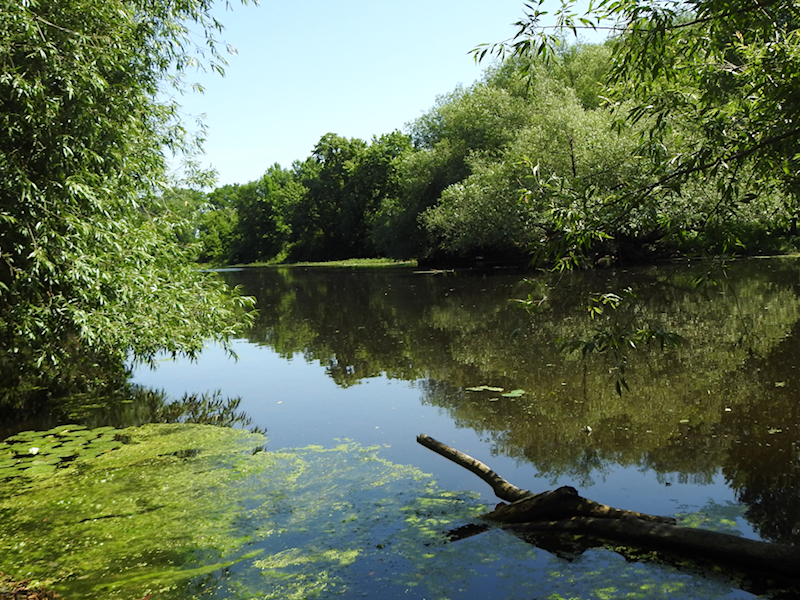
Terry Carisse Park – originally named Bow of the Jock Park until 2006 when it was renamed in honour of Canadian country music hall-of-famer Terry Carisse – is a small recreational park tucked in a remote part of the city between Fallowfield and Twin Elm. Located at 3035 Steeple Hill Crescent, it is surrounded by farmland and runs along a small part of the Jock River. There is a small, unpaved parking area at the north end that can hold about a dozen vehicles on a good day, but watch for potholes, ruts and mud puddles (and mud-puddling butterflies!). While originally known as a great spot to fish or launch canoes or kayaks from the public dock, Terry Carisse Park did not become a birding destination until 2014 when a rare Hooded Warbler made a spring appearance here. It is best for birding during migration and the early part of the breeding season, so I never really considered it as a potential spot for summer odonates until 2022 when I was looking for ode-hunting areas close to home. That year it became a project to see how many species I could find there in one season, and I was pleasantly surprised!
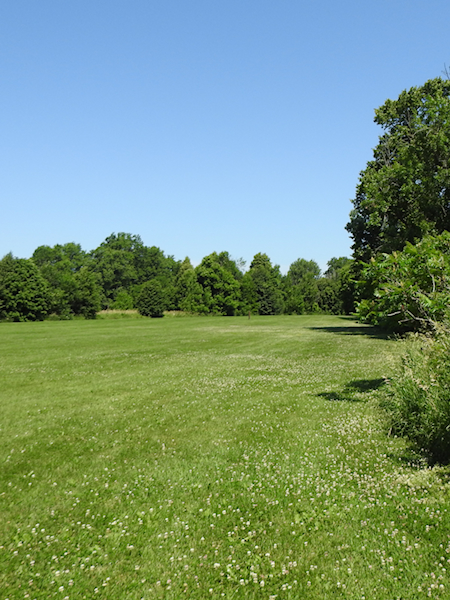
This park consists of a narrow strip of green space that runs perhaps just under a kilometer in length on an elevated bank about two meters above the Jock River. Most of it is made up of manicured lawn, with a wooded swamp at the north end where Mahoney Creek empties into the Jock, a seasonal dock for launching boats just across from the parking area, a playground, and a thick band of riparian vegetation that almost completely blocks all views of the river from one end of the park to the other. There is also a steep, well-worn trail down to the water at the north end for launching boats directly from the bank. The Jock River is smaller than the Rideau River, and much more sluggish, without a lot of rocks or rapids that would attract the clubtails and spiketails found in Gatineau Park. It hasn’t been surveyed for odonates as well as the Ottawa River has, mainly because much of it runs through private agricultural or residential land, with only a few small parks with even smaller access points in Richmond and Ottawa.
Because of the elevation and the naturalized vegetation, there are only three ways to get to the water, of which the two aforementioned boat launches are the easiest to access. The launch at the north end is the better spot for searching for searching for odes due to the easy access to the water and emergent vegetation close to the shore, though a steep drop-off underwater means it isn’t a great spot for wading even with boots. The floating dock is best for watching larger dragonflies flying up and down the river. There is a third opening not too far south of the parking area, and this was the best spot for odes when I started visiting it in 2022 as it was the largest one – about twenty metres long, and perhaps three metres wide at its widest (depending on the water level), though most of it is covered in vegetation. Although there is a small path leading through the trees to the water, it is partially hidden and you have to pay attention to find the opening. You can find it on iNaturalist by looking for the dense cluster of observations.
If you plan to check the water for odes, the best time of the day to visit the park is in the morning when the sun is shining directly on the western bank and the emergent vegetation. If you visit in the afternoon, you are better off walking the length of the park, checking the riparian vegetation from the lawn for perching damselflies and watching for zooming emeralds or darners hunting over the lawn.
Specialties
Link to List of Odonata Species found at Terry Carisse Park
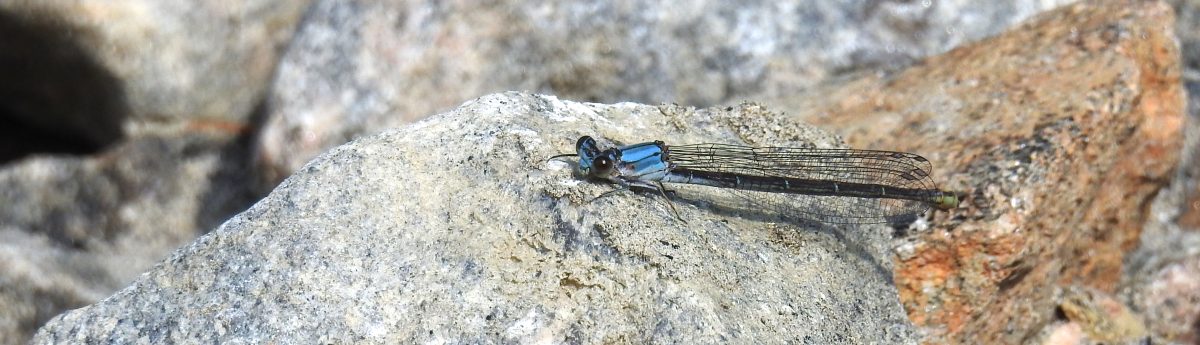
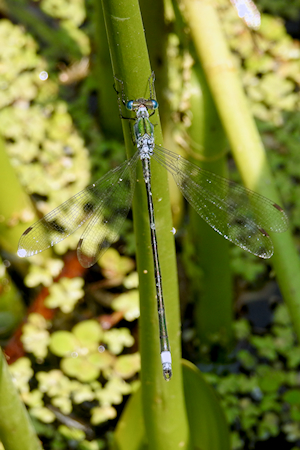
Although I’ve only found 25 species here, what makes Terry Carisse Park special is that it has some of the same odonates found only in places in like Petrie Island and Morris Island Conservation Area and a terrific variety of damselflies. These uncommon odes include Slaty Skimmer, which I’ve only seen once back in 2022, and Elegant Spreadwing, which I’ve seen each year from 2022 – 2024. I did not see any on my visits in 2025, possibly due to high water levels and sparse emergent vegetation near the boat launch.
Some of the less common species seen here include Common Baskettail, Orange Bluet, Stream Bluet and the spectacular Rainbow Bluet. Most dragonflies are the usual pond skimmers found at any marsh or storm water pond.
Related Blog Posts:
 OdoNotations