

During the third week of August I spent some time at my Dad’s trailer in the Pinehurst Lake Conservation Area near Glen Morris, Ontario. Although more of a campground/recreation area than a conservation area, it is nevertheless a great spot to spend a few days and see some “southern” wildlife. The last time I was here (August 2014) I was treated to the antics of a couple of juvenile Broad-winged Hawks, found a small pond where female Black-tipped Darners laid their eggs in the late afternoon, observed a Blue-winged Warbler on a morning walk, saw my first Red-spotted Purple butterfly, and even saw a bat near one of the washroom lights after dark. I didn’t see any Broad-winged Hawks or cool southern bird species this time, but I still ended up with 28 bird species over three days – the same number I saw in 2014 – and saw several interesting odes, including a lifer!
The weather wasn’t particularly cooperative once we arrived at the trailer – overcast skies and intermittent rain showers limited the amount of time I was able to spend dragon-hunting (and I had specifically brought my net on the train to do so). However, as soon as we had some clear skies the next day I wasted no time checking out my favourite areas along the Pine Grove Trail from my last visit.
There’s a large, open spot at the crest of a hill that is great for birds and bugs. I spent some time there in the afternoon once the sun came out and saw a Monarch butterfly, a Common Wood-nymph, a fritillary (likely a Great-spangled Fritillary), and a couple of colourful little moths which were identified for me as Alfalfa Webworms.
My best find was a glider patrolling the sunny ridge. Fortunately I was able to catch it, and was surprised to find a Spot-winged Glider in my net instead of the more common Wandering Glider. I took a few photos of it in the hand, then placed it on the vegetation. He stayed there for several minutes, long enough to get several photos. I don’t have as much luck seeing this species in Ottawa as I do the Wandering Glider, so I was especially thrilled to catch it.

After dinner on our first day, I took a walk down to the small pond where I had seen the Black-tipped Darners ovipositing on my last visit. It must have been too late in the day or too cool, for I didn’t see any darners patrolling above the water. However, I did find a White-faced Meadowhawk and this red-faced meadowhawk, either a Cherry-faced or a Ruby Meadowhawk. I wasn’t able to catch it so I couldn’t give it a positive ID – Ruby Meadowhawk would be a lifer for me.

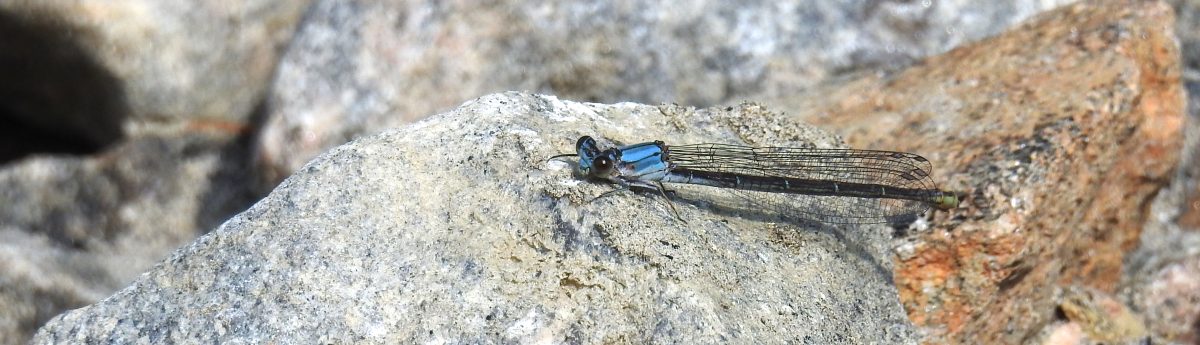
I saw my only bluet of the trip back at the trailer site after I returned. I caught it and photographed it, and the appendages were clear enough in the photos to identify it as a Familiar Bluet. These damselflies often fly late into the year – as late as October in Ontario – and are common around still and slow-flowing water bodies.

The next morning Sharon, Ashley and I went for a walk along a new trail, Morton’s Trail, which – according to the map – passes by two large wetlands. I was eager to look for dragonflies and damselflies in these wetlands, and brought my net. The trail itself started in an open area at the top of a hill. I saw a few darners patrolling the sky, but wasn’t able to catch them. The view was amazing.

The trail follows the open field into the woods, and other birds seen and heard include Baltimore Oriole, Cedar Waxwing, Gray Catbird, a pair of Red-eyed Vireos and a single Eastern Wood-Pewee. I was disappointed that one of the two wetlands appears to have dried up in the drought, while the other was at the base of a steep depression with no way to get down to the water. I assumed there was water there due to the large growth of cattails; I couldn’t see any water (or any dragonflies for that matter) from my vantage point.
After leaving the woods again the trail enters another open grassy area dotted with small shrubs and wildflowers.

This turned out to be the best part of the trail for insects – I saw two Monarch butterflies, several Pennsylvania Leatherwing beetles, and quite a few dragonflies flying high in the air. A few darners were patrolling the trail, zooming in close to the shrubs and then back out, and after waiting patiently one finally flew within reach. I netted the dragonfly, and was surprised to see this interesting lady when I pulled her out.

To be completely honest, I wasn’t sure what she was even after taking several photos. My first thought was Shadow Darner, as the first thoracic striped resembled a “walking cane”, the abdominal spots were small, and the appendages were broken off. However, the colour and the “walking cane” shape of the first thoracic stripe didn’t really match that species. I checked the other species in my Algonquin guide, hoping it might be a Green-striped Darner, but ruled it out as the guide shows the first stripe looking more like a “ripple” (similar to the Lance-tipped Darner) rather than a “walking cane” shape. Chris Lewis pointed out to me that this individual looks very similar to the Green-striped Darner pictured in the Paulson field guide…and evidently the females of that species often have broken-off cerci (appendages) too. I have no experience with this darner, as it is a southern species, and posted my photos in the Northeastern Ode group on Facebook. They confirmed what Chris suspected – my lifer Green-striped Darner!

The Green-striped Darner is similar in appearance to Canada, Lance-tipped, and Lake Darners. It breeds in small lakes, ponds, and fens, and is regularly seen patrolling the shoreline with lots of emergent vegetation. This is now the fifth confirmed Aeshna species I’ve seen at my dad’s trailer: Shadow, Canada, Variable, Black-tipped and now Green-striped.
I was eager to see the Black-tipped Darners again, too, so later in the day I took another walk down to the small pond. Along the way I found a Spotted Spreadwing perching along the road.

When I reached the small pond I was happy to see several darners flying low over the water and landing in the emergent vegetation. A quick look at the thoracic stripes (and a longer look when I managed to catch a couple) confirmed them as Black-tipped Darners. In this photo you can see the straight thoracic stripe and the entirely black 10th segment that help to ID these dragonflies, as well as the exuviae of a freshly emerged dragonfly in the lower left.

In this photo you can see the female darner inserting her ovipositor into the vegetation to lay her eggs. Oviposition occurs during late afternoon and into evening, and females lay their eggs into a variety of emergent vegetation both above and at the waterline. This species has also been observed laying eggs in floating plants, dry grass, or mud.

I also saw a mating pair of White-faced Meadowhawks, a Fragile Forktail, and a couple of Slender Spreadwings in the same area.
I returned to the open ridge on the Pine Grove Trail on my last day there, but identified only a Common Green Darner flying around – the Spot-winged Glider was gone, and the few mosaic darners that I saw were flying too far out of reach to catch or identify. I kept hoping they would land – this was the area where I’d seen the Variable Darner perching two years ago – but none of them would oblige me.
I also had time to return to the small pond where I had seen the Black-tipped Darners, only to find out that they were gone. The sun shining on the dew-covered vegetation made for a pretty sight, and I couldn’t resist photographing this female Eastern Forktail sitting on a dew-beaded leaf:

I was sad when we left the trailer, as the abundance of wildlife at the Pinehurst Lake Conservation Area makes it a great place to study and photograph birds, bugs, herps, and more. I am glad to have discovered Morton’s Trail on this trip, as the field there is a wonderful place to watch butterflies and dragonflies. I can’t wait to return and hopefully catch another Green-striped Darner fully knowing what it is.

 OdoNotations