
Darner (genus Aeshna) season typically begins in July in the Ottawa-Gatineau region. The two most common mosaic darners, Lance-tipped and Canada, emerge early in the month, along with the slightly less common Shadow Darner. These three species are the most widespread members of this group, and if you see a mosaic darner flying along a forest trail or in an open clearing in the greenbelt it is most likely to be one of these. Lake Darner, Variable Darner, and Black-tipped Darner are considered “uncommon” in the Ottawa-Gatineau region, with the first being a localized species and the latter two species considered to be widespread. I suspect they may be easier to find on the Quebec side of the region, as there are more lakes and suitable bodies of water in Gatineau Park, and Black-tipped Darner has been relatively easy to find there. Finally, the Mottled Darner and Green-striped Darner are both considered “very rare”, with only a handful of records of each. I’ve been lucky to see a few Green-striped Darners in Stony Swamp in recent years, with one individual at Bruce Pit in September 2019 and two individuals at the Beaver Trail in September 2021. I’ve never seen a Mottled Darner, and hope to catch up with this species one day.
I wasn’t able to catch up with any darners until August, and in early August both the expected Canada and Lance-tipped Darners were easy to find. I saw one of each on August 10th, at Mud Lake and Andrew Haydon Park respectively, and then a swarm of at least six or seven darners zipping over the meadow at the Beaver Trail the following day. I netted two that turned out to be Lance-tipped Darners, and saw a Canada Darner perching on a tree trunk. At the end of the month I started seeing more Shadow Darners, including one at the Eagleson storm water ponds and another at the park off of Steeple Hill Drive in Fallowfield.
Shadow Darners are somewhat easier to identify in flight than the other mosaic darners. The coloured spots on the abdomen are quite small, which makes this darner seem darker in comparison.

Shadow Darners are most active in the late afternoon and early evening, preferring to perch in grassy areas during the day. When flushed in the early morning, they will often find another spot to perch close by, allowing an eager dragon hunter to get quite close to it. There is no need to net this one to identify it, as the straight anterior thoracic stripe with the backwards-facing flag at the top gives it a distinct appearance often described as a “walking cane”.

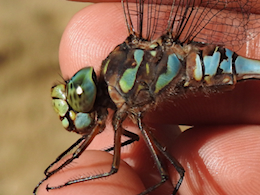
Although I had high hopes, I wasn’t really expecting to see any other species. I spent some time at Terry Carisse Park on August 31st watching at least three or four darners flying lazily over the grass and up into the trees, trying to catch them with my net; the one that I caught turned out to be a Lance-tipped Darner. So did the one I caught at Andrew Haydon Park a few days later, making it the second one I’d seen there this year. The anterior thoracic stripe in the Lance-tipped Darner has a slight notch on each side, giving it a rippled appearance quite unlike the stripe found on the Canada Darner. In addition, the extension at the top of this stripe is quite small. Below are the blue male that I caught at Terry Carisse and the green-form female I caught at Andrew Haydon Park showing this field mark. Note that the first anterior stripe of the male is blue at the top and green at the bottom. Females may either be blue like males, yellow, or green. (Click either image to enlarge it.)


In the Canada Darner, only the front side of the anterior thoracic stripe is notched. The other side is straight. Like the Shadow Darner, the top of this stripe has a noticeable extension or flag pointing backwards. Below are two different individuals I caught at the Timm Road trails one day. You will note that there is a small circular spot in between the two stripes on the thorax. Although this isn’t diagnostic, it’s another field mark to look out for on perched individuals. The female on the right is the same colour as the male, but like most mosaic darners, her spots may be blue, yellow or green.


While at Sarsaparilla Trail on September 3rd, I noticed two Aeshna darners patrolling the sunny clearing between the parking lot and the outhouse. I only managed to catch one of them, and when I pulled it out of my net I wasn’t sure what I was looking at. The first thoracic stripe had a rippled appearance, not a strong notch, so it wasn’t a Canada Darner. However, the extension at the top was quite pronounced with a downward-pointing hook, ruling out Lance-tipped Darner. I had caught a Green-striped Darner instead, my fourth individual in four years! This made me wonder whether the other darner flying in the clearing had also been a Green-striped Darner, as I had found a male and female together at the Beaver Trail in 2021.

Although Green-striped Darners typically have greenish thoracic stripes and blue abdominal spots, and while other darner species generally lack this colour combination, there is enough variation within individuals that this colour combination is not considered diagnostic. The thickened flag at the top of the first thoracic stripe is a much better clue, along with the rippled shape and lack of a large circular spot between the two stripes.

After that amazing find I didn’t expect to see anything else as wonderful, but then after I walked around Mud Lake on September 14th I returned to my car to find this fellow resting on the pavement a few feet away from my front tire. I thought it was dead, as most darners perch vertically on tree trunks or thick stalks of vegetation rather than on the ground; the Variable Darner is an exception that is equally at home on the ground or on a vertical surface, as I learned from my trips to Alberta. I peered at the dragonfly through my binoculars to see if I could identify it before I approached it; right away, the rather prominent dark cross-stripe on the face alerted me that this wasn’t another Canada or Lance-tipped Darner, it was the rather uncommon Lake Darner!

Lake Darners breed in wooded lakes and large beaver ponds where they often patrol the shoreline or in forest openings. They are not common here in Ottawa, but given the strong northwest winds we’d had the night before it might have blown in from the Quebec side of the river where there are plenty of small lakes in Gatineau Park where they might breed. They look quite similar to the Canada Darner, with a strongly notched anterior thoracic stripe – however, in this species, the notch nearly divides the stripe in two. The triangular flag at the top is often slightly detached from the first stripe. Unlike the Canada Darner, the Lake Darner has no spots on the underside of its abdomen, something I’d never known before.

I wanted to pick it up and examine it, but just in case it was still alive I put my net over it first. It was a good thing I did, as the darner immediately flew up inside the net! I plucked it out, and was thrilled to see this magnificent beauty up close. The Lake Darner is one of our largest darners, and seems huge in my small hand. From this angle you can see that the underside is entirely black, as well as the the thickened posterior thoracic stripe which is much broader than the pointed “thorn-shaped” stripe in the Canada and Green-striped Darners:

It was an exciting find, especially as it seemed to be waiting for me right next to my car!
Fortunately that was not my last Lake Darner of the year. Chris Traynor and I visited Bruce Pit on September 24th to look for darners and other insects. I brought my net, but there weren’t many Mosaic Darners flying around for me to catch. The few that we did see were either flying too high or quickly disappeared over the trees. It wasn’t until we were walking through the sandy part on the east side of the lake that we noticed one flying about shoulder-height over the vegetation. I swung my net at it and was almost surprised when I caught it on the first swing. I was even more surprised when I saw the dark cross-stripe on the face.

The shape of the anterior thoracic stripe also made it easy to identify as a Lake Darner. This is the second one I’ve seen at Bruce Pit; the previous one was found perching on a tree in the field just beyond the same area on September 9, 2019. According to Paulson’s Dragonflies of the East, male Lake Darners often patrol water bodies with a drooped abdomen, rarely hovering (unlike other Aeshna species). Females deposit eggs into floating logs, stems of emergent vegetation, or in exposed root tangles on vertical banks at or below the water’s surface. Males and females favour tree trunks, bare twigs, or the ground for perching. Interestingly, they can sometimes be found at the water in large numbers in the rain.

One additional field mark is visible from the top…I rarely take photos from this angle as it means holding the dragonfly by the legs, which is a skill I haven’t mastered yet (usually I am so afraid of damaging them that I hold them so loosely that the dragonfly is able to escape and fly off). However, with Chris present, I gave the dragonfly to him to hold for photos.
This field mark is the vertical line on the large segment at the top of the abdomen, S2, between the two hindwings. In the Lake Darner it reaches the top of the segment. In the similar species described above, the line does not extend all the way to the top. Even though this individual has a weak line that appears broken in two places, there is still a partial line at the top of the segment.

Darners are large, fascinating dragonflies, and it is a fun challenge to catch them in order to identify them. Here is a side-by-side comparison of the four similar species described above (click any image to enlarge). If you are lucky enough to come across one perching on a tree trunk or in a grassy area near water, you may be able to identify them easily even without a net.


Chris Traynor himself writes a series of dragonfly articles for the ONFC publication Trail & Landscape; for his excellent in-depth look at the Canada Darner and other similar mosaic darners, check out his online article published in Volume 57(1)!

 OdoNotations