
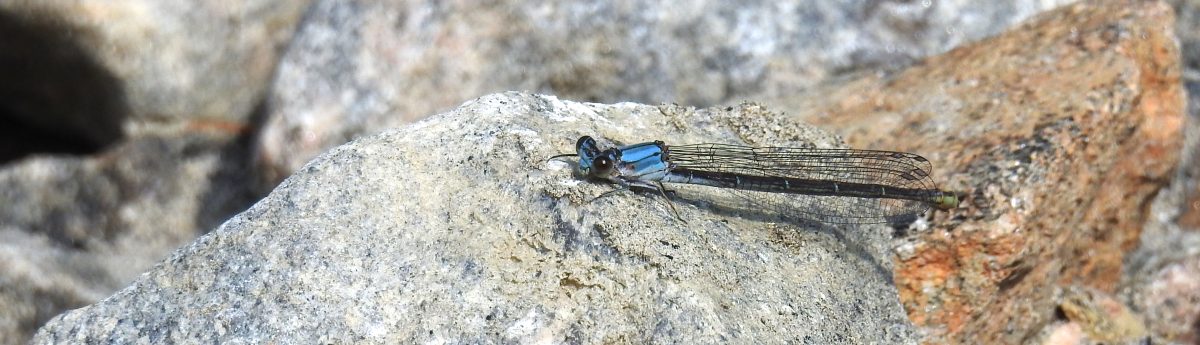

When I first heard about the Odolympics – a special bioblitz hosted by the Dragonfly Society of the Americas, Sociedad de Odonatología Latinoamericana, and Odonata Central in order to record as many odonata species from as many places in the Western Hemisphere as possible – I knew I had to participate. This specialized bioblitz is only two years old, and there are usually two Odolympics each year: one falling during the North American summer, and one falling during the South American summer in order generate a snapshot of odonate distribution throughout both hemispheres.
Dragonflies and damselflies, collectively known as odonates, are valuable indicators of a wetland’s environmental health and biodiversity. Simply put, the more odonates that use a wetland for breeding and feeding purposes, the healthier the ecosystem. Naturalists were encouraged to submit their observations during the bioblitz via one of two platforms: iNaturalist, or Odonata Central. While I love iNaturalist and have been using it for a few years now to record my non-avian observations, I began submitting my observations to Odonata Central last year when it developed a checklist-based phone app similar to eBird. iNaturalist also has a phone-based app for submitting observations, but it is intended to be used in conjunction with the phone’s camera which I only use as a backup camera when my Nikon Coolpix’s battery decides to take a nap. Although I love the ease of searching for data in iNaturalist’s projects, I chose to record my Odolympic observations in Odonata Central as it allowed me to include observations of species for which I am usually unable to get a photo (yes, I’m looking at you, Prince Baskettail and Wandering Glider!)
The 2023 Summer Odolympics ran from August 19-27, giving me two weekends to collect observations. Although late August is well past the peak of dragonfly diversity, I’d managed to find 25 species the previous weekend (including a brief outing Monday evening) and hoped to find that many during the 9-day census period despite working full time and losing a couple of lunch hours to appointments. I planned to collect observations solely from within Ottawa’s west end; goals included visiting places such as the Eagleson ponds, Stony Swamp, Bruce Pit, Richmond Conservation Area, Andrew Haydon Park, and Mud Lake. If the weather cooperated and I managed to find everything I wanted to see from those areas, a jaunt down to Roger’s Pond in Marlborough Forest was not out of the question.
Unfortunately, the weather chose not to cooperate. Both Saturdays dawned with a thick overcast sky that blotted out the sun entirely. The first Sunday was better, though the sun battled through the clouds all day. The last day of the project was clear and sunny and warm, and the best day of the whole bioblitz. In the end I ended up counting 27 species, and photographed all but three. Because I ended up repeating visits to Sarsaparilla Trail, the Steeple Hill park area, Andrew Haydon Park and the Eagleson ponds, I wasn’t able to visit Roger’s Pond or Mud Lake. Here is summary of the species that I found.
Broad-winged Damselflies
I saw no River or Ebony Jewelwings during the census period. There was only one spot where I might have seen the Ebony Jewelwing; however, I had not seen any Ebony Jewelwings at the Eagleson ponds after the deluge on August 10 during which more than 50 mm of rain fell over a 90-minute period, causing the pond’s water level to rise and the cattails to become flattened. I did not look for any River Jewelwings.
Spread-winged Damselflies
I observed only two species, both typically found in the latter half of the summer: Spotted Spreadwing and Slender Spreadwing. Both were found in good numbers, too; in fact, I think this was the most Slender Spreadwings I have ever seen in one summer! While both species were seen in Andrew Haydon Park, I saw the highest numbers at the Richmond Conservation Area and Bruce Pit.


Pond Damselflies
Eastern Forktails were just about everywhere I went, except for Sarsaparilla Trail; I have been specifically looking for them there after noticing none have been reported on iNaturalist. These tiny damselflies are abundant wherever they breed, and I found upwards of 100 at Andrew Haydon Park and Richmond Lagoons. Older pruinose females seemed to outnumber the males and immature females. This atypical female, seen at Andrew Haydon Park, has a green thorax like a male but a pruinose dusky blue abdomen of an older female. Females that have the same colour as the male are said to be homeochromatic, or androchromatic, though they usually have a black abdomen with smaller blue patterns on segments 8 and 9 of the abdomen.

I tried to take some photos of the brilliantly coloured orange females, but had no success as they rarely perched out in the open. Then I spotted one flying through the tall grass at Richmond right next to me. It looked like it was about to land, so I kept my attention on it until it abruptly shot down into the vegetation. I peered down through the grass to find that it had been snatched by a katydid – something I have never seen before.

Fragile Forktails, too, were found in every wetland that I checked, and in good numbers, too – I counted 15 at the Richmond Lagoons! These flying “little green dots” can be hard to see because they are so small with very little colour. I was able to find them by watching for darker damsels flying through the same vegetation as the Eastern Forktails, as the two species usually occurred together.


It took me until August 27th, the second Saturday of the Odolympics, to find any Sedge Sprites. In the week prior to the bioblitz I’d seen them around at Sarsaparilla Trail, Lime Kiln Trail, and Bruce Pit. I thought they’d be easy to find, but it wasn’t until I walked around the western shoreline of Bruce Pit that I found any.
Bluets were well-represented with six species. I was hoping that the Orange and Vesper Bluets would still be present at Andrew Haydon Park, and made sure to visit one evening after work, as the Vesper Bluets did not seem to emerge until after 6:00. The black and blue bluets were more difficult to find – while many species fly into September and a couple into October, their numbers peaked earlier in the season and only a few stragglers remained in the places I checked. I thought Terry Carisse Park would be a great spot to check for bluets and skimmers, and was surprised when I found only two Stream Bluets and no Skimming Bluets. I also found a single Stream Bluet along the Jock River behind the Richmond Conservation Area, as well as a single female Skimming Bluet next to one of the lagoons in the same place.

I expected to find Marsh Bluets at Andrew Haydon Park but was not able to catch any blue-type bluets in order to identify them. There were few left, and those that remained either perched on the vegetation way out in the water or flew off when I approached them along the water’s edge. I finally found about half a dozen of them at Sarsaparilla Trail on a sunny day.

I was surprised not to find any Familiar Bluets, as this is usually the last bluet on the wing in October. I’d caught them at both Andrew Haydon Park and the Eagleson ponds during the previous week, but had no luck at either spot during the bioblitz. The Ottawa River can be a good spot to find them, but I never made it out to Shirley’s Bay. At Andrew Haydon Park I photographed some of the bluets perching on the vegetation in the water, and was lucky that they could be identified as Tule Bluets, another late-flying species. They have larger amounts of black on their abdominal segments which helps differentiate them from Familiar Bluets.
Unlike the other bluets, Orange and Vesper Bluets were easy to find at Andrew Haydon Park when I visited a couple of times in the afternoon. The male Orange Bluets were conspicuous on the lilypads, often flying in tandem with females which appeared a paler shade of orange.

I had never seen an immature Orange Bluet, which is blue, and was thrilled when an early afternoon visit revealed just where the immature Orange Bluets were hanging out after emerging. I was following the vegetation next to Graham Creek toward the creek’s mouth when I spotted a few small blue damselflies in the vegetation near the small woodlot at the mouth of the creek. I wasn’t sure what they were at first until I noticed the long upper claspers, called cerci. Then I realized that they were immature Orange Bluets.

Tuesday, August 22nd was a warm, sunny day, so after work I drove over to Andrew Haydon Park to look for Vesper Bluets. I had discovered these uncommon bluets at the park back on July 29, 2023; prior to this the only known reliable spot for these colourful bluets was Petrie Island in the east end. Since then I’d seen them on August 2nd and 14th and was hoping they were still around in order to be counted for the Odolympics. I didn’t need to worry; I found at least eight individuals around the western pond and north shore of the eastern pond. While some individuals preferred the lilypads, others perched atop the stems of aquatic plants, and others rested on the mat of vegetation floating on the water. Often the incandescent yellow of their bodies stood out more than the blue-tipped abdomen.

There are two dancer species in Ottawa, and I found both of them during the Odolympics. Powdered Dancers are common in gravelly areas near the Ottawa, Rideau and Jock Rivers, and I had intended to go to Mud Lake to tick this species as they are so abundant there around Britannia Point and the ridge. However, on Tuesday, August 22nd I was working downtown and brought my binoculars and camera so I could visit Hurdman Park on my lunch hour. This is the closest spot to my work where I can get out and enjoy a quick “nature break” at lunch, and the woods and sunny meadows adjacent to the Rideau River make it a great spot for birds, butterflies and sometimes dragonflies. It was too late in the season to see the Rainbow Bluets, but I had hoped to find Cherry-faced Meadowhawks, Powdered Dancers, and perhaps a couple of Wandering Gliders flying over the meadow. The meadowhawks and gliders were a no-show, but I did find three Powdered Dancers near the river.

The Violet Dancer isn’t common near my part of Kanata, but last year on July 3rd I’d discovered a small population along the Jock River behind the Richmond Conservation Area. I’d only checked that area once this year without seeing any, and hoped that they would still be flying this late in August – according to the Ottawa Checklist of Dragonflies, they should still be on the wing through early September. It was a gloomy, overcast day when I finally visited the Richmond Conservation Area, and I found no dancers on the gravel trail along the Jock River. However, I finally found one in the vegetation along a small side path that goes to the river, and it was so dark I didn’t realize what it was. The bright blue tip of the abdomen and purplish colour of the rest of the body left no doubt in my mind that it was the Violet Dancer, our regional subspecies of the widespread Variable Dancer.

Darners
This is the best time of year to find a variety of darners, and I wasn’t disappointed. Common Green Darners are widespread, abundant, and easy to find in almost any habitat…the problem is getting a photograph! I got lucky at the Beaver Trail, where there is a wildflower meadow in the middle of woods. On sunny days the darners like to fly over the meadow, catching tiny flies; on cloudy days and early mornings they like to roost in the vegetation, only seen when I accidentally flush them. I visited on the first Sunday of the bioblitz at 8:30 in the morning. The sky was a mix of sun and clouds, and it was sunny by the time I reached the meadow, but no darners were flying. I flushed two of them walking through the vegetation, and only realized I had brushed by a third when I heard the wings buzzing in the vegetation right beside me. I swung my net down to trap the buzzing sound, lifted the bag and found a beautiful Common Green Darner within!

Lance-tipped Darners are the most common and widespread of the mosaic darners, but the Shadow Darner was the first Aeshnid I saw during the Odolympics. I found a large darner that had just emerged from its larval shell just off the shore of the western pond at Andrew Haydon Park and thought it was a Common Green Darner whose colours hadn’t come in yet. Only when I photographed it from the side did I see the bright yellow stripe down the side of the thorax. The top of the “cane” was harder to see, and once I saw it on my photos at home did I realize what it was. I had planned to leave it while I walked the rest of the park and come back after an hour or so but it flew off while I was watching it, perhaps unhappy with the scrutiny.

The Canada Darner, also a common and widespread species, was my next Aeshnid species. I saw one hang up beneath a tree limb at Sarsaparilla Trail and netted it to confirm its identity. It was a beautiful green-form female.

Surprisingly, Lance-tipped Darner was the last of the three common mosaic darners to be found, but once I did it was the only Aeshnid I saw during the rest of the bioblitz, first at the Rideau Trail off of Old Richmond Road, then at NCC Trail 25 near the Lime Kiln Trail, and finally two at the Richmond Conservation Area. None of these needed to be caught, as I saw them land in the vegetation and managed to get photos of their bodies from the side. The other two species I was hoping to find are much less common. I’ve seen Green-striped Darner around sunny openings at three different places, and Lake Darner twice at Bruce Pit. I wasn’t able to net either of these species or find any individuals perching.
Clubtails
The biggest surprise of the Odolympics was finding a Dragonhunter along the Rideau River at Hurdman on a small gravelly slope leading down to the water. Very few clubtails are flying on the Ottawa side of the river this time of year; I thought I might get lucky with a Black-shouldered Spinyleg or Lancet Clubtail on the Ottawa River at Mud Lake, where I’d seen them in the past. Clubtails were barely even on my radar for the Rideau River, although I’d once had a Black-shouldered Spinyleg on the exact same rocky slope at Hurdman on July 22, 2013 and a Lancet Clubtail near the transitway bridge on June 3, 2015. Still, I was looking for Powdered Dancers on the ground and small damselflies in the emergent vegetation near the shore when I startled a large clubtail that had been resting on the gravel.

Fortunately, it flew up in a short arc then landed a short distance away. I was thinking Black-shouldered Spinyleg until I got my bins on its and saw the distinctive stripes of a Dragonhunter. I took a couple of photos, then slowly edged around it to put the sun behind me. It was tolerant of my presence as I crept a bit closer…probably the most tolerant of any Dragonhunter I’d seen before. Then it saw a bug flying through the air, flew out and caught it. It seemed to give the Dragonhunter a hard time as the two hit the water, and the Dragonhunter came up without it. Then it flew back to its spot on the shore only a few feet away from me. This is one of the most awesome experiences I’ve had with this species!
Spiketails and Cruisers
Of the three spiketails and two cruisers present in Ottawa, only one is still flying by mid-August, the Swift River Cruiser. I’d had one at Bruce Pit in the past, but the best spot to see them is Mud Lake. I regretted not being able to fit a trip in during the Odolympics.
Emeralds
The most common emerald seen in Ottawa by mid-August is the Prince Baskettail, though it doesn’t land very often. There was at least one still flying over the eastern pond of Andrew Haydon Park on August 20.
Racket-tailed Emeralds fly into late August according to the Ottawa checklist, but I usually stop seeing them much earlier in the season. It was a surprise to me to see one at Sarsaparilla Trail, flying over the water beside the boardwalk on August 21. I had seen an emerald in the same area on a previous visit but wasn’t able to confirm its identity; fortunately this one landed on the cattail reeds right in front of me!

Skimmers
Skimmers are on the wane by mid- to late August. Although meadowhawks were everywhere, the King Skimmers were difficult to find. I’d last seen Widow Skimmer at Andrew Haydon Park on August 6, Twelve-spotted Skimmer at the pond near the Lime Kiln Trail parking lot on August 13, and Common Whitetail at Bruce Pit on August 13. Perhaps it was because of the weather, but I didn’t see any of these species until the last day of the Odolympics on August 27 when Chris Lewis and I found two Twelve-spotted Skimmers at Bruce Pit, one of which was an ovipositing female.
I was surprised to find a few Blue Dashers and Eastern Pondhawks still flying. One male Blue Dasher was perching over the Eagleson ponds on the first day, and at least two males were at Sarsaparilla Trail on the last day. It is too bad that the views of the pond there are limited to just one small opening next to the boardwalk, for I’m sure more dragonflies must have been flying along the shoreline that I couldn’t see or access. The boardwalk is currently closed as it is falling apart, and while I secretly hope the NCC will extend the boardwalk and build a raised viewing platform beyond the wall of cattails enclosing it on two of the three sides, they did nothing to improve the boardwalks or the views at the Beaver or Rideau Trails in the last two years, just replaced the existing structures.

Of course there was no difficulty in finding any meadowhawks, the last species on the wing here in Ottawa. The aptly named Autumn Meadowhawks can be seen well into November, with a late record date of November 18. White-faced Meadowhawks fly almost as long as Autumn Meadowhawks, and are also abundant this time of year. I found both almost everywhere I went.

Band-winged Meadowhawks are not as abundant as the previous two species, and I found a few along the bridge over the eastern stream at Andrew Haydon Park and Bruce Pit. The only other potential meadowhawks I could have seen are Cherry-faced Meadowhawk and Saffron-winged Meadowhawk. It’s been a few years since I’d seen the colony of Cherry-faced Meadowhawks at Hurdman Park, and I did not see any on my visit on Tuesday. It’s been a while, in fact, since I’ve seen any candidates for this species around Ottawa, making me wonder if this species is declining in our region.

Saffron-winged Meadowhawks have become more common in western Ottawa, where I’ve found them at Bruce Pit, the Eagleson ponds, and the fields behind Steeple Hill Crescent in the last two years. This year, however, I was not able to find any Saffron-winged Meadowhawks at any of those spots. I suspect that the Eagleson ponds have become too vegetated for this species, and the water at Bruce Pit too high this year due to the amount of rain we’ve had. They fly into September, so it is worth checking these places again after the Odolympics end.
It is also the season for gliders, and I managed to find Wandering Glider only once during the bioblitz period, when I saw at least five at the open area behind the church on Steeple Hill Crescent. I had also seen Spot-winged Glider here a few days earlier, but was not able pick any up during the bioblitz period.
I had a great time looking for odonates and seeing how many species I could find within the 9-day period covered by the Odolympics despite the less-than perfect weather. I think that 27 species for the end of August is pretty good, providing a much better snapshot of the odes on wing this time of year in Ottawa than I had anticipated. I look forward to participating again next year!
List of Species Seen
Damselflies
- Slender Spreadwing
- Spotted Spreadwing
- Eastern Forktail
- Fragile Forktail
- Sedge Sprite
- Orange Bluet
- Vesper Bluet
- Stream Bluet
- Skimming Bluet
- Tule Bluet
- Marsh Bluet
- Violet Dancer
- Powdered Dancer
Dragonflies
- Common Green Darner
- Canada Darner
- Lance-tipped Darner
- Shadow Darner
- Dragonhunter
- Racket-tailed Emerald
- Prince Baskettail
- Wandering Glider
- Eastern Pondhawk
- Blue Dasher
- White-faced Meadowhawk
- Band-winged Meadowhawk
- Autumn Meadowhawk
- Twelve-spotted Skimmer

 OdoNotations