

Although I could have spent most of my time in Chatham-Kent at Peers Wetland, we visited a few other places in my quest to find odonates around Wallaceburg. After a productive morning at Peer’s Wetland on August 31st, we went home for lunch, then took a walk at Crothers Conservation Area only a few blocks from my mom’s house in the north end of Wallaceburg. This little slice of green space runs alongside Running Creek, a small muddy stream which flows into the North Sydenham River. Although this small conservation area consists mostly of neatly manicured lawn, and more rightly ought to be called a park than a conservation area, the riverbank has some natural growth of riparian shrubs and cattails that prevent it from looking too obviously landscaped. Wild green space is scant in the southwestern corner of the province – a bird’s eye view shows it to be entirely dominated by the patchwork of farms vital to the province’s agricultural industry. The few remaining patches of forest, wetlands, and untamed thickets along the riverine corridors are precious; it seems that in this part of the province, every square inch has been assessed and tallied with almost all of it given over to human management, whether for production, recreation, residential, or commercial purposes.
Even though I found Crothers to be depressing as a conservation area, I was happy to see the small trail that meandered along the vegetation at the water’s edge, with a few spots that looked out onto Running Creek. I spent an hour here in the heat, scanning the leaves and lily pads and finding a lot of Eastern Forktails and a couple of Fragile Forktails and Orange Bluets. Then at one of the openings onto the water I spied a few Eastern Amberwings sitting on the vegetation above the water.

A pair were even mating on a lily pad, something I’ve only seen once before.

A little further along I found a Blue Dasher and a Widow Skimmer at the water’s edge. The only other dragonfly species I found here was Common Green Darner, with at least four of them circling the air above the trail. Alhough I waited for them to come down close enough to catch with my net, they never did.
The next day we visited a spot with a little more natural beauty and a lot more vegetation, Greenhill Gardens in Wilkesport. Though it looked like it would be a terrific spot for dragonflies and damselflies, I saw only a few small dark damsels in the vegetation close to the water – old female Fragile Forktails. There were more turtles in the pond than there were odes in the garden, and among the usual Painted Turtles I saw one Red-eared Slider.
Donated to the St. Clair Region Conservation Foundation (SCRCF) by the Robson family in 2022, this picturesque oasis in the middle of farm country boasts a stunning 2.4-hectare (6 acre) garden whose roots date back to 2008, a 7.7-hectare (19 acre) woodlot, and 30 hectares (74 acres) of agricultural land. There is a large pond in the garden complete with wooden bridges and benches made for pondering. My mother wanted to visit after reading about it, and found it well worth the visit.


I was impressed by the gardens but a bit disappointed with the lack of odes at Greenhill Gardens. Fortunately I found two odonates that made the visit worthwhile – a zippy Wandering Glider and Spot-winged Glider too busy patrolling the area next to the parking lot to see my net swinging toward them. I was hoping to catch the Spot-winged Glider, which is the less common of the two, but ended up with the Wandering Glider, a beautiful dragonfly in its own right. Of course the Spot-winged Glider disappeared, never to be seen again.

On our way back home we stopped in at Nicholls Memorial Forest, a spot I found through eBird. There is a plantation here, beyond which is a prairie and a wetland which have been created to provide wildlife habitat. Unfortunately it was full of mosquitoes, so my mom waited in the car while I made a quick loop around the property to see if I could find any odes. Although the marshy pond looked promising, all I found were a few Eastern Forktails and a teneral Eastern Pondhawk.

On my last full day my mom, step-dad and I went to the Darcy McKeough Conservation Area and dam to see what was around. This site one of the most reliable spots in Ontario to find the attractive Flag-tailed Spinyleg, a clubtail with a beautiful black and yellow striped body, blue-gray eyes, and a large yellowish-orange club. Unfortunately I was too late in the season to see it, as most records from this area are from mid-July to mid-August. I ended up catching another Wandering Glider as a consolation prize, though a swarm of darners flying over the spillway was amazing to see (though once again none of them flew within reach of my net…are they onto me?)

We also stopped in at Reid Conservation Area, home to the Royal River Cruiser. This, too would be a lifer for me but again it was too full of biting bugs to want to stay for very long. I did see a few large dark dragonflies flying into the shade of the trees that lined the trail, but didn’t get a good look at any, and saw a darner of some sort land in a tree on an island of vegetation in the small wetland. The trail was short, appearing to end at a farmer’s field, so I turned around as I wasn’t sure I should go off-trail to look for the cruisers.
I fared better at Mitchell’s Bay South Shore Trail on Lake St. Clair on my last day there. My first dragonfly was a slightly battered Eastern Pondhawk, as well as a few Fragile Forktails near the entrance.
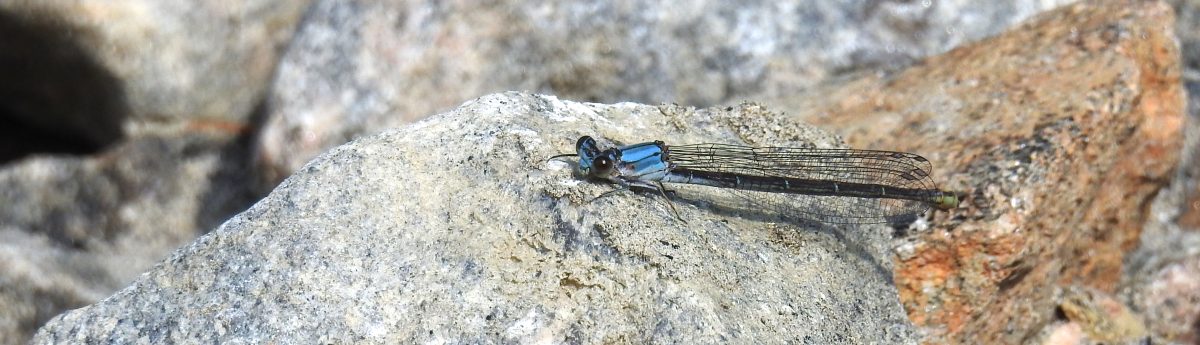
The trail followed a wide ditch filled with water, and I scanned the vegetation, hoping to find something perching in the shrubs or flying out over the water. When we came to a break in the vegetation I saw some perching Blue Dashers and a flying Widow Skimmer I was unable to photograph. There were more Fragile Forktails, too, as well as some Eastern Forktails. Then I spotted some bluets and stopped to catch a couple. Both turned out to be Tule Bluets, a new species for the trip. These intermediate-type bluets have more black than blue on the abdomen except for segments 8 and 9 near the tip.

We came to a small boardwalk that crossed over the ditch and passed through a small marsh to look out over Mitchell’s Bay. According to the sign there we had walked 875 metres from where we parked on Angler’s Line, though it felt a lot farther due to the heat. It was a nice walk, with about the same variety of odes as Crothers Conservation Area, though both fell short of the variety at Peer’s Wetland.
Of all the places we visited I would love to return to the Darcy McKeough Conservation Area, Reid Conservation Area and Nicholls Memorial Forest again earlier in the season as I particularly liked those areas and would have a better chance of seeing more species in mid-summer. Also, a trip in mid-July should give me a decent chance of seeing Royal River Cruisers, Flag-tailed Spinylegs, and Pronghorn Clubtails (another Darcy McKeough specialty). I’m not sure if the biting bugs will be any better, but there should definitely be a few more odes around to deal with them!

 OdoNotations