

After I returned from my visit to southern Ontario I still had bugs on the brain, specifically odonates. Now that September has arrived the days will be getting shorter and the nights cooler, which spells the end of the season for a number of different species. It is, however, prime time for darners, and I still had yet to find a Lake Darner or Green-striped Darner this year. I also haven’t seen any Saffron-winged Meadowhawks either, another species that peaks in August and early September, despite searching known locations at the Eagleson storm water ponds. While I knew that bird migration was heating up, my brain hasn’t yet made the switch from odes to birds. I am having trouble getting up early enough to get out for my regular birding walks before work, and I won’t even consider putting my net away while the weather is still nice – I want to wring every last sunny moment looking for dragonflies and damselflies before taking the mandatory six-month winter hiatus. This has never happened to me before, and while I still am using eBird to keep track of what I see, most of my checklists are incidental ones noting only a few species that caught my attention while out later in the day dragonfly-hunting.
A few days ago I was invited by Chris Traynor to go ode-hunting this weekend. He had been contacted by a Masters student at Carleton University who is studying behaviour in dragonflies but has limited real-life experience with them. He and another student had read Chris’s Trail & Landscape Dragonfly Species Profiles and hoped to tag along with him on an outing to learn more about local species and how to identify them. Chris asked me if I would be interested in joining them, and that was how I ended up meeting Chris and two Carleton students at Bruce Pit at noon today.
Isaac and Marissa were eager to learn; Marissa had brought a net, which upped the odds that one of us would catch any flying mosaic darners we might encounter. They also showed a keen eye for large dragonflies flying over grassy areas, sometimes spotting odes before Chris or I did. However, we all noticed the bright golden dragonfly flying over the top of the toboggan hill at the same time just after we arrived. I immediately identified it as a Wandering Glider, and as there was no tall grass nearby, I knew it wouldn’t land. I felt a bit of pressure to capture it with an audience, but I waited until I got an idea of its flight pattern and swung only when I certain I would net it. Sure enough I heard the frantically buzzing wings in the net and pulled out the first species of the day!

This is one of those dragonflies that is an instant crowd-pleaser: it’s large enough to see the tapered shape which has given rise to the nickname “flying carrot”, it has a huge wingspan, and it is actually quite colourful with large grey and red eyes attached to a body painted in beautiful hues of yellow and orange. Isaac and Marissa were duly impressed, and with our first catch under our belt we set off to the meadow at the back of the field to look for darners.
We weren’t able to scare any up from the meadow – it was probably too nice of a day for them to be sheltering in the grass there – but we did find some in the path to the pond where Chris and I had observed the Lake Darner last year. It was Chris who saw the Common Green Darner land in a shrub at about knee height.

Shortly after that, he and Marissa went off to chase one mosaic darner (a Shadow Darner) while Isaac pointed out another Aeshnid hanging in a sapling. Darners either land vertically on tree trunks or hang from branches or stems; I saw the small tree branch Isaac described, and took a few photos before sweeping the darner into the net. It was the first Canada Darner of the day! The indented first thoracic stripe with the thin “flag” extending backward from the top and the small spot between the first and second stripes are characteristic of this species.

We found a second one shortly after that when we followed the narrow path to the water-filled channel that runs behind the pond on the east side. Unfortunately the water was too high to cross the channel without boots, and while we were pondering our options someone pointed out a Canada Darner perching in the tree right beside us munching on a female Autumn Meadowhawk. You can see the brownish-orange abdomen sticking out of the darner’s mouth, and I was further able to identify it in subsequent photos where I could see an egg mass protruding from the end of the abdomen and disembodied brownish-yellow legs caught in the hairs of the darner’s thorax (visible here against the pale brown branch in the background). It’s a dragonfly-eat-dragonfly world out there, but I wish the meadowhawk had at least had time to lay her eggs in the pond!

As the others were photographing the darner a male Fragile Forktail flying in the leaves just above the darner caught my attention; it was the only one that we saw there. I pointed it out, and hoped it would avoid the same fate as the female meadowhawk.
After that we walked back to the toboggan hill, catching our third Canada Darner of the day. I was surprised that we hadn’t caught any Lance-tipped Darners and was still really hoping for a Green-striped or Lake Darner even though I had only had them in the back meadow here in the past. Still, there were a few other darners flying about that we weren’t able to catch, and I was hoping we’d have better luck when we reached the water.
We did better with meadowhawks in the grassy areas next to the water on the west side of the pond. White-faced Meadowhawks seemed more abundant on the south side, while Autumn Meadowhawks seemed more abundant on the north side.

We saw a few darners patrolling the area, including one that flew into the clearing where we were standing and then landed on a small tree right in front of us, perching vertically on the trunk. Something about its thorax looked different to me, but just as I tried to move in a better position it flew off and landed on the blade of a dead cattail next to me. This time I was ready with the camera. I managed a few shots before it flew off, and my impression at first was that it was a Canada Darner as it had a deeply notched first thoracic stripe. Then when I saw the photos I knew I was wrong. First, it had a dark cross-stripe on the face which Canada lacks. Second, the “flag” at the top of the first thoracic stripe was triangular in shape and detached from the stripe. Second, the notch was extremely deep, almost pinching the stripe into two separate markings. It was a Lake Darner, and I wished I had been able to get a look enough look at it in person to identify it in the field. It would have been cool to catch it and show it to the students to show them how tough it can be to separate the Aeshnid darners without a close look.

From there we found our way to the water’s edge on the west side of the pond. Only a few years ago you could look out into the middle of the pond from the west shore below the road, but the cattails have grown so thick that there was only a small patch of open water in front of a narrow channel leading to the center. There was still some open water left in between the shore and the wall of cattails about ten or fifteen feet out, but it was deep so I didn’t stray too far from the bank in my rubber boots. There were some damselflies here, including both Eastern and Fragile Forktails and Sedge Sprites. Chris and I spotted some spreadwings flying low over the water but none ventured close enough to catch.

We didn’t spend too much time at this opening as Chris and I wanted to spend most of the time in the northwest corner, the only spot along the shore that has not been walled in by cattails or phragmites. Along the way we found perching Slender and Spotted Spreadwings, which are easy enough to identify without catching.


I also caught a Sweetflag Spreadwing, a much more difficult spreadwing to identify as it is similar in appearance to the Northern Spreadwing. It is not as dark as the Spotted Spreadwing, having a blue shoulder stripe on the thorax; often both the thorax and the final two or three abdominal segments turn bluish-gray as they become pruinose. Under magnification the male Sweetflag Spreadwing has two curved upper claspers each bearing two teeth – the teeth are small and far apart, compared to the Northern Spreadwing which has curved upper claspers with two teeth that are close together, one of which is noticeably larger.

Once we arrived at the mucky northwestern edge of the pond we spent some time looking for damselflies in the sedges and larger dragonflies on the water. A female or immature Common Whitetail flew by a few times without landing, and at least two darners were regularly patrolling that section of the pond, zigzagging in and out of nooks and crannies in the cattails. One kept flying by really low and hovering while sheltered within some of the sedges, and I spent a lot of time waiting for it to come within reach of my net. It never did.
In the meantime Isaac caught three different dragonfly nymphs hiding in the muddy substrate of the pond. This one is small, though that could either be because it is a small species or has not finished growing yet….dragonfly nymphs may molt up to 14 times before reaching its final size! I have not delved into the world of nymph identification and have no idea what family, let alone species, this little fellow might belong to. I can say that it is not a damselfly, which are best identified by three paddle-shaped structures called caudal lamellae at the end of the abdomen. These structures act as gills; in comparison, a dragonfly nymph has internal gills located inside the abdomen.

I had noticed some bluets perching on some stems poking out of the water several feet from the shore, but didn’t think too much about identifying them until Chris noticed some were Azure Bluets. We haven’t seen any Azure Bluets in Ottawa since the sandy pond at the Bill Mason Center sold to a private individual, so this was a terrific surprise! I asked my mentor, Chris Lewis about them, and she told me that they were on her Bruce Pit list, though this would have been before the Phragmites and cattails took over the southwestern corner where we used to go. It is only because that area has become so choked with a wall of impenetrable vegetation that we stopped going well before the pandemic, and I started going to the northwest side instead.

That was our best find on the west side, bringing the total number of species seen to 14. After we left the water we walked through the long grass at the edge of the toboggan hill, trying to scare up any other lurking odes. Instead we flushed a very large robber fly of genus Proctacanthus, which I later learned are called Marauders – one of the more interesting and, to me, delightful names of the insect world. We also came face-to-face with a large Yellow Garden Spider. Sadly, these orbweavers have become much more scarce since I first started coming to Bruce Pit around 15 years ago.

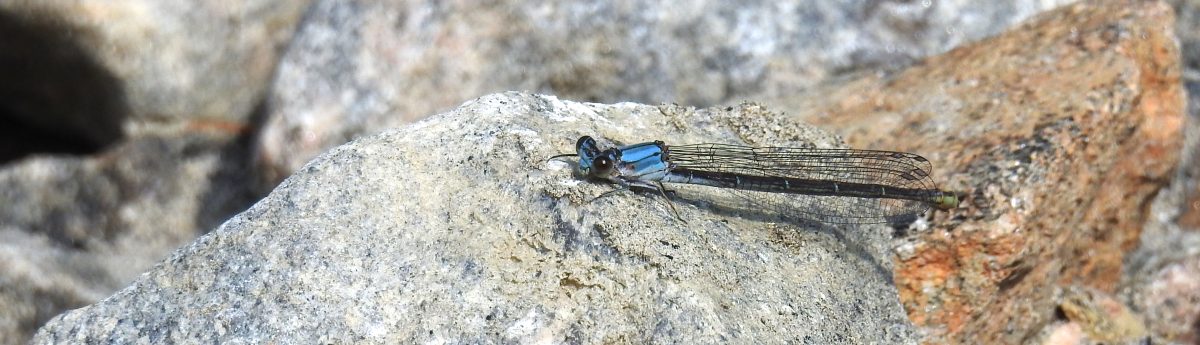
From there we headed to Andrew Haydon Park, a spot I chose as it also had a good number of odonates still flying, a decent number of species, and some different ones than the ones we saw at Bruce Pit. I was hoping to show them the Orange and Vesper Bluets that had been present from late July to mid-August; I hadn’t yet visited the park after returning from southern Ontario and wasn’t sure they would still be there. We were in luck – a search around the perimeter of the ponds netted us about 15 individual Orange Bluets and 4 Vesper Bluets! I was happy to see some mating Orange Bluets in the reeds again, close enough to shore to get some great photos.

The Vesper Bluets were perching on vegetation further out, and Chris appeared pleased to see them as they are pretty little damselflies that aren’t easy to find.

Autumn Meadowhawks were not as common as I’d thought they would be – we saw only five – but Eastern Forktails were everywhere. In fact, we had much better luck with damselflies than dragonflies as we found five species of damselfly compared to only two dragonfly species….a Fragile Forktail and a couple of Familiar Bluets I caught and examined in the hand were the others.
The final dragonfly was a beauty, and was of much more interest to Isaac and Marissa than the small but colourful damselflies. We saw one or two darners zipping along the edges of the pond quite close to the bank, rarely pausing enough to get a good look. Then at the bridge over the eastern pond we found one that spent quite a bit of time flying over the bridge and hovering right in front of it before circling around to investigate the edges of the shoreline. Chris and I finally identified it as a Shadow Darner, and we spent some time with our nets ready in case it decided to fly past us. It was wily, however, and managed to evade any attempts at capture. Fortunately both Chris and I were able to get photos of it as it hovered, enabling us to include it in our online records.
I had great fun introducing Isaac and Marissa to the world of dragon-hunting with Chris, and they seemed to enjoy the experience as well. I’m just glad the big guys cooperated for us, as it’s easy to impress a new dragon-hunter when you show them a big beautiful Wandering Glider in the hand or a mosaic darner perching in the vegetation right in front of you while it eats. Hopefully our outing today laid the foundation for an interest that will extend long beyond their current Masters’ project and well into their careers or paths as naturalists!


