

Although technically still considered summer until the equinox, the month of September ushers in the beginning of fall, the season most associated with change and impermanence, with encroaching darkness, with death and transition and the melancholy appreciation of the last burst of colour before the inevitable bleakness of winter. I can’t help but be reminded that this is the season of endings every time I go outside: the robins are gone from the neighbourhood, the songbirds in the woods have stopped singing, trees are changing colour, and the asters and goldenrods have replaced all the other wildflowers along roadsides and in conservation areas. In the dragonfly world, it is the season of the meadowhawk, the glider, and the darner, as these types of dragonflies are by far the most numerous. The goal now is to search out any others that may still be flying, and see how long into the season they last. Part of the reason is purely scientific – to get a better grasp of the flight seasons of local odonates. However, another part of the reason is purely emotional – I never know if a sighting will be the last of the year, and hope to put off the final goodbyes as long as possible.
Overall I had 74 observations of 22 species this month – 37 of which, or fully half, belonged to the five latest-flying Ottawa species. Note in this case “observation” means a species photographed at one particular trail or conservation area on one day – it does not refer to the total number of individuals seen, but rather the number of locations at which they were seen regardless of date. For example, I might photograph one Spot-winged Glider at Andrew Haydon Park and another at Shirley’s Bay the same day (not likely, but hey, it’s my hypothetical!); these count as two observations, even though there may have been large swarms at each place. [Author’s note: I am not great at recording totals of individuals of the same species seen, though I am trying to get better by using Odonata Central as well as iNaturalist when I go out specifically to look for odes. Odonata Central is more like eBird than iNaturalist – it allows you to record a checklist of dragonflies you have identified at a location, even if you did not get a photo. It also asks you to enter the number of individuals seen for each species, encouraging me to at least make an estimate of how many individuals I saw.]
The five most common species in September are Autumn Meadowhawk (9 observations), White-faced Meadowhawk (9), Spotted Spreadwing (8), Eastern Forktail (6) and Shadow Darner (5). Just because I like data, here is a summary of the species seen, the number of observations, and the last date they were seen:
| Species | Observations | Last Date |
| Sweetflag Spreadwing | 1 | September 9, 2023 |
| Orange Bluet | 1 | September 9, 2023 |
| Vesper Bluet | 1 | September 9, 2023 |
| Sedge Sprite | 1 | September 9, 2023 |
| Canada Darner | 1 | September 9, 2023 |
| Common Green Darner1 | 2 | September 9, 2023 |
| Saffron-winged Meadowhawk | 2 | September 10, 2023 |
| Azure Bluet | 2 | September 16, 2023 |
| Tule Bluet | 1 | September 22, 2023 |
| Lake Darner | 2 | September 22, 2023 |
| Powdered Dancer | 1 | September 23, 2023 |
| Lance-tipped Darner | 2 | September 24, 2023 |
| Wandering Glider | 3 | September 30, 2023 |
| Band-winged Meadowhawk | 4 | September 30, 2023 |
| Slender Spreadwing | 4 | September 30, 2023 |
| Familiar Bluet | 4 | September 30, 2023 |
| Fragile Forktail | 5 | September 30, 2023 |
| Shadow Darner | 5 | September 30, 2023 |
| Eastern Forktail | 6 | September 30, 2023 |
| Spotted Spreadwing | 8 | September 30, 2023 |
| White-faced Meadowhawk | 9 | September 30, 2023 |
| Autumn Meadowhawk | 9 | September 30, 2023 |
- According to Odonata Central my last Common Green Darner seen, but not photographed, was on September 16, 2023 ↩︎
I have already blogged about my outing with Chris Traynor and the two Carleton students on September 9th and won’t recap those sightings here. Although Saffron-winged Meadowhawk was a species we had hoped to find at Bruce Pit to show to the two students, I didn’t find any until the next day, when I observed two: one at the Eagleson Ponds, and one at the park behind Steeple Hill Crescent. You can see the reddish tint to the leading edges of the individual I photographed at Steeple Hill park on September 10th:

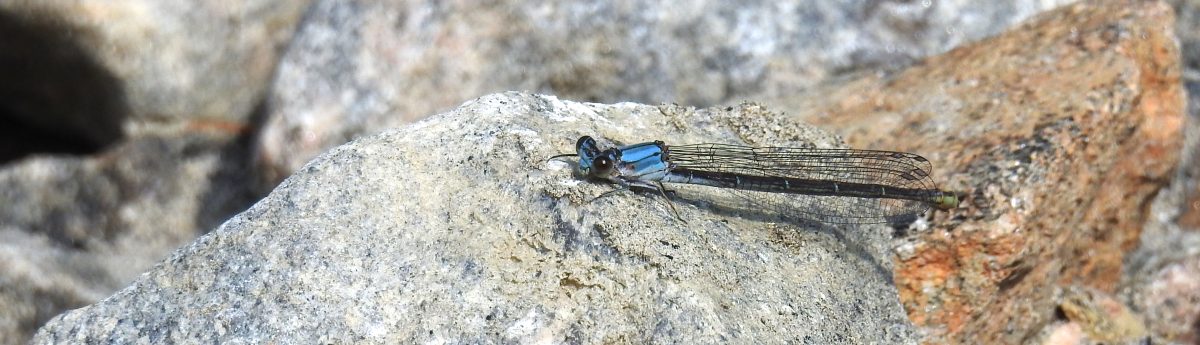
I had some pretty awesome sightings in the middle of the month, too. Azure Bluets were still flying at Bruce Pit when I visited on September 16th. According to the Checklist of the Damselflies and Dragonflies and Ottawa-Gatineau (Bracken and Lewis, updated by Traynor), this rare, local species flies only until late August. These intense blue damselflies were a recent discovery at the Bruce Pit for me, but not new for the Bruce Pit checklist; a conversation with my mentor and the co-author of the Ottawa dragonfly checklist revealed that she had seen them there in the past.

On September 22nd I returned to Andrew Haydon Park after work to check on the Vesper and Orange Bluets. I had last seen these species on September 9th, which is later than the Vesper Bluet’s known flight season has ended (late August). Unfortunately I could not find either the Vesper Bluets or Orange Bluets (which are known to fly into mid-September), but I was happy to see a Tule Bluet, a species that doesn’t disappear until early October. It is differentiated by other bluets by the pattern of black on the abdomen: the black usually covers more than one-half of the segment length, the amount becoming larger from S2 to S7. Segments 8 and 9 are entirely blue.

That same day I’d gotten lucky at Sarsaparilla Trail at lunch time with a large darner flying around the clearing nearly the boardwalk. This area has been a hotspot for odes since the large pines came down in the derecho of 2022, opening up the forest to the sun and attracting all sorts of small bugs which in turn attract the larger insects that feed on them. This darner flew just out of reach of my net, but landed on a tree trunk where I could see it; I got my binoculars on it long enough to see the notched shape of the first thoracic stripe before it flew off again, circling the clearing before settling on another tree.

This time it stayed put long enough for me to take out my camera and get a few pictures. I was thrilled when I saw the fine cross-stripe on its face and the triangular “flag” detached from the first thoracic stripe; it was another Lake Darner, my second of the year!

September 23rd was a beautiful day so I thought I would spend some time along the Ottawa River looking for newly emerged Elusive Clubtails. I have only seen mature adults in distress, or teneral/immature adults that had just emerged. I thought that the shore along Trail 10 just east of Shirley’s Bay would be a good place to check and found only a Powdered Dancer instead.

As the chart indicates, September 30th was a great day for ode-hunting with ten species. It was a beautiful, sunny day that reached 24°C with little wind, perfect weather for dragon-hunting. I went first to Lime Kiln Trail, a spot I’d started visiting on a whim just before the Odolympics when it occurred to me that I might find some odes around the newly constructed ponds beside the parking lot. Although I’d only found the more common species on my previous visits, I was thrilled when I discovered a pair of Band-winged Meadowhawks in the vegetation right next to the parking lot.

There were also a couple of darners flying around the edges of the pond on the south side of the parking lot. They kept circling the edge of the pond, investigating the little nook where I stood; then as soon as one caught sight of the other, it immediately changed course to chase the “intruder” away. I waited with my net ready for a long time, and eventually my patience was rewarded – my net shot out when I saw one of the dragonflies flying toward me and captured a Shadow Darner, a relatively dark species due to the tiny spots on top of the abdomen. The thoracic stripes are yellowish-green in colour, and the anterior stripe is shaped like a “walking cane”.

I decided to walk the full loop to the open alvar at the back, and ended up being glad that I did; I found a Wandering Glider flying over the sparse grass in the large open area close to where the forest had burned back in 2012. This was the same spot where I’d found one in August 2020 by walking through the grass and unintentionally disturbing one sheltering there. This time I saw it buzzing low over the grass, and waited to see if it would land. Fortunately it did, allowing me to get some photos of it perching naturally.

After that I headed to Bruce Pit, spending some time around the water at the west end. The usual White-faced Meadowhawks were in the clearing on the south side and the usual Autumn Meadowhawks were in the vegetation on the north side, but I was most happy to find a Band-winged Meadowhawk in the wildflower field in the middle. A Fragile Forktail, a Slender Spreadwing, and a Spotted Spreadwing were also around the water in the middle of the western shore. While the Spotted Spreadwing can still be found through late October, our latest-flying damselfly, the other two damselflies have a shorter flight season which should already be over according to the Ottawa checklist: the Slender Spreadwing is listed as flying until mid-September, while the Fragile Forktail is listed as flying until only late August.


Spotted Spreadwings, male and female. Click to enlarge.
I added only two additional species along the tiny piece of shore in the northwest corner: Eastern Forktail and Familiar Bluet, the latest-flying bluet in our region. I didn’t see any Azure Bluets at all, and once again all of the darners that flew by me evaded capture. The Familiar Bluet is a widespread and abundant large bluet which flies until mid-October, outlasting even the ubiquitous Eastern Forktail which tends to disappear early in the month, along with the Tule Bluet.

Although odonate diversity is usually low in September, I was pleasantly surprised by the number of species still flying right up until the 30th, no doubt a result of the warm weather and sunshine these past few weeks. Not only did I see good numbers of the five common latest-flying species, but also many individuals of species I hadn’t expected to see, including those whose flight season should have already ended according to the official Ottawa checklist. By the end of the month I had encountered four damselfly species after their known flight period: Vesper Bluet, Azure Bluet, Slender Spreadwing, and Fragile Forktail. However, these late observations are likely not true extensions of their season, but rather represent new knowledge filling in gaps that existed at the time the original checklist was created in 1998 (and updated in 2008). Because odonates are not as well-documented as birds or even butterflies, our knowledge of their true range distribution and flight season is often incomplete compared to these more popular fauna. Thanks to iNaturalist in particular, anyone with a camera and internet connection can now record the dragonflies they see, and dedicated ode enthusiasts will make it a point to seek out the more difficult-to-find and/or -identify species and submit their sightings to iNaturalist, Odonata Central, or both. I certainly enjoy contributing to the information and using iNaturalist in particular to see what species are being recorded where. Now that October is here and the season is truly winding down, I look forward to using both platforms over the colder months to find some interesting new places to go next year!

 OdoNotations