
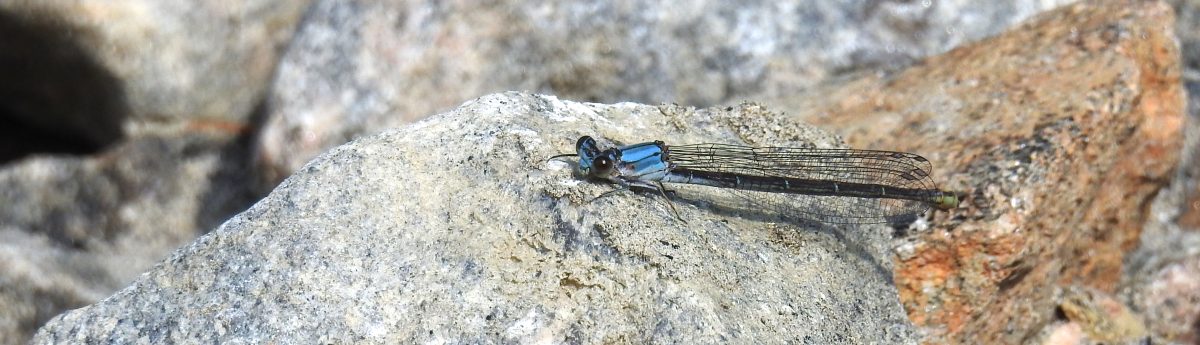

After leaving Yarmouth we drove to our next stop on the tour, a cottage on Trout Lake south of Middleton in Annapolis County. The lake was nice, but quiet: there was a small sandy beach with several rocks protruding from the water at either edge of the property. A little bit of emergent vegetation made for some great perches for skimmers and damselflies, but I didn’t see either during our short stay. The weather was cool and cloudy for most of our time there, which, combined with the early season – there were no Slaty Skimmers or Calico Pennants flying yet – likely had a lot to do with a lack of odes at the water.
Both of the days we were there dawned with the sky completely covered in cloud. It was cold our first morning there, so cold that I didn’t even want to go for a walk along the gravel road. Instead we went into Greenwood to get breakfast, pick up some groceries, and check out a few rocky creeks and waterfalls that we had visited on past trips. The thick blanket of clouds covering the sky showed signs of breaking up by the time we finished our errands, so we headed to a small trail on Rock Notch Road that looked over Fales River and a medium-sized waterfall that once powered a water mill from 1857 to 2002.
We followed the trail to the top of the waterfall, then spent some time scanning the calm pools of water at the top. We saw a few small dark dragonflies zipping up and down the river, but none landed or came close enough to the shore to identify. Still, it was nice to see them flying even though it was still mostly cloudy.


We headed to Crystal Falls next, stopping at a bridge over Mumford Brook (another small stream which flows into the Fales River). There were fewer rocks here, and again we saw a few small, dark dragonflies patrolling the water and chasing each other out of their territory. A few hovered long enough for me to identify them as emeralds by their greenish eyes, and that was it. We didn’t see any other types of dragonflies zipping by or damselflies perching in the vegetation.
We followed a bumpy dirt road for a while, and the sun came out just as we arrived at Crystal Falls. No one was there; while it can be busy on weekends, it was quiet on a school day in June. There is a pool at the base of the falls large enough for swimming, and already I could see the flashes of sun reflecting off a few sets of dragonfly wings as they flew low over the water.

Two were patrolling the rocky shoreline, and so I stood on a rock above the water and waited. Fortunately they stopped and hovered a few times, and I was able to snatch my first dragonfly up fairly quickly. I knew what it was as soon as I pulled it out of the net. It had orange markings down the side like a baskettail, but there were distinct black and amber patches at the base of the wings. It was the final dragonfly I had hoped to get for my life list – an Uhler’s Sundragon!

The Uhler’s Sundragon is a member of the emerald family, resembling a baskettail except for the black, orange and white marks at the base of their fore- and hindwings. The orange markings along the side are pointed, more resembling the triangular markings of the Petite Emerald. They prefer rocky forest streams that are small to medium in size, with a mix of riffles and pools and a sand or gravel substrate.
Males patrol territories over the course of the stream, much like Stream Cruisers and Fawn Darners – after learning this I wouldn’t be surprised if most of the dragonflies I’d seen patrolling over the water this morning were Uhler’s Sundragons. They may also be found foraging well away from water along trails and in sunny woodland openings, much like baskettails, and sometimes hang up on low branches much like American Emeralds. I didn’t come across any perching, but this one stayed put when I placed it on a branch for a photo.

The appendages and narrow constriction at S3 make this a male. Females have a thicker waist, more pointed wings, and a noticeable row of tiny spots along the cross-veins extending outward from the dark basal spot on each wing; they look like an over-enthusiastic application of ink from a leaky pen in an ink drawing. This individual has emerged only recently given the shiny saran-wrap wings; its eyes appeared gray from the side while I held it in my hand, but green from above when I placed it on a branch. Like most emeralds, it takes some time for the green eyes to develop. These were a pretty seafoam green.
After I finished photographing the Uhler’s Sundragon I picked up my net, stood on a rock at the edge of the water, and waited once more for one of the dragonflies to approach me. It took some time and a few different positions before I managed to snag another, also a male Uhler’s Sundragon. I was quite happy to see two of these lifer dragons up close, and also to get photos of them in the hand and perching “naturally” on a branch!

I was surprised to see no damselflies in the vegetation or resting on the rocks. There was one other dragonfly zooming around the pool below the falls that didn’t look like the sundragons zipping by, possibly a Springtime Darner, perhaps something else. It never did come close enough to my area to catch, so it will have to remain a mystery.
After our visit we made the drive back to the cottage, and the back roads were teeming with butterflies and dragonflies now that the sun had come out. Canadian Tiger Swallowtails had emerged in good numbers, and I found a group of five mud-puddling together. A few dragonflies that looked like emeralds were flying along the road, but even though we stopped a few times I was not able catch any. I doubted that anything else flying there would have been as thrilling as the Uhler’s Sundragon, as it was still a bit early for any Somatochlora emeralds to be flying.
When we got back to the cottage, I spent some time walking along the gravel road hoping to find some more dragonflies flying around, but the sky had clouded over again and all I found were a few “perchers” resting on the ground: Lancet Clubtail, Common Whitetail, and a fresh Chalk-fronted Corporal.

The next morning was cloudy, but not as cold at 15°C so I got out of bed early and went for a walk around 8:30 am. On my first day there I had walked down Broad Lake Road to Highway 10, a small two-lane road; this morning I intended to take a small private side road called Lady Slipper Lane to Adams Road, which also intersects with Highway 10. Google maps shows a stream or small creek running under Adams Road, and I was curious to see whether it was just a ditch or something more attractive to odes.
Lady Slipper Lane is heavily treed, and the shade made it appear quite dark. It lived up to its name; I saw a few Pink Lady’s Slippers growing next to the road, along with some lupins and the cheerful sunny flowers of Bluebead Lilies.

I heard a Broad-winged Hawk calling overhead somewhere, as well as warblers such as Northern Parula, Magnolia Warbler, Blackburnian Warbler (one heard and one seen), Yellow-rumped Warbler, and a male Black-throated Blue Warbler which I tracked down when I heard it singing. The first dragonfly of the day turned out to be a Lancet Clubtail, which seems to be Nova Scotia’s default clubtail, possibly because there are so many lakes and marshes scattered across the province.

Once I turned onto Adams Road the forest drew back to make room for a wide ditch on either side of the road. The stream I found at the end of the road was in fact a wide, shallow ditch choked with vegetation, and I wasn’t able to see much water from the bank. By the time I reached the end of the road and turned around the sun was starting to come out, and I saw a couple of dragonflies hunting in the sunlight. They looked like baskettails but didn’t come close enough for me to catch.
Once I reached Lady Slipper Lane again, however, I spotted a few more dragonflies patrolling an open area of the woods. They hung up in a small shrub, one after the other, and I could see that they were both Stream Cruisers!

We spent some time with family for most of the day, but after dinner I grabbed my net and headed back out again. There were some dragonflies buzzing around the front driveway just as I was leaving, and when I caught one it turned out to be a Spiny Baskettail! The black patch at the base of the hindwing was larger than those found in Ontario Spiny Baskettails, but much smaller than the Mantled Baskettails I had seen in the Yarmouth area. Although not quite visible in this photo, the diagnostic spine or tooth on the upper clasper is shown in other photos on my iNaturalist observation to confirm the identification.

The second one I caught turned out to be a female Spiny Baskettail. I took some photos in the hand and then placed her on a branch for a photo. Beaverpond baskettails have short appendages that are close together while Spiny Baskettails have long appendages that are close together. Common Baskettails have widely separated appendages. I also photographed the underside of the abdomen; the images on iNaturalist show the genital plates of a female Spiny Baskettail.

I walked up to Adams Road and then turned back. A clubtail settled at my feet on Lady Slipper Lane and when I bent down to take a look it seemed darker than the Lancet Clubtails I had been photographing. Perhaps this was my first Dusky Clubtail in Nova Scotia! The final segments of the abdomen look dark enough, though I am just not sure why the yellow stripes on top of the thorax are wavy instead of straight. It has not yet been identified on iNaturalist – a few more images are present under this observation, though my side angle photo is a bit unfocussed.

When I returned to the cottage the sun was low in the sky and the woods were dark except for a few wider spots where the sun still shone in from the lake. I found a couple of dragonflies buzzing over the low-growing brush that covered the sunken area between the road and the tree-line but wasn’t able to get close enough to catch them – there were too many stumps and fallen trees to climb over. When one of them landed on a tree trunk perhaps 12 or 15 feet up I was thrilled to identify it as a Harlequin Darner, my first for Nova Scotia! I tried to get a photo but it flew off before I could find it with my camera. I waited at on the road for a while longer but never saw it again.
Although our stay in Annapolis County was short, it was great to get out to some of our old haunts and see some new species. Finding the Uhler’s Sundragons was an unexpected surprise, and gave me an idea of what kind of habitat to look for back home in Ottawa!

 OdoNotations