

We arrived in Moncton late on Wednesday, June 5th. Our AirBNB for this stay was a basement unit in Riverview, the small town situated on the south side of the Petitcodiac River and a short drive from both downtown Moncton and the Moncton Coliseum, home of East Coast Comic Expo. I had already scouted a few places that looked good for both birding and and ode-hunting; these included Riverview Marsh contained within a bend of the Petitcodiac River for Nelson’s Sparrow, Mill Creek Nature Park for forest birds and stream dragonflies, Bell Street Marsh for marsh birds and odes, and a small stream in a hydro corridor near Mill Creek for Superb Jewelwing, a potential lifer for me.
We didn’t have to set up for the expo until lunch time on Thursday, so Doran and I checked out Riverview Marsh first thing in the morning. It was a beautiful sunny day, and we found the parking lot for the marsh without any difficulty.

There was a nice, wide gravel trail winding along the edge of the park with a straight trail leading directly to the river, cutting through the marsh to get there. We observed the usual marsh birds – Great Blue Heron, a pair of Spotted Sandpipers in flight, Tree Swallows, Swamp Sparrows, Song Sparrows, Red-winged Blackbirds, Common Yellowthroats, and Yellow Warblers, as well as several waterfowl making use of the open water of the marsh: Canada Geese, Mallards, two Gadwall and two Green-winged Teal. It wasn’t until we reached the end of the trail and the gazebo there that I started hearing the sizzling-oil-on-a-hot-skillet sound of a couple of Nelson’s Sparrows in the dense vegetation beyond the trail. It sounded as though there were about four of them close by, and I found a bench where I could sit and try to observe them for a while. Eventually I found them flying up out of the vegetation while they sang and realized they were doing flight displays! It was really cool to see birds that I have only seen during migration in Ottawa out in the open on their breeding grounds, and they alone were worth the stop in Moncton. I tried but was unable to get any photographs that were in focus….they never landed on at the top of a shrub out in the open, but behind a screen of reeds every single time.
After watching them for a while we made our way to the gazebo and the river. It was a pretty spot, making me wish we could have a picnic there.

The river itself was ugly. It was the brownish-red colour of many other tidal rivers in the Maritimes, and due to the high levels of silt and clay it has been nicknamed the Chocolate River – the amount of sedimentation in the river is among the highest in North America. There was no vegetation, nor any picturesque boulders or rock ledges to create any tumbling falls or rapids. We came upon a man with a camera watching the river, then realized a large number of people were standing along the railing in the park across the river. They appeared to be waiting for something, and a few minutes later we saw it: the tidal bore! Normally the Petitcodiac River runs south and empties into the upper reaches of the Bay of Fundy; however, twice a day the incoming high tide pushes back against the river’s natural flow and causes it to flow backward, the leading edge of the incoming tide forming a wall of water that runs upstream.

The wave of the tidal bore can vary in height from 3 cm (1 inch) to 60 cm (2 feet). Larger waves occur at the time of the full moon; they can be powerful enough for surfers to ride the wave up the Petitcodiac River. The water level of the river rises dramatically following the passage of the tidal bore as the riverbanks fill with the incoming Fundy tide, showing the muddy river bottom one moment then rapidly rising more than seven metres high!
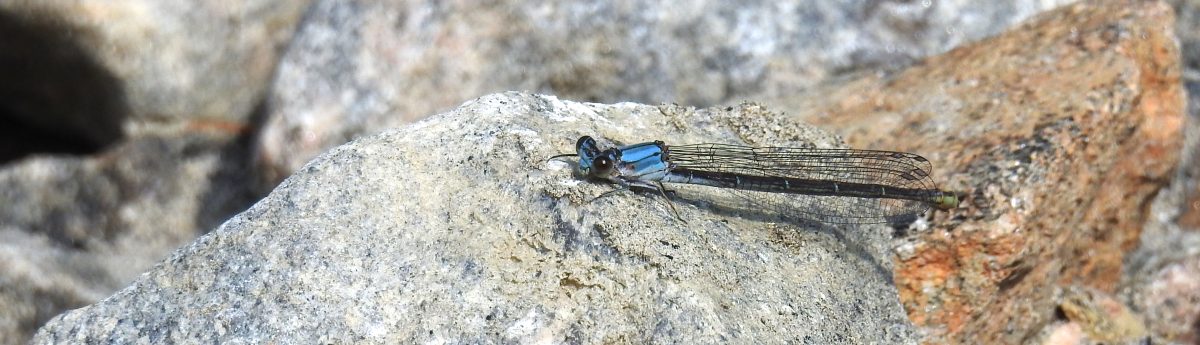
We didn’t stay long enough to see the riverbank fill up; instead we turned around an headed back the way we came. On the way back I spotted a Silvery Blue butterfly, a Clouded Sulphur, and my first odonate of the day, a Taiga Bluet!

There didn’t seem to much else to see, so we headed over to our next destination, Mill Creek Nature Park. Mill Creek is a very pretty, well-maintained park of 330 acres built around the Mill Creek Reservoir, which supplies water to Riverview. The reservoir is a small lake created by a 10-12 foot high dam on the Nolan’s Gully Trail and has several lookouts along the shore. Another trail follows the stream below the reservoir and eventually crosses over a bridge. It was this stream I was interested in, hoping to find creek-loving odonates similar to those found in Gatineau Park.

When we arrived we easily found parking just south of the Bridgedale traffic circle at the end of Runneymeade Road. As soon as we got out of the car I saw a couple of robins on the grass and a pair of Ring-necked Pheasants walking along the edge of the parking lot! They were in a hurry as they ambled toward Runneymeade, then crossed the paved road.
We entered the park, descending a wide, sunny, gravel path toward the water. Nowlan’s (or Nolan’s) Gully Trail, described as the “centerpiece” of the park was steep but well-maintained, and the forest beyond was alive with birdsong – I heard a couple of Red-eyed Vireos and a Blue-headed Vireo, a Brown Creeper, Black-and-white Warbler, several Northern Parulas and Black-throated Green Warblers, an Ovenbird and an Alder Flycatcher.

We came out to an open area above the dam where a small meadow hosted a couple of tantalizing baskettails flying in the sunlight and a modern-looking outhouse that appeared to be solar-powered. We reached the staircase at the top of the dam and were both impressed by the beauty of Mill Creek Reservoir at the top.

When we looked down we could see the cement dam with water pouring over a 10-12 foot drop into the rocky creek below. There was a picnic table close to the waterfall as well as an open area looking directly onto the water. After falling over the dam the stream wended its way over rocks and past clumps of sedges into the forest. It looked like a great spot for dragonflies, and I was happy to see one or two flying up the stream!


Doran like the park just as much as I did – it’s not often that happens! – but we had to go to the Coliseum to set up his booth for the comic expo and grab some food so we didn’t stay long. However, I returned about 90 minutes later once I was finished helping him bring his booth and assorted materials into the venue, arriving around 1:30. It was warmer, and there were even more dragonflies flying!
There was a shallow puddle of water in the ditch next to the trail, and I scanned it for damselflies as I made my way back to the dam. To my surprise I found a couple of Aurora Damsels.

I spent most of my time around the dam and the stream below. At the bottom of the staircase I could see some odes patrolling along the shoreline toward the dam and a pair of Aurora Damsels ovipositing in a submerged piece of vegetation. A Green Frog waited patiently in the water near the bank, while an Eastern Forktail perched on a stick overhanging the water. I saw an unidentified male bluet perching on the ground as well, but as he was facing me and I was unable to get a photo of the shape of its claspers. I did get a few photos of the patrolling dragonflies and identified a male Beaverpond Baskettail and a Stream Cruiser.

I saw a few more dragonflies patrolling the stream below the dam, often stopping to hover near the waterfall. I went to the bank as close as I could to watch them; a few darker ones that looked like baskettails stayed out of reach, but I spotted the brown and blue blotches of a darner and swept it up in my net. Unsurprisingly it was a Springtime Darner. It seems like the Maritimes provinces have a lot of these!

I left the spot at the base of the waterfall and continued following the trail, though a wide band of riparian vegetation prevented me from walking right along the water’s edge. I found two other spots that opened onto the water. Again I could see a few dragonflies patrolling the water, and one that looked like a spiketail returned a couple of times though so infrequently I was unable to catch it. I spotted another Aurora Damsel in the vegetation, as well as a male jewelwing. Superb Jewelwings are found in this part of New Brunswick, inhabiting clear, cold streams with rocky rapids. I was hoping to find one since one had been reported along Mill Creek several kilometers away (another spot I was hoping to check while in Moncton). However, after reviewing the differences, I was disappointed to find it was “only” a River Jewelwing, as the black patch at the end of the wings was too large and too dark for Superb Jewelwing, and the wings were too wide and rounded. Still, I was happy to find it as it was a new species for the trip, and the first one reported from Mill Creek Nature Park on iNaturalist.

I spent a long time on that small section of Mill Creek, as after about half a kilometer the trail curved away from the water and the bank became too vegetated to follow. I watched the spiketail and baskettails and Springtime Darners dance over the water, and when it became clear that I wasn’t able to access the stream further down, I turned around and headed back to the falls.
When I arrived I was surprised to see a clubtail resting on a rock in the middle of the creek. This is the first one I had seen since I first spotted the Lancet Clubtail on our arrival. I didn’t have boots or “water” sandals and didn’t want to walk around with wet feet, so I contented myself with photographing it from a distance. Then it flew out after a bug and returned to the same rock, so I was able to get two different views of the same dragonfly:

I knew it was one of the Phanogomphus clubtails that are difficult to distinguish, and a male based on the claspers at the tip of the abdomen. The black and yellow colours appeared to be too bold and bright for the usual Lancet and Dusky Clubtails I am used to seeing in Ottawa, and the yellow on the leading edge of the wings seemed unusual. It wasn’t until I downloaded my photos that I was able to identify it as either a Beaverpond or Harpoon Clubtail – the last yellow streak on S7 instead of S8 eliminates Dusky.

Once I uploaded my photos to iNaturalist Chris Traynor explained his reasoning for identifying it as a Harpoon Clubtail: there is a small “hook” on the antehumeral thorax stripes, which Beaverpond lacks; there are no paired spots on the sides of the abdomen, which is common in Beaverpond; and the markings on the side of S8 which Beaverpond lacks. In addition, the yellow markings on top of the thorax are narrow, whereas they are wide and triangular in Beaverpond Clubtail. It was thrilling to confirm it as a Harpoon Clubtail as it is a species I rarely see, and never on the Ottawa side of the OFNC study area.
After spending another ten minutes at the bottom of the waterfall it seemed there were no other species to be found, so I decided to go back up the stairs and follow the trail along the reservoir. Unfortunately the trail did not run right along the water’s edge, and there was a high screen of vegetation blocking the water from view. Still the trail was wide and sunny, and I found a few baskettails accompanying me on my walk. It took some time, but I managed to catch a couple and they both turned out to be Beaverpond Baskettails.

I found a spot in the vegetation that looked out onto the water, and saw a Spotted Sandpiper working its way along the muddy edge. I didn’t see any odes perching close by, though a few were flying over the water too far out to net. After that the trail left the water’s edge and proceeded through the forest before intersecting with another wide trail that looked like a former road. I looked for any clubtails perching on the ground or vegetation, hoping to find a Beaverpond Clubtail, but didn’t see any. I found a few more baskettails patrolling the sunnier parts of the path, another Aurora Damsel, and a Common Whitetail in the vegetation next to the path.

There wasn’t much flying on the road. By then it was 4:00 and the sun was much lower in the sky. The best part of my walk there was seeing a Hermit Thrush land on the path ahead of me, where it appeared to pick up some insect from the ground.
I thoroughly enjoyed my time at Mill Creek Nature Park, which reminded me of Gatineau Park in some ways with its beautiful scenery and well-maintained grounds. Both the odes and the birds were fabulous, and I was happy to get some new species of both for my New Brunswick bird and ode lists. It’s definitely high on my list of places I want to visit again!


