

Late spring is a wonderful time to visit Sarsaparilla Trail. I usually start visiting in May to look for early dragonflies such as Spiny Baskettails and Chalk-fronted Corporals, both of which emerge in good numbers in mid- to late May. It is also a good place to look for Taiga Bluets, often my first damselfly of the year. Friday, May 24th was a beautiful, sunny day despite a cool north wind blowing, so I spent my lunch hour there searching for signs of spring. I began my walk by scanning the shrubs bordering the clearing near the outhouse for dragonflies perching in the vegetation and baskettails flying in the open…there were no emeralds flying on my visit, although there had been over a dozen Spiny Baskettails present only eight days earlier. I did scare up a dragonfly perching close to the ground – it turned out to be a Four-spotted Skimmer.
Four-spotted Skimmers are brilliantly coloured dragonflies unlikely to be mistaken for anything else. They hunt by perching from an exposed perch such as a twig or leaf, and often return to the same perch when hunting. This one was perching on an old dandelion flower that had gone to seed.

In the woods I started seeing Chalk-fronted Corporals, most of which were perching in sunny spots on the ground that were protected from the north wind. I started seeing more and more of them as I approached the boardwalk, and at one point I counted seven perching on a log and 34 on the gravel path ahead of me! Most were mature adults with white pruinosity on the front of the thorax and at the base of the abdomen, but there were a few immature individuals present as well.

As I counted the Chalk-fronted Corporals on the ground in the wooded clearing I noticed a larger, browner dragonfly flying over the trail at about shoulder height. It didn’t look like a Chalk-fronted Corporal, and at first I thought it might be an emerald. Then it flew directly at me and landed on my leg! It was a Harlequin Darner, one of the most notorious species for landing on people! It didn’t stay long enough for me to grab a photo of it on my leg, but after making one more pass up and down the trail it landed on the ground not too far away.

Although the Harlequin Darner looks like a mosaic darner with its cryptic patterns, it is smaller and emerges much earlier than the Aeshna species in our region. It, together with the similar-looking Taper-tailed Darner, belongs to a sub-group known as the pygmy darners. It breeds in wooded swamps or boggy wetlands where it likes to perch on vertical surfaces such as tree trunks, where its mottled appearance often goes unnoticed, and will often land on observers (especially, in my experience, those wearing light-coloured clothing!). Harlequin Darners may also be found foraging away from the water along sunny woodland edges and meadows near the water. This is the first one I’ve seen in Stony Swamp, so it was an exciting discovery.
There was nothing flying at the boardwalk except for a few more corporals – in the end I estimated there were at least 120 individuals present! – so I made my way back through the woods toward the parking lot. I encountered a few Taiga Bluets in the low-growing vegetation next to the trail and an American Emerald flying near the entrance to the woods. This species likes to land more frequently than other emeralds and I got a photo of this dragonfly on a leaf showing its bright green eyes.

I scared up one other dragonfly on my way back to the car, a relatively young Dot-tailed Whiteface. Immature Dot-tailed Whitefaces have elongated yellow spots on top of segments 2 through 6 with a squared-off spot on segment 7 that is wider than it is long (and is usually wider than the one above it). While the spots on top of segments 2-6 usually fade with age, the female doesn’t become as dark as the male and usually retains a faint pattern spots on the middle segments of the abdomen, with the spot on S7 being noticeably brighter than the others.
Immatures also have a bright, thin yellow line (called the carina) running down the middle of the top of the thorax. Yellow-form female and immature Hudsonian Whitefaces are the most similar dragonflies to the immature or female Dot-tailed Whiteface. They have wide yellow spots running down the length of the abdomen, and unlike the Dot-tailed Whiteface, the final spot on S7 is not wider than the spot on S6, and is pointed rather than squared-off. Some immature Hudsonian Whitefaces may have a pale carina, but those in our area also have pale yellow veins within the black triangular spots at the base of the hindwings, something that no other whiteface in our area has.

It was a good visit for the end of May, with 7 species including the highlight of the trip, the Harlequin Darner. I had an even better visit on June 12th, a few days after my return from my trip out east. It was a cooler day for June, only about 20°C, with a mostly blue sky. I headed there after finishing work, and to my delight there was a Snowshoe Hare on the lawn by the outhouse – it was mostly brown with some white fur still remaining on its underside.
Just like my previous visit, I started my walk by looking for insects in the vegetation on the sunny side of the clearing. I was happy to find a female Eastern Pondhawk blending in with a leaf in the sunshine. Only when I got home did I realize there was a tiny beetle on the leaf in front of her; while she might be sizing it up as a potential snack, pondhawks tend to hunt flying insects which they can easily catch on the wing.

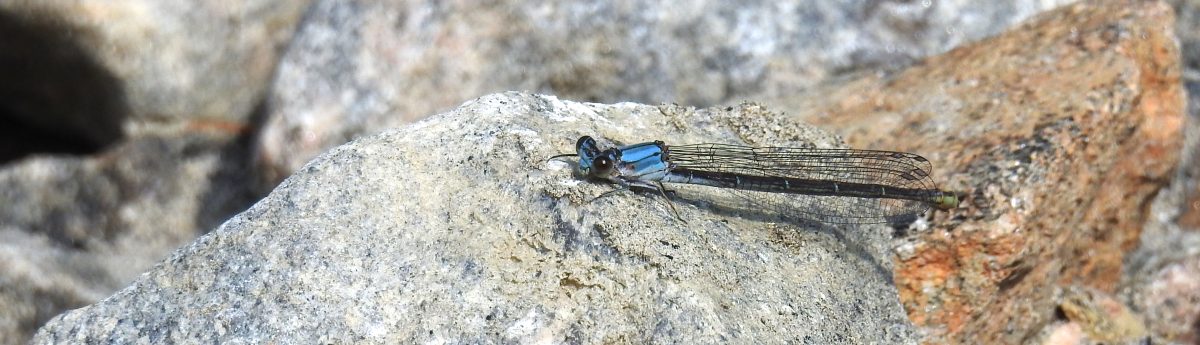
There were more bluets in the woods on this walk than on my previous walk, and I identified three different species! There were still a few Taiga Bluets around, which don’t need to be examined in the hand in order to identify them – the two-and-a-half black segments at segments 5-7 are unique. This damselfly is the northernmost-flying damselfly, occurring as far north as the Arctic Ocean!
I had to catch the next two species in order to identify them. The first was a Boreal Bluet, while the second was a Hagen’s Bluet. While I had had this species once before in Stony Swamp at Jack Pine Trail in 2023, this was the first time I had seen one at Sarsaparilla Trail. I photographed it in the hand before placing it on a leaf.

At the boardwalk I was happy to see a watersnake basking in the sun. The boardwalk was in rough shape, but still walkable. As it is one of the best spots to see dragonflies at Sarsaparilla Trail, it annoys me that it is still closed and only deteriorating further. The NCC website says that it will be closed from 12:00 pm on May 30, 2023 until further notice as “repair work is necessary to ensure the safety of users,” although so far there has been any sign of any work being carried out. I am sure the watersnakes of the pond are happy with less traffic, as they often hang out here on sunny days.

I made my way to the end of the boardwalk by keeping to the right-hand side, as the left-hand side slanted down toward the water at the start of the boardwalk. I spotted a pruinose whiteface resting on the boardwalk rail and was able to identify it as a Belted Whiteface based on the reddish colouration between the wings and the brown spot near the base on the abdomen. A few Chalk-fronted Corporals and Dot-tailed Whitefaces were present as well. There was also a male Eastern Pondhawk resting on a log floating in the water.

When I looked out over the water I saw a few emeralds flying over the pond. One or two were flying in the small opening next to the boardwalk; when I saw one coming toward me I swung my net and caught it. It was a Racket-tailed Emerald, a common species at Sarsaparilla Trail. Although quite similar in appearance to the American Emerald, the band around the base of the abdomen is orange rather whitish-yellow, and thicker with two points that make it look like a collar when viewed from a above. The thorax is plain bronze and green, lacking the yellow markings of the Somatochlora emeralds.

It was fantastic to see such a variety of predators at Sarsaparilla Trail, and the most interesting one to me was a Six-spotted Fishing Spider that had caught a bluet and was feeding on it at water-level. I caught a glimpse of the blue abdomen of the bluet against the brilliant green of a lily pad and was amazed to see the spider sitting on top of the head and thorax of the damselfly, with one pair of wings sticking out beyond its head. Fishing Spiders usually feed on tadpoles, dragonfly larvae, aquatic beetles, and many other terrestrial invertebrates that live around ponds and marshes. I had not known they could catch a damselfly, but given that damselflies are weaker fliers than dragonflies, and fishing spiders excel in the art of ambush, I suppose it must happen fairly often. It’s always sad to see a predator become prey, especially when that predator is a dragonfly or a damselfly. Still, I was intrigued by the sighting and will have to make it a point to watch for other Six-spotted Fishing Spiders eating odonates in the future.

There is so much biodiversity in the marsh and woods of Sarsaparilla Trail that a visit in the warmer months is always worth it. I was happy to see so many different predators here on my recent visits. Big or small, they all have their place in the ecosystem and make nature incredibly interesting!

 OdoNotations