
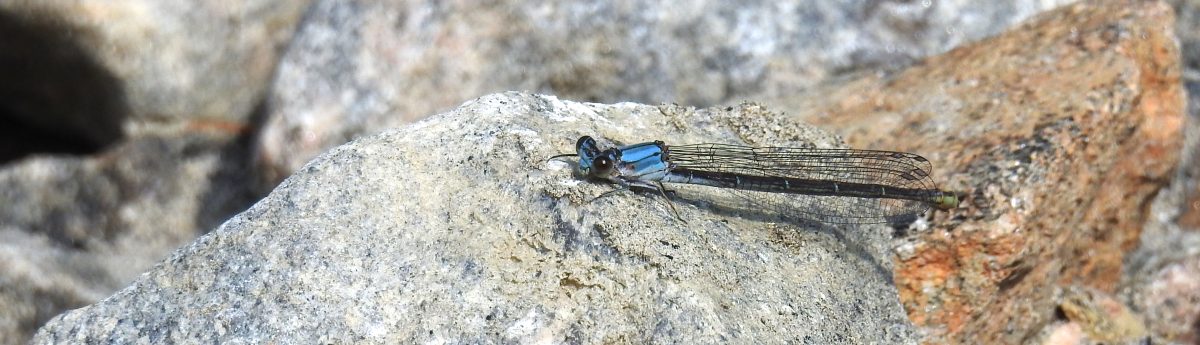

The 2024 North American edition of the Summer Odolympics were held between September 7-15, giving ode enthusiasts two weekends and as much time as a regular working week would allow to collect observations. I had hoped to find 19 or 20 species based on the same period spent collecting observations last year, but as most species are on the decline by this time, I knew I needed both good weather and good luck to come up with a respectful number. Unfortunately, neither luck nor weather were in my favour that first crucial weekend when I hoped to find a few species whose season ended around the beginning of September; it rained most of Saturday, and the temperature never rose above 15°C. Although it didn’t rain nearly as much on Sunday, the weather was worse: it was cloudy, windy, and the temperature never rose above 14°C. In fact, it was the coldest September 8th in more than 70 years (since 1949) and the windiest since records began in 1953 with a mean wind of 21 km/h. With a 1:00am windchill of 1.6 it was almost (within 0.1) the lowest windchill ever recorded on September 7th. Cold, wet, windy nights are even more of an obstacle, as many late-lingering species may not survive the low temperatures. When the sun began peeking out from the thick, fast-moving clouds around 4:30 I headed out despite the wind as to have zero species recorded on the first weekend was unthinkable. I didn’t expect much, and found only two species at the Eagleson ponds: an Eastern Forktail and a Slender Spreadwing.
The weather became calmer and sunnier and warmer throughout the week, until temperatures reached 27°C (33 with the humidex) on Saturday, September 14th and 29°C (34 with the humidex) on Sunday, September 15th. Excellent weather for ode-hunting…except there wasn’t much to be found. Numbers were low in terms of both species and individuals. In the end I ended up counting 17 species, and photographed all but one. I visited many of the same places I visited last year, with additional trips to Roger’s Pond, Sheila McKee Memorial Park, and the new storm water pond in Richmond. Here is summary of the species that I found.
Broad-winged Damselflies
None.
Spread-winged Damselflies
I observed three species during the Odolympics: Spotted Spreadwing, Slender Spreadwing and Northern Spreadwing. Spotted Spreadwings were in short supply, with two seen in the woods at Sarsaparilla Trail and only one seen at Bruce Pit. Slender Spreadwings were more widespread, with individuals seen at the Eagleson ponds, Lime Kiln Trail, Bruce Pit, and Richmond Lagoons. I caught one of the confusing Northern/Sweetflag Spreadwings at Sarsaparilla Trail; I didn’t even need my net, as it was caught in a spider web. I am pretty sure it is a Northern Spreadwing. I saw others in flight at Bruce Pit and Roger’s Pond but wasn’t able to catch any to ascertain their identity.

Pond Damselflies
Unlike last year, pond damselfly numbers were very low. I saw Eastern Forktails at six different locations, but only at Andrew Haydon Park did I see more than just one or two, with at least 20 individuals in the section of vegetation that I surveyed. I saw Fragile Forktails at four different locations, with up to three individuals seen (Bruce Pit and Lime Kiln Trail). Interestingly, I didn’t see any immature Eastern Forktails or Fragile Forktails.
Last year I saw only four bluets, and this year I saw the same number of species during the period of September 7-15. They were few and far between, with only one or two of Orange Bluet, Vesper Bluet, and Tule Bluet at Andrew Haydon Park. There were a few Familiar Bluets at Bruce Pit, and one today at Richmond Lagoons. I also several flying over the water at the new storm water pond in Richmond and suspect they were also Familiar Bluets. Without any way to get to the water to net them, however, I was unable to add any odonates there to my list.

I did not find any Powdered Dancers or Sedge Sprites.
Dragonflies
I did not find any Clubtails, Spiketails, Cruisers, or Emeralds. I specifically visited Sheila McKee Memorial Park on a warm September day on the off-chance I might find some Elusive Clubtails emerging, as this particular species is known to have a second emergence late in the season. Black-shouldered Spinylegs is the only other clubtail species I had a chance of seeing, but I found no clubtails there whatsoever.
Darners
September is darner season, but I didn’t see as many as I usually see. Before the freakish cold spell on the weekend of September 7th I was seeing plenty of darners at Bruce Pit, Sarsaparilla Trail and Beaver Trail. During the Odolympics I had a tough time finding any large numbers, and an even tougher time trying to catch them. My search at Beaver Trail turned up completely fruitless except for one individual in the grass that flew up and out of sight. Similarly, I saw two flying over the lawn at Terry Carisse Park which I simply could not catch. There were still one or two at Sarsaparilla Trail flying over the boardwalk, but none in the clearing where I’d had a Lake Darner last year. There seemed to be fewer flying the edges of the pond at Bruce Pit. And there were none at all at Sheila McKee Park, when earlier in the season all I needed to do was walk close to the trees of the corridors in order to flush them and have them land on my net or arm.
I caught my first darner, a Shadow Darner, at the Eagleson Ponds on the evening of September 10th. The following day I found a group of Common Green Darners flying over the field behind the graveyard on Steeple Hill Crescent, one of which obligingly landed in the grass for a photo. Then yesterday I had a stellar day at Roger’s Pond when I caught one Lake Darner, and photographed another which kept flying from tree trunk to tree trunk along the main path. There were quite a few darners flying over the water, though I’m wondering if most of those were Lake Darners.

After visiting Roger’s Pond I stopped by the parking lot at Lime Kiln Trail to look for Band-winged Meadowhawks. Last year I’d also caught a Shadow Darner flying in and out of the reeds at the edge of the pond. This year I caught another darner on the second-to-last day of the Odolympics flying over the ditch along Moodie Drive, and it, too turned out to be a Shadow Darner.
Up until then I still needed both Canada and Lance-tipped Darner, which was odd because they are two of our most common species. While I probably had seen one or both of these in flight, I couldn’t count them unless I caught and identified them. On the last day of the Odolympics I stopped in at the Richmond Lagoons, not expecting much but hoping to find a late Skimming Bluet, Violet Dancer, Powdered Dancer, or some gliders and other non-meadowhawk skimmers. I had no luck with any of those, but in the same section of the southern-most lagoon where I’d had a pair of mating Lance-tipped Darners last September I scared up a pair in a mating wheel and then found a third perching on a stem close to where they’d landed.
To my annoyance I never did see or catch any Canada Darners.

Skimmers
If there’s one family we are able to count on, it’s the skimmers, right? This family is the largest of all the dragonfly families with the most members, and as they are found at the edges of various still and slow-moving bodies of waters, along ditches, in meadows, and even in my backyard, they are usually the ones people encounter the most. Meadowhawks are everywhere this time of year, and I knew I should also be able to find some Wandering Gliders, Twelve-spotted Skimmers, and Common Whitetails, all of which are on the wing until mid- or late September. If I was lucky I might even find a Halloween Pennant or Blue Dasher!
Disappointingly, all I saw almost everywhere I went were meadowhawks. Autumn Meadowhawks, of course, were the most numerous in terms of numbers of location and numbers of individuals. White-faced Meadowhawks were almost as common, and I found Band-winged Meadowhawk in only two places: the ditch along Moodie Drive beside the Lime Kiln Trail parking lot, and the parking lot at Roger’s Pond. I did not see any Saffron-winged Meadowhawks despite searching for them at the Eagleson Ponds and Steeple Hill Park twice.

I did not see a single glider even though I could reasonably expect to find them in flight at the Eagleson ponds, the open areas at Steeple Hill Park, and by the river at Andrew Haydon Park. They had been quite common in the Maritimes during my trip, but except for one never-lander seen in flying over a puddle in a waste area back on July 14, I had yet to see one in Ottawa.
The only non-meadowhawk skimmer I saw came as a surprise when I saw a male Eastern Pondhawk at Roger’s Pond. I saw something thicker and darker than the Autumn and White-faced Meadowhawks flying over the shallow part near the shore, and when I got my binoculars I was surprised to see the pondhawk – a beautiful half-blue, half-green male in transition. It landed briefly but I couldn’t get my camera up in time to photograph it.
It was much more of a challenge finding different species during the Odolympics window than I expected, even though the first weekend was still early enough to expect a decent variety of late summer species. However, the weather leading up to the Odolympics certainly contributed to the lack of diversity (especially the gliders) with the remnants of Post-Tropical Storm Debby and additional rain events wreaking havoc in August, followed by an unseasonably cold, windy, and wet first weekend. I ended up with 17 species, but could have done a lot better with better weather. It will be interesting to see how the lists from 2023 and 2024 compare to next season’s Odolympics. I just hope they aren’t in October!
List of Species Seen
- Slender Spreadwing
- Northern Spreadwing
- Spotted Spreadwing
- Familiar Bluet
- Tule Bluet
- Orange Bluet
- Vesper Bluet
- Eastern Forktail
- Fragile Forktail
- Common Green Darner
- Lance-tipped Darner
- Shadow Darner
- Lake Darner
- Eastern Pondhawk
- White-faced Meadowhawk
- Autumn Meadowhawk
- Band-winged Meadowhawk


 OdoNotations