
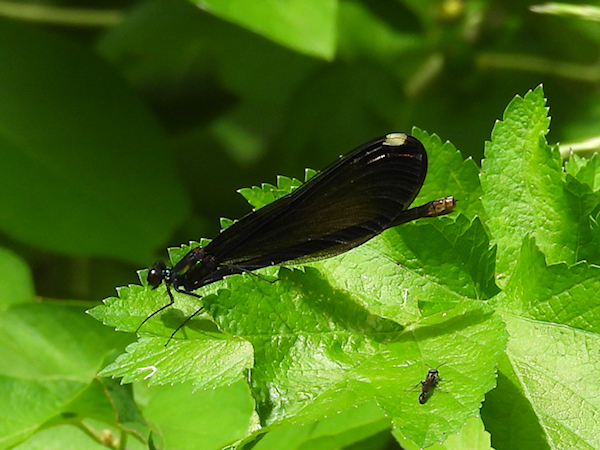
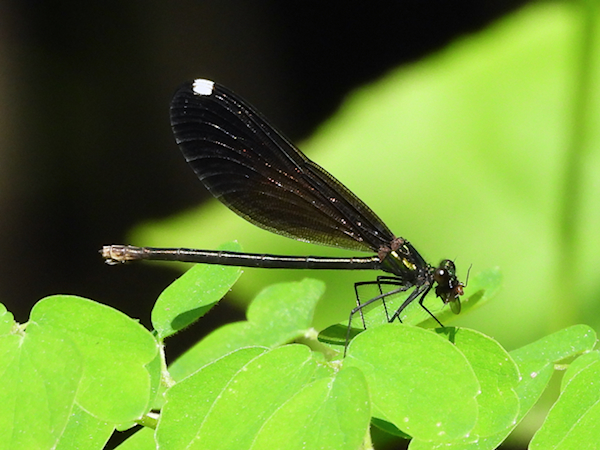
Although Saturday morning started off overcast, the clouds began to break up around noon and the sun started shining through. I headed out at 1:30 to hit a few spots close to home in case it started to rain: the former sewage lagoons at the Richmond Conservation Area, and Jack Pine Trail to look for emeralds. The Richmond CA ended up being a terrific place to spend some time. I saw a female Ebony Jewelwing along the small path between the parking lot and the lagoons; although this isn’t the first time I’ve had one here, it is the first one I have photographed and added to iNaturalist.
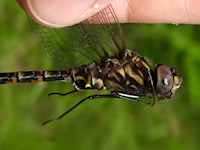
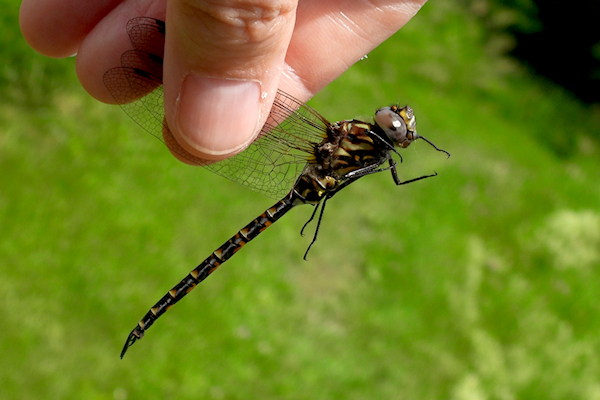
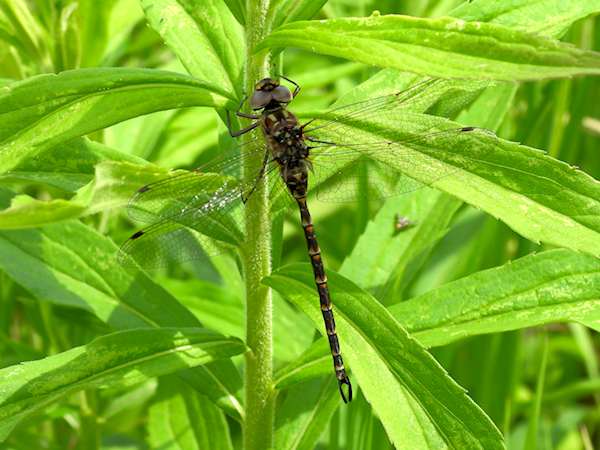
There was a slight breeze blowing as I made my way between the first and second cells, and in the vegetation I saw a few newly emerged meadowhawks and spreadwings. The spreadwings were mostly orange in colour, and I didn’t want to risk handling them in order to identify them. Near the small observation platform I saw a small dark dragonfly zipping out over the water and back, and when it got close enough I recognized it as a Harlequin Darner! I waited and hoped it would land on me, but it never did – I had to catch it in order to photograph it. Once I finished taking pictures I placed it in a small shrub to recover.
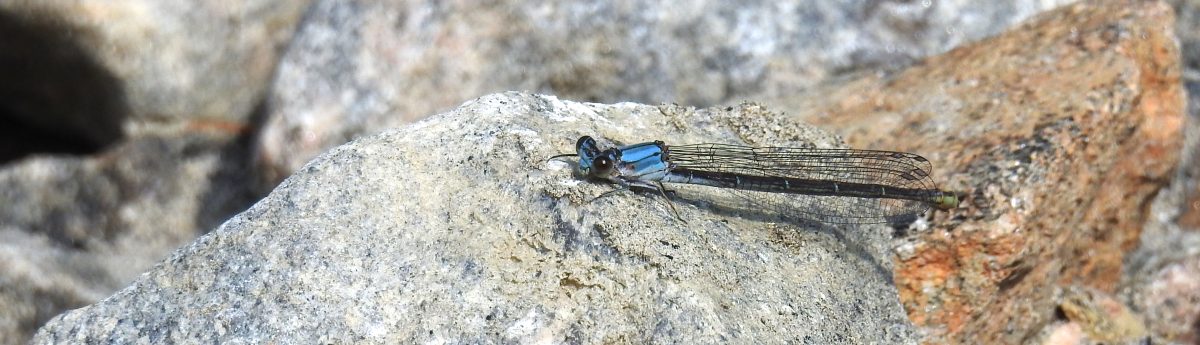
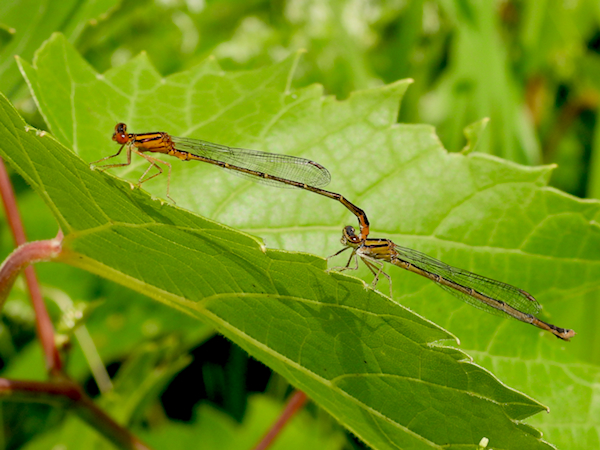
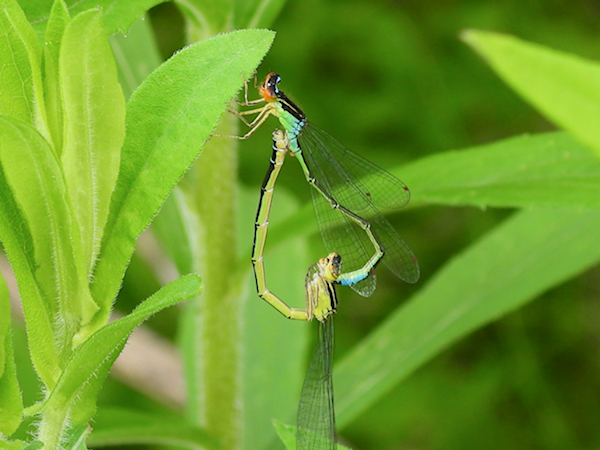
I saw a few Eastern Forktails along the trail, but not as many as I had expected or seen on previous visits. Then I spotted what looked like an immature Eastern Forktail flying through the vegetation with another damselfly attached to the tip of its abdomen! This piqued my interest immediately, as the female is always the second damselfly in a tandem pair – never the first one. This meant it could not be an Eastern Forktail. When it landed I noticed the orange tip at the end of the abdomen, making it a pair of Orange Bluets – a species I had never seen here before!
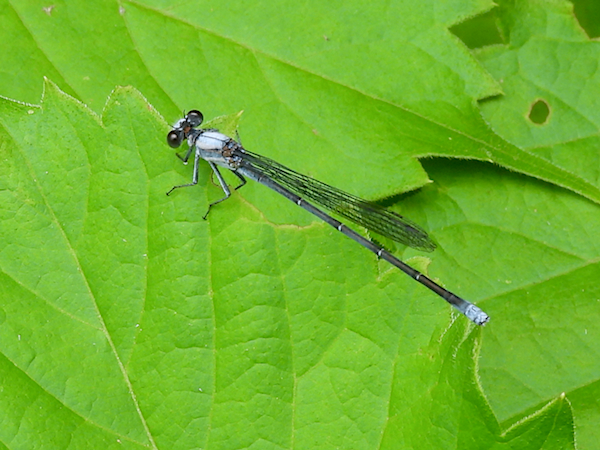
I continued heading toward the Jock River, scaring up a couple of Common Whitetails along the path but nothing else. However, near the river I started finding lots of damselflies: mostly Stream Bluets, with a few Powdered Dancers as well. I was hoping to find a Violet Dancer, but didn’t see any on my walk.
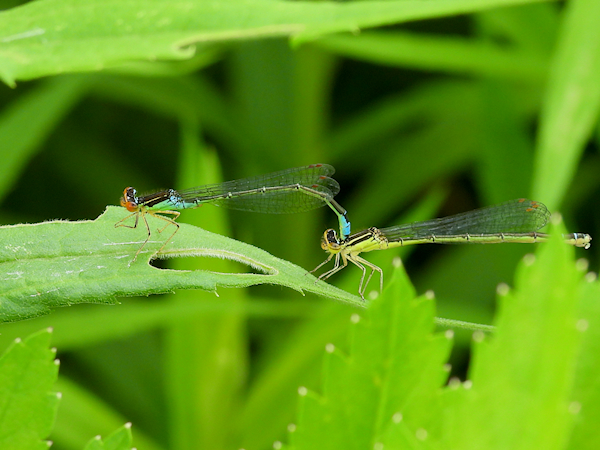
A pair of Rainbow Bluets were flying in the vegetation next to the path, and I found them lurking in tandem in a shrub before coming together to form a mating.
At the edge of the river I saw one dragonfly briefly hovering over the water before flying off to parts unknown. The water was higher than it was last summer, with very little room to walk, so I didn’t stay long. I saw a Skimming Bluet, an Orange Bluet, and a few more Stream Bluets and Powdered Dancers and that was it.
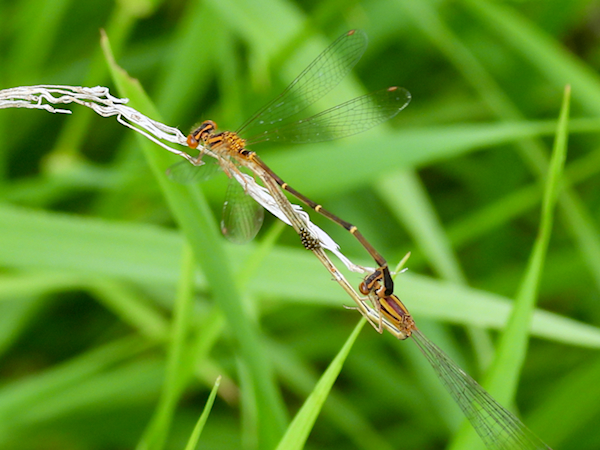
On my way back to the parking lot I saw a pair of Orange Bluets mating in the vegetation. This appears to be a different pair as the female here has a number of water mites attached to the underside of her abdomen. Like dragonflies and damselflies, water mites begin their lives underwater where they attach themselves to larvae of the damselflies or dragonflies. When the odonate sheds its exoskeleton during transformation, the water mites transfer to the freshly emerged teneral and feed on the fluids it sucks out of the host. When the odonate returns to the water to breed, the mites drop off to continue their own life cycle.
I spent some time scanning the water of both lagoons but saw no wing shimmer – not even the Common Green Darners were present.
From there I drove over to Jack Pine Trail where I was hoping to finally see some Brush-tipped Emeralds. I walked down the length of the trail at the back (which I call the Emerald Corridor) and saw a single Racket-tailed Emerald and that was it. I checked spiketail creek once again, and was happy to see a single Ebony Jewelwing in the area.
I waited to see if any spiketails would fly by, and eventually one did! It even landed in the vegetation across the stream, but the water was high and I didn’t have boots on to get to where it was. Still, I presume it’s the same Arrowhead Spiketail species that has inhabited this stream for a number of years now. Even more importantly, its presence signaled that the larvae had survived last year’s drought! I did not visit the creek when water levels were at their lowest, but in previous droughts the stream has dried up completely.
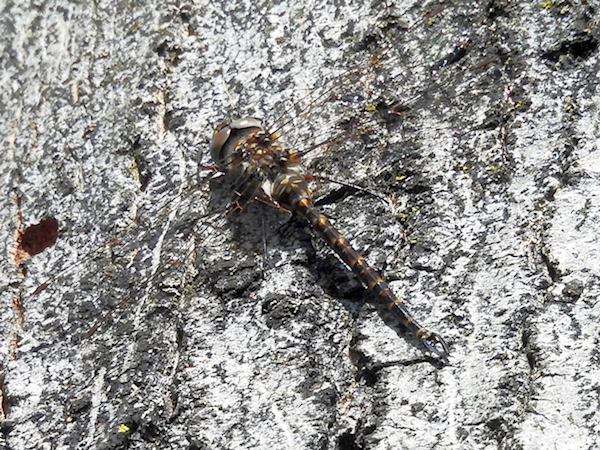
I headed back to the parking lot after that, spying only one more dragonfly along the way – a dark dragonfly that landed on a tree trunk near the feeder clearing (which has a new bench) several feet above my head. It was another Harlequin Darner, my second one today and third one of the season! Although they seem to be quite widespread, turning up in places I never would have expected, I have always wondered how it manages to reproduce given that I have never seen more than one in a single spot.
I had time to stop by one more spot after that, so I checked Sarsaparilla Trail again to see if I could positively identify the bluets there. I thought they might be Boreal Bluets, but it was difficult to get a good photo showing the backwards “B” I could see at the tip of the abdomen. I didn’t see much else of interest, just the same few skimmers and Sedge Sprites I had seen before.
It was terrific to add a few new species to my Odolympics list; with one day left in the bioblitz, I’ll be heading to Marlborough Forest where I should find some other common species that I’ve missed so far!


