
In June 2026 I travelled to Europe for the first time – a trip resulting from a decision I made in 2024 when I joined a local community choir, not expecting that it would lead me on a nine-day singing tour of the three Baltic countries with a group of 65 people! Ellison, our travel agent, had not only helped to arrange concerts in the three capital cities, the NATO forces base in Latvia, and the small community of Nida in Lithuania, but also walking tours of the Tallinn, Riga and Vilnius, as well as visits to places of cultural significance: Rundale Palace in Lativa, and the Hill of Crosses, Curonian Spit, and Trakai Castle in Lithuania. There would be plenty of opportunities for me to take in some nature and do some birdwatching along the way, and with our visit taking place in late June/early July I had a good chance of seeing some European dragonflies, too.
Of course, I couldn’t go to Europe without adding a fourth country to the list solely for leisure. My fellow alto, Jordan, and I decided to travel together and visit Stockholm, Sweden before the choir met in Tallinn on June 29th. Although I would have loved to have visit a southern country, we wanted to go someplace relatively close to the Baltics. Also, Jordan has already been to a large number of countries and wanted to go someplace new. We landed on Stockholm, a city which intrigued me as it is built on an archipelago – its nickname is the “Venice of the North” given the number of bridges and ferries that connect its 14 islands. As it turned out, Sweden gave me the highest number of odonates of the trip, mainly due to the weather (western Europe was still baking under a deadly heat dome when we arrived so we had plenty of sunny days) and ample free time in which to explore.
I found two good places for odonates in Sweden. The first was Djurgården island, which I explored mostly on my own during our first morning in Stockholm; the second was Tyresta National Park just outside the city where we did some hiking.
Djurgården island, Stockholm
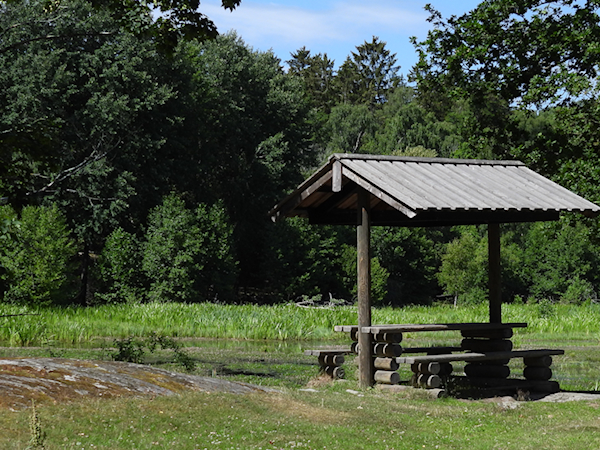
The eastern half of this island contains a nature reserve, which was originally created as the King’s private hunting reserve back in the 16th century. My goal was to explore the wetland of Isbladskärret within the nature reserve, as I figured this would give me the best chance of finding dragonflies and damselflies, and I was not wrong. When I found the wetland, I was dismayed to find a wire fence between the path and the embankment leading down to the water, though a nice picnic table in an open area looking quite inviting. I later found out that the fence was to keep cattle in rather than people out, though I did not know this at the time and stayed outside the fence just in case.
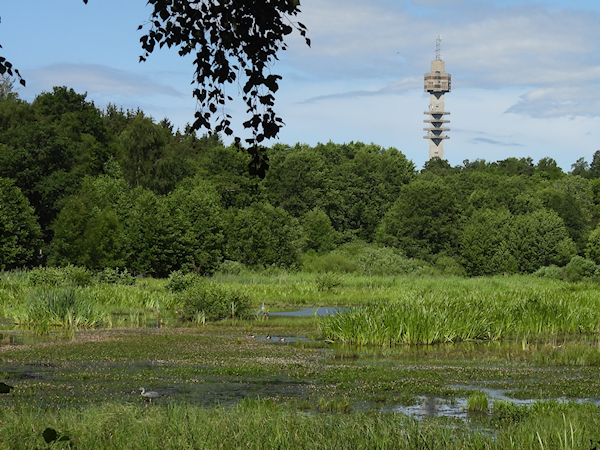
After watching and photographing the birds on the pond (herons, coots and geese) I spent some time scanning the vegetation just inside the fence as the water came quite close to it near the path. I was happy to find a good number of bluets perching low in the vegetation, though it wasn’t until I got home that iNaturalist identified them as Azure Damselflies (Coenagrion puella), bluets that are closely related to the Taiga Bluets in North America. Like the Taiga Bluet, the Azure Damselflies often perch with their wings slightly spread.

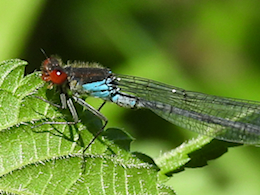
I found a second type of damselfly resting on one of the lily pads floating in the water, and later managed to find a much closer one on the shore – it looked like a bluet, except its eyes were red! This one was later identified as a Red-eyed Damselfly (Erythromma najas). According to the British Dragonfly Society, this species is a robust damselfly which inhabits lakes, gravel pits, canals and slow-flowing rivers. The site also confirms that the males often perch on floating leaves and vegetation to defend their leaf from other males. Females are chiefly black and green with red eyes; I would have loved to seen one!

My third damselfly was found not by the water, but in the woods which encircled the wetland. Movement in a sunny spot caught my attention, and I watched as the small damselfly landed on a shrub inside the fence. The metallic green and bronze colour identified it as a spreadwing, even if it wasn’t holding its wings out at an angle. iNaturalist identified it as a Common Spreadwing (Lestes sponsa), however, Sweden does have Emerald Spreadwings (Lestes dryas), too, the same early-flying species we have in North America. Females are tricky to identify, and closer views of my photos showed me two key field marks: the side of the prothorax (the area between the head and the thorax) is entirely bronze, whereas it would be metallic green in the Emerald Spreadwing, and the visible area of two dots on segment 2 just below the wings show an angle of much less than 90°, making them triangular in shape – the rectangular spots on segment 2 of the Emerald Spreadwing have angles of about 90°. It was a thrill to see my first (and only) spreadwing of the trip!

About an hour later Jordan messaged me to say she was ready to meet up for lunch, and after eating at a lovely place along the western shore of the island we went for a walk along the canal. There were some rocks at the edge of the water with some sedges just beyond, so I gave them a quick check for odonates.

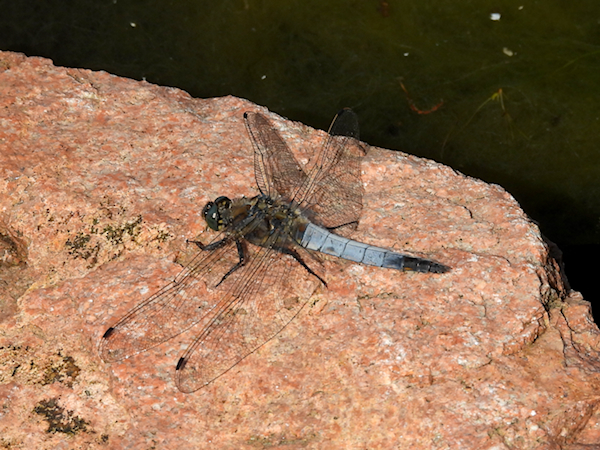
To my delight, I found a dragonfly and a damselfly perching in the same area. The dragonfly, a skimmer, was perching on a rock and looked like a Chalk-fronted Corporal except that the pruinosity at the base of the abdomen was bluish instead of white, and there was no pruniosity on the top of the thorax. I was later able to identify it as a Black-tailed Skimmer, one of the most common dragonflies in Europe whose range extends from the Mediterranean to the southern half of Scandinavia.
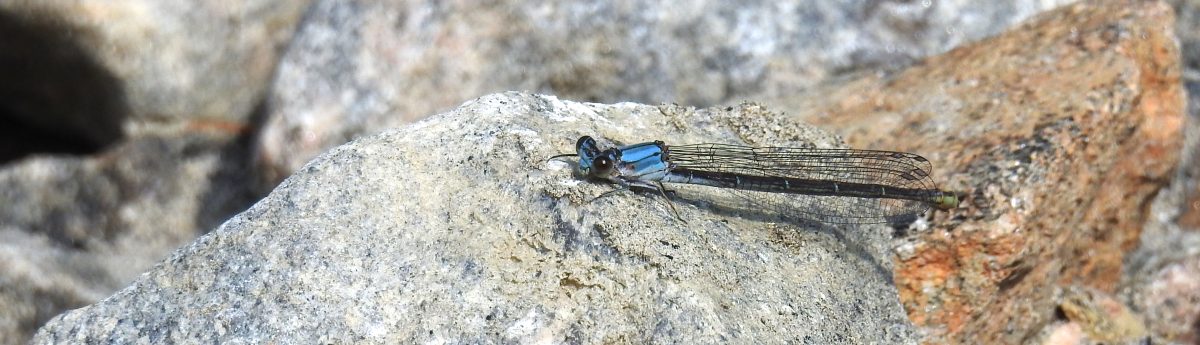
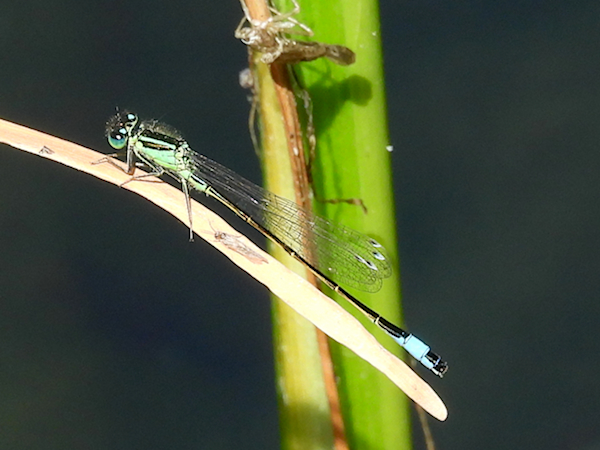
The damselfly looked like a male Eastern Forktail, except only one of the segments at the tip of the abdomen was blue on top. It is a European Bluetail, another common species, and in the same genus as the forktails of Ontario. Like the Eastern Forktail, females come in more than one colour – including a beautiful shade of salmon-pink on the thorax, with a black abdomen and a single blue segment that disappears with age. I would have loved to have seen that colour morph!
The only other dragonfly I saw along the canal was a Four-spotted Skimmer (Libellula quadrimaculata), the same species we have in North America, and I did not get a great photo of it.
Tyresta National Park
Jordan and I spent much of our second full day in Sweden in Tyresta National Park just outside the city. It is easy to reach via public transit and free to enter. Per the park staff’s recommendation we hiked the Bylsjöpromenaden Trail, an easy 5-kilometre trail that passes through old-growth coniferous forest and circles Lake Bylsjön, passing over a couple of marshy areas and bogs along the way.
When we came to our first boardwalk across a narrow channel of water I took some time to scan the edges for resting odonates. There were plenty of emergent reeds and sedges which made it look like a fantastic place for odes – and I did indeed see the flash of wings over the water in the distance. Two other dragonflies were perching right below the bridge as well!


The first dragonfly was a Four-spotted Skimmer, and I got a nice photo of it this time. This species has a distribution that ranges above the Tropic of Cancer in North America, Europe and Asia, and is known as the Four-spotted Chaser in Britain. It was nice to see a familiar species from back home!

The second dragonfly was a new one for me. At first I only saw it from the rear as it perched on a reed above the water – it was black with red spots down the top of the abdomen and between the wings like a Hudsonian Whiteface. It was definitely a skimmer, though I wasn’t sure whether it was a whiteface until it zipped out to catch a bug, then returned to a new post facing me.

This time I could see the white face, confirming my suspicions that it was in fact a member of the whiteface family, aka genus Leucorrhinia. When I later uploaded my photos to iNaturalist, it gave me three options: Ruby Whiteface, Small Whiteface, and Large White-faced Darter. The Small Whiteface appears to have only two large red spots near the end of the abdomen, while this individual has three. The Large White-faced Darter, on the other hand, has reddish-orange spots down the abdomen with the final spot being bright yellow. The Ruby Whiteface has completely yellow costas (the veins of the leading edge of the wings), whereas the similar-looking Small Whiteface has veins that are black from the base to the node, then yellow from node to wing tip. This appeared to be a Ruby Whiteface, which was confirmed on iNaturalist.

The Ruby Whiteface is also known as the Northern White-faced Darter. It is one of the the first dragonflies to emerge in spring, usually in large numbers, and has a more northerly distribution than other whiteface species – one of the few dragonflies to survive above the Arctic Circle, it has been found at the northernmost latitudes in Sweden, Finland and Russia, and lives as far south as Belgium where it inhabits peaty wetlands, acidic bogs, and forest lakes.
I scanned the water’s edge for other odes but did not see any, so we continued on our way. Not long after that we caught our first glimpse of Lake Bylsjön, a small lake which fills a rift valley, one of the common geologic features of the park. We followed the trail around the lake, crossing over another wet spot where I found another dragonfly. This one had the faded brown and black colours of a Four-spotted Skimmer with a large pale spot near the tip of the abdomen, but it turned out to be a mature female Large White-faced Darter aka Yellow-spotted Whiteface. She is not as striking as a fresh young male, which starts out with yellowish spots that turn red – except for the last one – but she was new for my European list and I enjoyed seeing her!

We also found a large granite lookout from high above the water; there was an easy way down to the shoreline so I followed it to the water to look for dragonflies among the reeds.

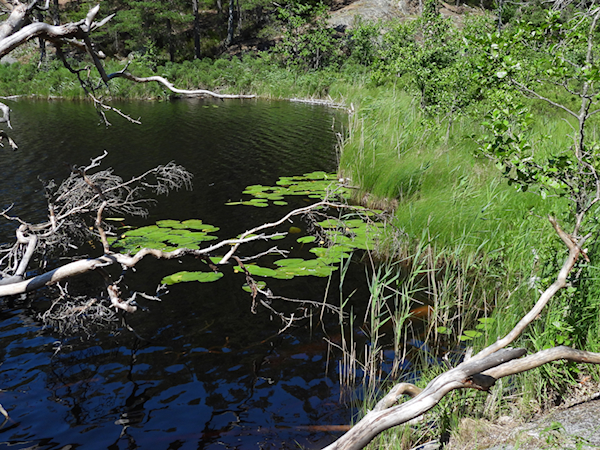
I immediately found two or three dragonflies darting around and chasing one another above the water. One was identifiable as a Four-spotted Skimmer, while the others were emeralds. Of course I didn’t have my net, and I could not capture any decent photos with my camera – my best photos are on iNaturalist where they will likely languish without ever being identified. They looked like Racket-tailed Emeralds without the large club, and are likely either Downy Emeralds (Cordulia aenea) or Brilliant Emeralds (Somatochlora metallica).
At a much smaller opening I scared a lizard basking in the sun – something I never expected to find given how far north Sweden is! – into the brush. When I was unable to relocate it I scanned the vegetation for odonates and found a Four-spotted Skimmer perching in the reeds and a Red-eyed Damselfly on a lily pad.

Not long after we passed the lake we came to a boardwalk passing through a large open area. The vegetation belonged to that of a bog or a fen, and I crossed my fingers that some dragonflies would be flying within view. Unfortunately I saw only one emerald that did not stay within sight for very long.


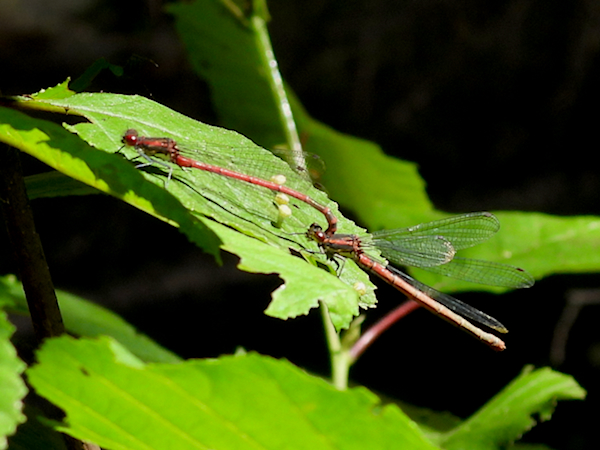
The trail re-entered the woods, following a small, shady channel of water bordered by vegetation and blocked with fallen branches. It was too slow-moving to be called a stream, and, indeed, seemed stagnant in the places where it came close to the trail. I checked at the few openings we encountered, looking for odonates but not expecting much. In one small open area I found another emerald buzzing around the shadows, but as usual it refused to land. However, in the vegetation along the stream I noticed several small red damselflies perching in singles and in pairs!
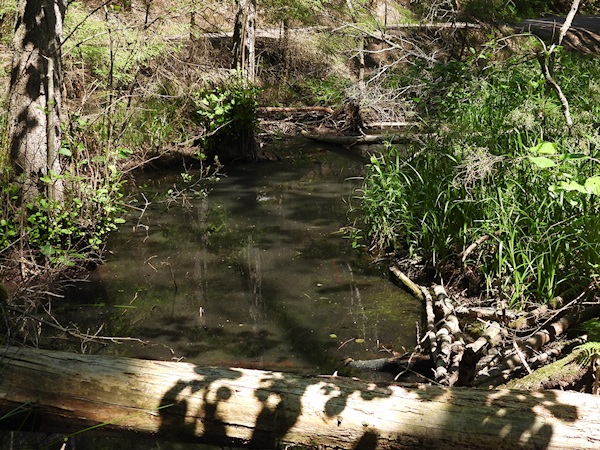
There are two red damselflies in Europe: the Small Red Damselfly (Ceriagrion tenellum) prefers shallow pools, seepages and streams in heathland bog and has red legs and red pterostigma (wing spots); males have an entirely red abdomen. The Large Red Damselfly (Pyrrhosoma nymphula), on the other hand, has black legs, black pterostigma (wing spots), and the male has a red abdomen with black markings. It inhabits most wetland habitats except for swiftly flowing water. This made it easy to identify the damselflies as Large Red Damselflies, and later research on iNaturalist showed no observations of Small Red Damselfly in the country.

After leaving the murky stream, I came across one last odonate in the woods – a darner! It was circling a sunny opening as darners like to do, but without a net I had no way of catching it. It flew up a vegetated slope and disappeared, leaving me to wonder just which species I had seen – I had really wanted to see a Southern Hawker, a gorgeous mosaic darner with blue eyes and bright yellow and blue markings on the thorax and abdomen, but I don’t think this was one.
Those were the last odonates I saw in Sweden, which has 65 species as of 2026. I saw a total of nine species, with at least two others (a darner and several emeralds) I could not identify. Given the relatively low number of species in the entire country as compared to Ottawa, I did not feel too bad for identifying only nine species.
The Baltics
While the weather was still quite warm upon our arrival in Estonia, I did not see any dragonflies there in my free time, as our hotel was situated right on the Baltic Sea and dragonflies require fresh water in which to breed. We only had one tour in that country, a walking tour of Kadrioru Park and Tallinn’s Old Town on June 30th, and while I did see one large dragonfly zooming over Swan Pond at Kadrioru Park, the canal at Toompark was entirely without odonata, to my disappointment. That was our only day in Estonia as we left early the next morning for Riga, Latvia.
On Canada Day the weather changed. Most days began with clouds and drizzle, with thick, lingering clouds and some sun breaking through in the afternoon, but many days were windy, and all of them were cooler than expected (only about 20°C and sometimes not even that). We left Estonia for Latvia on a rainy Wednesday morning. After a drizzly start to our tour in Riga the following day, the sun came out just in time for our free time at lunch. I spent some time at Bastejkalna Park which has a canal running through it and managed to find one dragonfly along the water.
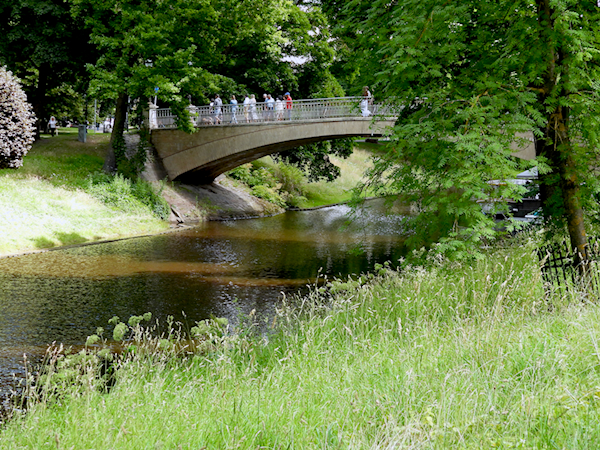
Bastejkalna Park, or Bastion Hill Park, is a long, narrow green corridor that follows the outer edge of Riga’s Old Town. The canal, known as the Riga City Canal, was once a moat that protected the medieval city. Today this lovely green space is a well-maintained urban park with flower beds, bridges and pathways that make it easy to see some of Riga’s most famous landmarks on foot.
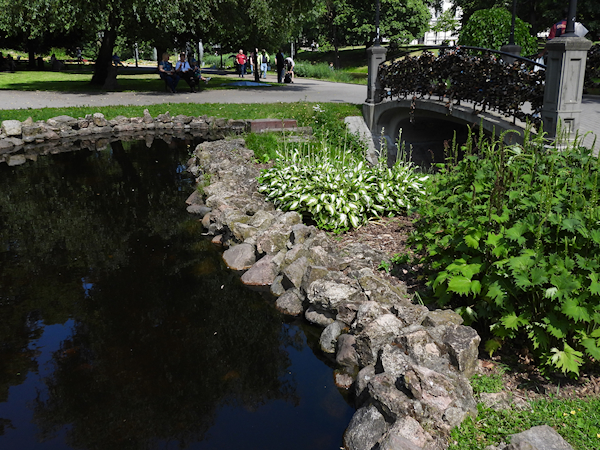
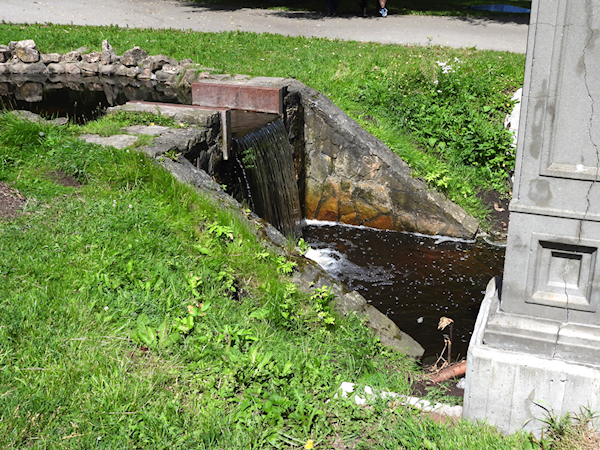
I found the dragonfly resting in the vegetation surrounding a small pond above the canal where it flowed over a small waterfall. It looked like a yellow meadowhawk of some sort (genus Sympetrum), and as someone once famously said, Sympetrum are hard. It was either a Common or a Ruddy Darter, but was identified as a Ruddy Darter due to its by its all-black legs. Males have a distinctly pinched, club-shaped abdomen which is not as obvious in females.
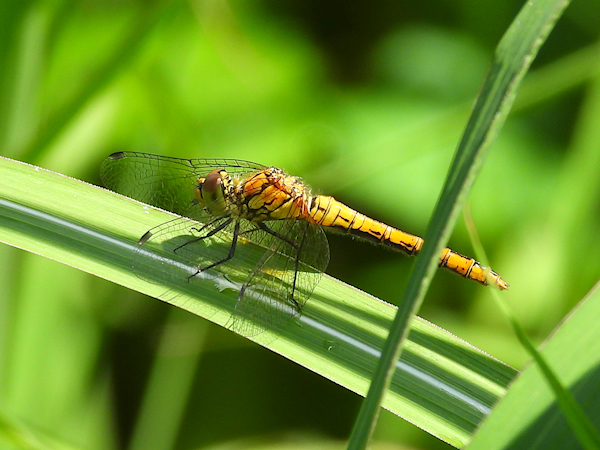
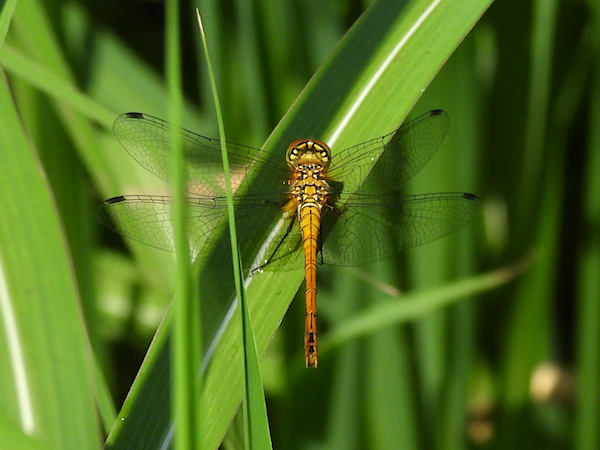
This was the only odonate I photographed in Latvia, which has a total of 60 species as of 2026. I saw a few others at the canals at Rundale Palace further inland but was not able to photograph them; one was a Four-spotted Skimmer, and I don’t know what the damselfly was. While our day started out sunny there, the clouds and rain moved in while we were touring the palace, and the sun came out only as we were leaving, giving me no time to explore the banks of the water.
The suboptimal weather continued as we entered Lithuania. Our trip to the Curonian Spit, the most highly-anticipated tourist destination of the tour for me, was delayed due to high winds. A UNESCO World Heritage Site, the spit consists of forest and sand dunes, and is protected for its unique landscape and fragile ecosystem. The sun came out intermittently that day, the winds were high on the Baltic Sea side, and although the birding was good I saw no dragonflies.
I was also looking forward to our trip to Trakai Castle on Lake Galve, a large freshwater lake, so I could look for odes around the vegetated shoreline. However, it was still cool, damp and cloudy that day so I didn’t see any.
It wasn’t until our last day in Lithuania – a free day after the choir tour officially ended the day before – that the sun came out briefly in the afternoon. Our hotel was close to both the Neris and Vilnia Rivers, where I hoped to find some odes. The Neris is wide and hemmed in by concrete where it passes through the city (much like the Rideau Canal at home), but the Vilnia was smaller and looked better for odes as it passed through a lovely wooded park.
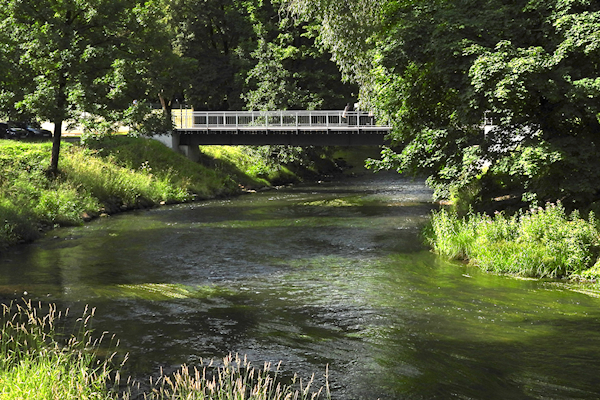
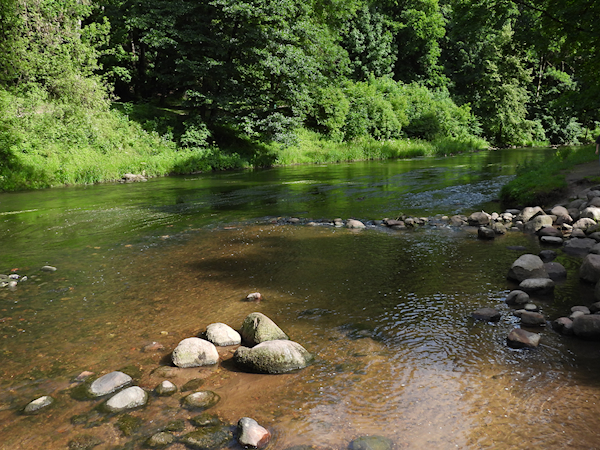
Unfortunately the sun didn’t last long, but as soon as it came out I noticed some jewelwings fluttering over the water and perching on the opposite bank. By the time I found the closest bridge, crossed it, and located the jewelwing spot the sun had disappeared and so had the damselflies. However, one of my friends spotted one perching in the vegetation, and thus I photographed my first Banded Demoiselle and final ode of the trip.
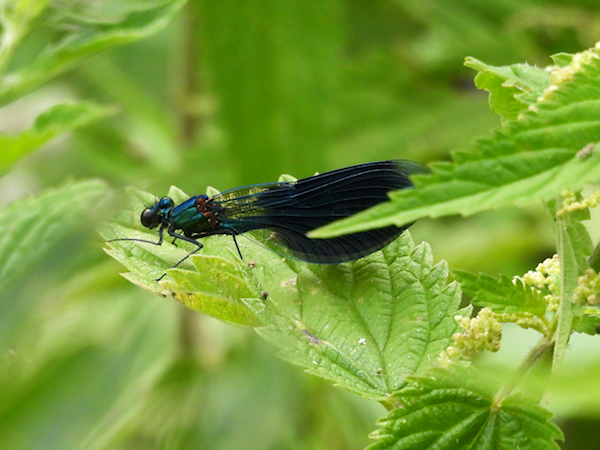
The demoiselles are related to the jewelwings of North America: the Banded Demoiselle is similar to our River Jewelwing, while the Beautiful Demoiselle is similar to our Ebony Jewelwing. These four species all belong to the same genus, Calopteryx, which means “beautiful wing” in Greek.
Had the weather been better doubtless I would have seen more of the 67 species that call Lithuania home. I had especially wanted to see a Blue Featherleg and a River Clubtail on this trip, two reasonably common species with many sightings on iNaturalist, but I suppose those will have to wait for a future trip.
Altogether I identified 11 species of odonates in Europe, though I enjoyed seeing the darner and emeralds even if I don’t know what they were….not bad for a non-nature trip!
- Common Spreadwing (Lestes sponsa)
- Banded Demoiselle (Calopteryx splendens)
- European Bluetail (Ischnura elegans)
- Azure Dameslfly (Coenagrion puella)
- Red-eyed Damselfly (Erythromma najas)
- Large Red Damsel (Pyrrhosoma nymphula)
- Four-Spotted Chaser (Libellula quadrimaculata)
- Black-Tailed Skimmer (Orthetrum cancellatum)
- Ruby Whiteface (Leucorrhinia rubicunda)
- Large White-faced Darter (Leucorrhinia pectoralis)
- Ruddy Darter (Sympetrum sanguineum)
A note about the species names in this post: I have taken the English names from iNaturalist. The above links will take you to the relevant species page on DragonflyPix, a wonderful site for information on European odes that provides many breathtaking photos and lists the species found in each country, although it often uses different common names. This is one reason I like to include the scientific names in this website – and because common names may change over time.


