Rarities Along the River

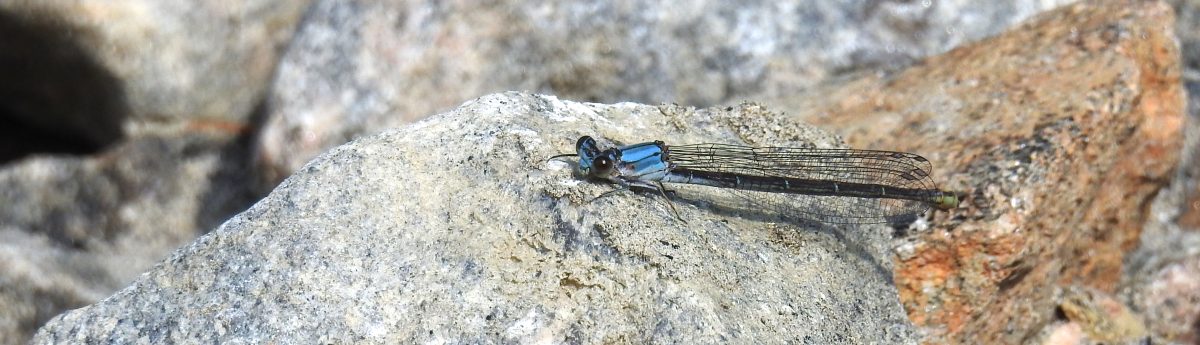
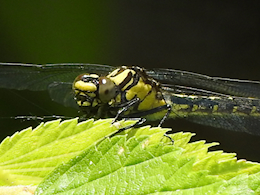
Mustached Clubtail

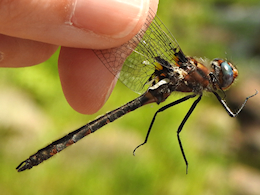
The Uhler’s Sundragon is an early-flying member of the emerald family that is apparently more easily found on the Quebec side of the OFNC study circle. However, iNaturalist shows a few records from the Quyon ferry dock along the Ottawa River, so one of my goals was to spend some time visiting places like the ferry dock, Sheila McKee Memorial Park, and Fitzroy Provincial Park to look for it and other river odes, including the uncommon Mustached Clubtail. I’ve only seen the Sundragon twice, both times in Nova Scotia, and in the same habitat – medium-sized- rocky forest streams flying over the gentle pools of water either at the top or bottom of a waterfall. Fortunately their patrols take them along the shoreline, and I was able to catch two in 2024 and one earlier this year. My goal was to see one in Ottawa, and I had high hopes for finding one at Fitzroy Provincial Park as there are two small rivers running through it that I wanted to check.

Continue reading “Rarities Along the River”
To See an Elfin Skimmer

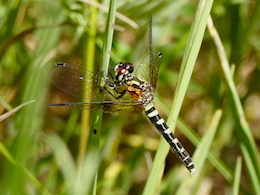
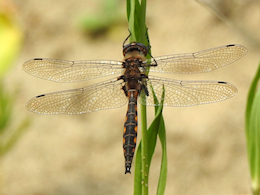
Elfin Skimmer

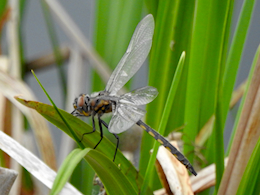
On Saturday, June 14, 2025 Derek Dunnett and I led a combined birding and dragonfly outing at Murphy’s Point Provincial Park for the Ottawa Field-Naturalists’ and McNamara Field Naturalists’ Clubs. It was restricted to 20 people for carpooling purposes (the park roads are quite narrow for parking) and 18 showed up altogether. Unlike our trip last year, the weather was perfect: cool and sunny in the morning, hot and sunny in the afternoon with a hint of a breeze. Our targets this year included Cerulean Warbler (which had been heard singing earlier in the week), Blue-winged Warbler, and Golden-winged Warbler, while our odonate targets included the diminutive Elfin Skimmer and various stream odonates. Last year the trip had been postponed several times due to rain, and we missed the Blue-winged Warbler, Golden-winged Warbler, and Elfin Skimmer as by the time we had visited (July 7) it was late in the breeding season and the weather for ode-hunting (thickly overcast in the morning) was less than ideal.

Continue reading “To See an Elfin Skimmer”

New Dragonflies at Bruce Pit

Beaverpond Baskettail

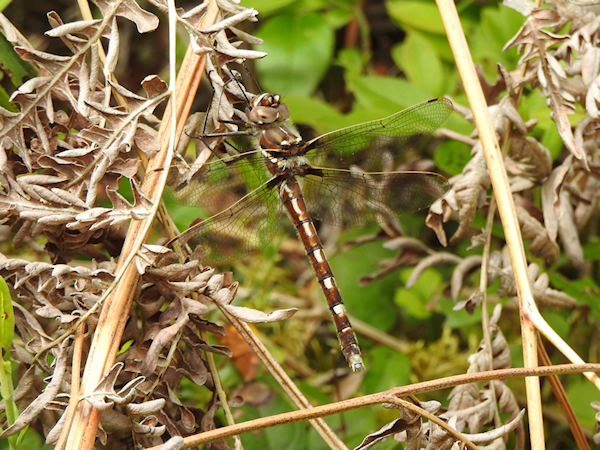
I’ve been spending time on iNaturalist again, updating my list of odonates found at various places around Ottawa and making a list of target species that others have seen that I have not. Bruce Pit was of particular interest to me, as Chris Lewis had sent me her personal list of species last summer; I was missing quite a few species she had seen (though I had found others she had not). Between her list and those listed in iNaturalist, I counted nine regular species that I was missing from my personal list: Black-tipped Darner, Harlequin Darner, Dusky Clubtail, Lilypad Clubtail, Common Baskettail, Prince Baskettail, Emerald Spreadwing, Orange Bluet, and Stream Bluet. One reason is that I usually don’t visit Bruce Pit early in the dragonfly season when some of these species are flying, while another is that sometimes when I visit I only check one or two areas. As a result, I planned to visit the conservation earlier in the season and see if I could find some new species for my personal list.

Continue reading “New Dragonflies at Bruce Pit”

Nova Scotia in June

Uhler’s Sundragon

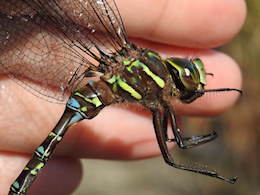
Back in March my partner and I bought a trailer in Nova Scotia. We don’t have any property yet so it is currently parked next to a relative’s house. This will give us a place to stay when we go back instead of spending money on an Airbnb – though we have stayed in some nice ones over the years! This also means I could buy a second dragonfly net and leave it there for those occasions when we fly instead of drive.

We took a vacation during the first week of June so I could see it for the first time. It’s amazing – 40 feet long, with an actual bedroom, living area, kitchen area, and dining area and even an electric fireplace! Although it is 12 years old, it has been immaculately maintained with new furniture and a new furnace. We spent the first two days furnishing it and getting to know how it works – the weather was lousy (cold, overcast and blustery) so I wasn’t interested in spending much time outdoors anyway.

Continue reading “Nova Scotia in June”

The 2025 Ode Season Begins!

Spiny Baskettail

I usually see my first dragonfly of the year in April, which is not surprising given that the first dragonflies migrate here from further south during the first prolonged warm spell of the month. They are always Common Green Darners, heading north to find new ponds and lakes in which to breed. It isn’t until later in May, usually the second week when temperatures are consistently in the 15-20°C range, that the local species emerge, chiefly skimmers and emeralds and, of course, damselflies. However, this season it didn’t warm up to 20°C until the very end of the month of April. It was still warm by the time the first weekend of May arrived, and on May 4th I finally saw my first Common Green Darners at a small pond in Stony Swamp – three males, it appeared.

Continue reading “The 2025 Ode Season Begins!”

In Memoriam – Christina Lewis

Christina Lewis (1960-2025)

Earlier this month I was informed of the passing of one of Ottawa’s original dragon-hunters, Christina Lewis. She was not only a mentor to me and Chris Traynor in all things odonate, she was a dear friend and a lovely person – humble, self-effacing, with a quiet sense of humor and deep love of nature.

Chris and her late partner Bob Bracken developed an interest in odes in the 1990s and were tutored by Raymond Hutchinson, Benoit Menard, Paul Catling, Colin Jones and Michael Runtz. They pored over EM Walker’s old publications, corresponded with Colin Jones, and spent time in the field with Raymond Hutchinson and Benoit Menard on the Quebec side of the Ottawa River, Paul Catling on the Ontario side, and Michael Runtz in Renfrew County where he lived at the time. These men were the most instrumental in helping Chris and Bob learn how to look at odes, where to go to find them, and encouraging them to document their records. In 1998 she and Bob produced the official checklist of odonates in the Ottawa-Gatineau region, which has been updated several times since then. They wrote many articles for the Ottawa Field Naturalists (and not just about odonates), but their joy came from visiting a variety of habitats just to see what was around, sometimes looking for specific species, often submitting their observations to Ontario Odonata.

Continue reading “In Memoriam – Christina Lewis”

Taxonomy Change: Didymops

The so-called “brown cruisers” are no more. On April 16, 2025 genus Didymops, representing two species – the Stream Cruiser (Didymops transversa) and Florida Cruiser (Didymops foridensis) – was changed to Macromia, which includes all of the river cruisers.

Regarding differences between the two genera, Ed Lam’s fantastic new field guide Dragonflies of North America notes that the brown cruisers “fly early in the spring, their life cycle largely completed before river cruisers emerge”. Dennis Paulson’s information-packed guide Dragonflies and Damselflies of the East describes brown cruisers as “smaller, duller editions of the large and showy river cruisers” and states that they “hold the abdomen more elevated than river cruisers do”.

Clearly such differences are no longer important enough to warrant the brown cruisers being placed in their own genus.

Stream Cruiser (Macromia transversa)

Odonata Highlights 2024

Mottled Darner

This year has been a good one for odonates. I have enjoyed ode-hunting in a few new provinces, discovered new parks and ponds right here in Ottawa, found lifers in three different provinces, re-discovered species I hadn’t seen in years, and added quite a few new species to places I thought I knew well. Despite the changing climate and weather systems that are occasionally severe enough to damage vulnerable ecosystems, odonates continue to survive and thrive in many parts of eastern Canada. Here are my top ten odonata highlights of the year.

Continue reading “Odonata Highlights 2024”

Last Odes on the Wing: October and November 2024

Spotted Spreadwing (Lestes congener)

Another ode season is over. Ottawa had some beautiful warm weather during the month of October – there were 26 consecutive days where the daytime high reached 9°C or above (between October 1st and 26th), tying for the 5th longest streak on record. As a result of the warm weather, I thought this would be the year I’d find more species flying later. Our first frost of the season occurred on October 16th with an overnight low of -1°C; this is a week later than the average first frost date. Then a warm spell hit late in the month – October 30th reached a ridiculous high of 22.2°C and October 31st hit 23.9°C, the warmest such days since records began in 1872. The month was mostly dry, with very little rain until the 29th.

November was cooler, though daytime temperatures remained above zero throughout the entire month. It’s not the day-time high that limits the dragonfly season in Ottawa, however; rather, it’s the nighttime lows falling below freezing. While the latest-flying dragonfly, the Autumn Meadowhawk, can withstand a few light frosts, a hard frost will kill both it and the flying insects it feeds on even if subsequent days reach double-digits. November 2nd and 3rd were both below -3°C, while November 9th and 10th were both below -2°C. A string of subzero nights after November 11th followed by warmer but cloudy, windy or wet days after November 20th ended the dragonfly season for good.

Continue reading “Last Odes on the Wing: October and November 2024”

A Darner Kind of Day

Variable Darner (Aeshna interrupta)

Today I went to Bruce Pit to see if anything was still flying around the edges of the pond and the field at the back. When I was here last weekend, there had still been three meadowhawk species and six damselfly species (Slender Spreadwing, Spotted Spreadwing, Azure Bluet, Familiar Bluet, Fragile Forktail and Eastern Forktail) still present, as well as an unidentified darner in flight over the water. With only two days left in the month I wasn’t expecting much, and indeed the wet vegetation at the edge of the pond yielded only three damselflies on this visit: Slender Spreadwing, Spotted Spreadwing, and Familiar Bluet. I also saw White-faced and Autumn Meadowhawks, but the Band-winged Meadowhawk from last weekend was gone.

I was pleasantly surprised when I saw at least two large darners zipping along the edge of the shore, especially when one flew low to investigate the reeds close to where I was standing. My net shot out, and the next thing I knew there was an angry buzzing sound coming from inside. I had caught a darner, and I was not really surprised to find a male Canada Darner inside.

Continue reading “A Darner Kind of Day”

Hunting the Elusive

Elusive Clubtail

Yesterday at 10:30 pm I received a message from Chris Traynor – he had been perusing iNaturalist and noticed that a few Elusive Clubtail observations had been reported on iNaturalist just that day and the day before! They were bright black and yellow adults, too, not the translucent beige tenerals we had seen emerging at Sheila McKee Park back in July. As a result, he decided to scour Petrie Island and perhaps Macoun Marsh for these elusive dragonflies – he had never seen the mature adult Elusive Clubtail and was eager to see one. Both Petrie Island and Macoun Marsh are repeat sites for this species.

His message fired my imagination. Elusive Clubtails have two noticeable mass emergences in Ottawa: once around Canada Day, and once around the fall equinox. Fresh adults may be seen around those times before dispersing into the tree tops where they apparently live, though it is more common to see tenerals fresh from emergence along the shoreline. I thought it sounded fun to look for mature Elusive Clubtails along the Ottawa River, though my initial plan was to check out the Carp River restoration ponds and see what bluets might be flying…I was keen to find another spot for Azure Bluets, and thought that I might see some gliders there.

Continue reading “Hunting the Elusive”

The 2024 Summer Odolympics

Autumn Meadowhawk (Sympetrum vicinum)

The 2024 North American edition of the Summer Odolympics were held between September 7-15, giving ode enthusiasts two weekends and as much time as a regular working week would allow to collect observations. I had hoped to find 19 or 20 species based on the same period spent collecting observations last year, but as most species are on the decline by this time, I knew I needed both good weather and good luck to come up with a respectful number. Unfortunately, neither luck nor weather were in my favour that first crucial weekend when I hoped to find a few species whose season ended around the beginning of September; it rained most of Saturday, and the temperature never rose above 15°C. Although it didn’t rain nearly as much on Sunday, the weather was worse: it was cloudy, windy, and the temperature never rose above 14°C. In fact, it was the coldest September 8th in more than 70 years (since 1949) and the windiest since records began in 1953 with a mean wind of 21 km/h. With a 1:00am windchill of 1.6 it was almost (within 0.1) the lowest windchill ever recorded on September 7th. Cold, wet, windy nights are even more of an obstacle, as many late-lingering species may not survive the low temperatures. When the sun began peeking out from the thick, fast-moving clouds around 4:30 I headed out despite the wind as to have zero species recorded on the first weekend was unthinkable. I didn’t expect much, and found only two species at the Eagleson ponds: an Eastern Forktail and a Slender Spreadwing.

Continue reading “The 2024 Summer Odolympics”

Preparing for the 2024 Odolympics

Shadow Darner

Last year I participated in my first Odolympics and had so much fun that I planned to do it again this year. The Odolympics is a special bioblitz hosted by the Dragonfly Society of the AmericasOdonata Central, and Sociedad de Odonatología Latinoamericana in order to record as many odonata species from as many places in the Western Hemisphere as possible. This specialized bioblitz is only three years old, and there are usually two Odolympics each year: one falling during the North American summer, and one falling during the South American summer in order generate a snapshot of odonate distribution throughout both hemispheres. The 2023 Summer Odolympics ran from August 19-27, giving observers two weekends to collect observations. Although late August is well past the peak of dragonfly diversity, I ended up counting 27 species, and photographed all but three. Even with the less-than perfect weather last year, I thought that 27 species for the end of August is pretty good, providing a much better snapshot of the odes on wing in Ottawa than I had anticipated. 

Continue reading “Preparing for the 2024 Odolympics”

Cherry-Faced Meadowhawks

Cherry-faced Meadowhawk

Cherry-faced Meadowhawks are much more common in Kings County, Nova Scotia than Ottawa. While I usually see several when I’m visiting the East Coast (in season), I hardly see them in Ottawa anymore. In my early days of ode-hunting I used to turn up males with deep red faces fairly regularly among the multitude of White-faced Meadowhawks, and I’d discovered a reliable population near the Hurdman transit station that persisted for several years. I don’t get there often anymore because it takes too long to get there from work now to make a leisurely lunch-time visit, so for all I know they are still there. It’s been a long time since I have even seen any potential candidates when I’m out ode-hunting in the west end; I think my last was a male in the ditch near near the Eagleson ponds several years ago.

Continue reading “Cherry-Faced Meadowhawks”

Road Trip: Odes in Nova Scotia

Familiar Bluet

We left P.E.I. via ferry, crossing from Wood Islands to Caribou after dinner. It was dark by the time we arrived at Seabank House in Pictou, a beautiful Victorian bed-and-breakfast overlooking the harbour that looked like something out of a Stephen King movie. In reality this 1854 building was quite charming inside, featuring spacious rooms, stained glass windows, and a grand staircase. This was our favourite accommodation of the trip (not including the AirBnB we stayed at in the Annapolis Valley). We stayed in the Hummingbird Suite with its two canopy beds, and enjoyed a breakfast of Eggs Benedict and fruit and yogurt the following morning. I was hoping to go for a walk along the harbour and look for sea and water birds for my county list before we left, but it was quite foggy outside and I couldn’t see much so I skipped it.

Continue reading “Road Trip: Odes in Nova Scotia”