I am a lover of nature whose primary interests are birds, butterflies, and dragonflies. While I enjoy photographing them, my main interest is in observing and learning about the species I see through my lens. For those of you who are interested in seeing the best of my nature photos, please feel free to check out my gallery on Pbase.
We only had one night on P.E.I. (which we spent at a hotel in Summerside across from the harbour) so we didn’t do a lot of hiking or exploring. We spent the day we arrived touring the western side of the island, where I thoroughly enjoyed the birds and views of North Cape, and the day of our departure exploring the eastern half. It wasn’t until the second day that I saw any odonates – we visited the Anne of Green Gables Museum and the birthplace of L.M. Montgomery, had lunch in Charlottetown, then drove across the island to East Point before catching the ferry at Wood Islands to Nova Scotia. When we reached the museum I immediately decided not to join my dad and step-mom on the tour: there was a pond on one side of the driveway, and a small marshy wet spot on the other. I could finally do some ode-hunting!
My dad, who is almost 75, has always loved to drive. He’s been talking about a road trip to the east coast for a few years now, but in August 2024 we finally did it: he, my step-mother and I left Ottawa on August 10th for a two-week road trip covering Quebec, New Brunswick, P.E.I., and Nova Scotia. We had done a similar trip when I was 12, but that trip included a ferry ride to Newfoundland to visit family on my mother’s side as well. Newfoundland is still very much in my father’s plans, and he hopes (as do I) to visit it in a year or two.
As usual, it was my goal to get some nature study and photography in, too, but I knew this trip would feature lots of time spent driving and visiting tourist attractions – my Dad wanted to revisit his previous trips there, including his time in the Navy when he was a youth stationed in Nova Scotia, while my step-mother had never been east before. And with neither of them in peak health anymore, we would have to limit our time on the trails, though there were plenty of national and provincial parks I was interested in visiting.
Sheila McKee Memorial Park has been such an amazing spot for odes this year that when the weekend called for not one, but TWO clear days, I decided it was worth going back for a few hours and looking for more clubtails. I arrived around 10:00, and as usual a dragonfly had claimed the first sunny opening in the woods as its territory – however, unlike the Common Whitetail, Racket-tailed Emerald, and Black-shouldered Spinyleg of my previous visits, this one was a brilliant green Eastern Pondhawk actively darting around and landing on different leaves. I took one terrible photo of it sitting on a leaf above head-height, facing me. This was the only pondhawk I saw, so I’m glad I got a photo for iNaturalist.
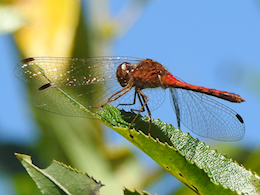
The Amber-winged Spreadwing at Bruce Pit wasn’t the only good find there on July 14th. Back on July 6th I’d found a different sort of amber-wing: an Eastern Amberwing, one of our smallest dragonflies. I’d also found and photographed a Halloween Pennant, a species I’d seen flying over the water last year but hadn’t managed to find perching. I observed both species on the slope between the fence and the edge of the pond, and both were new for my Bruce Pit list. I asked Chris Lewis if she had seen either species there before, and she told me she had seen Halloween Pennant there in the past, but not Eastern Amberwing – no surprise there, since this is a relatively new addition to the Ottawa area. When I headed over to Bruce Pit after finding the Amber-winged Spreadwing at Bill Teron Park on July 14th, it was to see if I could find any more Eastern Amberwings or Halloween Pennants and get some better photos.
Last year on August 5th Chris Traynor and I headed up to La Vérendrye Wildlife Reserve just beyond Grand-Remous, Quebec to look for the Common Sanddragons that had been discovered along the Desert River (Rivière Désert) in 2016. We were too late in the season to find any, but had a marvelous time watching dragonhunters and catching darners. We made a pact to return the following year earlier in the season, and on July 21st Chris, Sophie Roy and I finally fulfilled that pact. The sky was spattered with more puffy, white clouds than I would have liked, showing little blue at first, but the further north we drove the clearer the sky became. The temperature was perfect, about 24 or 25°C, with only a slight amount of humidity that really only made the temperature start to feel too warm later in the afternoon, but a fresh breeze kept us cool enough. We were in high spirits because even if we missed out on the sanddragons again there were sure to be enough interesting birds and bugs to make the journey worthwhile. And of course, the rushing rivers and waterfalls of Quebec are beautiful in their own right.
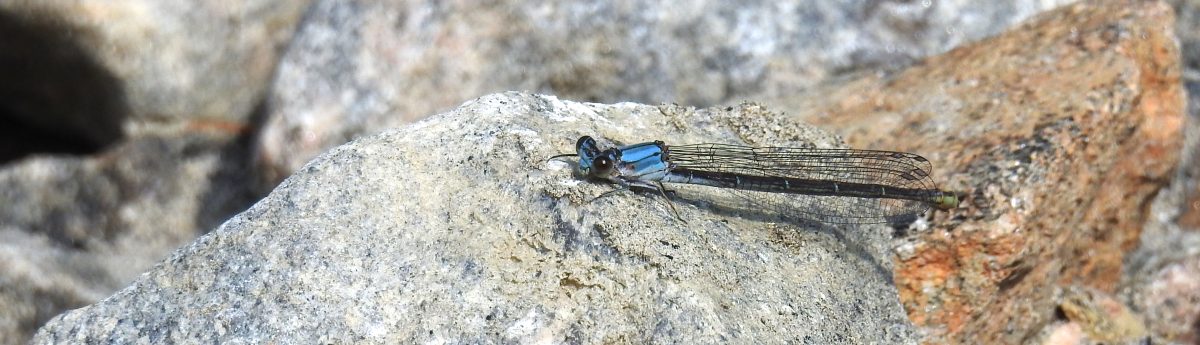
On August 4, 2020 I was surprised to find a Violet Dancer on a dirt trail at the Eagleson ponds. The closest place I’ve ever seen this species to home is out near Morris Island, so it was a shock to find one practically in my own backyard. Then in 2022 I found a few near the Jock River behind the former Richmond sewage lagoons. This suggested where the one at Eagleson might have come from – still a fair distance for a tiny damselfly, but not insurmountable if the winds are blowing the right way. I didn’t expect to see another one there any time soon; if anything, Powdered Dancer was next on my list of species I expected to show up there, because they are much more abundant and widespread along the Ottawa and Rideau Rivers than the Violet Dancer, and breed at the same location on the Jock River behind the former Richmond sewage lagoons. However, when I took a walk there on July 16 after work, it was the first odonate I found, resting on the rocks near the bridge.
Marlborough Forest is always a fun place to visit, and after failing to find any Brush-tipped Emeralds at Jack Pine Trail earlier this week I decided to go to the E6 trail and Roger’s Pond this morning to see if I could find any of these unique Somatochlora emeralds there. Unfortunately that was not to be the case, but I had a great time and found a nice selection of odes while I was there. At Trail E6 I found many of the usual species, including Racket-tailed Emeralds, Frosted Whitefaces, and White-faced Meadowhawks.
On July 15th I went to Jack Pine Trail at lunch to look for dragonflies. I was hoping to find some Brush-tipped Emeralds, a species I hadn’t seen there since 2019. I have not visited Jack Pine Trail much in the past five years for a variety of reasons, including closures during the pandemic lockdowns and after the derecho of May 2022. However, the main reason is that I stopped looking for them there after I began visiting Marlborough Forest during the pandemic and saw how common the Brush-tipped Emeralds were on all the trails there. Unfortunately Marlborough Forest is a little bit too far to visit on a lunch hour, but Jack Pine Trail is nice and close. It can be good for baskettails, and it’s the most reliable spot in the area for Arrowhead Spiketails in mid-June. I’ve also had Slaty Skimmer there and two unidentified clubtails that I never got a good look at before they flew off. I usually find something interesting there when I visit, and was hoping to do so again today.
I have been spending time on iNaturalist lately, looking at historical records of various odonate species and checking what species have been seen around Ottawa recently. This search stemmed from an interest in seeing whether there were any new locations or new records for the Eastern Red Damsel and Amber-winged Spreadwing, two species that used to be common at Bruce Pit but aren’t any longer. The Amber-winged Spreadwing is a relatively hefty species that inhabits various bogs, lakes and ponds, preferably those which do not contain fish. It’s been a good ten years since I’ve seen one at Bruce Pit, and the only other place I’ve seen one in Ottawa is at the Mississippi Snye in 2021. To my surprise one had been reported in Kanata not too far from home: Bill Teron Park in Kanata North. Named for the developer who initially designed Kanata to be a garden city existing in harmony with nature – no straight roads or cookie-cutter houses, while preserving rock outcroppings and areas for parks – it is a delightful pocket of the same rocky, wooded ecosystem found at South March Highlands hidden within an urban setting. There is a small pond here, with the usual dragonflies being seen at the water or along the nearby trails: Chalk-fronted Corporals, Dot-tailed Whitefaces, Common Whitetails, Autumn Meadowhawks, Common Green Darners.
On Sunday, July 7, 2024 Jeff Skevington, known chiefly for his work on butterflies and flower flies, discovered a first record of dragonfly species for the Ottawa region: a Painted Skimmer (Libellula semifasciata) in Burnt Lands Provincial Park. This species is at the northern edge of its range in southern Ontario, though there is one record from Algonquin Park and one record from Smiths Falls on iNaturalist. This dragonfly has the body of a Four-spotted Skimmer and wing pattern of a Calico Pennant, though the spots are brown instead of red, with a wide amber patch at the base of the wings. The veins at the leading edge of the wings are colourful, too: gold in females and red in males. It is a distinct dragonfly within its range, and outside of it too: Paulson states it is probably migratory in the northern part of its range, and it has been observed moving north over the past 15 years. Perhaps it was only a matter of time before one was seen in Ottawa.
I thought briefly about trying to see the Painted Skimmer the following Saturday, but the forecast, as well as the chances of trying to re-find a bug that had been seen 6 days ago, deterred me: the forecast called for a sunny high of 29°C with the humidity making it feel closer to 40. Burnt Lands Provincial Park is a hot, shadeless alvar better suited for grassland species such as Clay-colored Sparrows than woodland species such as Wood Thrush, and with no trees, running water, or shelter I decided – reluctantly – to head elsewhere, though I would have loved to have seen the Painted Skimmer. It is a species I will have to keep an eye out for while visiting southern Ontario.
I’ve seen large numbers of emeralds (Spiny Baskettails) emerging at Mud Lake and skimmers (species unknown) emerging at Roger’s Pond. These mass emergences were thrilling, but not surprising given how I often I see large numbers of adults of both types of dragonflies feeding together before dispersing – swarms of baskettails flying up and down trails, and large groups of Chalk-fronted Corporals and Dot-tailed Whitefaces resting on various perches close to the water. Clubtails are not usually found in swarms or large groups (they are perchers rather than fliers, so a swarm would be particularly unusual), so I never thought I’d see a large emergence of members of this dragonfly family. That changed with my Canada Day visit to Sheila McKee Park.
The first emerging clubtail caught my eye when I saw what looked like two nymphs on the rocky beach grappling with each other. Closer inspection revealed it to be a nymph trying to break free of its larval shell so it could complete its transformation. It seemed odd to me that it was on the ground – all the baskettails I’ve seen emerging had crawled up onto the branches of the shrubs at the water’s edge, and all of the skimmers had crawled up the stems of the short grassy vegetation lining the trail at Roger’s Pond. The only place I’ve seen clubtail exuviae is on the trunks of the large trees behind the ridge at Mud Lake or on rocks within the water in Gatineau Park. It looked to me that this fellow had walked out of the water and couldn’t wait to get to a safe spot before bursting out of the shell. It was a clubtail, the only nymph I can identify with confidence because it is the only type of dragonfly with widely-separated eyes.
On July 1st I spent the morning at Sheila McKee Memorial Park with the full intention of heading out to Pinhey’s Point afterward. My goals were to get to Sheila McKee early enough to look for the Yellow-throated Vireo and Yellow-billed Cuckoo that had been found there recently, then look for dragonflies in the open meadow and along the river shore. I was hoping to find another Mustached Clubtail, or perhaps an Arrow Clubtail, or the first Cobra or Midland Clubtails of the season. It was a bit cool in the morning, so I waited until 8:30 am to leave. When I got there just before 9:00 there were already several cars in the parking lot, and by the time I headed out to the road to listen for the elusive cuckoo a cavalcade of cars was turning into the parking lot from Sixth Line Road.
After a couple of wonderful outings the previous weekend, I was looking forward to heading back out to the west end to Sheila McKee Memorial Park to see if any new dragonflies had emerged. However, the weather was most uncooperative – it rained almost the entire weekend. So I took Tuesday morning off work instead, as it was forecast to be both warm and sunny…the temperature had already reached 20°C by 7:00am. My goals were still to look for rarities such as the Mustached Clubtail reported there on May 24, 2021 and the Arrow Clubtail reported there on June 24, 2021. I knew the Arrow Clubtail would be almost impossible, as it is very rare in our region, but as the Mustached Clubtail had a few sporadic reports from Remic Rapids on both sides of the Ottawa River I thought I had at least a shot of finding that species….long though it might be!
The sky was pure blue when I left, and the day’s high forecast was to be a sunny, humid 29°C – perfect weather for dragon-hunting. I left just before 9:00 so I would miss the worst of the rush hour traffic and arrived about 10:20. Being a workday, there were only two other cars in the parking lot when I arrived, and I saw no one on the beach by the time I got there.
Last year I spent a cloudy Sunday morning in the south end of Marlborough Forest, looking for for new parts of Marlborough Forest to explore as there were very few odonate records on iNaturalist from that area. I visited four places that looked intriguing on Google Map: an unmaintained trail extending beyond Mulholland Road at Harnett Road; a large wetland further south on Harnett Road directly accessible by car; another unmaintained trail beyond Weedmark Road off of Paden Road; and the Paden Road trail itself. I had hoped to have time to explore Heaphy Road on the western boundary, as Google Maps shows it running through another big wetland and crossing over a large creek before encountering more wetlands. I wasn’t sure what the creek looked like in this area, whether it was a slow, deep, muddy, meandering waterway like the Jock River or if it was a narrow, rocky, fast-flowing stream like those I had seen recently in Nova Scotia. Fast-flowing waters provide habitat to a different variety of odonate species than the slow-moving streams and marshy ponds that make up much of Ottawa county, and I was hoping that there was a fast enough flow to attract jewelwings, clubtails, and perhaps even a spiketail. So far all that had been recorded in that area was Sedge Sprite, Common Whitetail, Dot-tailed Whiteface, and Common Green Darner, all very abundant and widespread species in Ottawa.
After leaving Mud Lake I went to Sheila McKee Memorial Park to try my luck there. I was hoping that the whitefaces would still be flying, as I wanted to find some fully mature individuals after seeing so many tenerals and immatures right before my trip to the Maritimes, and I was hoping that some clubtails had emerged. It was still sunny, only about 18°C, and while the wind was still blowing, the small clearings in the woods at the top of the escarpment were relatively protected. I didn’t see any odes other than a few Powdered Dancers until I reached the main clearing where the trail leading down to the water branches off to the right. Some smaller dragonflies were perching in shrubs at the edge of the clearing, and I was delighted to find some freshly emerged Blue Dashers – both males and females!





 OdoNotations