I am a lover of nature whose primary interests are birds, butterflies, and dragonflies. While I enjoy photographing them, my main interest is in observing and learning about the species I see through my lens. For those of you who are interested in seeing the best of my nature photos, please feel free to check out my gallery on Pbase.
The drought this summer has been awful – we’ve had less precipitation than normal every month from May through September, and not only are ponds and creeks drying up, but people’s wells are running dry. Ottawa received 48 mm of rain in July, (typical average: 88 mm), 48.2 mm of rain in August (typical average: 79 mm), and 32 mm so far in September (typical average: 90 mm) with still no rain in the forecast. A visit to Richmond Lagoons revealed only a puddle of water in the middle cell – the one which normally has the most water – and the Jock River behind the former sewage lagoons had been reduced to a trickle of water. Meanwhile, Bruce Pit has a large sandy shore which has made it impossible to find odonates that like to perch on emergent plants and stems. I went to Roger’s Pond on September 14th expecting more of the same, but was still shocked by how very little water was present.
Earlier this year I spent some time exploring the creeks of Kanata in an attempt to find some of the creek-loving odonates that inhabit Gatineau Park on this side of the Ottawa River. While I was happy to find new places for damselflies such as Aurora Damsel, Ebony Jewelwing and River Jewelwing, I wasn’t able to find any creek-loving clubtails, darners or spiketails. One place that intrigued me was Brassils Creek in Marlborough Forest. It meanders through a large portion of the forest, though it is wide and marshy in most places where the trails cross it, with a slow-moving current similar to the Jock River. Google maps shows that this creek passes beneath Flood Road just off of Upper Dwyer Hill Road, and on July 12th I spent an hour exploring the area to assess its potential for odes.
Mature Elusive Clubtails are difficult to find. The best way to find one is by simply being in the right place at the right time – a strategy that requires a little knowledge of its preferred habitats and an enormous amount of luck. My first two encounters with a mature adult were entirely unexpected. I was in the right habitat, but as I was fall-birding at the time I wasn’t expecting to see any particularly exciting dragonflies…and unfortunately, the luck that led to my discoveries was of the bad variety – bad for the dragonfly.
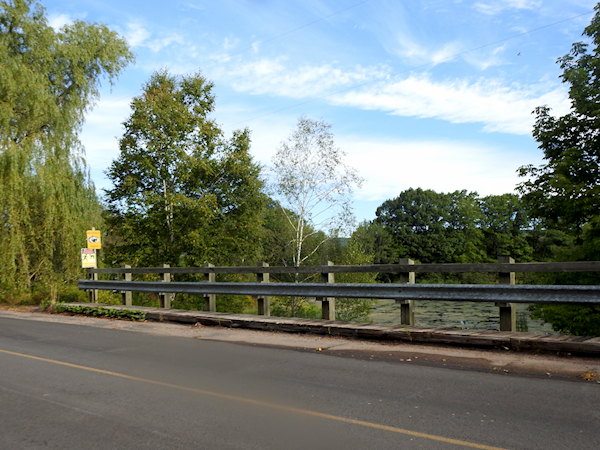
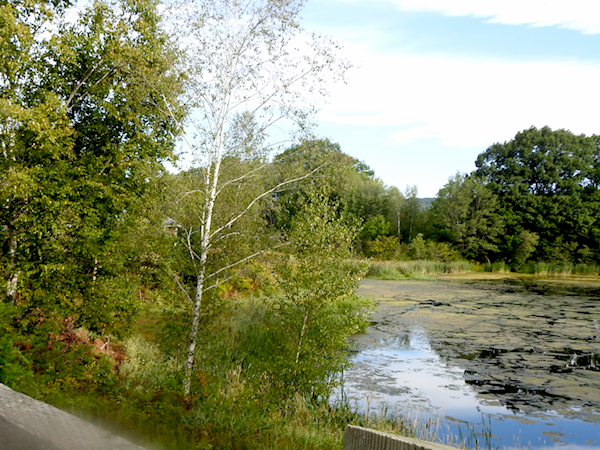
I wasn’t planning on looking for dragonflies when I got up early on the morning of August 27th and went for a short drive to Bridge Street just around the corner. I was curious about what type of bridge I might find – and what kind of stream or creek flowed below – as Google Maps showed an open marsh to the north of the bridge and a wooded creek to the south; I was hoping that I could access the water in case it turned out to be a good spot for odonates.
Bridge Street
Marsh north of Bridge Street
Unfortunately, there was no way to get to the water. The land on surrounding the marsh was entirely private, and the water emptied into a gulley on the other side of the bridge with banks too steep to climb down.
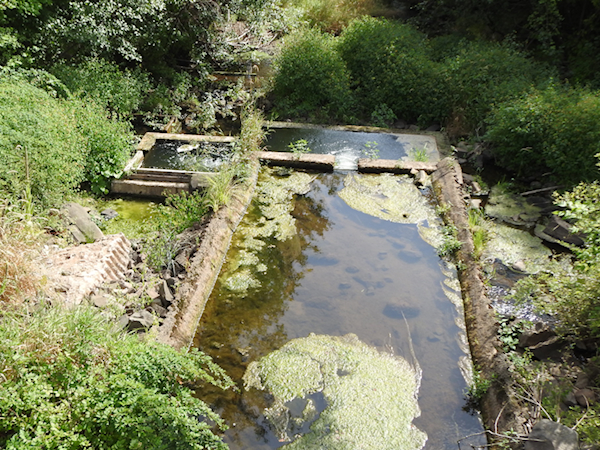
Interestingly, the stream below the bridge appeared to be contained within series of rectangular concrete “locks” – perhaps these locks are completely submerged when water levels are normal and the stream is in full spate. I will have to check again next year to see if this theory is true, but in the meantime it looked like an interesting place to go exploring!
Contained Stream below Bridge Street
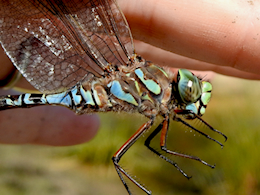
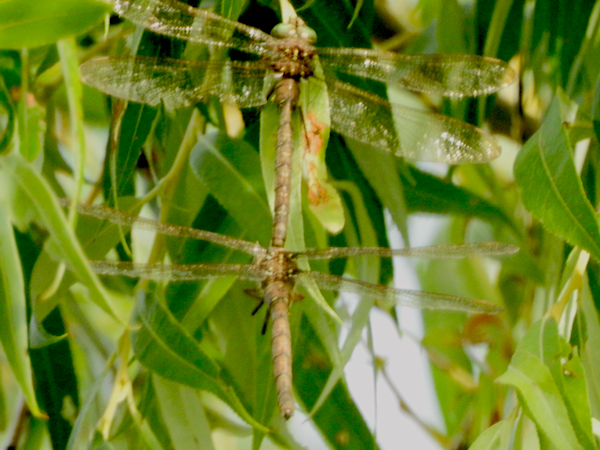
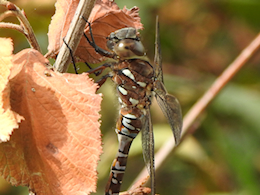
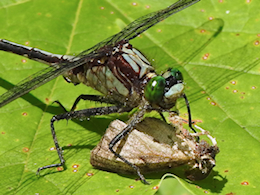
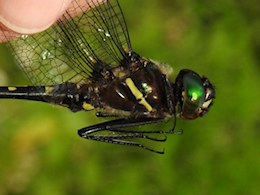
Despite the lack of water access, it turned out to be a great spot for birds, and I spent almost half an hour there before I had to log onto work. A flock of early migrants was making use of the trees above the marsh, and I saw several Cedar Waxwings, at least two Rose-breasted Grosbeaks, two Gray Catbirds, a Ruby-throated Hummingbird, an Eastern Wood-Pewee, and several warblers including Black-and-white, Yellow-rumped, and Black-throated Green. It was a good thing there were so many birds to watch as I would have missed a pair of darners in a mating wheel fly by if I’d left earlier. I was surprised as it was not even 20°C and still quite cool for odonates; perhaps one of the birds startled them out of the trees. They zoomed around for several seconds locked together, letting me get a long enough look to confirm them as some sort of darner. My first thought was that they were Shadow Darners, as they were quite dark in appearance and lacked the large abdominal spots of other Aeshna darners. Then, to my delight they landed; however, they landed well above my head where I had a tough time seeing them and even more difficulty photographing them. This was the best image I could get, and the brown colouration and mint-green eyes of the male (top dragonfly) made me realize they were NOT Shadow Darners.
Ocellated Darners (Boyeria grafiana)
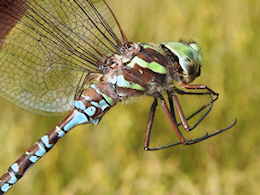
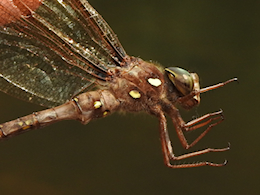
There are two brown darners in eastern North America, usually called spotted darners due to the distinctive yellowish-white spots on the thorax. These medium-sized darners prefer shady forested streams where they often fly late in the day, patrolling in dimly-lit wooded environments. The Ocellated Darner tends to prefer faster streams than the Fawn Darner, usually with rocky bottoms. Both species are found in Europe, where they are referred to as “spectres”- a much cooler name!
I had seen plenty of Fawn Darners in Quebec but had never seen an Ocellated Darner before. They can be tricky to tell apart, but the Ocellated Darner is more grayish overall while the Fawn Darner is a warmer shade of brown -often looking yellowish in flight. The Ocellated Darner has a very small brown patch at the wing base while the Fawn Darner has larger brown patches. The pale spots on the abdomen and are larger and more prominent in Ocellated Darners. The mature Ocellated Darner has eyes that are brighter and greener than those of the mature Fawn Darner. The cerci of the female Fawn Darner are longer than the cerci of the female Ocellated Darner, which are short enough to mistakenly believe they have broken off.
Although my photo isn’t crisp, it shows enough detail to identify these as Ocellated Darners – a lifer for me! The female’s cerci are short, the male’s eyes are bright green, and both lack brown patches at the base of the wings. In addition, the spots along the abdomen are clearly visible in the male, while those of the Fawn Darner are usually too small to detect from a distance. This ID was confirmed on iNaturalist- my 56th species in Nova Scotia!
It was incredible that I had found this species just around the corner from our trailer. Even better, I had found the male and female in tandem, something rarely seen…females are often difficult to find, and it is believed they lay their eggs after dark. Ocellated Darners prefer cooler temperatures than other dragonflies, flying later in the evening and also on cooler days which explains why they were active so early in the morning. This was definitely the best find of the trip, and now that I know they are there I will have to keep an eye out for them!
I was quite happy when I learned that this year’s North American Odolympics were to take place in mid-August this year. This would be my third year participating; the 2023 Odolympics ran from August 19-27 while the 2024 Odolympics ran from September 7-15, so I was worried that this year’s bioblitz would be held in October! However, with a start date of August 16th (and running till August 24th) it would be my earliest bioblitz yet!
Unfortunately there was one problem with that date: I would be driving to Nova Scotia with my partner and three cats during the entire first weekend! Then came the second blow: while I was excited to participate in my first Nova Scotia Odolympics, a forest fire was burning out of control in Annapolis County (not too far from where our trailer is located); the fire risk was extremely high all throughout the province due to the prolonged drought conditions; and the government had closed the woods to recreational activities, including trails in provincial and national parks. The reason for the closure was to prevent additional human-caused forest fires, which meant hiking, camping, fishing, and driving recreational vehicles on both Crown and private property were all prohibited. This decision was based on the amount of dry, flammable material present which could easily start a fire, and the fine for violating the ban was $25,000. Immediately my dreams of looking for odes along forest creeks – which were already terribly low from a lack of summer rainfall – were dashed, and even places like Miner’s Marsh were out of the question as the marsh had entirely dried up, leaving the dry, cracked muddy bottom completely exposed.
On Sunday, August 10 Chris and I returned to Kazabazua, determined to obtain better photos to confirm that the clubtails we’d seen patrolling above the Kazabazua River were indeed Riverine Clubtails. We started a little later in the day, and headed to the dead-end road past the Eco-Centre around noon. When we got there the only dragonflies flying over the river were Fawn Darners. One hung up on a shady branch in front of me, so I caught it – a great start to the day.
Chris Traynor and I planned a wonderful outing in the Kazabazua area for the August long weekend. He’d been reviewing some of Chris Lewis’s notes about expeditions to the Kazabazua area about an hour north of downtown Ottawa, in particular to a small fen near Danford Lake where she and Bob Bracken had found Zigzag Darners, a Forcipate Emerald and and an Incurvate Emerald. The dates of their expeditions and findings are as follows: August 3, 1998 (several Zigzag Darners and one Forcipate Emerald); August 15, 1999 (several Zigzag Darners and one Incurvate Emerald); August 21, 2000 (6 Zigzag Darners); and August 10, 2002 (5 Zigzag Darners). He’d also dug out some notes from Benoit Menard who had found Subarctic Bluet (the damselfly) and Subarctic Darner (the dragonfly) in the fen. The Incurvate Emerald would be new for Chris; and the Subarctic Bluet, Zigzag Darner, Subarctic Darner, and Forcipate Emerald would be new for both of us, so we were keen on going even if it was a bit early in the season for the dragonflies. This area has the added attraction of being close to the Kazabazua River where we had seen Zebra Clubtails in 2023. I jokingly told Chris I was looking forward to writing a blog post called “Of Zigzags and Zebras” as these species at least seemed almost a sure thing, but the reality was very different.
On the Friday before the long weekend my workplace allowed employees to log off work an hour earlier. This meant I had a beautiful, sunny afternoon to myself starting at 3:30. Andrew Haydon Park and the colony of Vesper Bluets I’d found there two years ago were on my mind, so I drove over right after I closed my laptop. I’d searched for them there the previous weekend, to no avail….I was probably there too early in the day for them and the Orange Bluets as I saw neither species at the water. With the sun setting a little earlier each evening as the earth tilts its way toward the equinox, the shadows were long when I arrived and I thought I might have a chance of seeing both species. I was also looking for Skimming Bluets, darners, and skimmers, though of course any cooperative ode would be welcome!
The forecast for Saturday looked gorgeous, but hot and humid. It’s been one heat wave after another this summer, and while it’s certainly preferable to the rain and smoke we’ve had previous years, I find I get tired faster in the heat.
Chris and I have been planning another trip to Quebec. He’s been eager to explore a section of Meech Creek with hidden rapids and waterfalls that looked good for clubtails and snaketails. I wanted to go with him, but I was worried about exploring a new place when I didn’t know how high or fast the water might be, how much bushwhacking we might have to do, or how long we would be out. So on Friday night I suggested that Chris do an exploratory scouting mission while I headed to a couple of places I haven’t spent too much time yet this year – Sheila McKee Park or Marlborough Forest.
In addition to the Somatochlora emeralds, I saw some other interesting dragonflies at Jack Pine Trail over the past few weeks. The first species was a large dragonfly called the Arrowhead Spiketail. I’ve seen this species many times over the years along the stream at the back of the trail, usually between the first and third weeks of June. Normally I only see them on one or two visits, making me wonder how long their flight season actually is – while the Ottawa Checklist says they fly from early June to early July, I don’t think I’ve actually seen any beyond the third week of June. While the range of dates surely applies to all populations within the Ottawa region, I was certain that individuals lived longer than a single week, and checked the stream each time on my visits to see how many spiketails I could find.
Last year I visited Jack Pine Trail in mid-July to look for Brush-tipped Emeralds. I didn’t find any, though I found three species of darners, which made me wonder if the emeralds were still present – I hadn’t recorded any there since 2019 for a myriad of reasons, including closures during the pandemic lockdowns and after the derecho of May 2022. The Brush-tipped Emerald belongs to genus Somatochlora, the striped emeralds, and is the smallest representative in our region. Somatochlora dragonflies are eagerly sought after by odonata enthusiasts, as they are uncommon to scarce in most human-populated areas, requiring special trips to remote peatlands, bogs, fens and swamps; and they are gorgeous, with their metallic green, yellow and black bodies and bright green eyes. They spend most of their time hunting on the wing and will land just often enough to give a dragon-hunter hope that they might get a good look or a photo of one perching naturally, though these emeralds often don’t often perch for very long – unless it’s on the side of a house during a drizzly day, or high up in a tree where they are shaded by the canopy. Their very unpredictability in where they will turn up makes it a delightful shock when you see one flying by.
Sarsaparilla Trail is always worth a quick visit in the warmer months, even with the limited access to the water. The pond is fairly large, and I’ve often wondered just how many species actually live and breed here away from the boardwalk – the only point of access to the water. On June 18, 2025 I added a new species here to the list of Stony Swamp odes, a female Horned Clubtail that landed on the boardwalk and stayed long enough for some photos. After seeing that magnificent dragonfly I wasn’t expecting to add another new species to the list anytime soon, but that is what happened on one of my visits this month.
The circular trail through the woods is short – the inner loop is only about 0.5 km – so most times I only stop by for a quick walk on my lunch break while working from home, or a short visit after returning from somewhere else. My July 8 visit was a lunchtime visit, and although there were lots of clouds in the sky, the odes were flying around the pond as usual.
I don’t see Swift River Cruisers very often, and even when I do, I seldom get the opportunity to catch or photograph one. I used to see them fairly regularly at Mud Lake, but now it seems the best place to see them – aside from my recent outing to Quebec with Chris Traynor – is Sheila McKee Memorial Park. However, even here I only see them in flight, either far out on the water or soaring high above the trees with the Prince Baskettails. Swift River Cruisers love feeding in large, sunny clearings near the rivers they breed in, dancing in the sky with graceful twists and turns too rapid to follow with the eye. They do, however, perch fairly regularly, though I have never seen one doing so at Sheila McKee Park. As such, I have not been able to enter any of my sightings into iNaturalist as photographing them is next to impossible while they are in flight.
Burritt’s Rapids has been on my radar as a low-priority place to visit for about a year now, and if I hadn’t missed a turn on my way to the southwestern corner of Marlborough Forest I wouldn’t have ended up there on a nice warm day in mid-July. I had been curious about what species I might find at the rapids there, and was hoping to find a few new species to add to iNaturalist as it didn’t have many when I first started thinking about going there. One species I was curious about was Swamp Spreadwing, which had been found a short distance east at Rideau River Provincial Park back in 2022. The only place I’ve seen this species in Ottawa is Petrie Island, and it would be fantastic to find another one closer to home. I was also wondering if the river and rocky rapids might host some of our common clubtails, such as Dragonhunter or Black-shouldered Spinyleg.
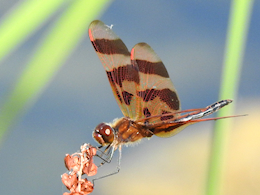
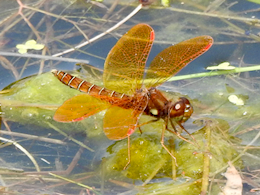
A day without seeing a dragonfly is like a day without chocolate – sure, it’s completely survivable, but utterly lacking in joy. I had to work downtown on both the Wednesday and Thursday after Canada Day, and decided to go for a lunchtime walk along the canal to the river on Wednesday to see if I could find any weekday odes. I’d seen Prince Baskettails and Common Green Darners flying up and down the canal, and a Midland Clubtail on the rocky shore behind Parliament Hill many moons ago, so the downtown core is not completely devoid of odonates. Still, I wasn’t expecting much, and got lucky on Wednesday when I saw first a Common Green Darner flying by, then a Prince Baskettail. Then something small fluttering above one of the mats of vegetation caught my eye – a female Eastern Amberwing ovipositing in some floating vegetation! After a few more minutes of watching, I saw a pair of males fly by. I waited for several minutes for one to land but they never did.