I am a lover of nature whose primary interests are birds, butterflies, and dragonflies. While I enjoy photographing them, my main interest is in observing and learning about the species I see through my lens. For those of you who are interested in seeing the best of my nature photos, please feel free to check out my gallery on Pbase.
My mother lives in Wallaceburg in Chatham-Kent, which is about a 7.5 hour drive from Ottawa, or a full day train adventure with a transfer in Toronto (my advice for anyone travelling economy on Via: take your own sandwiches and snacks, as the menu was somewhat unpalatable…and chocolate bars/chips alone were $3.00). Being so far south she gets a variety of birds, bugs and plants that we do not get here in eastern Ontario, so I’ve been meaning to visit in the summer when I might see some new southern butterflies and dragonflies for my life list. I took an extra two days off at the end of August so I could spend the Labour Day long weekend with her, though two of the days were lost to travel. As my mother and her husband both enjoyed birds and nature, I knew they’d be interested in taking a few nature walks with me, even if the idea of looking for dragonflies didn’t exactly fill them with delight.
When I first heard about the Odolympics – a special bioblitz hosted by the Dragonfly Society of the Americas, Sociedad de Odonatología Latinoamericana, and Odonata Central in order to record as many odonata species from as many places in the Western Hemisphere as possible – I knew I had to participate. This specialized bioblitz is only two years old, and there are usually two Odolympics each year: one falling during the North American summer, and one falling during the South American summer in order generate a snapshot of odonate distribution throughout both hemispheres.
Dragonflies and damselflies, collectively known as odonates, are valuable indicators of a wetland’s environmental health and biodiversity. Simply put, the more odonates that use a wetland for breeding and feeding purposes, the healthier the ecosystem. Naturalists were encouraged to submit their observations during the bioblitz via one of two platforms: iNaturalist, or Odonata Central. While I love iNaturalist and have been using it for a few years now to record my non-avian observations, I began submitting my observations to Odonata Central last year when it developed a checklist-based phone app similar to eBird. iNaturalist also has a phone-based app for submitting observations, but it is intended to be used in conjunction with the phone’s camera which I only use as a backup camera when my Nikon Coolpix’s battery decides to take a nap. Although I love the ease of searching for data in iNaturalist’s projects, I chose to record my Odolympic observations in Odonata Central as it allowed me to include observations of species for which I am usually unable to get a photo (yes, I’m looking at you, Prince Baskettail and Wandering Glider!)
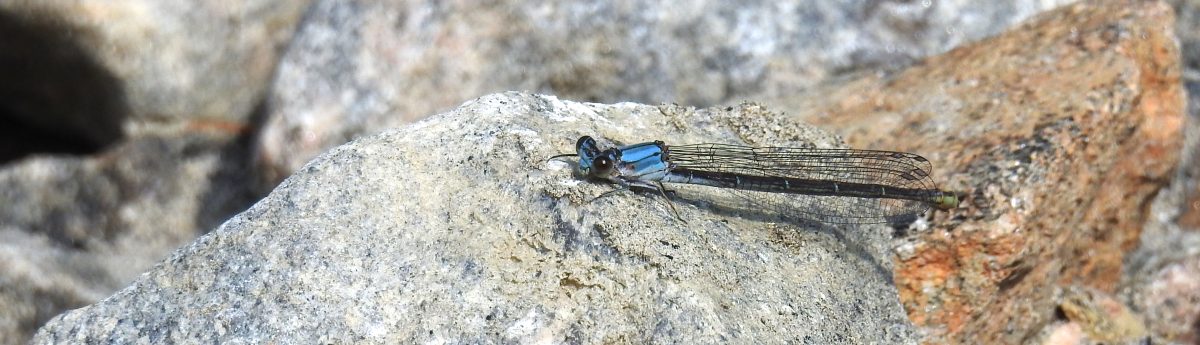
After my successful outing at Andrew Haydon Park on July 29th, I couldn’t wait to return to see the Vesper Bluets again and to look for the elusive Orange Bluet. The two successfully share the same habitat at Petrie Island, so why not in the ponds at AHP? While Vesper Bluet habitat includes the edges of woodland lakes, ponds, and slow rivers rich with emergent vegetation, Orange Bluets are present in those habitats as well as in swamp edges, bogs, slow streams, and degraded wetlands containing varying levels of pollution. I knew they were already on the wing, as I had first seen them at the Eagleson Ponds on July 3rd and have been seeing them there on and off ever since. It was just a matter of returning to Andrew Haydon Park later in the afternoon when they would be at the water, as they spend the early part of the day in the vegetation or trees nearby.
The Common Sanddragon is one of the dragonfly species in the Algonquin Park field that is not found in the Ottawa-Gatineau region. A member of the clubtail family, it is well-marked with a mottled green and brown thorax reminiscent of a Harlequin Darner and uniquely-shaped markings down the length of the abdomen to segment 7: they look like goblets in the male, and start out as goblet-shaped in the female but gradually lose the stem. Their legs are very short for a dragonfly, and mature males have green eyes while females have gray or brown eyes. The appendages in both sexes are pale, and they are the only dragonfly in our region which has pale appendages, a mottled thorax, and brown spots at the base of each wing. Its larvae live in rivers, lakes, and streams with sandy bottoms, and due to its short legs, the adults perch horizontally on the sandy beaches and banks of its rivers rather than hanging from trees or in the vegetation. At the time of the printing of the first edition of the Algonquin field guide, it had not been recorded within the park and was only known from a few sites in Peterborough County and a single record from Windsor in Ontario’s deep south.
July is usually the start of the best three months of ode-hunting at Andrew Haydon Park. Although I often visit the park in the spring and fall for birds, my time here in the summer is devoted to dragonflies. This park is reliable for Halloween Pennants, Blue Dashers, Eastern Pondhawks, Common Green Darners, Prince Baskettails, and the usual King Skimmers, and I’ve had Cobra Clubtail and Elusive Clubtail here as well. I visited on July 29th with the hope of seeing another Cobra Clubtail, as it was on July 21, 2019 that I saw one fly into a tree on a windy day, eating what looked to be a male Orange Bluet. Though I’ve looked for both species here in July in subsequent years, I only had luck with one female Orange Bluet on July 24, 2021.
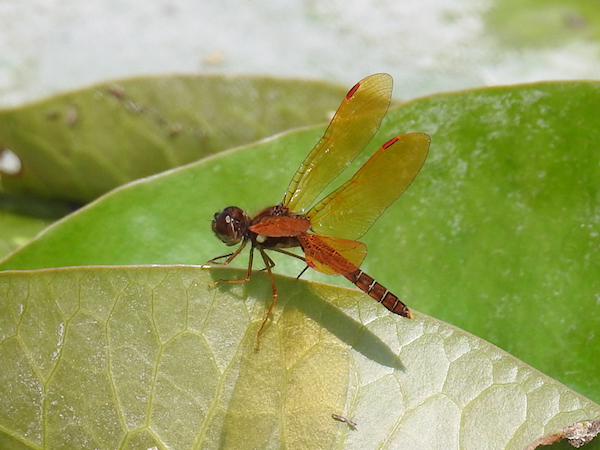
It was only six weeks ago that I last added a new species to the Eagleson storm water ponds ode list, the River Jewelwing that mysteriously showed up for one day back on June 10, 2023. I wasn’t expecting to find another new species so soon, but that is exactly what happened when I went for a walk there this afternoon. My goal was to look for the diminutive Eastern Amberwings, a species that I would have looked for earlier in the month had I not been in Nova Scotia. This colony first showed up in 2017 and its numbers have been increasing in the southern ponds over the last six years. I was happy to find four males perching on the lily pads on my visit; it appears they are still thriving here.
Eastern Amberwing
I saw Orange Bluets here for the first time this year on July 3, 2023, and I was hoping to find a few close enough to the shore to get a good photo. This is the second season that I’ve confirmed their presence here, and I was disappointed not to find any on this visit.
I saw Blue Dashers here for the first time this year on July 7, 2023; this is also only the second year that I’ve seen them here, and I counted at least eight of them around the two southern-most ponds. They are so beautiful and colourful when fresh – I can’t imagine ever becoming so used to them that I don’t want to stop and admire them, especially when they are sitting on a such a lovely perch.
Blue Dasher
I saw a male and female Common Whitetail flying over the pond together; the female was ovipositing. A White-faced Meadowhawk and a Band-winged Meadowhawk were nice to see, though the Band-winged Meadowhawk didn’t stick around long enough for photos. I’ve been keeping an eye out for Saffron-winged Meadowhawks, a species that was common here in 2020 but has been diminishing in numbers ever since – I only found two in 2021 and one in 2022. I didn’t see any on this walk, making me wonder if the population has died out. Its season lasts until September, so it is not too late to keep looking for this species.
A Slender Spreadwing was the only other odonate of interest, other than the Eastern Forktails that are usually too numerous to count.
I finished my walk with a loop around the Hope Side pond, stopping at the bridge where I took a moment to scan the water toward the overpass. I’ve seen muskrats swimming and dragonflies flitting among the vegetation here, and almost immediately something small and black fluttering in the tunnel formed by the cattails toward the bridge. When I got my binoculars on it I saw a male Ebony Jewelwing sitting in the sun!
Ebony Jewelwing
Ebony Jewelwings are usually found at woodland streams, preferring those with rapids although they may be found at shaded, slow-moving streams as well. The area it was inhabiting at the Eagleson ponds is no more than a shallow channel that drains water from the ponds into a narrow waterway running alongside a patch-work of fields before entering the Jock River at Terry Carisse Park. But since a River Jewelwing has already found its way up here perhaps I shouldn’t be surprised that this Ebony Jewelwing had followed. This is ode species #36 for the ponds – a terrific number for such a small area and limited habitat.
The weather played a big part in our trip this year. Rainclouds blew in and blew out all week long, bringing rain on most of the days we were there. Fortunately the sun came out long enough to get in a few hikes at the various waterfalls and for me to take some long walks while Doran was out with the car. I spent quite a few hours looking for odonates and other critters around the ponds and the Annapolis Rail Trail, mostly in the afternoons when the sky cleared up. Although they are maybe half as long as the Eagleson storm water ponds by my house and much less diverse in terms of wildlife species, I still managed to find an interesting variety of creatures.
The afternoon after our waterfall search was particularly productive. I found my first Band-winged Meadowhawk and Familiar Bluet of the trip, which are also my first observations in iNaturalist for Nova Scotia for these species.
The morning of July 18th was warm and cloudless, so we resumed our search for rushing creeks, waterfalls, and odes. I had noticed one spot on Google maps that wasn’t too far from us – Slokum Brook Falls, just north of the Trans-Canada Highway. Photos showed a nice little brook with a steep waterfall in the middle of the woods, and reviews on Alltrails.com indicated that it was a bit difficult to find, as it is very overgrown at the beginning. It is said to be the highest falls on the North Mountain that drains into the valley, though there is really only water here during the spring runoff. We drove down Lily Lake Road, slowing down once we got past the lake itself. I peered into the dense foliage along the road, and found only two spots that looked like trails entering the woods, though both had “private property” signs at the entrance. Once the forest opened up we realized we must have gone past it, and decided to turn around at the end of the road, which elbowed north onto Douglas Road as the woods gave way to farm fields.
Doran and I visited Nova Scotia again in mid-July, now one of my favourite times to visit after seeing so many dragonfly species on our last trip. This time we rented an Airbnb in Middleton – the basement suite of a house right on the Annapolis River. Although the vegetation along the river was much too thick to get close to the water, there were a few well-trampled trails leading down to the water’s edge. In addition, our location was close to both Bridge Street (Highway 10), with Riverside Park on the opposite bank, and the South Shore Annapolis Trail which has its own bridge across the water and runs behind Riverside Park and the Middleton sewage lagoons. We got settled into the apartment, and the following day that Doran and I went exploring. My fiancé had recently become interested in searching out local waterfalls, and as a number of clubtail species can be found on fast-flowing rocky rivers, I was more than keen to accompany him.
Chris Traynor and I chat about dragonflies and damselflies a lot. We both also like to pour over old dragonfly reports, iNaturalist records, and Google maps looking for suitable habitat for this species or that, as well as interesting places to go dragon-hunting in general. It was Chris who, when searching for places to see Clamp-tipped Emerald, thought that Taylor Lake in the northwestern part of Gatineau Park might be worth a visit. There are two iNat records from the area from 2015, as well as one Brush-tipped Emerald record from a few kilometers away. The map shows a variety of ode-worthy wetlands including streams, ponds, seeps and marshes, and an exploratory hike of about 5 kilometers in the fall cemented his impressions and desire to return there during prime dragonfly season. It was also almost completely unexplored for odonates, which made it quite enticing in my eyes, and close to a spot where Chris Lewis and Bob Bracken had discovered a stream with mature Eastern Least Clubtails and other clubtails several years ago. Good Somatochlora spots in the Ottawa-Gatineau region are uncommon, and we both thought would be fantastic to discover one up in Gatineau Park. I emailed Chris Lewis about Chris’s idea to check on the trails around Taylor Lake and revisit some of her and Bob’s footsteps in Gatineau Park, and the three of us made plans to visit its northern reaches on July 8th.
If the first half of June is great for seeing all kinds of pond damsels (Family Coenagrionidae), the latter half is great for seeing all sorts of spreadwings (Family Lestidae). They may not have the bright colours or the variety of hues of the pond damsels, but what the spreadwings lack in colour they make up for with their larger size and the beautiful metallic green colouration of some of the species. Adult male spreadwings are generally one of three colours: metallic green, black, or brown, each developing various amounts of bluish-gray pruinosity on the thorax and tip of the abdomen. They can be easily identified in the hand or in a photograph that clearly shows the tip of the abdomen viewed from above, as each species has paraprocts that are distinctly different in size and/or shape. On the other hand, females and tenerals are generally duller, browner, or sometimes even bronze or orange in colour. Much like female bluets, these spreadwings are difficult to identify in the field; though some can be examined and identified in the hand, others require a microscope. As such, I have never really delved into the difficulties of identifying female spreadwings.
Last year I embarked on a new odonate project: to study the species found at one tiny park along the Jock River. This park, originally named Bow of the Jock Park before it was changed to Terry Carisse Park in 2006, consists of a narrow strip of green space that runs perhaps 500 or 700 meters along the shore of the Jock River on an elevated bank about two meters above the water. The park itself consists mostly of manicured lawn with a wooded swamp at the north end where Mahoney Creek empties into the Jock River, two launching areas for canoes and kayaks, a playground, and a thick band of riparian vegetation that almost completely blocks all views of the river from one end of the park to the other. The Jock River itself is smaller than the Rideau River, much more sluggish, without a lot of rocks or rapids that would attract the clubtails and spiketails found in Gatineau Park. It hasn’t been surveyed for odonates as well as the Ottawa River has, mainly because much of it runs through private agricultural or residential land, with only a few small parks with even smaller access points in Richmond and Ottawa.
When I went out searching for Rainbow Bluets at the Eagleson Ponds on June 10th I photographed all damselflies that had the characteristically pale thorax, orange eyes, and blue markings at the tip of the abdomen as I expected that many individuals that had recently emerged would not have developed their full colouration yet…when most teneral bluets emerge, they are a colourless pale beige with black markings, and it takes time for their colours to deepen. When I found this particular individual damselfly in the grass along the southern-most pond, I assumed it was Rainbow Bluet still developing, snapped a quick photo…then realized the field marks didn’t add up. For one thing, the green shoulder stripes were too wide, and for another, it lacked the narrow blue bar connecting the two eyespots.
The thorax was pale green, and the legs and parts of the eyes appeared orange, but the tip of the abdomen showed two irregular blue markings on top of segments 8 and 9. It had an ovipositor, so it was a female – but what species? When it flew a short distance to a blade of grass close by, I followed in order to get some photographs from the top. The eyespots looked more like those of a forktail which started to make me think: could this be a rare andromorph female Eastern Forktail?
An andromorph damselfly is a female which looks like a male. Female forktails (genus Ischnura) in the northeast can be quite confusing as they have two more colour forms: most have an immature form and a mature form (which, if different from the male, are both considered heterochromatic), and some have a male-like andromorph, or homeochromatic, form as well.
Of the three forktail species found in Ontario, the Fragile Forktail (Ischnura posita) is the easiest to identify as the female has only an immature and mature form, both of which have the same broken shoulder stripes (resembling double exclamation marks) as the male and the same black abdomen with no blue markings on any of the final segments. Both forms are considered homeochromatic. A little further south, and once upon a Burnt Lands alvar, the female Citrine Forktail (Ischnura hastata) has only an immature and mature form as well, both of which are heterochromatic. Nothing about the three forms suggests they are all the same species: the male is primarily green and yellow with small black markings on top of the first seven abdominal segments, the immature female is primarily orange with black markings on top of segments 6-8, and the mature female is almost entirely black with brownish or olive markings on the thorax.
Similarly, none of the three common forms of the Eastern Forktail (Ischnura verticalis) suggest they are all the same species, either: the male is primarily green and black with blue markings on segments 8 and 9; the immature female is primarily black and orange; and the mature female is a pruinose grayish purple.
Eastern Forktail (Ischnura verticalis), male
Homeochromatic females are rare and look quite similar to the males, but may also show some variation. The thorax is typically greenish-blue, and the blue spots on top of segments 8 and 9 are variable. Some females may show an orange blush on segments 1-3, with the most orange showing on segment 3. In the photo below showing the profile it looks as though there is a hint of orange on the underside of segments 2 and 3. The thorax is also paler than that of the male, the green colour showing more yellow than blue.
Eastern Forktail, andromorph female
Finding one of these unusual colour morphs is akin to finding a four-leaf clover. This is only the second time I’ve ever seen a homeochromatic, or andromorph female; I saw my first at Hurdman Park many, many moons ago. It, too, had unusual blue markings at the tip of its abdomen. It just goes to show that these damselflies – quite possibly the most common, the most widespread, and most abundant odonate in the northeast due to its ability to colonize just about any still or slow-moving body of water – are worth a second glance as you never know if their own version of the four-leaf clover is lurking among the rest of them.
I’ve been studying the map on iNaturalist over the past few weeks, looking for new parts of Marlborough Forest to explore. In particular, I’ve been looking for ways to access it from the south, where there are very few trails or points of entry….and very few odonate records. Paden Road runs along the southern boundary, while Malakoff Road winds along its eastern boundary. There is one formal trail on Paden Road, and there are other roads that enter the forest and come to dead ends with what look like trails extending beyond them. I found four places that looked intriguing: one such trail extending beyond Mulholland Road at Harnett Road; a place further south on Harnett Road where it cuts through a large wetland; another extension beyond Weedmark Road off of Paden Road; and the Paden Road trail itself. I planned a day outing in June to see if these places were as fantastic for odes as they looked on the map. If I had time, I also wanted to explore Heaphy Road on the western boundary, which runs through another big wetland. I scheduled this project for the second Sunday in June and was looking forward to it; however, when I woke up on June 11th and saw that the forecast called for increasing cloudiness with a low chance of rain later the afternoon I wasn’t sure if I would see many bugs. However, I didn’t want to put it off as it was already almost the middle of June and soon many species would be done for the year.
Spiketails are large, brightly coloured dragonflies that inhabit small or mid-sized streams, usually with a good current in forested areas. There are three species present in eastern Ontario, all with dark brown or black bodies, green eyes, and bold yellow patterns along the abdomen that may cause them to be confused with clubtails in flight. Each species has a dark thorax with two vivid yellow stripes on the side and two smaller yellow dashes on the top. It is the pattern on the top of the abdomen that distinguishes them: the Arrowhead Spiketail has a single line of yellow arrows pointing toward two round spots at the tip; the Twin-spotted Spiketail has two lines of yellow spots with straight tops and rounded bottoms running down the abdomen, set close together; and the Delta-spotted Spiketail has two lines of widely-separated spots running down the abdomen, each pointed and distinctly triangular in shape. Because of their habitat requirements, they are considered local and uncommon, and in Ottawa the Arrowhead Spiketail is considered the rarest of the three.





 OdoNotations