
Hunting the Elusive

Elusive Clubtail

Yesterday at 10:30 pm I received a message from Chris Traynor – he had been perusing iNaturalist and noticed that a few Elusive Clubtail observations had been reported on iNaturalist just that day and the day before! They were bright black and yellow adults, too, not the translucent beige tenerals we had seen emerging at Sheila McKee Park back in July. As a result, he decided to scour Petrie Island and perhaps Macoun Marsh for these elusive dragonflies – he had never seen the mature adult Elusive Clubtail and was eager to see one. Both Petrie Island and Macoun Marsh are repeat sites for this species.

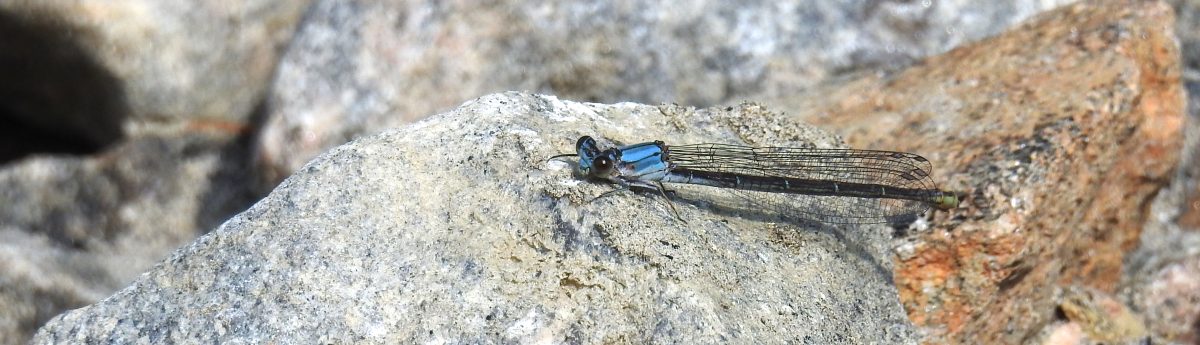
His message fired my imagination. Elusive Clubtails have two noticeable mass emergences in Ottawa: once around Canada Day, and once around the fall equinox. Fresh adults may be seen around those times before dispersing into the tree tops where they apparently live, though it is more common to see tenerals fresh from emergence along the shoreline. I thought it sounded fun to look for mature Elusive Clubtails along the Ottawa River, though my initial plan was to check out the Carp River restoration ponds and see what bluets might be flying…I was keen to find another spot for Azure Bluets, and thought that I might see some gliders there.

Continue reading “Hunting the Elusive”

Transformation

Elusive Clubtail

On Sunday, July 7, 2024 Jeff Skevington, known chiefly for his work on butterflies and flower flies, discovered a first record of dragonfly species for the Ottawa region: a Painted Skimmer (Libellula semifasciata) in Burnt Lands Provincial Park. This species is at the northern edge of its range in southern Ontario, though there is one record from Algonquin Park and one record from Smiths Falls on iNaturalist. This dragonfly has the body of a Four-spotted Skimmer and wing pattern of a Calico Pennant, though the spots are brown instead of red, with a wide amber patch at the base of the wings. The veins at the leading edge of the wings are colourful, too: gold in females and red in males. It is a distinct dragonfly within its range, and outside of it too: Paulson states it is probably migratory in the northern part of its range, and it has been observed moving north over the past 15 years. Perhaps it was only a matter of time before one was seen in Ottawa.

I thought briefly about trying to see the Painted Skimmer the following Saturday, but the forecast, as well as the chances of trying to re-find a bug that had been seen 6 days ago, deterred me: the forecast called for a sunny high of 29°C with the humidity making it feel closer to 40. Burnt Lands Provincial Park is a hot, shadeless alvar better suited for grassland species such as Clay-colored Sparrows than woodland species such as Wood Thrush, and with no trees, running water, or shelter I decided – reluctantly – to head elsewhere, though I would have loved to have seen the Painted Skimmer. It is a species I will have to keep an eye out for while visiting southern Ontario.

Continue reading “Transformation”

Canada Day Clubtails – Part 2: Emergence

Emerging Clubtail

I’ve seen large numbers of emeralds (Spiny Baskettails) emerging at Mud Lake and skimmers (species unknown) emerging at Roger’s Pond. These mass emergences were thrilling, but not surprising given how I often I see large numbers of adults of both types of dragonflies feeding together before dispersing – swarms of baskettails flying up and down trails, and large groups of Chalk-fronted Corporals and Dot-tailed Whitefaces resting on various perches close to the water. Clubtails are not usually found in swarms or large groups (they are perchers rather than fliers, so a swarm would be particularly unusual), so I never thought I’d see a large emergence of members of this dragonfly family. That changed with my Canada Day visit to Sheila McKee Park.

The first emerging clubtail caught my eye when I saw what looked like two nymphs on the rocky beach grappling with each other. Closer inspection revealed it to be a nymph trying to break free of its larval shell so it could complete its transformation. It seemed odd to me that it was on the ground – all the baskettails I’ve seen emerging had crawled up onto the branches of the shrubs at the water’s edge, and all of the skimmers had crawled up the stems of the short grassy vegetation lining the trail at Roger’s Pond. The only place I’ve seen clubtail exuviae is on the trunks of the large trees behind the ridge at Mud Lake or on rocks within the water in Gatineau Park. It looked to me that this fellow had walked out of the water and couldn’t wait to get to a safe spot before bursting out of the shell. It was a clubtail, the only nymph I can identify with confidence because it is the only type of dragonfly with widely-separated eyes.

Continue reading “Canada Day Clubtails – Part 2: Emergence”

September Odes – A Summary

Shadow Darner

By the time September rolls around, most odonate species are done for the year in the Ottawa region – gone are the Aurora Damsels and Elegant Spreawings, the Spiny Baskettails and Ebony Boghaunters, the Arrowhead Spiketails and Horned Clubtails, the Chalk-fronted Corporals and Four-spotted Skimmers. This is the time of year when the number of meadowhawks and darners begin to peak, and southern species such as Spot-winged and Wandering Gliders may blow into our region with the warm south winds. A few bluet and spreadwing species may persist, as well as the common and widespread Eastern Forktail, though each day sees fewer and fewer individuals. This is a summary of species I saw and photographed around Ottawa during September 2019 – due to my trip to Edmonton and some cool, cloudy weekends, I didn’t visit as many places as I had hoped and missed a few common species.

Continue reading “September Odes – A Summary”