In most years dragonfly season begins around the Victoria Day weekend (which always falls on the third Monday of May). I remember visiting Mud Lake on the long weekend in years past and seeing up to a hundred freshly emerged dragonflies perching in the trees there. However, in the last few years it seems that dragonfly season has started later than normal – the long-lingering cooler spring weather has played a large part in this, as emergence depends chiefly on the temperature of the water the dragonfly nymphs are living in. By the second weekend of May I’d go out eagerly hoping to see the first dragonflies of the year, and by the end of May I’d still be looking for them. Even when I eventually found some, such as last year, numbers would be low, and it would take time for the season to get back on track. Numbers remained low in Ottawa all summer last year for some reason, though we think that the unprecedented spring flooding might have been the cause, either washing away the small nymphs or dumping unhealthy amounts of debris, sediment, and chemical-laden runoff in areas where they breed.
On June 5th I headed out to Dunrobin to spend some time looking for odes and birds. My first stop was the Crazy Horse Trail on March Road at the end of Huntmar Road. This is a relatively new pedestrian-only trail for hikers, skiers, and snowshoers that was developed by the Friends of the Carp Hills under an agreement with the City of Ottawa. It is named for an old tavern that used to stand adjacent to the trailhead but has long since been demolished. The goal of the trail is to provide recreational access to the the Carp Hills on City-owned property while keeping impact on the environment to a minimum. The trail is narrow, and as there is no intention to groom or widen the trail, people are asked to respect the natural areas by staying on the trail, keeping dogs under control at all times (which means using a leash if necessary), leaving no waste, and respecting property boundaries. There are some rough, volunteer-built boardwalks in places too wet to cross which adds to its charm. In fact, all trail maintenance and improvement depends on volunteers, rather than the City, which makes it doubly important to respect the work they have done in creating this trail.
Back in 2015 I wrote a blog post about the odonates I found at Andrew Haydon Park one weekday afternoon near the end of July. Since discovering the colony of Halloween Pennants at AHP in 2014, I’ve made it a point to visit this park each year during mid-summer; it’s much closer than travelling all the way to Morris Island to see this stunning dragonfly! So far I’ve only made it out to Morris Island once this year, and when I found no Halloween Pennants flying along the causeway I decided to visit Andrew Haydon Park specifically to search for this species. With the strange, slow start to the season I was bit apprehensive about whether these odes would even be around at AHP, but thankfully I found a few on each of my visits, and in good numbers, too.
I spent some time at Jack Pine Trail this morning. It was a good walk, if not terribly productive. My best bird sighting was that of a Broad-winged Hawk – or rather, a family of Broad-winged Hawks, as I heard two birds calling incessantly in the woods and saw another soaring in the sky. I was wondering if the two calling birds were youngsters, as the calls were shortened – “chick-ee!” rather than the longer, drawn out whistled “chick-eeeeeee”. The one in flight gave the full call, which made me think it was an adult responding. I tried to get a look at the two birds, as they weren’t too far off the trail; however, the thick brush prevented me from seeing where they were perched. Other good birds there that were still singing included Alder Flycatcher, Winter Wren, Eastern Towhee, Black-and-white Warbler, and Black-throated Green Warbler.
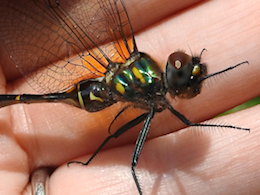
There weren’t too many dragonflies on the wing, but I was happy when an emerald I found patrolling along the boardwalk turned out to be a male Brush-tipped Emerald. This one was much fresher in appearance than the one I had caught at Roger’s Pond, with much brighter markings on the thorax.
Brush-tipped Emerald
As you can tell from the above image, this dragonfly is small with bright green eyes and a metallic bronze and green thorax. The second yellow spot on the thorax is oval-shaped, while the first spot is a longer and thinner – more of an irregular dash. The hairy claspers for which it is name are distinctive among the other emeralds in the same family. In this image you can see the “brush-tip”, as well as the yellow markings along the side of the abdomen which help to differentiate it from the Racket-tailed Emerald:
Brush-tipped Emerald
It is great seeing this species so close to home instead of travelling all the way to Marlborough Forest to look for it, which is the only other place in our area where I know it is found. I’ve been seeing them here for a few years now, indicating the population is relatively stable; for such a small creature, I think these dragonflies hold a lot of charm!
On July 18th I headed over to the Cedar Grove Nature Trail in Marlborough Forest, as a summer visit was long overdue. After a disappointing visit in June, when a lot of odes and butterflies seemed to be late due to the prolonged cold weather, I was hoping to find some of the early species still flying. To be honest, I had no idea whether insect emergence was still late or back on track, or whether I would even see some of the specialties I was hoping for – such as Calico Pennant, Brush-tipped Emerald, Aurora Damsel, Silvery Checkerspot, fritillaries and more. Regardless, I was looking forward to a change of scenery, and would be happy with whatever I saw.
There weren’t many birds of note, although I was surprised to hear both a Blue-headed Vireo and a Black-throated Green Warbler still singing. It was after 1:00 p.m. by the time I arrived, so not only was it late in the season, but also late in the day. A pair of female or immature Hooded Mergansers near the bridge was a surprise; this was the first time I had seen this species on the pond.
During the first week of July my fiancé and I spent some time in Prince Edward County with my dad’s family. We rented a cottage on Loves Lane on Prince Edward Bay, a nice three-bedroom place with 8 acres of land only 20 minutes away from both Sandbanks and Picton. The weather was beautiful, and I spent most of my time getting to know the local residents. On our first full day at the cottage (Monday, July 1st), I went for an afternoon walk on the property to see what I could find. It seemed to be a good spot for odonates; every now and then a couple of Prince and Common Baskettails flew in and started swooping above the deck. There were some other dragonflies present too, so I brought my net out in the hopes of catching one.
Usually by the time the Victoria Day long weekend arrives the first odes have emerged – in the past I’ve seen baskettails in large numbers at Mud Lake and whitefaces and emeralds in Stony Swamp. This year has been different. A persistent wind from the north has prevented the daytime temperatures from rising much above 20°C; nighttime temperatures are still in the single digits. As dragonfly emergence depends largely on water temperature, it isn’t surprising that I had only seen one dragonfly before the May long weekend, a Common Green Darner at Parliament Hill on May 6th. This is usually one of the first species I see, as they migrate north from the warm south where they emerge. Temperatures had risen from 10°C on May 3rd to 20°C on the 6th, although the morning had started out as a chilly 5°C – perhaps an influx of warm air brought this gorgeous dragonfly up from somewhere where the north wind and flooding weren’t wreaking havoc on the wildlife.
The August long weekend is here, and it’s been brutally hot and humid. Temperatures have reached as high as 32°C with a humidex of 41. It didn’t feel quite so hot yesterday, but today was awful. The sun was relentless, and there was no cooling breeze to provide relief. Being in the shade helped, but even so, I didn’t feel like staying out for very long.
We haven’t had much rain in the last month, so the water levels of the Ottawa River have dropped and mudflats are developing in Shirley’s Bay and Ottawa Beach. I wanted to look for shorebirds, but Shirley’s Bay didn’t sound too appealing – a long mosquito-infested walk through the woods to get to the dyke, which is almost completely open to the baking sun – all the while carrying a scope that sometimes feels like it weighs as much as I do. So yesterday I drove over to Andrew Haydon Park instead.
The Stony Swamp trail I spend the least time at, other than Lime Kiln, is Trailhead P11 on West Hunt Club. It’s a lovely trail, but it doesn’t have any marshes with boardwalks; the spring flooding requires knee-high rubber boots; and turning left back onto West Hunt Club into the Saturday mid-day traffic can be a nightmare. Still, it’s a great trail system through some prime mixed deciduous and coniferous forest, and I’ve been trying to visit more often to see what kinds of species make their homes here. It’s better for breeding Wood Thrushes than the other Stony Swamp trails, possibly because the forest is denser with fewer open areas, and I’ve had more Broad-winged Hawks here in the summer than anywhere else. I visited one morning in May while on vacation, hoping to find some new species to add to the hotspot list and perhaps to see some butterflies now that the weather has gotten warmer.
The birding turned out to be pretty good, despite the lack of variety in habitats. A Wild Turkey in full courtship display attempted to block my path, but ultimately decided to mosey off into the bush. A single Field Sparrow was singing in the hydro cut, and the usual Swamp Sparrows were at the marsh. Breeding warblers included Black-and-White Warbler, Common Yellowthroat, American Redstart, Pine Warbler, Black-throated Green Warbler, and 12 different Ovenbirds.
The best part of the trail for wildlife turned out to be the wide-open corridor at the back that leads to the Jack Pine loop. Here I observed a gorgeous male Scarlet Tanager singing at the top of a tree in the open near the intersection, an Eastern Kingbird flycatching, and heard both Winter Wren and Veery as well as a Broad-winged Hawk calling from somewhere overhead.
The sunny corridor at the back of the trail was also a terrific spot for insects. I was hoping to see a few butterflies, and was happy when I found my second Northern Spring Azure of the season as well as both Henry’s and Eastern Pine Elfins.
Then something larger zipped by my head, and when I looked up I saw a dragonfly flying off! I followed it for a while, then saw another hunting the vegetation at the edge of the trail. When it landed I was thrilled to see a female baskettail – my first dragonfly of the season! Although female baskettails aren’t as easy to identify as the males, the short cerci (abdominal appendages) indicate that this is a Beaverpond Baskettail, usually my first non-migrating dragonfly species of the year.
Beaverpond Baskettail
I saw a few more dragonflies flying along the path up ahead, and started walking toward them, flushing a Henry’s Elfin along the way. When I caught up to the dragonflies I realized two different emerald species flying – more baskettails, as well as a couple of American Emeralds. The eyes of both these species develop into various shades of green as the individuals mature; American Emeralds have lovely vivid green eyes, while all four baskettail species have eyes that are more of a turquoise green. The brown eyes of these individuals indicate that they have only recently emerged.
American Emerald
Most emeralds spent more time flying than perching, and often need to be caught with a net in order to identify them. However, I find that early in the season, when they have just emerged, it’s easier to find them perching, particularly the baskettails which spend more time on the wing.
American Emerald
I also saw a couple of small whiteface dragonflies, also freshly emerged as they still had a lot of yellow on their abdomens. Dot-tailed Whitefaces are the most common whiteface species in Stony Swamp, though I’ve seen Belted and Frosted Whitefaces at Sarsaparilla Trail. I was reluctant to leave the sunny open trail and the dragonflies, but it was exciting to know that dragonfly season had officially begun! With so many beautiful insects now taking wing, there’s even more reason to go outside and see what’s around!
In late August I took my usual trip to southern Ontario to see my Dad. As usual, we spent a few days at his trailer in the Pinehurst Lake Conservation Area. The birding was fine, although this time there were no flocks of migrants moving through; instead the birds still seemed busy with raising and feeding their young, even this late in the summer. For example, I saw a Red-eyed Vireo feeding a Brown-headed Cowbird, a young Indigo Bunting following its parent around, and a House Wren carrying food. We didn’t see the Broad-winged Hawk family this year either, which was disappointing. However, the insects were fascinating, and I found a lot to photograph.
My last day off was Tuesday, and the forecast finally called for a decent amount of sun during the morning and afternoon. I invited a friend, Jon, to go dragon-hunting with me at Morris Island since he was eager to become re-acquainted with odonates after a long absence. There were a few particular species on his must-see list, including Cobra Clubtail, Cyrano Darner and Dragonhunter; I’d seen all of these at Morris Island before, though I wasn’t optimistic about our chances of seeing the Cyrano. Although it is considered to be a widespread species, inhabiting swamps, small lakes, and slow-moving rivers of the eastern half of the continent, adults are rarely seen. It is thought that once they emerge they immediately fly up into the tree-tops where they spend most of their time. Adult males can sometimes be found patrolling their territory, and this appeared to be just such a case with the one that I caught in the parking lot of the Morris Island Conservation Area last year. That was on June 25th, however, I was worried that we might be too late to see them.
June is one of my favourite months. Normally the weather is hot and sunny by the time the solstice rolls around, the birds are all in full song, and newly-emerged butterflies and dragonflies are returning to woodlands, fields and wetlands. However, the weather this month has not been great. The rain from May continued on and off this month, keeping water levels of the rivers and ponds higher than normal, and likely delaying the emergence of many insects. The weekends have been nice, at least; I’ve been able to get out early in the day in order to look for new birds for my year list and any butterflies and dragonflies that may have emerged. While my enthusiasm has certainly declined since our amazing trip to Costa Rica, I’ve found myself regaining interest in visiting trails and conservation areas close to home, hoping to find some species I haven’t seen since the previous summer.
The day after my trip to the Bill Mason Center, I made plans with Chris Lewis and Chris Traynor to head out to the Cedar Grove Nature Trail in Marlborough Forest to look for odes around Roger’s Pond. I would be co-leading an OFNC outing there the following weekend with Jakob Mueller, a reptiles and amphibians guy, and wanted to get an idea of the dragonflies and damselflies that were flying. As we weren’t meeting at the parking lot there until 8:30, I headed out to Sarsaparilla Trail first, then the Rideau Trail for a quick look around.
When I got back from Costa Rica I didn’t much feel like doing any birding back here in Ottawa. I’d been spoiled by all the colourful, tropical birds and exotic species that I’d seen – Costa Rica was a dream come true for me, and it was hard to return to reality. As soon as I got back I started thinking about a return trip there, wanting to spend more time in the rainforest so I could see birds such as Cotingas, Jacamars and Bellbirds. And oh, the hummingbirds and tanagers there!
It was difficult to get excited about birding in Ottawa, and the weather didn’t help. It was cold and rainy when we left and still cold (only 16°C) when I returned. The thought of going dragon-hunting stirred my interest somewhat, and when the weather warmed up the weekend after we got back, I decided it was time to take my net out of hibernation.
On July 17th, Chris Lewis and a few other friends and I went dragon-hunting at Petrie Island. Although the morning started out cool, it quickly warmed up, and as a result we saw lots of great bugs. We started our outing by searching the vegetation between the parking lot and the first small bay, usually a productive area for some of the smaller dragonflies and damselflies. This is the only spot at Petrie Island where I’ve seen Vesper Bluet and Orange Bluet, and we spent a good half hour examining the shrubs for these small damselflies. Although both species are considered common in the Northeast, Petrie Island is the only place where I’ve seen them. However, both species are more active later in the day, and since I usually do my birding and ode-hunting in the morning and early afternoon, it is possible I’ve missed them in other places.
The day after the excellent snaketail adventure in Gatineau Park, I headed over to Jack Pine Trail to see if any of its unique dragonflies were on the wing. Two years ago I found a healthy population of Brush-tipped and Williamson’s Emeralds, and Arrowhead Spiketails are regularly seen along the stream at the back. Although I’d heard that it takes four years for Williamson’s Emerald larvae to mature, I had hopes of at least finding the Brush-tipped Emerald; I still think it’s amazing that all these wonderful dragonflies live and breed so close to home. I was also hoping to find some spreadwings, as I’ve seen both Northern and Emerald Spreadwings along the trails here in the past – though none in the past couple of years.








 OdoNotations