Although it’s been warming up nicely, I haven’t seen many dragonflies since witnessing the wonderful mass emergence of Spiny Baskettails at Mud Lake on May 12th. So when Chris T. told me he was thinking about going to Mer Bleue on the weekend, I decided to join him. Mer Bleue is ecologically significant as one of the few accessible bogs in eastern Ontario, hosting many different species not found in typical forests or wetlands. There were a couple of butterflies in particular I was hoping to see, the Brown Elfin and Jutta Arctic which I last saw in 2012, as well as the aptly-named day-flying Black-banded Orange Moth (Epelis truncataria). Several bog-loving odes were high on my list, chiefly Sphagnum Sprite, Ebony Boghaunter, Harlequin Darner, and Hudsonian Whiteface, all of which I’d seen here in my early ode-hunting days with Bob Bracken and Chris Lewis. I was also secretly hoping to stumble upon a Somatochlora emerald or two, as they are more likely to be found in the Mer Bleue bog than on the side of a random house in Nepean….or so I hoped!
The Common Green Darner is the first dragonfly I see most years, but its appearance doesn’t truly herald the start of the dragonfly season for me. Common Green Darners are migrants, usually showing up on the first warm winds of April. Spring is fickle here in Ottawa, however, and those warm southerly winds may be followed by blustery cold north winds the following week, or even worse, snow. As such it might be a long time before the next odonata sighting.
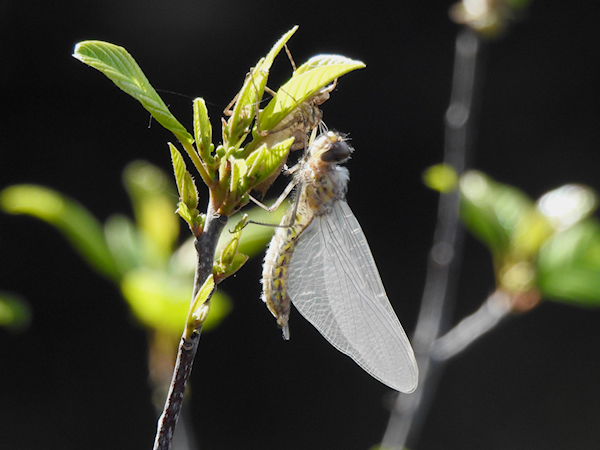
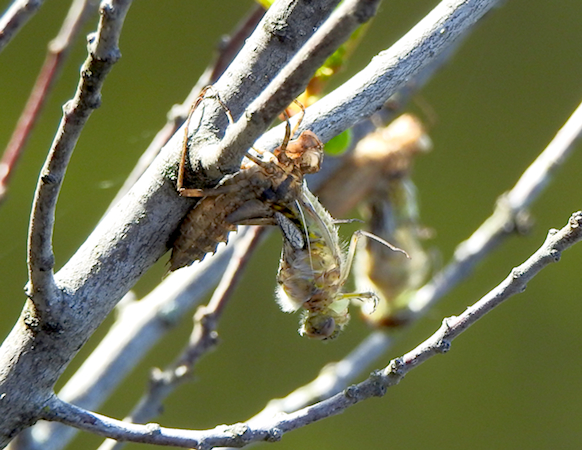
A more reliable sign for me is the emergence of the first dragonflies from local ponds and wetlands. So even though I saw my first Common Green Darners – a pair in a mating wheel at the Eagleson ponds – on April 28, I didn’t see the first local dragonflies until May 12 when a visit to Mud Lake produced several emerging Spiny Baskettails and a few teneral damselflies too colourless to identify. I took a few photos from the new observation platform; most still had milky-white wings while a few were still in the process of shedding their larval skin.
Spiny Baskettail (Epitheca spinigera)
After that I went over to the rocks on the south shore where I’d photographed a large number of Spiny Baskettails emerging in 2022. Sure enough, there I found a few fully-winged tenerals perching in the trees or on the side of the boulders waiting for their muscles to become strong enough for their first flight. Out of the corner of my eye I could see these fresh teneral dragonflies lifting off from their perches all around me and heading for the trees. In the meantime, I was able to prompt a few that were hanging precariously from the rocks above the water to crawl onto my hand where I identified them as Spiny Baskettails before placing them on the branch of a shrub in a safer position
Spiny Baskettail (Epitheca spinigera) Emerging
One fell into the water before I could lift it off of the rock face, and I was able to fish it out with my hand – I had no net with me as I had been birding with a friend and didn’t expect to see any dragonflies.
Seeing all these baskettails in various stages of emergence on such a beautiful, warm afternoon after a week of rain and cooler temperatures left me with a feeling of joy and wonder. Dragonfly season has finally begun – I’m hoping that they will bring the sun and nice weather with it!
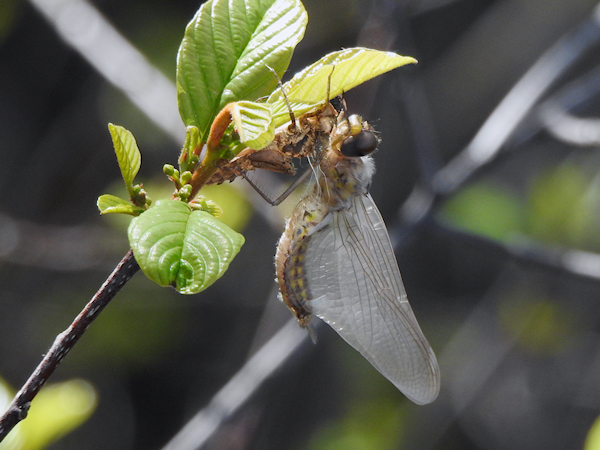
Spiny Baskettail (Epitheca spinigera) emerging – note the exuvia
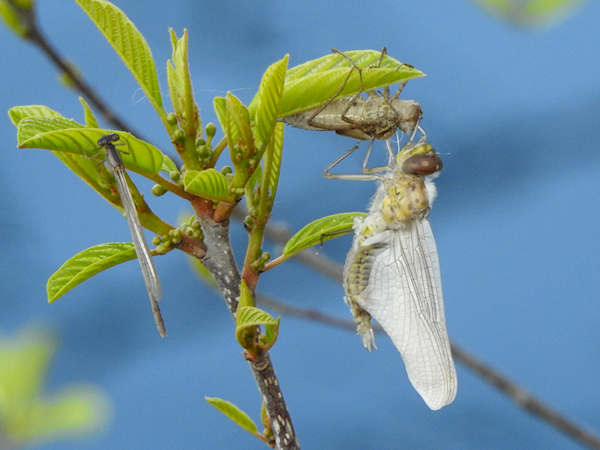
Spiny Baskettail (Epitheca spinigera) with its exuvia and a teneral damselfly
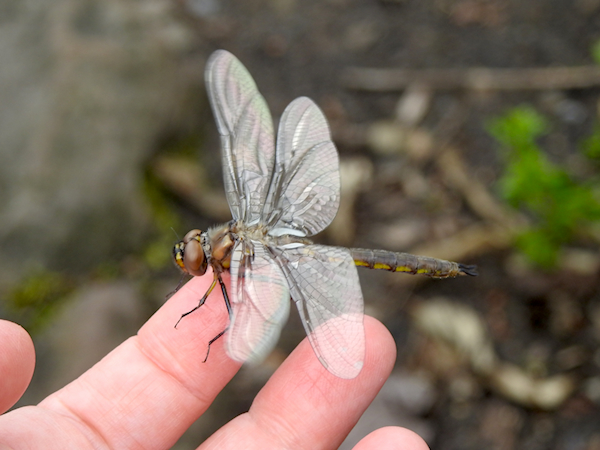
Teneral Spiny Baskettail (Epitheca spinigera) fluttering its wings before flight
Teneral Spiny Baskettail (Epitheca spinigera)
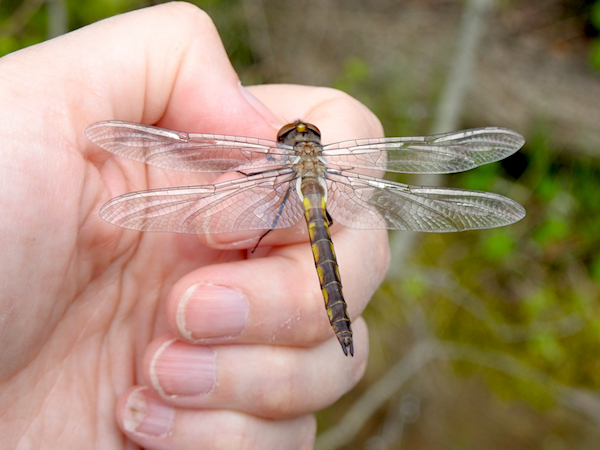
Male Spiny Baskettail (Epitheca spinigera) – note the curving claspers
When I first heard about the Odolympics – a special bioblitz hosted by the Dragonfly Society of the Americas, Sociedad de Odonatología Latinoamericana, and Odonata Central in order to record as many odonata species from as many places in the Western Hemisphere as possible – I knew I had to participate. This specialized bioblitz is only two years old, and there are usually two Odolympics each year: one falling during the North American summer, and one falling during the South American summer in order generate a snapshot of odonate distribution throughout both hemispheres.
Dragonflies and damselflies, collectively known as odonates, are valuable indicators of a wetland’s environmental health and biodiversity. Simply put, the more odonates that use a wetland for breeding and feeding purposes, the healthier the ecosystem. Naturalists were encouraged to submit their observations during the bioblitz via one of two platforms: iNaturalist, or Odonata Central. While I love iNaturalist and have been using it for a few years now to record my non-avian observations, I began submitting my observations to Odonata Central last year when it developed a checklist-based phone app similar to eBird. iNaturalist also has a phone-based app for submitting observations, but it is intended to be used in conjunction with the phone’s camera which I only use as a backup camera when my Nikon Coolpix’s battery decides to take a nap. Although I love the ease of searching for data in iNaturalist’s projects, I chose to record my Odolympic observations in Odonata Central as it allowed me to include observations of species for which I am usually unable to get a photo (yes, I’m looking at you, Prince Baskettail and Wandering Glider!)
The morning of July 18th was warm and cloudless, so we resumed our search for rushing creeks, waterfalls, and odes. I had noticed one spot on Google maps that wasn’t too far from us – Slokum Brook Falls, just north of the Trans-Canada Highway. Photos showed a nice little brook with a steep waterfall in the middle of the woods, and reviews on Alltrails.com indicated that it was a bit difficult to find, as it is very overgrown at the beginning. It is said to be the highest falls on the North Mountain that drains into the valley, though there is really only water here during the spring runoff. We drove down Lily Lake Road, slowing down once we got past the lake itself. I peered into the dense foliage along the road, and found only two spots that looked like trails entering the woods, though both had “private property” signs at the entrance. Once the forest opened up we realized we must have gone past it, and decided to turn around at the end of the road, which elbowed north onto Douglas Road as the woods gave way to farm fields.
Doran and I visited Nova Scotia again in mid-July, now one of my favourite times to visit after seeing so many dragonfly species on our last trip. This time we rented an Airbnb in Middleton – the basement suite of a house right on the Annapolis River. Although the vegetation along the river was much too thick to get close to the water, there were a few well-trampled trails leading down to the water’s edge. In addition, our location was close to both Bridge Street (Highway 10), with Riverside Park on the opposite bank, and the South Shore Annapolis Trail which has its own bridge across the water and runs behind Riverside Park and the Middleton sewage lagoons. We got settled into the apartment, and the following day that Doran and I went exploring. My fiancé had recently become interested in searching out local waterfalls, and as a number of clubtail species can be found on fast-flowing rocky rivers, I was more than keen to accompany him.
Last year I embarked on a new odonate project: to study the species found at one tiny park along the Jock River. This park, originally named Bow of the Jock Park before it was changed to Terry Carisse Park in 2006, consists of a narrow strip of green space that runs perhaps 500 or 700 meters along the shore of the Jock River on an elevated bank about two meters above the water. The park itself consists mostly of manicured lawn with a wooded swamp at the north end where Mahoney Creek empties into the Jock River, two launching areas for canoes and kayaks, a playground, and a thick band of riparian vegetation that almost completely blocks all views of the river from one end of the park to the other. The Jock River itself is smaller than the Rideau River, much more sluggish, without a lot of rocks or rapids that would attract the clubtails and spiketails found in Gatineau Park. It hasn’t been surveyed for odonates as well as the Ottawa River has, mainly because much of it runs through private agricultural or residential land, with only a few small parks with even smaller access points in Richmond and Ottawa.
I’ve been studying the map on iNaturalist over the past few weeks, looking for new parts of Marlborough Forest to explore. In particular, I’ve been looking for ways to access it from the south, where there are very few trails or points of entry….and very few odonate records. Paden Road runs along the southern boundary, while Malakoff Road winds along its eastern boundary. There is one formal trail on Paden Road, and there are other roads that enter the forest and come to dead ends with what look like trails extending beyond them. I found four places that looked intriguing: one such trail extending beyond Mulholland Road at Harnett Road; a place further south on Harnett Road where it cuts through a large wetland; another extension beyond Weedmark Road off of Paden Road; and the Paden Road trail itself. I planned a day outing in June to see if these places were as fantastic for odes as they looked on the map. If I had time, I also wanted to explore Heaphy Road on the western boundary, which runs through another big wetland. I scheduled this project for the second Sunday in June and was looking forward to it; however, when I woke up on June 11th and saw that the forecast called for increasing cloudiness with a low chance of rain later the afternoon I wasn’t sure if I would see many bugs. However, I didn’t want to put it off as it was already almost the middle of June and soon many species would be done for the year.
Spiketails are large, brightly coloured dragonflies that inhabit small or mid-sized streams, usually with a good current in forested areas. There are three species present in eastern Ontario, all with dark brown or black bodies, green eyes, and bold yellow patterns along the abdomen that may cause them to be confused with clubtails in flight. Each species has a dark thorax with two vivid yellow stripes on the side and two smaller yellow dashes on the top. It is the pattern on the top of the abdomen that distinguishes them: the Arrowhead Spiketail has a single line of yellow arrows pointing toward two round spots at the tip; the Twin-spotted Spiketail has two lines of yellow spots with straight tops and rounded bottoms running down the abdomen, set close together; and the Delta-spotted Spiketail has two lines of widely-separated spots running down the abdomen, each pointed and distinctly triangular in shape. Because of their habitat requirements, they are considered local and uncommon, and in Ottawa the Arrowhead Spiketail is considered the rarest of the three.
Family Corduliidae (the emeralds) is one of my favourite dragonfly families. My love for these green-eyed beauties grew when I started seeing a large number of Williamson’s Emeralds (Somatochlora williamsoni) in Stony Swamp in the summer of 2014; one particular day at the end of June stands out in my memory because I found a total of five emerald species at Jack Pine Trail in one visit (Common Baskettail, Prince Baskettail, Racket-tailed Emerald, Brush-tipped Emerald and Williamson’s Emerald). It was around that time that I realized that I didn’t have to wander too far from home to see such a fantastic variety of wildlife – Stony Swamp in particular is amazing, with the Eagleson storm water ponds close behind. I saw two Williamson’s Emeralds in Stony Swamp in 2018, then none in any subsequent years. The Brush-tipped Emerald population was still present as of last year, with one iNaturalist record (not mine) from Old Quarry Trail on July 1, 2022.
Sunny skies, a predicted high of 20°C, and a day off from work on the last Friday in May meant plans to visit Marlborough Forest for the first time this season with my mentor, Chris L. I had convinced her to come with me to trail E4 north of Roger Stevens Drive, home of the Ocellated Emerald, Ashy Clubtail, and Twin-spotted Spiketail – though it was too early for any of those to be flying yet. No less exciting were the possibilities for the early spring dragons that should be on the wing by now: Harlequin Darner, American Emerald, Ebony Boghaunter, and maybe a Springtime Darner or Stream Cruiser. We were sure to see plenty of whitefaces and other skimmers, some baskettails and a Dusky Clubtail or two, and some gossamer-winged butterflies to keep things interesting…the great thing about Marlborough Forest is that it is home to an amazing number of species not easily found in the city, so anything is possible!
Last year a particular OFNC outing caught my eye: a bioblitz to be held at the Morris Island Conservation Area on September 10th. Morris Island is a fantastic place for a bioblitz; the woodlands and wetlands of this 47-hectare site are home to a number of fascinating wildlife species, including several ode species not regularly found in my area of the city. I had never gone ode-hunting in September there before, as September is past the peak of ode season, with fewer species flying than in June or July. Still, it was a good chance to observe what was still flying there, and maybe find an unusual darner species or two. I attended with Chris T. and Chris L. and we photographed seven species for inclusion on the Morris Island Bioinventory Project on iNaturalist: Skimming Bluet, Eastern Forktail, Fragile Forktail, Powdered Dancer, Halloween Pennant, Autumn Meadowhawk, and White-faced Meadowhawk. So much for finding any cool darners!
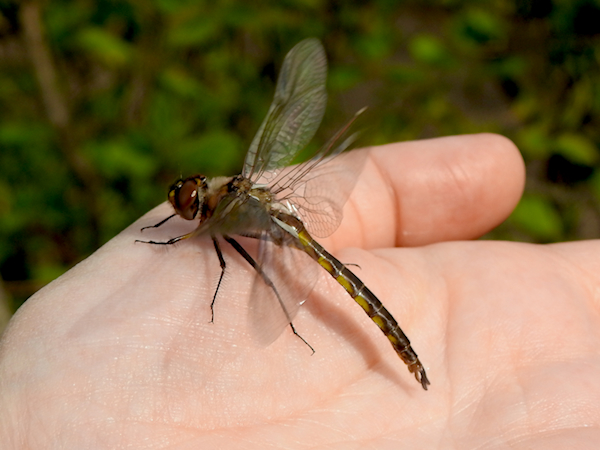
On May 20th I received a photo of a large male emerald dragonfly from Chris Traynor. It was a teneral, with brown eyes and crisp, intact wings, but wasn’t so fresh that the wings had that glistening Saran-wrap look. The abdomen was long, thin and black, with an incomplete thin yellowish-white ring near the base. The message that accompanied the photograph was brief: “Don’t have my book. Any ideas?”
I did not get out to Marlborough Forest as often as I would have liked this past summer; ongoing medical issues early in the season left me feeling too tired and too sore for the long five-hour outings I enjoyed so much last year. On June 2nd I visited the E6 trail with Rick Collins to look for the Sedge Wrens breeding there. We heard one without too much difficulty, though we weren’t able to spot it. Our other highlight was a female Ruffed Grouse on the trail trying to lure us away from its chicks (none seen) by giving distress calls. It was a gray, drizzly day so I didn’t see any insects worth photographing. Indeed, I didn’t take my camera out of my bag at all.
The weather was much better on June 19th, so Chris Traynor and I went to trail E4 to look for Twin-spotted Spiketails and some different emerald species for his life list. I was also eager to show him the pool below the culvert as this was where I’d seen my one and only Ocellated Emerald hanging out in 2020. It was a bit windy, but the sun was shining and the weather was warm, and the breeze made the usual biting insects less of a distraction.
On May 14th I wrote about a mass emergence of Spiny Baskettails at Mud Lake but didn’t explain much about how I identified them except to say my identification was based on the shape of the male claspers. Emerging dragonflies are pale and translucent, showing little to no colour of the mature adults they will become, but fortunately identification of the three small baskettail species in Ottawa does not depend the pattern of colours on its body (a fourth species, the Prince Baskettail, is much larger and has distinctive black spots at the base, tip and center of its wings). This post provides more detail about how to distinguish between the Common Baskettail, the Spiny Baskettail, and the Beaverpond Baskettail, three similar-looking species of the emerald family. While they are most likely to be found patrolling sunny woodland openings or grassy spaces next to water, they often perch on tree branches and plant stems at an angle, allowing good views or photographs.
By May 14th Ottawa had seen a string of six days with temperatures above 20°C, with the last three above 30°C. The warmth signaled the beginning of ode season, with my first dragonflies of the season – both Common Green Darners – seen at the Richmond Conservation Area (May 10) and Sarsaparilla Trail (May 11, 2022). Common Green Darners are migrants, however, arriving on the warm winds flowing from further south. The true ode season begins once it is warm enough for local dragonflies and damselflies to emerge from the rivers and wetlands in which their life cycle began. All odonates lay their eggs in water, and it takes time – from a few months to a few years – for the larvae to go through the individual stages of molting until they are large enough to begin the transformation from nymph to adult. When the nymph is ready, it crawls out of the water onto rocks, emergent vegetation, or nearby tree trunks or plant stems, and then bursts out of the larval shell through a hole in its back, using gravity to pull itself free. I have seen various dragonflies in the middle of this process a few times; I had never witnessed the full transformation as it takes a few hours for the dragonfly to become ready for its first flight. However, when I arrived at Mud Lake on a sunny day in mid-May hoping to find some warblers, it was a mass emergence of at least 50 individual dragonflies that engaged my attention, and I was able to observe many individuals at different points of the process.





 OdoNotations