New Odes in Marlborough Forest

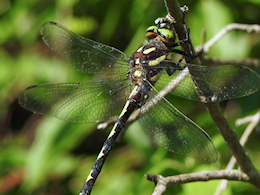
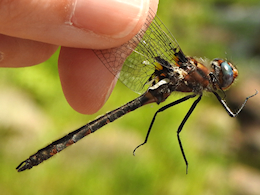
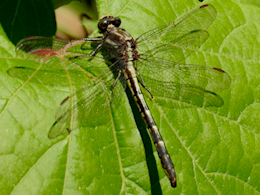
Arrowhead Spiketail (Zoraena obliqua)

Marlborough Forest is one of my favourite spots for ode-hunting. There are so many terrific species there, including some considered scarce, rare, or even very rare according to the official Ottawa checklist. So far I’ve found three lifers here – two of which I have not seen again in the forest or anywhere else: Ocellated Emerald on June 21, 2020, and Ashy Clubtail on June 19, 2022. The third species, Kennedy’s Emerald, was a lifer for me in Marlborough Forest on June 12, 2021 in Marlborough Forest and then, oddly enough, turned up on a house in Nepean on May 21, 2023. The sheer size of the forest – over 9,300 hectares of meadows, wetlands, old plantations and natural forests – tantalized me with the mysteries hidden within its depths, whether those be bog-loving Somatochlora emeralds, remnants of old farmsteads, or rumours of long-lost graveyards.

Continue reading “New Odes in Marlborough Forest”

Stony Swamp Dragons

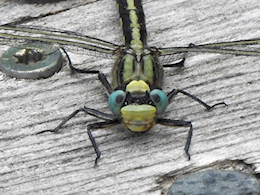
Horned Clubtail

It’s mid-June, which means the season is flying by and soon some of the early-season species will be gone. I’ve been trying to get out every chance I get, but uncooperative weather and a busy work week after my vacation meant that I wasn’t really able to get out until earlier this week for some intensive dragon-hunting. I worked from home Monday and Wednesday, and with the weather finally turning warm and sunny, a couple of lunchtime outings this week in Stony Swamp resulted in some surprisingly good dragonflies!

On Monday I visited Jack Pine Trail with one goal: to see if any Arrowhead Spiketails were flying. Some emeralds would be nice, too, as well as any spreadwings or cruisers, but the spiketail was my target species. Jack Pine Trail is the most reliable location for it in the west end, and when present I only seem to find it during the second or third week of June. The official checklist of Ottawa says it is present in the region between early June and early July, so I had high hopes of finding one.

Continue reading “Stony Swamp Dragons”

Rarities Along the River

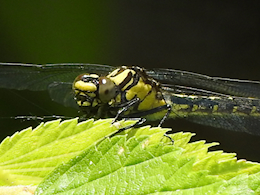
Mustached Clubtail

The Uhler’s Sundragon is an early-flying member of the emerald family that is apparently more easily found on the Quebec side of the OFNC study circle. However, iNaturalist shows a few records from the Quyon ferry dock along the Ottawa River, so one of my goals was to spend some time visiting places like the ferry dock, Sheila McKee Memorial Park, and Fitzroy Provincial Park to look for it and other river odes, including the uncommon Mustached Clubtail. I’ve only seen the Sundragon twice, both times in Nova Scotia, and in the same habitat – medium-sized- rocky forest streams flying over the gentle pools of water either at the top or bottom of a waterfall. Fortunately their patrols take them along the shoreline, and I was able to catch two in 2024 and one earlier this year. My goal was to see one in Ottawa, and I had high hopes for finding one at Fitzroy Provincial Park as there are two small rivers running through it that I wanted to check.

Continue reading “Rarities Along the River”

New Dragonflies at Bruce Pit

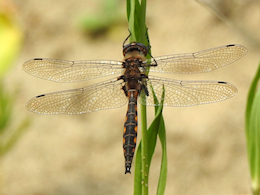
Beaverpond Baskettail

I’ve been spending time on iNaturalist again, updating my list of odonates found at various places around Ottawa and making a list of target species that others have seen that I have not. Bruce Pit was of particular interest to me, as Chris Lewis had sent me her personal list of species last summer; I was missing quite a few species she had seen (though I had found others she had not). Between her list and those listed in iNaturalist, I counted nine regular species that I was missing from my personal list: Black-tipped Darner, Harlequin Darner, Dusky Clubtail, Lilypad Clubtail, Common Baskettail, Prince Baskettail, Emerald Spreadwing, Orange Bluet, and Stream Bluet. One reason is that I usually don’t visit Bruce Pit early in the dragonfly season when some of these species are flying, while another is that sometimes when I visit I only check one or two areas. As a result, I planned to visit the conservation earlier in the season and see if I could find some new species for my personal list.

Continue reading “New Dragonflies at Bruce Pit”

Nova Scotia in June

Uhler’s Sundragon

Back in March my partner and I bought a trailer in Nova Scotia. We don’t have any property yet so it is currently parked next to a relative’s house. This will give us a place to stay when we go back instead of spending money on an Airbnb – though we have stayed in some nice ones over the years! This also means I could buy a second dragonfly net and leave it there for those occasions when we fly instead of drive.

We took a vacation during the first week of June so I could see it for the first time. It’s amazing – 40 feet long, with an actual bedroom, living area, kitchen area, and dining area and even an electric fireplace! Although it is 12 years old, it has been immaculately maintained with new furniture and a new furnace. We spent the first two days furnishing it and getting to know how it works – the weather was lousy (cold, overcast and blustery) so I wasn’t interested in spending much time outdoors anyway.

Continue reading “Nova Scotia in June”

Second Sightings

Skimming Bluet

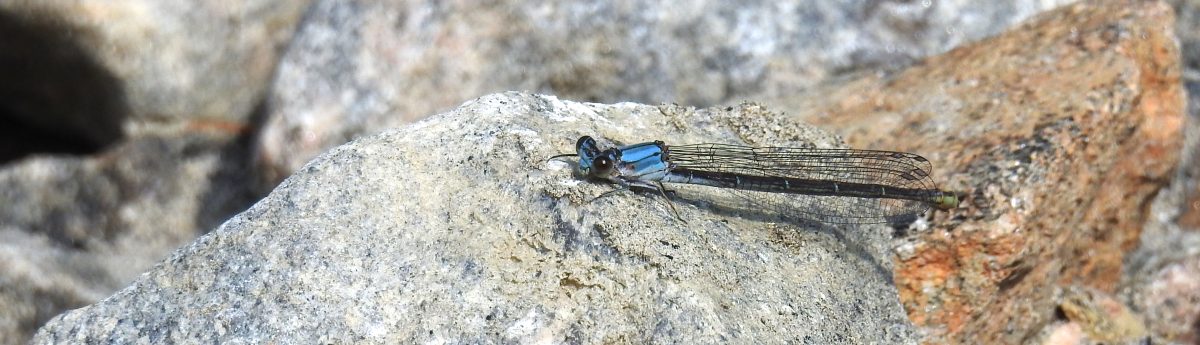
On August 4, 2020 I was surprised to find a Violet Dancer on a dirt trail at the Eagleson ponds. The closest place I’ve ever seen this species to home is out near Morris Island, so it was a shock to find one practically in my own backyard. Then in 2022 I found a few near the Jock River behind the former Richmond sewage lagoons. This suggested where the one at Eagleson might have come from – still a fair distance for a tiny damselfly, but not insurmountable if the winds are blowing the right way. I didn’t expect to see another one there any time soon; if anything, Powdered Dancer was next on my list of species I expected to show up there, because they are much more abundant and widespread along the Ottawa and Rideau Rivers than the Violet Dancer, and breed at the same location on the Jock River behind the former Richmond sewage lagoons. However, when I took a walk there on July 16 after work, it was the first odonate I found, resting on the rocks near the bridge.

Continue reading “Second Sightings”

Dragons in the Wind

Horned Clubtail

On June 15th I visited Mud Lake for a morning of birding and ode-hunting. It was about 13°C when I arrived at 8:30, and although it was sunny, the persistent breeze made it feel cooler. Still, there were more odes about than I had hoped for, although at first I saw only a few damselflies (Eastern Forktails, Fragile Forktails and Powdered Dancers) and Dot-tailed Whitefaces. It wasn’t until about an hour into my walk that I came across my first interesting odonate observation of the day: a lilac bush with several dragonflies perching on its branches. It was the Spiny Baskettail landing on an exposed twig that caught my attention, and while I was trying to photograph it a few more dragonflies landed nearby: first a Blue Dasher and then a Prince Baskettail! These large emeralds are the least likely of the baskettails to land, so seeing one perching is always a treat.

Continue reading “Dragons in the Wind”

Sarsaparilla Trail Predators

Six-spotted Fishing Spider

Late spring is a wonderful time to visit Sarsaparilla Trail. I usually start visiting in May to look for early dragonflies such as Spiny Baskettails and Chalk-fronted Corporals, both of which emerge in good numbers in mid- to late May. It is also a good place to look for Taiga Bluets, often my first damselfly of the year. Friday, May 24th was a beautiful, sunny day despite a cool north wind blowing, so I spent my lunch hour there searching for signs of spring. I began my walk by scanning the shrubs bordering the clearing near the outhouse for dragonflies perching in the vegetation and baskettails flying in the open…there were no emeralds flying on my visit, although there had been over a dozen Spiny Baskettails present only eight days earlier. I did scare up a dragonfly perching close to the ground – it turned out to be a Four-spotted Skimmer.

Continue reading “Sarsaparilla Trail Predators”

The 2023 Summer Odolympics

Dragonhunter
Dragonhunter

When I first heard about the Odolympics – a special bioblitz hosted by the Dragonfly Society of the Americas, Sociedad de Odonatología Latinoamericana, and Odonata Central in order to record as many odonata species from as many places in the Western Hemisphere as possible – I knew I had to participate. This specialized bioblitz is only two years old, and there are usually two Odolympics each year: one falling during the North American summer, and one falling during the South American summer in order generate a snapshot of odonate distribution throughout both hemispheres.

Dragonflies and damselflies, collectively known as odonates, are valuable indicators of a wetland’s environmental health and biodiversity. Simply put, the more odonates that use a wetland for breeding and feeding purposes, the healthier the ecosystem. Naturalists were encouraged to submit their observations during the bioblitz via one of two platforms: iNaturalist, or Odonata Central. While I love iNaturalist and have been using it for a few years now to record my non-avian observations, I began submitting my observations to Odonata Central last year when it developed a checklist-based phone app similar to eBird. iNaturalist also has a phone-based app for submitting observations, but it is intended to be used in conjunction with the phone’s camera which I only use as a backup camera when my Nikon Coolpix’s battery decides to take a nap. Although I love the ease of searching for data in iNaturalist’s projects, I chose to record my Odolympic observations in Odonata Central as it allowed me to include observations of species for which I am usually unable to get a photo (yes, I’m looking at you, Prince Baskettail and Wandering Glider!)

Continue reading “The 2023 Summer Odolympics”

Exploring Marlborough Forest South

Dot-tailed Whiteface

I’ve been studying the map on iNaturalist over the past few weeks, looking for new parts of Marlborough Forest to explore. In particular, I’ve been looking for ways to access it from the south, where there are very few trails or points of entry….and very few odonate records. Paden Road runs along the southern boundary, while Malakoff Road winds along its eastern boundary. There is one formal trail on Paden Road, and there are other roads that enter the forest and come to dead ends with what look like trails extending beyond them. I found four places that looked intriguing: one such trail extending beyond Mulholland Road at Harnett Road; a place further south on Harnett Road where it cuts through a large wetland; another extension beyond Weedmark Road off of Paden Road; and the Paden Road trail itself. I planned a day outing in June to see if these places were as fantastic for odes as they looked on the map. If I had time, I also wanted to explore Heaphy Road on the western boundary, which runs through another big wetland. I scheduled this project for the second Sunday in June and was looking forward to it; however, when I woke up on June 11th and saw that the forecast called for increasing cloudiness with a low chance of rain later the afternoon I wasn’t sure if I would see many bugs. However, I didn’t want to put it off as it was already almost the middle of June and soon many species would be done for the year.

Continue reading “Exploring Marlborough Forest South”

Searching for the Arrowhead Spiketail

Stream Cruiser

Spiketails are large, brightly coloured dragonflies that inhabit small or mid-sized streams, usually with a good current in forested areas. There are three species present in eastern Ontario, all with dark brown or black bodies, green eyes, and bold yellow patterns along the abdomen that may cause them to be confused with clubtails in flight. Each species has a dark thorax with two vivid yellow stripes on the side and two smaller yellow dashes on the top. It is the pattern on the top of the abdomen that distinguishes them: the Arrowhead Spiketail has a single line of yellow arrows pointing toward two round spots at the tip; the Twin-spotted Spiketail has two lines of yellow spots with straight tops and rounded bottoms running down the abdomen, set close together; and the Delta-spotted Spiketail has two lines of widely-separated spots running down the abdomen, each pointed and distinctly triangular in shape. Because of their habitat requirements, they are considered local and uncommon, and in Ottawa the Arrowhead Spiketail is considered the rarest of the three.

Continue reading “Searching for the Arrowhead Spiketail”

Brush-tipped Emeralds in Marlborough

Brush-tipped Emerald

Family Corduliidae (the emeralds) is one of my favourite dragonfly families. My love for these green-eyed beauties grew when I started seeing a large number of Williamson’s Emeralds (Somatochlora williamsoni) in Stony Swamp in the summer of 2014; one particular day at the end of June stands out in my memory because I found a total of five emerald species at Jack Pine Trail in one visit (Common Baskettail, Prince Baskettail, Racket-tailed Emerald, Brush-tipped Emerald and Williamson’s Emerald). It was around that time that I realized that I didn’t have to wander too far from home to see such a fantastic variety of wildlife – Stony Swamp in particular is amazing, with the Eagleson storm water ponds close behind. I saw two Williamson’s Emeralds in Stony Swamp in 2018, then none in any subsequent years. The Brush-tipped Emerald population was still present as of last year, with one iNaturalist record (not mine) from Old Quarry Trail on July 1, 2022.

Continue reading “Brush-tipped Emeralds in Marlborough”

Marlborough Forest: Summer 2022

Ashy Clubtail

I did not get out to Marlborough Forest as often as I would have liked this past summer; ongoing medical issues early in the season left me feeling too tired and too sore for the long five-hour outings I enjoyed so much last year. On June 2nd I visited the E6 trail with Rick Collins to look for the Sedge Wrens breeding there. We heard one without too much difficulty, though we weren’t able to spot it. Our other highlight was a female Ruffed Grouse on the trail trying to lure us away from its chicks (none seen) by giving distress calls. It was a gray, drizzly day so I didn’t see any insects worth photographing. Indeed, I didn’t take my camera out of my bag at all.

The weather was much better on June 19th, so Chris Traynor and I went to trail E4 to look for Twin-spotted Spiketails and some different emerald species for his life list. I was also eager to show him the pool below the culvert as this was where I’d seen my one and only Ocellated Emerald hanging out in 2020. It was a bit windy, but the sun was shining and the weather was warm, and the breeze made the usual biting insects less of a distraction.

Continue reading “Marlborough Forest: Summer 2022”

Dragon-hunting in the Carp Hills

Marsh Bluet

On June 20, 2021 I accompanied fellow OFNC members Derek and Erik to the Carp Barrens Trail off of Thomas Dolan Parkway to assist them in a survey of breeding birds and other wildlife. Because of the sensitivity of the ecosystem and number of at-risk species which breed here, this trail is closed to the public during the summer. In order for us to access the site, Derek had acquired a permit to allow us to look for unique breeding birds such as Black-billed Cuckoo, Eastern Towhee, Common Nighthawks and Whippoorwills. Derek and Erik started around dawn to listen for both nightjars, but heard none. I joined them at 6:00 am while they were still walking along Thomas Dolan Parkway, and together we entered the trail system.

The trail follows a rocky outcrop around a long slough. Many birds were already singing, and we heard the typical open field and woodland edge species: Field Sparrow, White-throated Sparrow, Veery, Scarlet Tanager, Rose-breasted Grosbeak, and many warblers, the best of which (in my humble opinion) included two Pine Warblers, two Yellow-rumped and two Nashville Warblers.

Continue reading “Dragon-hunting in the Carp Hills”

Ode-hunting in Prince Edward County

Calico Pennant

During the first week of July my fiancé and I spent some time in Prince Edward County with my dad’s family. We rented a cottage on Loves Lane on Prince Edward Bay, a nice three-bedroom place with 8 acres of land only 20 minutes away from both Sandbanks and Picton. The weather was beautiful, and I spent most of my time getting to know the local residents. On our first full day at the cottage (Monday, July 1st), I went for an afternoon walk on the property to see what I could find. It seemed to be a good spot for odonates; every now and then a couple of Prince and Common Baskettails flew in and started swooping above the deck. There were some other dragonflies present too, so I brought my net out in the hopes of catching one.

Continue reading “Ode-hunting in Prince Edward County”