The 2023 Summer Odolympics

Dragonhunter
Dragonhunter

When I first heard about the Odolympics – a special bioblitz hosted by the Dragonfly Society of the Americas, Sociedad de Odonatología Latinoamericana, and Odonata Central in order to record as many odonata species from as many places in the Western Hemisphere as possible – I knew I had to participate. This specialized bioblitz is only two years old, and there are usually two Odolympics each year: one falling during the North American summer, and one falling during the South American summer in order generate a snapshot of odonate distribution throughout both hemispheres.

Dragonflies and damselflies, collectively known as odonates, are valuable indicators of a wetland’s environmental health and biodiversity. Simply put, the more odonates that use a wetland for breeding and feeding purposes, the healthier the ecosystem. Naturalists were encouraged to submit their observations during the bioblitz via one of two platforms: iNaturalist, or Odonata Central. While I love iNaturalist and have been using it for a few years now to record my non-avian observations, I began submitting my observations to Odonata Central last year when it developed a checklist-based phone app similar to eBird. iNaturalist also has a phone-based app for submitting observations, but it is intended to be used in conjunction with the phone’s camera which I only use as a backup camera when my Nikon Coolpix’s battery decides to take a nap. Although I love the ease of searching for data in iNaturalist’s projects, I chose to record my Odolympic observations in Odonata Central as it allowed me to include observations of species for which I am usually unable to get a photo (yes, I’m looking at you, Prince Baskettail and Wandering Glider!)

Continue reading “The 2023 Summer Odolympics”

A Bluet of a Different Colour

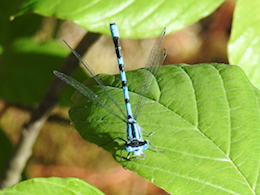
Eastern Forktail

July is usually the start of the best three months of ode-hunting at Andrew Haydon Park. Although I often visit the park in the spring and fall for birds, my time here in the summer is devoted to dragonflies. This park is reliable for Halloween Pennants, Blue Dashers, Eastern Pondhawks, Common Green Darners, Prince Baskettails, and the usual King Skimmers, and I’ve had Cobra Clubtail and Elusive Clubtail here as well. I visited on July 29th with the hope of seeing another Cobra Clubtail, as it was on July 21, 2019 that I saw one fly into a tree on a windy day, eating what looked to be a male Orange Bluet. Though I’ve looked for both species here in July in subsequent years, I only had luck with one female Orange Bluet on July 24, 2021.

Continue reading “A Bluet of a Different Colour”

Searching for the Arrowhead Spiketail

Stream Cruiser

Spiketails are large, brightly coloured dragonflies that inhabit small or mid-sized streams, usually with a good current in forested areas. There are three species present in eastern Ontario, all with dark brown or black bodies, green eyes, and bold yellow patterns along the abdomen that may cause them to be confused with clubtails in flight. Each species has a dark thorax with two vivid yellow stripes on the side and two smaller yellow dashes on the top. It is the pattern on the top of the abdomen that distinguishes them: the Arrowhead Spiketail has a single line of yellow arrows pointing toward two round spots at the tip; the Twin-spotted Spiketail has two lines of yellow spots with straight tops and rounded bottoms running down the abdomen, set close together; and the Delta-spotted Spiketail has two lines of widely-separated spots running down the abdomen, each pointed and distinctly triangular in shape. Because of their habitat requirements, they are considered local and uncommon, and in Ottawa the Arrowhead Spiketail is considered the rarest of the three.

Continue reading “Searching for the Arrowhead Spiketail”

Ode-Hunting in Early July

Taiga Bluet
Taiga Bluet

By early July a variety of dragonflies and damselflies are on the wing, although some of the early species – such as the Beaverpond and Spiny Baskettails – have already finished flying for the year. This is usually the time of year when I start focusing on odes on afternoon outings in addition to enjoying them as distractions on morning birding outings. While some of the best ode-hunting can be found along the Ottawa River (including Mud Lake, Andrew Haydon Park, Petrie Island, and Morris Island) there are some great spots in my own backyard, including Bruce Pit, Stony Swamp, and the Eagleson storm water ponds (which will be the focus of a separate post of its own). Bruce Pit is a particularly great spot for odes, and some unusual ones have turned up there including Swift River Cruiser, Black Meadowhawk and Black Saddlebags. Eastern Red Damsels used to breed there prior to 2010, and I decided to spend the afternoon of July 4th wading around the edges of Bruce Pit to see if I could find any. Unfortunately, the area where we used to see them (and odes such as Amber-winged Spreadwing and Saffron-winged Meadowhawk) has become overgrown with cattails and phragmites over the year, so I wasn’t sure it was possible to walk along the shore where we used to go a decade ago (I can’t believe it has been so long …. apologies to those who have never visited my old LiveJournal site, back in the days when I used to host my images on Photobucket which no longer allows free hosting and has hidden many of my images).

Continue reading “Ode-Hunting in Early July”

Dragon-hunting in the Carp Hills

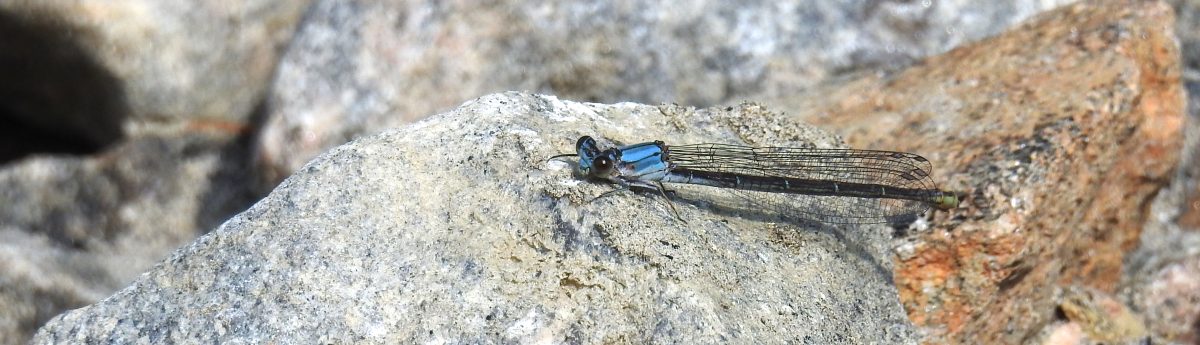
Marsh Bluet

On June 20, 2021 I accompanied fellow OFNC members Derek and Erik to the Carp Barrens Trail off of Thomas Dolan Parkway to assist them in a survey of breeding birds and other wildlife. Because of the sensitivity of the ecosystem and number of at-risk species which breed here, this trail is closed to the public during the summer. In order for us to access the site, Derek had acquired a permit to allow us to look for unique breeding birds such as Black-billed Cuckoo, Eastern Towhee, Common Nighthawks and Whippoorwills. Derek and Erik started around dawn to listen for both nightjars, but heard none. I joined them at 6:00 am while they were still walking along Thomas Dolan Parkway, and together we entered the trail system.

The trail follows a rocky outcrop around a long slough. Many birds were already singing, and we heard the typical open field and woodland edge species: Field Sparrow, White-throated Sparrow, Veery, Scarlet Tanager, Rose-breasted Grosbeak, and many warblers, the best of which (in my humble opinion) included two Pine Warblers, two Yellow-rumped and two Nashville Warblers.

Continue reading “Dragon-hunting in the Carp Hills”