Terry Carisse Park in the Summer

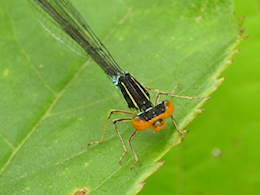
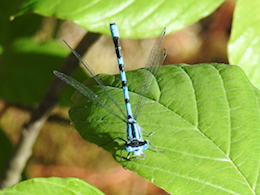
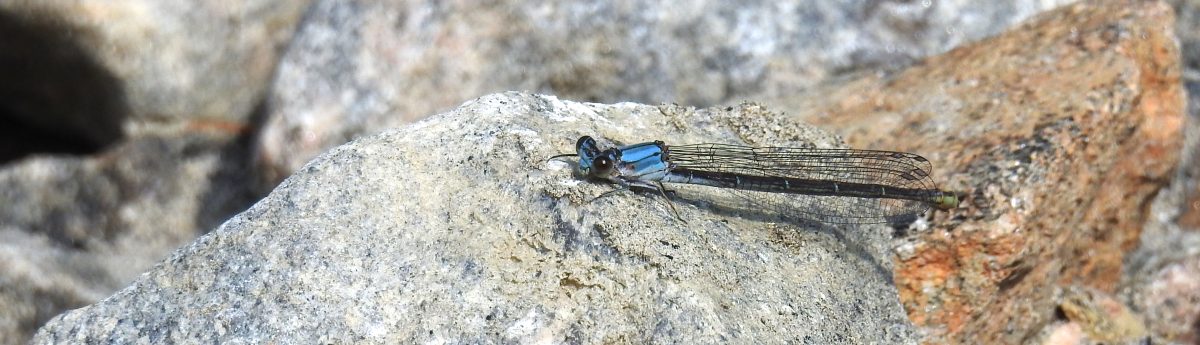
Rainbow Bluet

Most naturalists who have heard of Terry Carisse Park along the Jock River associate it with birds – particularly the Hooded Warbler that spent a few days there in May 2014. As a rare bird for Ottawa, this discovery put this small riparian park on the map for many Ottawa birders. Other people may associate it with the Osprey nest there, although the Osprey haven’t nested there for a few years now. I myself have returned regularly to this park in the spring and fall to look for the Rusty Blackbirds that often stop over here during migration – in May 2021 I found at least 50 of these declining birds feeding on the lawn and perched in the trees that line the river bank. Because of the thick shoreline vegetation, the wooded swamp to the north, and the open grassy areas dotted with conifers it is a good place to look for birds during migration. I had never been here during the summer breeding season, and it occurred to me this summer that it might be a good spot to look for odonates. I started my summer ode survey on July 2, 2022, continuing through early August, and found more species than I expected – including some species I’ve only seen at Petrie Island or Morris Island Conservation Area!

Continue reading “Terry Carisse Park in the Summer”

A Rare Dragonfly at Bruce Pit

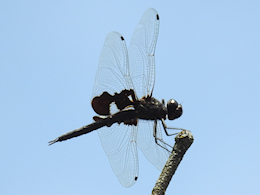
Black Saddlebags

Bruce Pit is under-valued as a great spot to see a variety of insects at the peak of summer. Though I’ve spent a lot of time looking for dragonflies there, it can be quite good for tiger beetles and butterflies as well, including Wild Indigo Duskywing, Gray Comma, Painted Lady, Compton Tortoiseshell, and migrating Monarchs. A visit anytime during the summer can usually turn up a few interesting species, and this year I started visiting on June 17th this year, hoping to find a few different insect species for my life list.

Continue reading “A Rare Dragonfly at Bruce Pit”

Marlborough Forest: Summer 2022

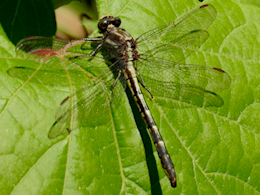
Ashy Clubtail

I did not get out to Marlborough Forest as often as I would have liked this past summer; ongoing medical issues early in the season left me feeling too tired and too sore for the long five-hour outings I enjoyed so much last year. On June 2nd I visited the E6 trail with Rick Collins to look for the Sedge Wrens breeding there. We heard one without too much difficulty, though we weren’t able to spot it. Our other highlight was a female Ruffed Grouse on the trail trying to lure us away from its chicks (none seen) by giving distress calls. It was a gray, drizzly day so I didn’t see any insects worth photographing. Indeed, I didn’t take my camera out of my bag at all.

The weather was much better on June 19th, so Chris Traynor and I went to trail E4 to look for Twin-spotted Spiketails and some different emerald species for his life list. I was also eager to show him the pool below the culvert as this was where I’d seen my one and only Ocellated Emerald hanging out in 2020. It was a bit windy, but the sun was shining and the weather was warm, and the breeze made the usual biting insects less of a distraction.

Continue reading “Marlborough Forest: Summer 2022”

Ode-hunting along the River

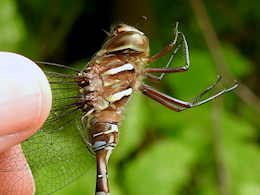
Shadow Darner
Shadow Darner

Mud Lake and Andrew Haydon Park are usually excellent places to find different species of dragons and damsels throughout the summer months. In both 2015 and 2019 I had a good number of species at Andrew Haydon Park in late July, and an OFNC dragonfly outing at Mud Lake on July 21, 2013 also netted some fantastic species. I was hoping for some similar luck on an ode-hunting trip on July 24th, but this time I found fewer species and fewer individuals overall. I am not sure why there seem to be so few dragonflies around good pond habitat these past two years (such as the Eagleson ponds), but the trend is concerning.

My first stop was the shoreline at Mud Lake where I hoped to find some large river clubtails perching on the rocks in the channel behind the filtration plant. When I arrived I was happy to find two dragonflies perching on the rocks right away, and managed only to photograph one before a couple of people came along and scared them both – while I’m certain one of them was a clubtail, the one I photographed turned out o be an Eastern Pondhawk. The clubtail did not return, although I saw a couple flying out over the water several times on my visit.

Continue reading “Ode-hunting along the River”

Ode-Hunting in Early July

Taiga Bluet
Taiga Bluet

By early July a variety of dragonflies and damselflies are on the wing, although some of the early species – such as the Beaverpond and Spiny Baskettails – have already finished flying for the year. This is usually the time of year when I start focusing on odes on afternoon outings in addition to enjoying them as distractions on morning birding outings. While some of the best ode-hunting can be found along the Ottawa River (including Mud Lake, Andrew Haydon Park, Petrie Island, and Morris Island) there are some great spots in my own backyard, including Bruce Pit, Stony Swamp, and the Eagleson storm water ponds (which will be the focus of a separate post of its own). Bruce Pit is a particularly great spot for odes, and some unusual ones have turned up there including Swift River Cruiser, Black Meadowhawk and Black Saddlebags. Eastern Red Damsels used to breed there prior to 2010, and I decided to spend the afternoon of July 4th wading around the edges of Bruce Pit to see if I could find any. Unfortunately, the area where we used to see them (and odes such as Amber-winged Spreadwing and Saffron-winged Meadowhawk) has become overgrown with cattails and phragmites over the year, so I wasn’t sure it was possible to walk along the shore where we used to go a decade ago (I can’t believe it has been so long …. apologies to those who have never visited my old LiveJournal site, back in the days when I used to host my images on Photobucket which no longer allows free hosting and has hidden many of my images).

Continue reading “Ode-Hunting in Early July”

A trip to Morris Island with the McNamara Field Naturalists

Slaty Skimmer
Slaty Skimmer

On Saturday, July 3rd I accompanied the McNamara Field Naturalists on their first in-person outing since the latest Stay-at-Home Order ended on June 2nd. Ontario entered Stage 2 of its reopening plan on July 2nd, which raised the number of people who could attend outdoor social gatherings and organized public events to 25 people (as well as allowing haircuts and personal care services again). Although I am not a member of the McNamara Field Naturalists Club, which calls Arnprior home but whose explorations include a large swath of the Ottawa Valley, one of my friends happens to be in charge of putting field trips together, and asked if I wanted to help lead a dragonfly walk. I said yes, and suggested Morris Island as it’s a great place to find all sorts of odes, including several flashy skimmers and clubtails that can be found perching in the vegetation and along the trails. I was thrilled when my mentor Chris Lewis joined us, as it would be easier to find some more of the unique species with a couple of knowledgeable people looking.

Continue reading “A trip to Morris Island with the McNamara Field Naturalists”

Dragon-hunting in the Carp Hills

Marsh Bluet

On June 20, 2021 I accompanied fellow OFNC members Derek and Erik to the Carp Barrens Trail off of Thomas Dolan Parkway to assist them in a survey of breeding birds and other wildlife. Because of the sensitivity of the ecosystem and number of at-risk species which breed here, this trail is closed to the public during the summer. In order for us to access the site, Derek had acquired a permit to allow us to look for unique breeding birds such as Black-billed Cuckoo, Eastern Towhee, Common Nighthawks and Whippoorwills. Derek and Erik started around dawn to listen for both nightjars, but heard none. I joined them at 6:00 am while they were still walking along Thomas Dolan Parkway, and together we entered the trail system.

The trail follows a rocky outcrop around a long slough. Many birds were already singing, and we heard the typical open field and woodland edge species: Field Sparrow, White-throated Sparrow, Veery, Scarlet Tanager, Rose-breasted Grosbeak, and many warblers, the best of which (in my humble opinion) included two Pine Warblers, two Yellow-rumped and two Nashville Warblers.

Continue reading “Dragon-hunting in the Carp Hills”

New Dragonflies at Marlborough Forest

Kennedy's Emerald
Kennedy’s Emerald

The beginning of June arrived with plenty of warmth and sunshine, and I couldn’t wait to go back to Marlborough Forest at the peak of butterfly and dragonfly season to look for new species living there. Last year when I started going to Marlborough Forest in mid-June, I kept seeing large, dark dragonflies – almost certainly emeralds of some sort – zipping down the shadowy trail before the sun had fully risen above the trees. I never had my net on me when I saw them on my early-morning birding walks, so I was unable to catch one to verify their identity. This time I was prepared for these dawn-flying dragons, and brought my net with me. I had already added one dragonfly to my life list, the Ocellated Emerald at Trail E4 last year; was it possible that there were other species of interest here?

My first summer visit to Trail E4 occurred on June 6th. Although the morning started out cool, it quickly warmed up. The usual birds were singing along the trail, including all the Red-eyed Vireos, Eastern Wood-pewees, Eastern Kingbirds, Veeries, and the Tree Swallows that were missing from my mid-May visit. I heard seven warblers (Ovenbirds, Northern Waterthrushes, Black-and-whites, Nashvilles, Common Yellowthroats, Black-throated Greens, and a single Magnolia Warbler), two Chipping Sparrows, a Field Sparrow, and a Blue-headed Vireo singing in its usual spot in the large open area devastated by motor bikes and ATVs.

Continue reading “New Dragonflies at Marlborough Forest”

Amber and Saffron Wings

Saffron-winged Meadowhawk

It’s been a good season for hard-to-find dragonflies at the Eagleson Ponds. Ever since I discovered both Eastern Amberwings and Saffron-winged Meadowhawks here in 2017 I’ve been spending more time here later in the day looking for odes, rather than doing a quick search for birds first thing in the morning before heading elsewhere. The Covid-19 pandemic has made that even easier for me, as I am still working from home and can get out at lunch time for a quick check when the temperature has warmed up enough for many odes to be flying.

Mid-summer seems to be the best time for seeing a variety of odes at the ponds. While I have seen a few early-season species here, such as the Taiga Bluet and Spiny Baskettail, most odes that breed here don’t emerge until later in the summer. I’m not sure if the late start to spring had anything to do with it, but up until the end of June I found very few dragonflies here – skimmers are usually abundant throughout the season, but on June 30th I recorded a single Dot-tailed Whiteface and a single Twelve-spotted Skimmer along with a couple of Common Green Darners and Prince Baskettails that refused to land. Even the Eastern Forktails seemed down in numbers.

Continue reading “Amber and Saffron Wings”

Gatineau Park: Specialty Dragon-hunting

Zebra Clubtail

Gatineau Park is a special place for dragonflies – many species of the National Capital Region can be found there that aren’t found on the Ontario side of the Ottawa River, while others seem to be much more common there than in Ottawa. Chris Traynor has been exploring the park quite a bit these past couple of years, searching for dragonflies that breed in the quiet lakes, sluggish streams, and fast-flowing creeks of the Gatineau Hills. Not surprisingly, he has found a good number of species that have not been reported in Ottawa, such as Eastern Least Clubtail, Mustached Clubtail, Beaverpond and Harpoon Clubtails, and even a couple of snaketails. Many of these species prefer clear, swift-moving streams with rocky bottoms, which might be the reason for their absence in Ottawa; the Ontario side of the National Capital Region is relatively flat, with more marshes and slow-moving, mucky streams winding through suburbs and forest rather than down the foothills and escarpments which form the Canadian Shield. One of Chris’s best finds was a portion of Meech Creek where Zebra Clubtails and Fawn Darners are quite common, with the occasional Dragonhunter and Violet Dancer. I accompanied him twice to this magical spot, once during the August long weekend last year, and once again this year. As I never did get around to posting those photos last year (remember I mentioned I’d fallen behind?), I will incorporate both sets of photos in this post.

Continue reading “Gatineau Park: Specialty Dragon-hunting”

Clubtails at Sheila McKee Park

Cobra Clubtail

On July 22nd I received an email from Chris Lewis about a new dragonfly spot along the Ottawa River. I’d been to Shelia McKee Park out near Dunrobin just once, on an OFNC trip in 2015 to look for herps; it has a network of woodland trails and a steep staircase that leads down from the top of the cliff to the rocky beach at the bottom. Chris said she found evidence of a very recent dragonfly emergence of in the form of both exuviae and teneral dragonflies; she recognized exuviae of both clubtails and emeralds, though she was not able to identify them to species. She saw an unidentified darner and several teneral meadowhawks in the woods, and several Powdered Dancers and a pair of Stream Bluets in tandem near the water. However, it was her clubtail report that intrigued me: she mentioned one Lancet Clubtail, both mature and teneral Black-shouldered Spinylegs, several Midland Clubtails, and one Cobra Clubtail which had become the unfortunate meal of a Midland Clubtail. It is amazing that I’ve never considered going back to this park for odes before – the shoreline here is quite rocky, with little or no emergent vegetation, reminiscent of Britannia Point at Mud Lake or the causeway at Morris Island, both of which are great spots for clubtails. Curious to see these clubtails for myself, I headed out the following Sunday (July 28th) and brought my net in case there was anything worth catching.

Continue reading “Clubtails at Sheila McKee Park”

Ode-hunting in Prince Edward County

Calico Pennant

During the first week of July my fiancé and I spent some time in Prince Edward County with my dad’s family. We rented a cottage on Loves Lane on Prince Edward Bay, a nice three-bedroom place with 8 acres of land only 20 minutes away from both Sandbanks and Picton. The weather was beautiful, and I spent most of my time getting to know the local residents. On our first full day at the cottage (Monday, July 1st), I went for an afternoon walk on the property to see what I could find. It seemed to be a good spot for odonates; every now and then a couple of Prince and Common Baskettails flew in and started swooping above the deck. There were some other dragonflies present too, so I brought my net out in the hopes of catching one.

Continue reading “Ode-hunting in Prince Edward County”

Fragile Forktail Confirmed!

After discovering the Saffron-winged Meadowhawks and Eastern Amberwings at the Eagleson Ponds on Sunday, July 30th, I returned again Friday after work, as well as on Saturday and Sunday. I checked the small crescent-shaped bay near the small building each time for the meadowhawks, to no avail; in fact, I didn’t see any meadowhawks on any of my visits at all. I got lucky and found one of the male Eastern Amberwings on the same mat of vegetation on Friday after work, but didn’t see any females.

I returned to the peninsula on the edge of the central pond where I had found the female spreadwing on a previous visit, but found no spreadwings on this visit. I did, however, find a tiny Fragile Forktail gliding low among the weeds, confirming this species’ presence at the ponds. I had seen one several years ago prior to the reconstruction, so I was happy to see that the population had either survived or re-established itself.

Fragile Forktail

This is a male, based on the green thorax and lack of ovipositor at the tip of the abdomen – young females are typically blue instead of green, and become bluish-gray with pruinosity as they age. Both sexes have exclamation points on top of the thorax, which distinguishes them from the more common Eastern Forktail. Male Fragile Forktails also lack the two blue spots at the tip of the male Eastern Forktail’s abdomen….the abdomen is entirely black, which makes it difficult to see flying in shaded areas.

Fragile Forktail

I stopped by again early on Saturday morning, which was sunnier and windier, so I didn’t see many dragonflies. There were, however, plenty of Eastern Forktails sheltering in the tall vegetation. I think this orange female is one of our prettier damselflies. Like the male Fragile Forktail, the tip of the abdomen is black when viewed from the top – it is often pale orange below. The immature Eastern Forktail is confusable only with the male Orange Bluet, which has an orange-tipped abdomen with noticeably long cerci at the end.

Eastern Forktail

My best find on Sunday was a fresh Wild Indigo Duskywing. Although I’ve been looking for them, this was my first confirmed sighting of the 2017 season. The caterpillars feed on Crown Vetch, of which there is an abundance here, particularly on the point on the east side of the pond.

I was glad to confirm that both Wild Indigo Duskywings and Fragile Forktails were still present in the area, and to see another Eastern Amberwing. The ponds have become one of my favourite birding and nature spots, and with plenty of time left in the ode season, it will be a great place for studying wildlife for the next few months!

Morris Island

Halloween Pennant

My last day off was Tuesday, and the forecast finally called for a decent amount of sun during the morning and afternoon. I invited a friend, Jon, to go dragon-hunting with me at Morris Island since he was eager to become re-acquainted with odonates after a long absence. There were a few particular species on his must-see list, including Cobra Clubtail, Cyrano Darner and Dragonhunter; I’d seen all of these at Morris Island before, though I wasn’t optimistic about our chances of seeing the Cyrano. Although it is considered to be a widespread species, inhabiting swamps, small lakes, and slow-moving rivers of the eastern half of the continent, adults are rarely seen. It is thought that once they emerge they immediately fly up into the tree-tops where they spend most of their time. Adult males can sometimes be found patrolling their territory, and this appeared to be just such a case with the one that I caught in the parking lot of the Morris Island Conservation Area last year. That was on June 25th, however, I was worried that we might be too late to see them.

Continue reading “Morris Island”

Late Season Bluets

Bluet sp.

I was intrigued by the small blue damselflies I saw lurking in the vegetation at the Eagleson storm water ponds earlier on Sunday, so I returned later that afternoon with my net in order to catch them and identify them. The blue-type bluets are among the most difficult damselflies to identify, requiring a hand lens to see the male’s terminal appendages in order to distinguish between several similar-looking species. Fortunately there are fewer species flying this time of the year than in June and July, narrowing down the tricky possibilities to only a handful: Northern Bluet flies until mid-September, while both Familiar Bluet and Tule Bluet fly into October. Other blue-type bluets are already gone for the year, including Hagen’s Bluet (which flies until mid-August) and Marsh Bluet (which flies until early September).

Continue reading “Late Season Bluets”