Sarsaparilla Trail Predators

Six-spotted Fishing Spider

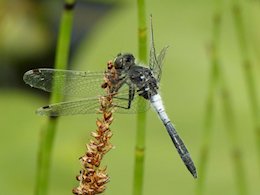
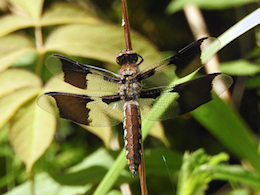
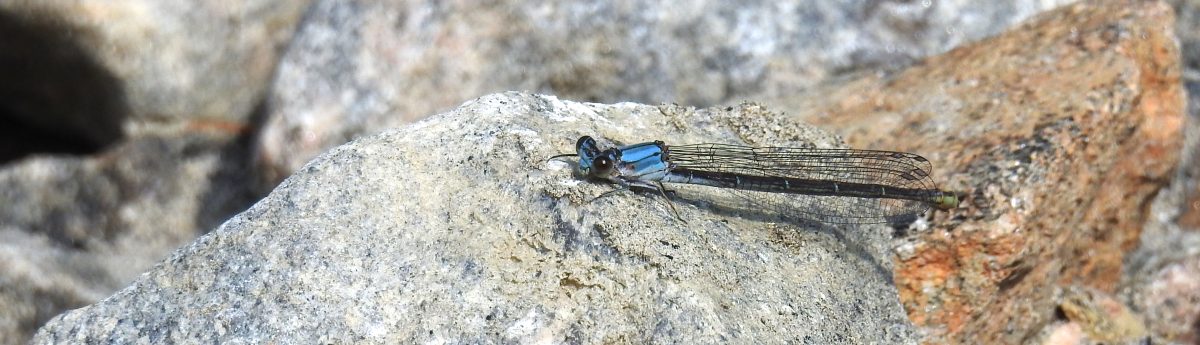
Late spring is a wonderful time to visit Sarsaparilla Trail. I usually start visiting in May to look for early dragonflies such as Spiny Baskettails and Chalk-fronted Corporals, both of which emerge in good numbers in mid- to late May. It is also a good place to look for Taiga Bluets, often my first damselfly of the year. Friday, May 24th was a beautiful, sunny day despite a cool north wind blowing, so I spent my lunch hour there searching for signs of spring. I began my walk by scanning the shrubs bordering the clearing near the outhouse for dragonflies perching in the vegetation and baskettails flying in the open…there were no emeralds flying on my visit, although there had been over a dozen Spiny Baskettails present only eight days earlier. I did scare up a dragonfly perching close to the ground – it turned out to be a Four-spotted Skimmer.

Continue reading “Sarsaparilla Trail Predators”

Moncton, NB: A sunny day in Riverview

Lancet Clubtail

We arrived in Moncton late on Wednesday, June 5th. Our AirBNB for this stay was a basement unit in Riverview, the small town situated on the south side of the Petitcodiac River and a short drive from both downtown Moncton and the Moncton Coliseum, home of East Coast Comic Expo. I had already scouted a few places that looked good for both birding and and ode-hunting; these included Riverview Marsh contained within a bend of the Petitcodiac River for Nelson’s Sparrow, Mill Creek Nature Park for forest birds and stream dragonflies, Bell Street Marsh for marsh birds and odes, and a small stream in a hydro corridor near Mill Creek for Superb Jewelwing, a potential lifer for me.

Continue reading “Moncton, NB: A sunny day in Riverview”

Yarmouth, Nova Scotia: Hebron Recreational Complex

Common Whitetail (Plathemis lydia)

My fiancé Doran and I spent two weeks in the Maritimes in late May/early June: first we spent some time in Yarmouth, Nova Scotia, where Doran (a comic book creator) had a booth for all three days of the Y-Con Gaming & Comics Convention, followed by three days in the Annapolis Valley to visit family, and finishing with a few days in Moncton, New Brunswick where Doran had a booth at East Coast Comic Expo for a day and a half. These are places I never would have planned to visit for birds and dragonflies on my own, so it was a great opportunity to explore some places completely off my radar! I prepared for the trip the same way any contemporary naturalist would prepare: I investigated iNaturalist, explored eBird, and goggled over Google maps looking for places that had an intriguing variety of birds, odonates, and habitats in order to come up with a short list of places to visit around each of our AirBnBs. I wanted to see (or hear) and document as many species as possible with three main goals in mind: (1) to find some East Coast lifers whose range is limited to the Maritimes (White Corporal and Mantled Baskettail being at the top of my list); (2) to find some species that live in the Ottawa-Gatineau region but are difficult to find, mainly due to the inaccessibility of habitat (such as emeralds in bogs or clubtails and snaketails in rushing creeks); and (3) add as many ode records as possible to Nova Scotia and Moncton in order to increase the general knowledge of the species that live there.

Continue reading “Yarmouth, Nova Scotia: Hebron Recreational Complex”

Odonates on the Wing: October and November 2023

Autumn Meadowhawk

By October I’m thinking about putting the net away for the season. If it is still warm at the beginning of the month, I will usually take the net out as long as I’m still seeing darners and small bluets around. Once I’m seeing nothing but meadowhawks, however, it’s time for me to declare an end to the season and put my gear away until the spring. This year the first week of October was very warm, with temperatures reaching 30°C; they then returned to seasonal for the next week with temperatures in the mid-teens. By the end of the month temperatures were in the single digits during the day and falling to below zero overnight, bringing an end to all but the hardiest of dragonflies. That title belongs to the meadowhawks, in particular the Autumn Meadowhawk (Sympetrum vicinum). It is no coincidence that it is the latest-flying dragonfly in many areas of the northeast….sometimes by several weeks. Once called the Yellow-legged Meadowhawk, it was renamed in 2004 by the Dragonfly Society of the Americas because mature individuals often have brown legs instead of yellow and because it persists so long into the fall. It is the only dragonfly in our area with entirely brown or yellow legs (never black), making identification relatively easy. And it is the only species you are likely to see in Ottawa in November!

Continue reading “Odonates on the Wing: October and November 2023”

Odonates on the wing: September 2023 Summary

Band-winged Meadowhawk

Although technically still considered summer until the equinox, the month of September ushers in the beginning of fall, the season most associated with change and impermanence, with encroaching darkness, with death and transition and the melancholy appreciation of the last burst of colour before the inevitable bleakness of winter. I can’t help but be reminded that this is the season of endings every time I go outside: the robins are gone from the neighbourhood, the songbirds in the woods have stopped singing, trees are changing colour, and the asters and goldenrods have replaced all the other wildflowers along roadsides and in conservation areas. In the dragonfly world, it is the season of the meadowhawk, the glider, and the darner, as these types of dragonflies are by far the most numerous. The goal now is to search out any others that may still be flying, and see how long into the season they last. Part of the reason is purely scientific – to get a better grasp of the flight seasons of local odonates. However, another part of the reason is purely emotional – I never know if a sighting will be the last of the year, and hope to put off the final goodbyes as long as possible.

Continue reading “Odonates on the wing: September 2023 Summary”

Next Gen Dragon-hunters

Canada Darner
Canada Darner

After I returned from my visit to southern Ontario I still had bugs on the brain, specifically odonates. Now that September has arrived the days will be getting shorter and the nights cooler, which spells the end of the season for a number of different species. It is, however, prime time for darners, and I still had yet to find a Lake Darner or Green-striped Darner this year. I also haven’t seen any Saffron-winged Meadowhawks either, another species that peaks in August and early September, despite searching known locations at the Eagleson storm water ponds. While I knew that bird migration was heating up, my brain hasn’t yet made the switch from odes to birds. I am having trouble getting up early enough to get out for my regular birding walks before work, and I won’t even consider putting my net away while the weather is still nice – I want to wring every last sunny moment looking for dragonflies and damselflies before taking the mandatory six-month winter hiatus. This has never happened to me before, and while I still am using eBird to keep track of what I see, most of my checklists are incidental ones noting only a few species that caught my attention while out later in the day dragonfly-hunting.

Continue reading “Next Gen Dragon-hunters”

More Ode-hunting in Chatham-Kent

Eastern Amberwing

Although I could have spent most of my time in Chatham-Kent at Peers Wetland, we visited a few other places in my quest to find odonates around Wallaceburg. After a productive morning at Peer’s Wetland on August 31st, we went home for lunch, then took a walk at Crothers Conservation Area only a few blocks from my mom’s house in the north end of Wallaceburg. This little slice of green space runs alongside Running Creek, a small muddy stream which flows into the North Sydenham River. Although this small conservation area consists mostly of neatly manicured lawn, and more rightly ought to be called a park than a conservation area, the riverbank has some natural growth of riparian shrubs and cattails that prevent it from looking too obviously landscaped. Wild green space is scant in the southwestern corner of the province – a bird’s eye view shows it to be entirely dominated by the patchwork of farms vital to the province’s agricultural industry. The few remaining patches of forest, wetlands, and untamed thickets along the riverine corridors are precious; it seems that in this part of the province, every square inch has been assessed and tallied with almost all of it given over to human management, whether for production, recreation, residential, or commercial purposes.

Continue reading “More Ode-hunting in Chatham-Kent”

Ode-hunting in Chatham-Kent: Peers Wetland

Probable Ruby Meadowhawk

My mother lives in Wallaceburg in Chatham-Kent, which is about a 7.5 hour drive from Ottawa, or a full day train adventure with a transfer in Toronto (my advice for anyone travelling economy on Via: take your own sandwiches and snacks, as the menu was somewhat unpalatable…and chocolate bars/chips alone were $3.00). Being so far south she gets a variety of birds, bugs and plants that we do not get here in eastern Ontario, so I’ve been meaning to visit in the summer when I might see some new southern butterflies and dragonflies for my life list. I took an extra two days off at the end of August so I could spend the Labour Day long weekend with her, though two of the days were lost to travel. As my mother and her husband both enjoyed birds and nature, I knew they’d be interested in taking a few nature walks with me, even if the idea of looking for dragonflies didn’t exactly fill them with delight.

Continue reading “Ode-hunting in Chatham-Kent: Peers Wetland”

The 2023 Summer Odolympics

Dragonhunter
Dragonhunter

When I first heard about the Odolympics – a special bioblitz hosted by the Dragonfly Society of the Americas, Sociedad de Odonatología Latinoamericana, and Odonata Central in order to record as many odonata species from as many places in the Western Hemisphere as possible – I knew I had to participate. This specialized bioblitz is only two years old, and there are usually two Odolympics each year: one falling during the North American summer, and one falling during the South American summer in order generate a snapshot of odonate distribution throughout both hemispheres.

Dragonflies and damselflies, collectively known as odonates, are valuable indicators of a wetland’s environmental health and biodiversity. Simply put, the more odonates that use a wetland for breeding and feeding purposes, the healthier the ecosystem. Naturalists were encouraged to submit their observations during the bioblitz via one of two platforms: iNaturalist, or Odonata Central. While I love iNaturalist and have been using it for a few years now to record my non-avian observations, I began submitting my observations to Odonata Central last year when it developed a checklist-based phone app similar to eBird. iNaturalist also has a phone-based app for submitting observations, but it is intended to be used in conjunction with the phone’s camera which I only use as a backup camera when my Nikon Coolpix’s battery decides to take a nap. Although I love the ease of searching for data in iNaturalist’s projects, I chose to record my Odolympic observations in Odonata Central as it allowed me to include observations of species for which I am usually unable to get a photo (yes, I’m looking at you, Prince Baskettail and Wandering Glider!)

Continue reading “The 2023 Summer Odolympics”

Orange Bluets at Andrew Haydon Park

Orange Bluet
Orange Bluet

After my successful outing at Andrew Haydon Park on July 29th, I couldn’t wait to return to see the Vesper Bluets again and to look for the elusive Orange Bluet. The two successfully share the same habitat at Petrie Island, so why not in the ponds at AHP? While Vesper Bluet habitat includes the edges of woodland lakes, ponds, and slow rivers rich with emergent vegetation, Orange Bluets are present in those habitats as well as in swamp edges, bogs, slow streams, and degraded wetlands containing varying levels of pollution. I knew they were already on the wing, as I had first seen them at the Eagleson Ponds on July 3rd and have been seeing them there on and off ever since. It was just a matter of returning to Andrew Haydon Park later in the afternoon when they would be at the water, as they spend the early part of the day in the vegetation or trees nearby.

Continue reading “Orange Bluets at Andrew Haydon Park”

Quebec: Kazabazua and Beyond

Black-tipped Darner

The Common Sanddragon is one of the dragonfly species in the Algonquin Park field that is not found in the Ottawa-Gatineau region. A member of the clubtail family, it is well-marked with a mottled green and brown thorax reminiscent of a Harlequin Darner and uniquely-shaped markings down the length of the abdomen to segment 7: they look like goblets in the male, and start out as goblet-shaped in the female but gradually lose the stem. Their legs are very short for a dragonfly, and mature males have green eyes while females have gray or brown eyes. The appendages in both sexes are pale, and they are the only dragonfly in our region which has pale appendages, a mottled thorax, and brown spots at the base of each wing. Its larvae live in rivers, lakes, and streams with sandy bottoms, and due to its short legs, the adults perch horizontally on the sandy beaches and banks of its rivers rather than hanging from trees or in the vegetation. At the time of the printing of the first edition of the Algonquin field guide, it had not been recorded within the park and was only known from a few sites in Peterborough County and a single record from Windsor in Ontario’s deep south.

Continue reading “Quebec: Kazabazua and Beyond”

A Bluet of a Different Colour

Eastern Forktail

July is usually the start of the best three months of ode-hunting at Andrew Haydon Park. Although I often visit the park in the spring and fall for birds, my time here in the summer is devoted to dragonflies. This park is reliable for Halloween Pennants, Blue Dashers, Eastern Pondhawks, Common Green Darners, Prince Baskettails, and the usual King Skimmers, and I’ve had Cobra Clubtail and Elusive Clubtail here as well. I visited on July 29th with the hope of seeing another Cobra Clubtail, as it was on July 21, 2019 that I saw one fly into a tree on a windy day, eating what looked to be a male Orange Bluet. Though I’ve looked for both species here in July in subsequent years, I only had luck with one female Orange Bluet on July 24, 2021.

Continue reading “A Bluet of a Different Colour”

Nova Scotia 2023: Odes of Marsh and Pond

River Jewelwing

The weather played a big part in our trip this year. Rainclouds blew in and blew out all week long, bringing rain on most of the days we were there.  Fortunately the sun came out long enough to get in a few hikes at the various waterfalls and for me to take some long walks while Doran was out with the car. I spent quite a few hours looking for odonates and other critters around the ponds and the Annapolis Rail Trail, mostly in the afternoons when the sky cleared up. Although they are maybe half as long as the Eagleson storm water ponds by my house and much less diverse in terms of wildlife species, I still managed to find an interesting variety of creatures.

The afternoon after our waterfall search was particularly productive. I found my first Band-winged Meadowhawk and Familiar Bluet of the trip, which are also my first observations in iNaturalist for Nova Scotia for these species.

Continue reading “Nova Scotia 2023: Odes of Marsh and Pond”

Nova Scotia 2023: Rural Roads and Waterfalls

Petite Emerald

The morning of July 18th was warm and cloudless, so we resumed our search for rushing creeks, waterfalls, and odes. I had noticed one spot on Google maps that wasn’t too far from us – Slokum Brook Falls, just north of the Trans-Canada Highway. Photos showed a nice little brook with a steep waterfall in the middle of the woods, and reviews on Alltrails.com indicated that it was a bit difficult to find, as it is very overgrown at the beginning. It is said to be the highest falls on the North Mountain that drains into the valley, though there is really only water here during the spring runoff. We drove down Lily Lake Road, slowing down once we got past the lake itself. I peered into the dense foliage along the road, and found only two spots that looked like trails entering the woods, though both had “private property” signs at the entrance. Once the forest opened up we realized we must have gone past it, and decided to turn around at the end of the road, which elbowed north onto Douglas Road as the woods gave way to farm fields.

Continue reading “Nova Scotia 2023: Rural Roads and Waterfalls”

Nova Scotia 2023: Dragon-hunting around Middleton

Ebony Jewelwing

Doran and I visited Nova Scotia again in mid-July, now one of my favourite times to visit after seeing so many dragonfly species on our last trip. This time we rented an Airbnb in Middleton – the basement suite of a house right on the Annapolis River. Although the vegetation along the river was much too thick to get close to the water, there were a few well-trampled trails leading down to the water’s edge. In addition, our location was close to both Bridge Street (Highway 10), with Riverside Park on the opposite bank, and the South Shore Annapolis Trail which has its own bridge across the water and runs behind Riverside Park and the Middleton sewage lagoons. We got settled into the apartment, and the following day that Doran and I went exploring. My fiancé had recently become interested in searching out local waterfalls, and as a number of clubtail species can be found on fast-flowing rocky rivers, I was more than keen to accompany him.

Continue reading “Nova Scotia 2023: Dragon-hunting around Middleton”