A Dazzle of Dashers

Blue Dasher

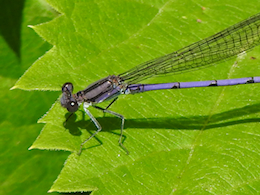
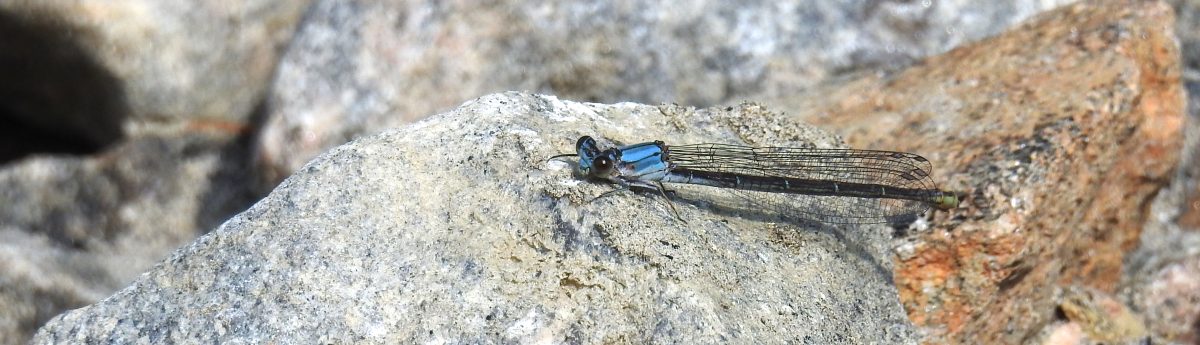
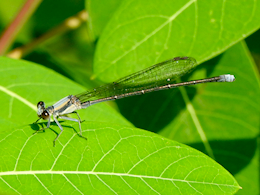
After leaving Mud Lake I went to Sheila McKee Memorial Park to try my luck there. I was hoping that the whitefaces would still be flying, as I wanted to find some fully mature individuals after seeing so many tenerals and immatures right before my trip to the Maritimes, and I was hoping that some clubtails had emerged. It was still sunny, only about 18°C, and while the wind was still blowing, the small clearings in the woods at the top of the escarpment were relatively protected. I didn’t see any odes other than a few Powdered Dancers until I reached the main clearing where the trail leading down to the water branches off to the right. Some smaller dragonflies were perching in shrubs at the edge of the clearing, and I was delighted to find some freshly emerged Blue Dashers – both males and females!

Continue reading “A Dazzle of Dashers”

Odonates on the wing: September 2023 Summary

Band-winged Meadowhawk

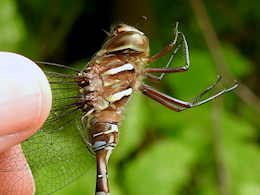
Although technically still considered summer until the equinox, the month of September ushers in the beginning of fall, the season most associated with change and impermanence, with encroaching darkness, with death and transition and the melancholy appreciation of the last burst of colour before the inevitable bleakness of winter. I can’t help but be reminded that this is the season of endings every time I go outside: the robins are gone from the neighbourhood, the songbirds in the woods have stopped singing, trees are changing colour, and the asters and goldenrods have replaced all the other wildflowers along roadsides and in conservation areas. In the dragonfly world, it is the season of the meadowhawk, the glider, and the darner, as these types of dragonflies are by far the most numerous. The goal now is to search out any others that may still be flying, and see how long into the season they last. Part of the reason is purely scientific – to get a better grasp of the flight seasons of local odonates. However, another part of the reason is purely emotional – I never know if a sighting will be the last of the year, and hope to put off the final goodbyes as long as possible.

Continue reading “Odonates on the wing: September 2023 Summary”

The 2023 Summer Odolympics

Dragonhunter
Dragonhunter

When I first heard about the Odolympics – a special bioblitz hosted by the Dragonfly Society of the Americas, Sociedad de Odonatología Latinoamericana, and Odonata Central in order to record as many odonata species from as many places in the Western Hemisphere as possible – I knew I had to participate. This specialized bioblitz is only two years old, and there are usually two Odolympics each year: one falling during the North American summer, and one falling during the South American summer in order generate a snapshot of odonate distribution throughout both hemispheres.

Dragonflies and damselflies, collectively known as odonates, are valuable indicators of a wetland’s environmental health and biodiversity. Simply put, the more odonates that use a wetland for breeding and feeding purposes, the healthier the ecosystem. Naturalists were encouraged to submit their observations during the bioblitz via one of two platforms: iNaturalist, or Odonata Central. While I love iNaturalist and have been using it for a few years now to record my non-avian observations, I began submitting my observations to Odonata Central last year when it developed a checklist-based phone app similar to eBird. iNaturalist also has a phone-based app for submitting observations, but it is intended to be used in conjunction with the phone’s camera which I only use as a backup camera when my Nikon Coolpix’s battery decides to take a nap. Although I love the ease of searching for data in iNaturalist’s projects, I chose to record my Odolympic observations in Odonata Central as it allowed me to include observations of species for which I am usually unable to get a photo (yes, I’m looking at you, Prince Baskettail and Wandering Glider!)

Continue reading “The 2023 Summer Odolympics”

Quebec: Kazabazua and Beyond

Black-tipped Darner

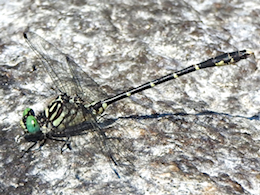
The Common Sanddragon is one of the dragonfly species in the Algonquin Park field that is not found in the Ottawa-Gatineau region. A member of the clubtail family, it is well-marked with a mottled green and brown thorax reminiscent of a Harlequin Darner and uniquely-shaped markings down the length of the abdomen to segment 7: they look like goblets in the male, and start out as goblet-shaped in the female but gradually lose the stem. Their legs are very short for a dragonfly, and mature males have green eyes while females have gray or brown eyes. The appendages in both sexes are pale, and they are the only dragonfly in our region which has pale appendages, a mottled thorax, and brown spots at the base of each wing. Its larvae live in rivers, lakes, and streams with sandy bottoms, and due to its short legs, the adults perch horizontally on the sandy beaches and banks of its rivers rather than hanging from trees or in the vegetation. At the time of the printing of the first edition of the Algonquin field guide, it had not been recorded within the park and was only known from a few sites in Peterborough County and a single record from Windsor in Ontario’s deep south.

Continue reading “Quebec: Kazabazua and Beyond”

Nova Scotia 2023: Dragon-hunting around Middleton

Ebony Jewelwing

Doran and I visited Nova Scotia again in mid-July, now one of my favourite times to visit after seeing so many dragonfly species on our last trip. This time we rented an Airbnb in Middleton – the basement suite of a house right on the Annapolis River. Although the vegetation along the river was much too thick to get close to the water, there were a few well-trampled trails leading down to the water’s edge. In addition, our location was close to both Bridge Street (Highway 10), with Riverside Park on the opposite bank, and the South Shore Annapolis Trail which has its own bridge across the water and runs behind Riverside Park and the Middleton sewage lagoons. We got settled into the apartment, and the following day that Doran and I went exploring. My fiancé had recently become interested in searching out local waterfalls, and as a number of clubtail species can be found on fast-flowing rocky rivers, I was more than keen to accompany him.

Continue reading “Nova Scotia 2023: Dragon-hunting around Middleton”

Ode-hunting along the River

Shadow Darner
Shadow Darner

Mud Lake and Andrew Haydon Park are usually excellent places to find different species of dragons and damsels throughout the summer months. In both 2015 and 2019 I had a good number of species at Andrew Haydon Park in late July, and an OFNC dragonfly outing at Mud Lake on July 21, 2013 also netted some fantastic species. I was hoping for some similar luck on an ode-hunting trip on July 24th, but this time I found fewer species and fewer individuals overall. I am not sure why there seem to be so few dragonflies around good pond habitat these past two years (such as the Eagleson ponds), but the trend is concerning.

My first stop was the shoreline at Mud Lake where I hoped to find some large river clubtails perching on the rocks in the channel behind the filtration plant. When I arrived I was happy to find two dragonflies perching on the rocks right away, and managed only to photograph one before a couple of people came along and scared them both – while I’m certain one of them was a clubtail, the one I photographed turned out o be an Eastern Pondhawk. The clubtail did not return, although I saw a couple flying out over the water several times on my visit.

Continue reading “Ode-hunting along the River”

Clubtails at Sheila McKee Park

Cobra Clubtail

On July 22nd I received an email from Chris Lewis about a new dragonfly spot along the Ottawa River. I’d been to Shelia McKee Park out near Dunrobin just once, on an OFNC trip in 2015 to look for herps; it has a network of woodland trails and a steep staircase that leads down from the top of the cliff to the rocky beach at the bottom. Chris said she found evidence of a very recent dragonfly emergence of in the form of both exuviae and teneral dragonflies; she recognized exuviae of both clubtails and emeralds, though she was not able to identify them to species. She saw an unidentified darner and several teneral meadowhawks in the woods, and several Powdered Dancers and a pair of Stream Bluets in tandem near the water. However, it was her clubtail report that intrigued me: she mentioned one Lancet Clubtail, both mature and teneral Black-shouldered Spinylegs, several Midland Clubtails, and one Cobra Clubtail which had become the unfortunate meal of a Midland Clubtail. It is amazing that I’ve never considered going back to this park for odes before – the shoreline here is quite rocky, with little or no emergent vegetation, reminiscent of Britannia Point at Mud Lake or the causeway at Morris Island, both of which are great spots for clubtails. Curious to see these clubtails for myself, I headed out the following Sunday (July 28th) and brought my net in case there was anything worth catching.

Continue reading “Clubtails at Sheila McKee Park”

The “Wild Ode West” Dragon-hunting Adventure

Widow Skimmer
Widow Skimmer

Chris Lewis and I had such a great time dragon-hunting in Gatineau last weekend that on June 25th we decided to hit several spots west of Ottawa to search for several local and unique species. On our list of locations were the Quyon Ferry Dock near Fitzroy to look for big river species, Morris Island for clubtails and skimmers, and Pakenham, Blakeney and Almonte for Rapids Clubtail. Before heading out to the Quyon Ferry Dock we stopped in at the fields near Constance Bay to look for Upland Sandpipers. We got lucky and found four. Not only did we see a couple of them flying over the fields, giving their distinctive call, we found one standing right on the shoulder of the road! Unfortunately we caused it to flush before I could get a photo of this bird; I still have yet to photograph this species. Indeed, this was the closest I’ve ever come to one of an Upland Sandpiper, which are difficult to find as they breed and feed in dry grasslands rather than muddy shorelines.

Continue reading “The “Wild Ode West” Dragon-hunting Adventure”

Searching for Damselflies at Hurdman

Eastern Forktail (male)

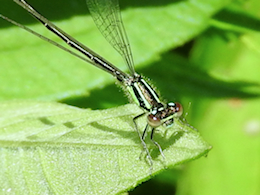
On the first day of June I brought my camera to work with me and headed over to Hurdman at lunch, hoping to find some interesting butterflies and odes to photograph. Hurdman can be a very “buggy” place, so I was sure to find something interesting; at that time I still hadn’t seen my first damselflies of the year, and Hurdman is a great spot to find Eastern Forktails, Elegant Spreadwings, Powdered Dancers, Stream Bluets and Rainbow Bluets during the month of June. However, with the closure of the transitway between Hurdman and Laurier stations, as well as the detours and increased traffic on Nicholas Street resulting from the sinkhole on Rideau Street, it now takes much longer to get there so I am no longer able to spend as much time there on my lunch hour as I would like. Getting around downtown has become and adventure, and timely bus schedules have become the first casualty of all the construction.

Continue reading “Searching for Damselflies at Hurdman”