
The 2024 Summer Odolympics

Autumn Meadowhawk (Sympetrum vicinum)

The 2024 North American edition of the Summer Odolympics were held between September 7-15, giving ode enthusiasts two weekends and as much time as a regular working week would allow to collect observations. I had hoped to find 19 or 20 species based on the same period spent collecting observations last year, but as most species are on the decline by this time, I knew I needed both good weather and good luck to come up with a respectful number. Unfortunately, neither luck nor weather were in my favour that first crucial weekend when I hoped to find a few species whose season ended around the beginning of September; it rained most of Saturday, and the temperature never rose above 15°C. Although it didn’t rain nearly as much on Sunday, the weather was worse: it was cloudy, windy, and the temperature never rose above 14°C. In fact, it was the coldest September 8th in more than 70 years (since 1949) and the windiest since records began in 1953 with a mean wind of 21 km/h. With a 1:00am windchill of 1.6 it was almost (within 0.1) the lowest windchill ever recorded on September 7th. Cold, wet, windy nights are even more of an obstacle, as many late-lingering species may not survive the low temperatures. When the sun began peeking out from the thick, fast-moving clouds around 4:30 I headed out despite the wind as to have zero species recorded on the first weekend was unthinkable. I didn’t expect much, and found only two species at the Eagleson ponds: an Eastern Forktail and a Slender Spreadwing.

Continue reading “The 2024 Summer Odolympics”

A Rare Mottled Darner

Mottled Darner

Sheila McKee Memorial Park has been such an amazing spot for odes this year that when the weekend called for not one, but TWO clear days, I decided it was worth going back for a few hours and looking for more clubtails. I arrived around 10:00, and as usual a dragonfly had claimed the first sunny opening in the woods as its territory – however, unlike the Common Whitetail, Racket-tailed Emerald, and Black-shouldered Spinyleg of my previous visits, this one was a brilliant green Eastern Pondhawk actively darting around and landing on different leaves. I took one terrible photo of it sitting on a leaf above head-height, facing me. This was the only pondhawk I saw, so I’m glad I got a photo for iNaturalist.

Continue reading “A Rare Mottled Darner”

Second Sightings

Skimming Bluet

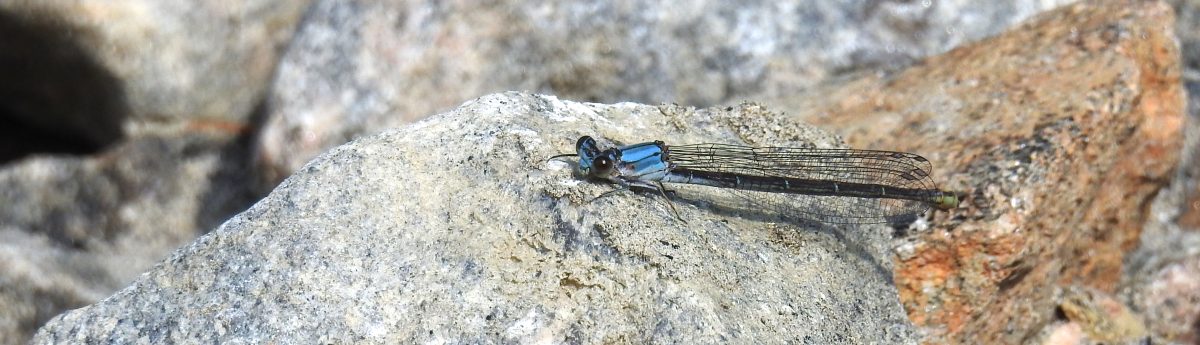
On August 4, 2020 I was surprised to find a Violet Dancer on a dirt trail at the Eagleson ponds. The closest place I’ve ever seen this species to home is out near Morris Island, so it was a shock to find one practically in my own backyard. Then in 2022 I found a few near the Jock River behind the former Richmond sewage lagoons. This suggested where the one at Eagleson might have come from – still a fair distance for a tiny damselfly, but not insurmountable if the winds are blowing the right way. I didn’t expect to see another one there any time soon; if anything, Powdered Dancer was next on my list of species I expected to show up there, because they are much more abundant and widespread along the Ottawa and Rideau Rivers than the Violet Dancer, and breed at the same location on the Jock River behind the former Richmond sewage lagoons. However, when I took a walk there on July 16 after work, it was the first odonate I found, resting on the rocks near the bridge.

Continue reading “Second Sightings”

Odonates on the Wing: October and November 2023

Autumn Meadowhawk

By October I’m thinking about putting the net away for the season. If it is still warm at the beginning of the month, I will usually take the net out as long as I’m still seeing darners and small bluets around. Once I’m seeing nothing but meadowhawks, however, it’s time for me to declare an end to the season and put my gear away until the spring. This year the first week of October was very warm, with temperatures reaching 30°C; they then returned to seasonal for the next week with temperatures in the mid-teens. By the end of the month temperatures were in the single digits during the day and falling to below zero overnight, bringing an end to all but the hardiest of dragonflies. That title belongs to the meadowhawks, in particular the Autumn Meadowhawk (Sympetrum vicinum). It is no coincidence that it is the latest-flying dragonfly in many areas of the northeast….sometimes by several weeks. Once called the Yellow-legged Meadowhawk, it was renamed in 2004 by the Dragonfly Society of the Americas because mature individuals often have brown legs instead of yellow and because it persists so long into the fall. It is the only dragonfly in our area with entirely brown or yellow legs (never black), making identification relatively easy. And it is the only species you are likely to see in Ottawa in November!

Continue reading “Odonates on the Wing: October and November 2023”

Odonates on the wing: September 2023 Summary

Band-winged Meadowhawk

Although technically still considered summer until the equinox, the month of September ushers in the beginning of fall, the season most associated with change and impermanence, with encroaching darkness, with death and transition and the melancholy appreciation of the last burst of colour before the inevitable bleakness of winter. I can’t help but be reminded that this is the season of endings every time I go outside: the robins are gone from the neighbourhood, the songbirds in the woods have stopped singing, trees are changing colour, and the asters and goldenrods have replaced all the other wildflowers along roadsides and in conservation areas. In the dragonfly world, it is the season of the meadowhawk, the glider, and the darner, as these types of dragonflies are by far the most numerous. The goal now is to search out any others that may still be flying, and see how long into the season they last. Part of the reason is purely scientific – to get a better grasp of the flight seasons of local odonates. However, another part of the reason is purely emotional – I never know if a sighting will be the last of the year, and hope to put off the final goodbyes as long as possible.

Continue reading “Odonates on the wing: September 2023 Summary”

More Ode-hunting in Chatham-Kent

Eastern Amberwing

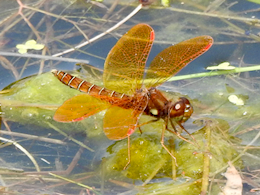
Although I could have spent most of my time in Chatham-Kent at Peers Wetland, we visited a few other places in my quest to find odonates around Wallaceburg. After a productive morning at Peer’s Wetland on August 31st, we went home for lunch, then took a walk at Crothers Conservation Area only a few blocks from my mom’s house in the north end of Wallaceburg. This little slice of green space runs alongside Running Creek, a small muddy stream which flows into the North Sydenham River. Although this small conservation area consists mostly of neatly manicured lawn, and more rightly ought to be called a park than a conservation area, the riverbank has some natural growth of riparian shrubs and cattails that prevent it from looking too obviously landscaped. Wild green space is scant in the southwestern corner of the province – a bird’s eye view shows it to be entirely dominated by the patchwork of farms vital to the province’s agricultural industry. The few remaining patches of forest, wetlands, and untamed thickets along the riverine corridors are precious; it seems that in this part of the province, every square inch has been assessed and tallied with almost all of it given over to human management, whether for production, recreation, residential, or commercial purposes.

Continue reading “More Ode-hunting in Chatham-Kent”

A Bluet of a Different Colour

Eastern Forktail

July is usually the start of the best three months of ode-hunting at Andrew Haydon Park. Although I often visit the park in the spring and fall for birds, my time here in the summer is devoted to dragonflies. This park is reliable for Halloween Pennants, Blue Dashers, Eastern Pondhawks, Common Green Darners, Prince Baskettails, and the usual King Skimmers, and I’ve had Cobra Clubtail and Elusive Clubtail here as well. I visited on July 29th with the hope of seeing another Cobra Clubtail, as it was on July 21, 2019 that I saw one fly into a tree on a windy day, eating what looked to be a male Orange Bluet. Though I’ve looked for both species here in July in subsequent years, I only had luck with one female Orange Bluet on July 24, 2021.

Continue reading “A Bluet of a Different Colour”

Late Season Bluets

Bluet sp.

I was intrigued by the small blue damselflies I saw lurking in the vegetation at the Eagleson storm water ponds earlier on Sunday, so I returned later that afternoon with my net in order to catch them and identify them. The blue-type bluets are among the most difficult damselflies to identify, requiring a hand lens to see the male’s terminal appendages in order to distinguish between several similar-looking species. Fortunately there are fewer species flying this time of the year than in June and July, narrowing down the tricky possibilities to only a handful: Northern Bluet flies until mid-September, while both Familiar Bluet and Tule Bluet fly into October. Other blue-type bluets are already gone for the year, including Hagen’s Bluet (which flies until mid-August) and Marsh Bluet (which flies until early September).

Continue reading “Late Season Bluets”