Of Sanddragons and Snaketails

Boreal Snaketail

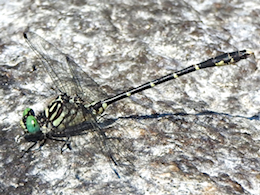
Last year on August 5th Chris Traynor and I headed up to La Vérendrye Wildlife Reserve just beyond Grand-Remous, Quebec to look for the Common Sanddragons that had been discovered along the Desert River (Rivière Désert) in 2016. We were too late in the season to find any, but had a marvelous time watching dragonhunters and catching darners. We made a pact to return the following year earlier in the season, and on July 21st Chris, Sophie Roy and I finally fulfilled that pact. The sky was spattered with more puffy, white clouds than I would have liked, showing little blue at first, but the further north we drove the clearer the sky became. The temperature was perfect, about 24 or 25°C, with only a slight amount of humidity that really only made the temperature start to feel too warm later in the afternoon, but a fresh breeze kept us cool enough. We were in high spirits because even if we missed out on the sanddragons again there were sure to be enough interesting birds and bugs to make the journey worthwhile. And of course, the rushing rivers and waterfalls of Quebec are beautiful in their own right.

Continue reading “Of Sanddragons and Snaketails”

Second Sightings

Skimming Bluet

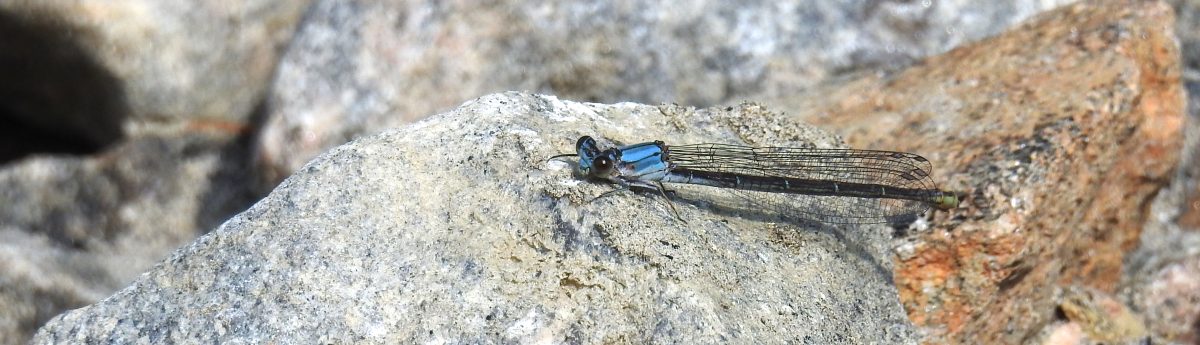
On August 4, 2020 I was surprised to find a Violet Dancer on a dirt trail at the Eagleson ponds. The closest place I’ve ever seen this species to home is out near Morris Island, so it was a shock to find one practically in my own backyard. Then in 2022 I found a few near the Jock River behind the former Richmond sewage lagoons. This suggested where the one at Eagleson might have come from – still a fair distance for a tiny damselfly, but not insurmountable if the winds are blowing the right way. I didn’t expect to see another one there any time soon; if anything, Powdered Dancer was next on my list of species I expected to show up there, because they are much more abundant and widespread along the Ottawa and Rideau Rivers than the Violet Dancer, and breed at the same location on the Jock River behind the former Richmond sewage lagoons. However, when I took a walk there on July 16 after work, it was the first odonate I found, resting on the rocks near the bridge.

Continue reading “Second Sightings”

The 2023 Summer Odolympics

Dragonhunter
Dragonhunter

When I first heard about the Odolympics – a special bioblitz hosted by the Dragonfly Society of the Americas, Sociedad de Odonatología Latinoamericana, and Odonata Central in order to record as many odonata species from as many places in the Western Hemisphere as possible – I knew I had to participate. This specialized bioblitz is only two years old, and there are usually two Odolympics each year: one falling during the North American summer, and one falling during the South American summer in order generate a snapshot of odonate distribution throughout both hemispheres.

Dragonflies and damselflies, collectively known as odonates, are valuable indicators of a wetland’s environmental health and biodiversity. Simply put, the more odonates that use a wetland for breeding and feeding purposes, the healthier the ecosystem. Naturalists were encouraged to submit their observations during the bioblitz via one of two platforms: iNaturalist, or Odonata Central. While I love iNaturalist and have been using it for a few years now to record my non-avian observations, I began submitting my observations to Odonata Central last year when it developed a checklist-based phone app similar to eBird. iNaturalist also has a phone-based app for submitting observations, but it is intended to be used in conjunction with the phone’s camera which I only use as a backup camera when my Nikon Coolpix’s battery decides to take a nap. Although I love the ease of searching for data in iNaturalist’s projects, I chose to record my Odolympic observations in Odonata Central as it allowed me to include observations of species for which I am usually unable to get a photo (yes, I’m looking at you, Prince Baskettail and Wandering Glider!)

Continue reading “The 2023 Summer Odolympics”

Nova Scotia 2023: Rural Roads and Waterfalls

Petite Emerald

The morning of July 18th was warm and cloudless, so we resumed our search for rushing creeks, waterfalls, and odes. I had noticed one spot on Google maps that wasn’t too far from us – Slokum Brook Falls, just north of the Trans-Canada Highway. Photos showed a nice little brook with a steep waterfall in the middle of the woods, and reviews on Alltrails.com indicated that it was a bit difficult to find, as it is very overgrown at the beginning. It is said to be the highest falls on the North Mountain that drains into the valley, though there is really only water here during the spring runoff. We drove down Lily Lake Road, slowing down once we got past the lake itself. I peered into the dense foliage along the road, and found only two spots that looked like trails entering the woods, though both had “private property” signs at the entrance. Once the forest opened up we realized we must have gone past it, and decided to turn around at the end of the road, which elbowed north onto Douglas Road as the woods gave way to farm fields.

Continue reading “Nova Scotia 2023: Rural Roads and Waterfalls”

Gatineau Park: In Search of Emeralds and Clubtails

Violet Dancer
Violet Dancer

Chris Traynor and I chat about dragonflies and damselflies a lot. We both also like to pour over old dragonfly reports, iNaturalist records, and Google maps looking for suitable habitat for this species or that, as well as interesting places to go dragon-hunting in general. It was Chris who, when searching for places to see Clamp-tipped Emerald, thought that Taylor Lake in the northwestern part of Gatineau Park might be worth a visit. There are two iNat records from the area from 2015, as well as one Brush-tipped Emerald record from a few kilometers away. The map shows a variety of ode-worthy wetlands including streams, ponds, seeps and marshes, and an exploratory hike of about 5 kilometers in the fall cemented his impressions and desire to return there during prime dragonfly season. It was also almost completely unexplored for odonates, which made it quite enticing in my eyes, and close to a spot where Chris Lewis and Bob Bracken had discovered a stream with mature Eastern Least Clubtails and other clubtails several years ago. Good Somatochlora spots in the Ottawa-Gatineau region are uncommon, and we both thought would be fantastic to discover one up in Gatineau Park. I emailed Chris Lewis about Chris’s idea to check on the trails around Taylor Lake and revisit some of her and Bob’s footsteps in Gatineau Park, and the three of us made plans to visit its northern reaches on July 8th.

Continue reading “Gatineau Park: In Search of Emeralds and Clubtails”

Damselflies in New Places

Violet Dancer
Violet Dancer

Damselflies are small odonates related to dragonflies, but belong to Order Zygoptera instead of Order Anisoptera. Unlike dragonflies, damselflies have very slender abdomens, and the forewing and hindwing are similar size and shape. Two of the three families found in eastern North America – the broad-winged damsels and pond damsels – hold their wings above the body, parallel to the abdomen, while perching. The third family – the spreadwings – do not perch horizontally with their wings parallel to the body, but typically “hang” from a perch, with the wings slightly spread at an angle. Adult damselflies are not strong fliers, and generally do not travel far from water. They are most often found in vegetation or on the ground near ponds, streams, and other bodies of water. Because of their small size they can be difficult to see, but the dark wings of the jewelwings and brightly coloured abdomens of some of the pond damsels help aid in observation.

Continue reading “Damselflies in New Places”

Amber and Saffron Wings

Saffron-winged Meadowhawk

It’s been a good season for hard-to-find dragonflies at the Eagleson Ponds. Ever since I discovered both Eastern Amberwings and Saffron-winged Meadowhawks here in 2017 I’ve been spending more time here later in the day looking for odes, rather than doing a quick search for birds first thing in the morning before heading elsewhere. The Covid-19 pandemic has made that even easier for me, as I am still working from home and can get out at lunch time for a quick check when the temperature has warmed up enough for many odes to be flying.

Mid-summer seems to be the best time for seeing a variety of odes at the ponds. While I have seen a few early-season species here, such as the Taiga Bluet and Spiny Baskettail, most odes that breed here don’t emerge until later in the summer. I’m not sure if the late start to spring had anything to do with it, but up until the end of June I found very few dragonflies here – skimmers are usually abundant throughout the season, but on June 30th I recorded a single Dot-tailed Whiteface and a single Twelve-spotted Skimmer along with a couple of Common Green Darners and Prince Baskettails that refused to land. Even the Eastern Forktails seemed down in numbers.

Continue reading “Amber and Saffron Wings”

Gatineau Park: Specialty Dragon-hunting

Zebra Clubtail

Gatineau Park is a special place for dragonflies – many species of the National Capital Region can be found there that aren’t found on the Ontario side of the Ottawa River, while others seem to be much more common there than in Ottawa. Chris Traynor has been exploring the park quite a bit these past couple of years, searching for dragonflies that breed in the quiet lakes, sluggish streams, and fast-flowing creeks of the Gatineau Hills. Not surprisingly, he has found a good number of species that have not been reported in Ottawa, such as Eastern Least Clubtail, Mustached Clubtail, Beaverpond and Harpoon Clubtails, and even a couple of snaketails. Many of these species prefer clear, swift-moving streams with rocky bottoms, which might be the reason for their absence in Ottawa; the Ontario side of the National Capital Region is relatively flat, with more marshes and slow-moving, mucky streams winding through suburbs and forest rather than down the foothills and escarpments which form the Canadian Shield. One of Chris’s best finds was a portion of Meech Creek where Zebra Clubtails and Fawn Darners are quite common, with the occasional Dragonhunter and Violet Dancer. I accompanied him twice to this magical spot, once during the August long weekend last year, and once again this year. As I never did get around to posting those photos last year (remember I mentioned I’d fallen behind?), I will incorporate both sets of photos in this post.

Continue reading “Gatineau Park: Specialty Dragon-hunting”

Morris Island

Halloween Pennant

My last day off was Tuesday, and the forecast finally called for a decent amount of sun during the morning and afternoon. I invited a friend, Jon, to go dragon-hunting with me at Morris Island since he was eager to become re-acquainted with odonates after a long absence. There were a few particular species on his must-see list, including Cobra Clubtail, Cyrano Darner and Dragonhunter; I’d seen all of these at Morris Island before, though I wasn’t optimistic about our chances of seeing the Cyrano. Although it is considered to be a widespread species, inhabiting swamps, small lakes, and slow-moving rivers of the eastern half of the continent, adults are rarely seen. It is thought that once they emerge they immediately fly up into the tree-tops where they spend most of their time. Adult males can sometimes be found patrolling their territory, and this appeared to be just such a case with the one that I caught in the parking lot of the Morris Island Conservation Area last year. That was on June 25th, however, I was worried that we might be too late to see them.

Continue reading “Morris Island”