Last Odes on the Wing: October and November 2024

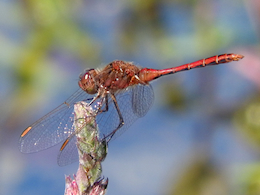
Spotted Spreadwing (Lestes congener)

Another ode season is over. Ottawa had some beautiful warm weather during the month of October – there were 26 consecutive days where the daytime high reached 9°C or above (between October 1st and 26th), tying for the 5th longest streak on record. As a result of the warm weather, I thought this would be the year I’d find more species flying later. Our first frost of the season occurred on October 16th with an overnight low of -1°C; this is a week later than the average first frost date. Then a warm spell hit late in the month – October 30th reached a ridiculous high of 22.2°C and October 31st hit 23.9°C, the warmest such days since records began in 1872. The month was mostly dry, with very little rain until the 29th.

November was cooler, though daytime temperatures remained above zero throughout the entire month. It’s not the day-time high that limits the dragonfly season in Ottawa, however; rather, it’s the nighttime lows falling below freezing. While the latest-flying dragonfly, the Autumn Meadowhawk, can withstand a few light frosts, a hard frost will kill both it and the flying insects it feeds on even if subsequent days reach double-digits. November 2nd and 3rd were both below -3°C, while November 9th and 10th were both below -2°C. A string of subzero nights after November 11th followed by warmer but cloudy, windy or wet days after November 20th ended the dragonfly season for good.

Continue reading “Last Odes on the Wing: October and November 2024”

Road Trip: Odes in Nova Scotia

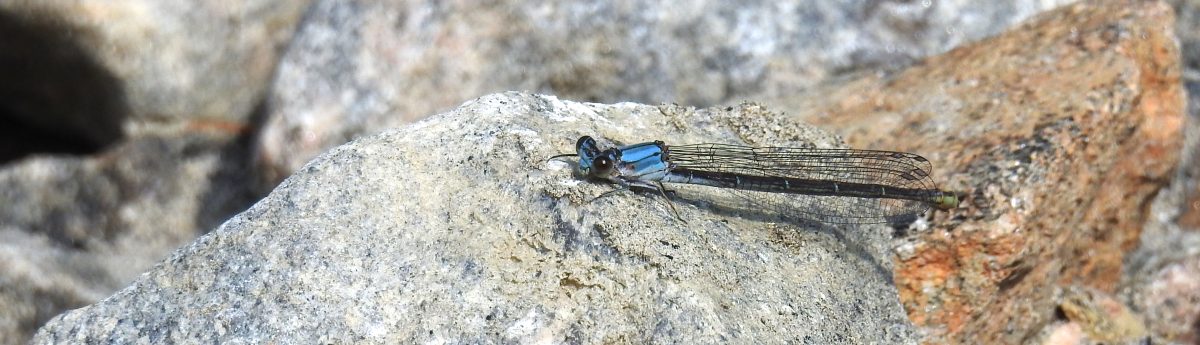
Familiar Bluet

We left P.E.I. via ferry, crossing from Wood Islands to Caribou after dinner. It was dark by the time we arrived at Seabank House in Pictou, a beautiful Victorian bed-and-breakfast overlooking the harbour that looked like something out of a Stephen King movie. In reality this 1854 building was quite charming inside, featuring spacious rooms, stained glass windows, and a grand staircase. This was our favourite accommodation of the trip (not including the AirBnB we stayed at in the Annapolis Valley). We stayed in the Hummingbird Suite with its two canopy beds, and enjoyed a breakfast of Eggs Benedict and fruit and yogurt the following morning. I was hoping to go for a walk along the harbour and look for sea and water birds for my county list before we left, but it was quite foggy outside and I couldn’t see much so I skipped it.

Continue reading “Road Trip: Odes in Nova Scotia”

A New Dragonfly at Roger’s Pond

Halloween Pennant

Marlborough Forest is always a fun place to visit, and after failing to find any Brush-tipped Emeralds at Jack Pine Trail earlier this week I decided to go to the E6 trail and Roger’s Pond this morning to see if I could find any of these unique Somatochlora emeralds there. Unfortunately that was not to be the case, but I had a great time and found a nice selection of odes while I was there. At Trail E6 I found many of the usual species, including Racket-tailed Emeralds, Frosted Whitefaces, and White-faced Meadowhawks.

Continue reading “A New Dragonfly at Roger’s Pond”

Odonates on the Wing: October and November 2023

Autumn Meadowhawk

By October I’m thinking about putting the net away for the season. If it is still warm at the beginning of the month, I will usually take the net out as long as I’m still seeing darners and small bluets around. Once I’m seeing nothing but meadowhawks, however, it’s time for me to declare an end to the season and put my gear away until the spring. This year the first week of October was very warm, with temperatures reaching 30°C; they then returned to seasonal for the next week with temperatures in the mid-teens. By the end of the month temperatures were in the single digits during the day and falling to below zero overnight, bringing an end to all but the hardiest of dragonflies. That title belongs to the meadowhawks, in particular the Autumn Meadowhawk (Sympetrum vicinum). It is no coincidence that it is the latest-flying dragonfly in many areas of the northeast….sometimes by several weeks. Once called the Yellow-legged Meadowhawk, it was renamed in 2004 by the Dragonfly Society of the Americas because mature individuals often have brown legs instead of yellow and because it persists so long into the fall. It is the only dragonfly in our area with entirely brown or yellow legs (never black), making identification relatively easy. And it is the only species you are likely to see in Ottawa in November!

Continue reading “Odonates on the Wing: October and November 2023”

Odonates on the wing: September 2023 Summary

Band-winged Meadowhawk

Although technically still considered summer until the equinox, the month of September ushers in the beginning of fall, the season most associated with change and impermanence, with encroaching darkness, with death and transition and the melancholy appreciation of the last burst of colour before the inevitable bleakness of winter. I can’t help but be reminded that this is the season of endings every time I go outside: the robins are gone from the neighbourhood, the songbirds in the woods have stopped singing, trees are changing colour, and the asters and goldenrods have replaced all the other wildflowers along roadsides and in conservation areas. In the dragonfly world, it is the season of the meadowhawk, the glider, and the darner, as these types of dragonflies are by far the most numerous. The goal now is to search out any others that may still be flying, and see how long into the season they last. Part of the reason is purely scientific – to get a better grasp of the flight seasons of local odonates. However, another part of the reason is purely emotional – I never know if a sighting will be the last of the year, and hope to put off the final goodbyes as long as possible.

Continue reading “Odonates on the wing: September 2023 Summary”

The Odes of Late Summer

Green-striped Darner (male)

By mid-August most dragonfly species are on the wane. A few families are still quite abundant, particularly the darners and meadowhawks, while small numbers of other skimmers and a few clubtails often linger into September. Forktails, bluets, and some spreadwings are also still common in the appropriate habitats in August and September. This makes it worth going out to good dragonfly habitats such as large rivers, lakes and marshes to see a decent variety of species.

Large dragonflies this time of year are particularly interesting; while Common Green Darners are the most frequently encountered large dragonflies of late summer, you might come across a Black-shouldered Spinyleg basking on the rocks along the river, a Wandering Glider zipping over a meadow, a Twelve-spotted Skimmer flying above a pond, or a group of mosaic darners swarming through the air late in the afternoon. The mosaic darners are a particular favourite of mine; they are large brownish-black dragonflies with mottled spots of blue, green or yellow depending on the sex. While they spend most of their time flying through the air hunting for small insects, I often come across them perching vertically on thick stalks of vegetation below knee-height in open grassy areas early in the morning. We have several different species in Ottawa, and trying to find something other than the ubiquitous Canada and Lance-tipped Darners is a fun exercise.

Continue reading “The Odes of Late Summer”

Amber and Saffron Wings

Saffron-winged Meadowhawk

It’s been a good season for hard-to-find dragonflies at the Eagleson Ponds. Ever since I discovered both Eastern Amberwings and Saffron-winged Meadowhawks here in 2017 I’ve been spending more time here later in the day looking for odes, rather than doing a quick search for birds first thing in the morning before heading elsewhere. The Covid-19 pandemic has made that even easier for me, as I am still working from home and can get out at lunch time for a quick check when the temperature has warmed up enough for many odes to be flying.

Mid-summer seems to be the best time for seeing a variety of odes at the ponds. While I have seen a few early-season species here, such as the Taiga Bluet and Spiny Baskettail, most odes that breed here don’t emerge until later in the summer. I’m not sure if the late start to spring had anything to do with it, but up until the end of June I found very few dragonflies here – skimmers are usually abundant throughout the season, but on June 30th I recorded a single Dot-tailed Whiteface and a single Twelve-spotted Skimmer along with a couple of Common Green Darners and Prince Baskettails that refused to land. Even the Eastern Forktails seemed down in numbers.

Continue reading “Amber and Saffron Wings”

September Odes – A Summary

Shadow Darner

By the time September rolls around, most odonate species are done for the year in the Ottawa region – gone are the Aurora Damsels and Elegant Spreawings, the Spiny Baskettails and Ebony Boghaunters, the Arrowhead Spiketails and Horned Clubtails, the Chalk-fronted Corporals and Four-spotted Skimmers. This is the time of year when the number of meadowhawks and darners begin to peak, and southern species such as Spot-winged and Wandering Gliders may blow into our region with the warm south winds. A few bluet and spreadwing species may persist, as well as the common and widespread Eastern Forktail, though each day sees fewer and fewer individuals. This is a summary of species I saw and photographed around Ottawa during September 2019 – due to my trip to Edmonton and some cool, cloudy weekends, I didn’t visit as many places as I had hoped and missed a few common species.

Continue reading “September Odes – A Summary”

Late Summer Dragons at the Ponds

Eastern Amberwing

August isn’t my favourite month to go dragon-hunting; in our region, a number of species have already vanished for the year, including several of my favourite clubtails and emeralds, cruisers and spiketails. August, then, is a season of skimmers and darners, and as such, places like the Eagleson storm water ponds are good places to go dragon-hunting, as these are the most common families of dragonflies that breed here (of the other families mentioned above, only the emeralds are present, and only members of the genus Epitheca, the baskettails). I’ve spent much of my free time this month at the storm water ponds, not just looking for butterflies, but also for new species of odes. It was only two years ago that I discovered new populations of Eastern Amberwings and Saffron-winged Meadowhawks breeding here, and as a number of common species are still scarce or still missing, it is worth checking to see if any have made their way here yet. For a habitat that is quite similar to that of Mud Lake or the ponds at Andrew Haydon Park, it is curious to me that there are no Powdered Dancers, no Horned or Lancet Clubtails, no Halloween or Calico Pennants, no Blue Dashers, and very few Widow Skimmers, Dot-tailed Whitefaces, Eastern Pondhawks, and Common Whitetails. Even spreadwings and dragonflies as abundant as the Autumn Meadowhawk are difficult to find. This is why it is such a surprise that uncommon species such as Eastern Amberwing and Saffron-winged Meadowhawk have become quite common here in late summer.

Continue reading “Late Summer Dragons at the Ponds”

The Odes of Andrew Haydon Park – 2019 edition

Halloween Pennant

Back in 2015 I wrote a blog post about the odonates I found at Andrew Haydon Park one weekday afternoon near the end of July. Since discovering the colony of Halloween Pennants at AHP in 2014, I’ve made it a point to visit this park each year during mid-summer; it’s much closer than travelling all the way to Morris Island to see this stunning dragonfly! So far I’ve only made it out to Morris Island once this year, and when I found no Halloween Pennants flying along the causeway I decided to visit Andrew Haydon Park specifically to search for this species. With the strange, slow start to the season I was bit apprehensive about whether these odes would even be around at AHP, but thankfully I found a few on each of my visits, and in good numbers, too.

Continue reading “The Odes of Andrew Haydon Park – 2019 edition”

Eastern Amberwings

Eastern Amberwing

On July 18th I headed over to the Cedar Grove Nature Trail in Marlborough Forest, as a summer visit was long overdue.  After a disappointing visit in June, when a lot of odes and butterflies seemed to be late due to the prolonged cold weather, I was hoping to find some of the early species still flying.  To be honest, I had no idea whether insect emergence was still late or back on track, or whether I would even see some of the specialties I was hoping for – such as Calico Pennant, Brush-tipped Emerald, Aurora Damsel, Silvery Checkerspot, fritillaries and more.  Regardless, I was looking forward to a change of scenery, and would be happy with whatever I saw.

There weren’t many birds of note, although I was surprised to hear both a Blue-headed Vireo and a Black-throated Green Warbler still singing.  It was after 1:00 p.m. by the time I arrived, so not only was it late in the season, but also late in the day. A pair of female or immature Hooded Mergansers near the bridge was a surprise; this was the first time I had seen this species on the pond. 

Continue reading “Eastern Amberwings”

Kristina Kiss Park

Saffron-winged Meadowhawk

Late this past winter I discovered a new place for birding in my own neighbourhood: Kristina Kiss Park. It really isn’t much of a park; there’s a soccer field at the northern end (Kristina Kiss is a famous Canadian soccer player from Ottawa), a playground at the southern end, and the two are connected by a footpath that runs next to what I consider its most interesting feature: a channel of water that eventually drains into the Eagleson storm water ponds. Last winter I was driving through the area one day when I noticed what looked like an ice-covered pond behind the soccer field. Sure enough, there is a pond in the northeastern corner of the park according to Google maps. When March came and the ice melted, I found my first Killdeer of the year here, and I thought it could be interesting for shorebirds later in migration. However, as the spring progressed, the pond dried up and revealed itself as a large square patch of gravel with no apparent purpose but to collect the run-off from rainwater and snow-melt. The water channel that runs between the footpath and the houses on the next street over turned out to be more interesting, though it was choked with cattails in most places – there were muskrat push-ups scattered throughout, and when the spring returned, I found many of the more common city birds nesting within the vicinity: House Finches, robins, grackles, Red-winged Blackbirds, even a pair of Tree Swallows nesting in a nest box in one of the backyards!

Continue reading “Kristina Kiss Park”

To Catch a Wandering Glider

I had a fabulous outing in Stony Swamp this morning. I started the morning by birding at Sarsaparilla Trail where I found a pair of Pied-billed Grebes and a Merlin perched in one of the dead trees at the north end of the pond; it was so far off that I had to return to the car and get my scope to identify it. I was glad I had brought my scope, for as I was scanning the vegetation along the shoreline I discovered two heron species skulking at the edge of the pond: a tiny Green Heron poised on a log, and an American Bittern that was almost invisible in a gap in the reeds! It made me wonder what other birds were present, going about their lives while remaining hidden from view.

Continue reading “To Catch a Wandering Glider”