Burritt’s Rapids has been on my radar as a low-priority place to visit for about a year now, and if I hadn’t missed a turn on my way to the southwestern corner of Marlborough Forest I wouldn’t have ended up there on a nice warm day in mid-July. I had been curious about what species I might find at the rapids there, and was hoping to find a few new species to add to iNaturalist as it didn’t have many when I first started thinking about going there. One species I was curious about was Swamp Spreadwing, which had been found a short distance east at Rideau River Provincial Park back in 2022. The only place I’ve seen this species in Ottawa is Petrie Island, and it would be fantastic to find another one closer to home. I was also wondering if the river and rocky rapids might host some of our common clubtails, such as Dragonhunter or Black-shouldered Spinyleg.
This weekend promised to be the hottest one of the year – over 30°C with humidity that made being outdoors feel like being smothered in a wet sheet. I went out early Sunday morning to Sheila McKee Memorial Park, hoping to find more clubtails and perhaps an interesting darner or emerald. As it was already 10:00 when I got there, I went down to the beach first because I thought it would get more crowded later and because the sun hits the shoreline at the base of the escarpment early in the morning – a vital factor when looking for uncommon dragonflies sitting on sun-drenched leaves.
On Saturday, June 14, 2025 Derek Dunnett and I led a combined birding and dragonfly outing at Murphy’s Point Provincial Park for the Ottawa Field-Naturalists’ and McNamara Field Naturalists’ Clubs. It was restricted to 20 people for carpooling purposes (the park roads are quite narrow for parking) and 18 showed up altogether. Unlike our trip last year, the weather was perfect: cool and sunny in the morning, hot and sunny in the afternoon with a hint of a breeze. Our targets this year included Cerulean Warbler (which had been heard singing earlier in the week), Blue-winged Warbler, and Golden-winged Warbler, while our odonate targets included the diminutive Elfin Skimmer and various stream odonates. Last year the trip had been postponed several times due to rain, and we missed the Blue-winged Warbler, Golden-winged Warbler, and Elfin Skimmer as by the time we had visited (July 7) it was late in the breeding season and the weather for ode-hunting (thickly overcast in the morning) was less than ideal.
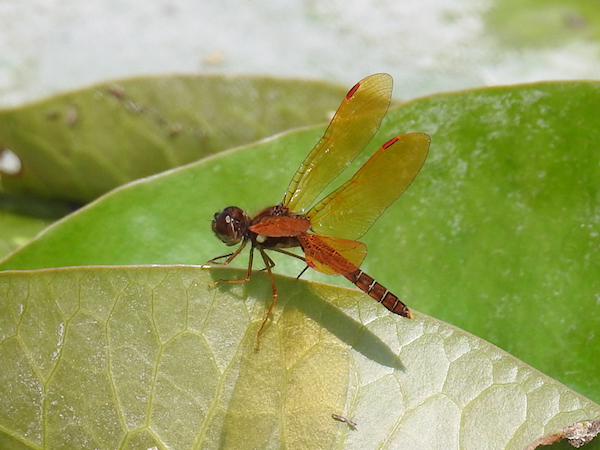
The Amber-winged Spreadwing at Bruce Pit wasn’t the only good find there on July 14th. Back on July 6th I’d found a different sort of amber-wing: an Eastern Amberwing, one of our smallest dragonflies. I’d also found and photographed a Halloween Pennant, a species I’d seen flying over the water last year but hadn’t managed to find perching. I observed both species on the slope between the fence and the edge of the pond, and both were new for my Bruce Pit list. I asked Chris Lewis if she had seen either species there before, and she told me she had seen Halloween Pennant there in the past, but not Eastern Amberwing – no surprise there, since this is a relatively new addition to the Ottawa area. When I headed over to Bruce Pit after finding the Amber-winged Spreadwing at Bill Teron Park on July 14th, it was to see if I could find any more Eastern Amberwings or Halloween Pennants and get some better photos.
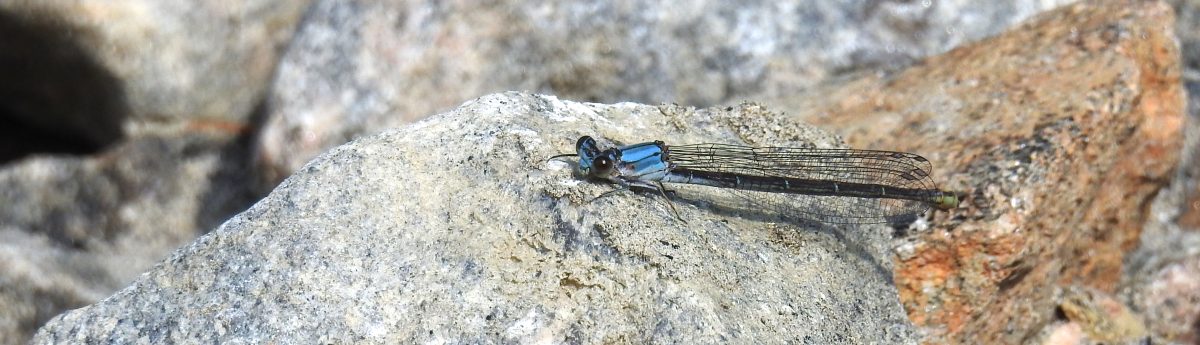
On August 4, 2020 I was surprised to find a Violet Dancer on a dirt trail at the Eagleson ponds. The closest place I’ve ever seen this species to home is out near Morris Island, so it was a shock to find one practically in my own backyard. Then in 2022 I found a few near the Jock River behind the former Richmond sewage lagoons. This suggested where the one at Eagleson might have come from – still a fair distance for a tiny damselfly, but not insurmountable if the winds are blowing the right way. I didn’t expect to see another one there any time soon; if anything, Powdered Dancer was next on my list of species I expected to show up there, because they are much more abundant and widespread along the Ottawa and Rideau Rivers than the Violet Dancer, and breed at the same location on the Jock River behind the former Richmond sewage lagoons. However, when I took a walk there on July 16 after work, it was the first odonate I found, resting on the rocks near the bridge.
On July 1st I spent the morning at Sheila McKee Memorial Park with the full intention of heading out to Pinhey’s Point afterward. My goals were to get to Sheila McKee early enough to look for the Yellow-throated Vireo and Yellow-billed Cuckoo that had been found there recently, then look for dragonflies in the open meadow and along the river shore. I was hoping to find another Mustached Clubtail, or perhaps an Arrow Clubtail, or the first Cobra or Midland Clubtails of the season. It was a bit cool in the morning, so I waited until 8:30 am to leave. When I got there just before 9:00 there were already several cars in the parking lot, and by the time I headed out to the road to listen for the elusive cuckoo a cavalcade of cars was turning into the parking lot from Sixth Line Road.
Last year I spent a cloudy Sunday morning in the south end of Marlborough Forest, looking for for new parts of Marlborough Forest to explore as there were very few odonate records on iNaturalist from that area. I visited four places that looked intriguing on Google Map: an unmaintained trail extending beyond Mulholland Road at Harnett Road; a large wetland further south on Harnett Road directly accessible by car; another unmaintained trail beyond Weedmark Road off of Paden Road; and the Paden Road trail itself. I had hoped to have time to explore Heaphy Road on the western boundary, as Google Maps shows it running through another big wetland and crossing over a large creek before encountering more wetlands. I wasn’t sure what the creek looked like in this area, whether it was a slow, deep, muddy, meandering waterway like the Jock River or if it was a narrow, rocky, fast-flowing stream like those I had seen recently in Nova Scotia. Fast-flowing waters provide habitat to a different variety of odonate species than the slow-moving streams and marshy ponds that make up much of Ottawa county, and I was hoping that there was a fast enough flow to attract jewelwings, clubtails, and perhaps even a spiketail. So far all that had been recorded in that area was Sedge Sprite, Common Whitetail, Dot-tailed Whiteface, and Common Green Darner, all very abundant and widespread species in Ottawa.
After leaving Mud Lake I went to Sheila McKee Memorial Park to try my luck there. I was hoping that the whitefaces would still be flying, as I wanted to find some fully mature individuals after seeing so many tenerals and immatures right before my trip to the Maritimes, and I was hoping that some clubtails had emerged. It was still sunny, only about 18°C, and while the wind was still blowing, the small clearings in the woods at the top of the escarpment were relatively protected. I didn’t see any odes other than a few Powdered Dancers until I reached the main clearing where the trail leading down to the water branches off to the right. Some smaller dragonflies were perching in shrubs at the edge of the clearing, and I was delighted to find some freshly emerged Blue Dashers – both males and females!
My mother lives in Wallaceburg in Chatham-Kent, which is about a 7.5 hour drive from Ottawa, or a full day train adventure with a transfer in Toronto (my advice for anyone travelling economy on Via: take your own sandwiches and snacks, as the menu was somewhat unpalatable…and chocolate bars/chips alone were $3.00). Being so far south she gets a variety of birds, bugs and plants that we do not get here in eastern Ontario, so I’ve been meaning to visit in the summer when I might see some new southern butterflies and dragonflies for my life list. I took an extra two days off at the end of August so I could spend the Labour Day long weekend with her, though two of the days were lost to travel. As my mother and her husband both enjoyed birds and nature, I knew they’d be interested in taking a few nature walks with me, even if the idea of looking for dragonflies didn’t exactly fill them with delight.
When I first heard about the Odolympics – a special bioblitz hosted by the Dragonfly Society of the Americas, Sociedad de Odonatología Latinoamericana, and Odonata Central in order to record as many odonata species from as many places in the Western Hemisphere as possible – I knew I had to participate. This specialized bioblitz is only two years old, and there are usually two Odolympics each year: one falling during the North American summer, and one falling during the South American summer in order generate a snapshot of odonate distribution throughout both hemispheres.
Dragonflies and damselflies, collectively known as odonates, are valuable indicators of a wetland’s environmental health and biodiversity. Simply put, the more odonates that use a wetland for breeding and feeding purposes, the healthier the ecosystem. Naturalists were encouraged to submit their observations during the bioblitz via one of two platforms: iNaturalist, or Odonata Central. While I love iNaturalist and have been using it for a few years now to record my non-avian observations, I began submitting my observations to Odonata Central last year when it developed a checklist-based phone app similar to eBird. iNaturalist also has a phone-based app for submitting observations, but it is intended to be used in conjunction with the phone’s camera which I only use as a backup camera when my Nikon Coolpix’s battery decides to take a nap. Although I love the ease of searching for data in iNaturalist’s projects, I chose to record my Odolympic observations in Odonata Central as it allowed me to include observations of species for which I am usually unable to get a photo (yes, I’m looking at you, Prince Baskettail and Wandering Glider!)
It was only six weeks ago that I last added a new species to the Eagleson storm water ponds ode list, the River Jewelwing that mysteriously showed up for one day back on June 10, 2023. I wasn’t expecting to find another new species so soon, but that is exactly what happened when I went for a walk there this afternoon. My goal was to look for the diminutive Eastern Amberwings, a species that I would have looked for earlier in the month had I not been in Nova Scotia. This colony first showed up in 2017 and its numbers have been increasing in the southern ponds over the last six years. I was happy to find four males perching on the lily pads on my visit; it appears they are still thriving here.
Eastern Amberwing
I saw Orange Bluets here for the first time this year on July 3, 2023, and I was hoping to find a few close enough to the shore to get a good photo. This is the second season that I’ve confirmed their presence here, and I was disappointed not to find any on this visit.
I saw Blue Dashers here for the first time this year on July 7, 2023; this is also only the second year that I’ve seen them here, and I counted at least eight of them around the two southern-most ponds. They are so beautiful and colourful when fresh – I can’t imagine ever becoming so used to them that I don’t want to stop and admire them, especially when they are sitting on a such a lovely perch.
Blue Dasher
I saw a male and female Common Whitetail flying over the pond together; the female was ovipositing. A White-faced Meadowhawk and a Band-winged Meadowhawk were nice to see, though the Band-winged Meadowhawk didn’t stick around long enough for photos. I’ve been keeping an eye out for Saffron-winged Meadowhawks, a species that was common here in 2020 but has been diminishing in numbers ever since – I only found two in 2021 and one in 2022. I didn’t see any on this walk, making me wonder if the population has died out. Its season lasts until September, so it is not too late to keep looking for this species.
A Slender Spreadwing was the only other odonate of interest, other than the Eastern Forktails that are usually too numerous to count.
I finished my walk with a loop around the Hope Side pond, stopping at the bridge where I took a moment to scan the water toward the overpass. I’ve seen muskrats swimming and dragonflies flitting among the vegetation here, and almost immediately something small and black fluttering in the tunnel formed by the cattails toward the bridge. When I got my binoculars on it I saw a male Ebony Jewelwing sitting in the sun!
Ebony Jewelwing
Ebony Jewelwings are usually found at woodland streams, preferring those with rapids although they may be found at shaded, slow-moving streams as well. The area it was inhabiting at the Eagleson ponds is no more than a shallow channel that drains water from the ponds into a narrow waterway running alongside a patch-work of fields before entering the Jock River at Terry Carisse Park. But since a River Jewelwing has already found its way up here perhaps I shouldn’t be surprised that this Ebony Jewelwing had followed. This is ode species #36 for the ponds – a terrific number for such a small area and limited habitat.
On Saturday, July 3rd I accompanied the McNamara Field Naturalists on their first in-person outing since the latest Stay-at-Home Order ended on June 2nd. Ontario entered Stage 2 of its reopening plan on July 2nd, which raised the number of people who could attend outdoor social gatherings and organized public events to 25 people (as well as allowing haircuts and personal care services again). Although I am not a member of the McNamara Field Naturalists Club, which calls Arnprior home but whose explorations include a large swath of the Ottawa Valley, one of my friends happens to be in charge of putting field trips together, and asked if I wanted to help lead a dragonfly walk. I said yes, and suggested Morris Island as it’s a great place to find all sorts of odes, including several flashy skimmers and clubtails that can be found perching in the vegetation and along the trails. I was thrilled when my mentor Chris Lewis joined us, as it would be easier to find some more of the unique species with a couple of knowledgeable people looking.
Back in 2015 I wrote a blog post about the odonates I found at Andrew Haydon Park one weekday afternoon near the end of July. Since discovering the colony of Halloween Pennants at AHP in 2014, I’ve made it a point to visit this park each year during mid-summer; it’s much closer than travelling all the way to Morris Island to see this stunning dragonfly! So far I’ve only made it out to Morris Island once this year, and when I found no Halloween Pennants flying along the causeway I decided to visit Andrew Haydon Park specifically to search for this species. With the strange, slow start to the season I was bit apprehensive about whether these odes would even be around at AHP, but thankfully I found a few on each of my visits, and in good numbers, too.
On August 26th I joined Eastern Ontario Birding’s trip to Presqu’ile Provincial Park. The owner of EOB, Jon, is a friend of mine and got more than he bargained for when he agreed to pick me up at 5:30 am – as soon as he pulled up in front of my house a police car pulled up beside him to ask if he knew anything about a complaint that had been called in. Jon told the officer he was there to pick up a friend to go birding, and the police officer told him that he believed him (the eBird sticker on his car probably hadn’t gone unnoticed, and lent credibility to his statement). The police car drove off just as I was heading out the door, but we saw it stop with two other cruisers on Grassy Plains. Emerald Meadows is a quiet neighbourhood, and I certainly didn’t hear anything at 4:30 in the morning, but it made for a strange start to the day.
The August long weekend is here, and it’s been brutally hot and humid. Temperatures have reached as high as 32°C with a humidex of 41. It didn’t feel quite so hot yesterday, but today was awful. The sun was relentless, and there was no cooling breeze to provide relief. Being in the shade helped, but even so, I didn’t feel like staying out for very long.
We haven’t had much rain in the last month, so the water levels of the Ottawa River have dropped and mudflats are developing in Shirley’s Bay and Ottawa Beach. I wanted to look for shorebirds, but Shirley’s Bay didn’t sound too appealing – a long mosquito-infested walk through the woods to get to the dyke, which is almost completely open to the baking sun – all the while carrying a scope that sometimes feels like it weighs as much as I do. So yesterday I drove over to Andrew Haydon Park instead.








 OdoNotations