Road Trip: Odes in Nova Scotia

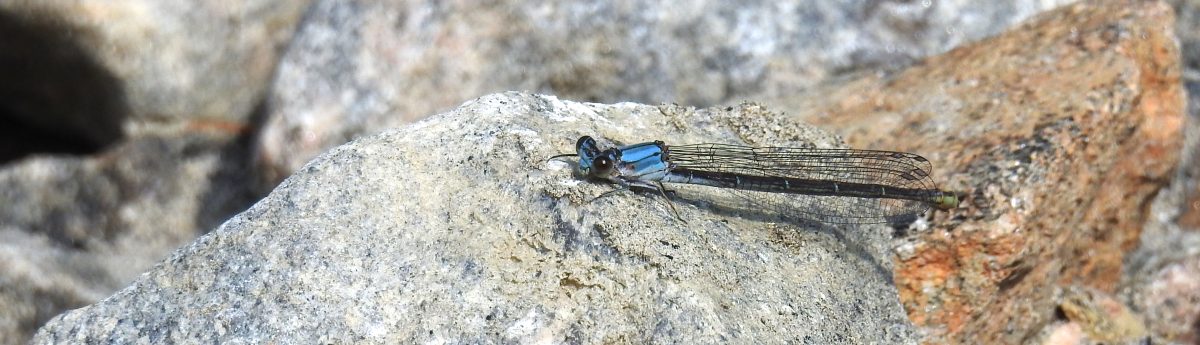
Familiar Bluet

We left P.E.I. via ferry, crossing from Wood Islands to Caribou after dinner. It was dark by the time we arrived at Seabank House in Pictou, a beautiful Victorian bed-and-breakfast overlooking the harbour that looked like something out of a Stephen King movie. In reality this 1854 building was quite charming inside, featuring spacious rooms, stained glass windows, and a grand staircase. This was our favourite accommodation of the trip (not including the AirBnB we stayed at in the Annapolis Valley). We stayed in the Hummingbird Suite with its two canopy beds, and enjoyed a breakfast of Eggs Benedict and fruit and yogurt the following morning. I was hoping to go for a walk along the harbour and look for sea and water birds for my county list before we left, but it was quite foggy outside and I couldn’t see much so I skipped it.

Continue reading “Road Trip: Odes in Nova Scotia”

Road Trip: Odes in P.E.I.

We only had one night on P.E.I. (which we spent at a hotel in Summerside across from the harbour) so we didn’t do a lot of hiking or exploring. We spent the day we arrived touring the western side of the island, where I thoroughly enjoyed the birds and views of North Cape, and the day of our departure exploring the eastern half. It wasn’t until the second day that I saw any odonates – we visited the Anne of Green Gables Museum and the birthplace of L.M. Montgomery, had lunch in Charlottetown, then drove across the island to East Point before catching the ferry at Wood Islands to Nova Scotia. When we reached the museum I immediately decided not to join my dad and step-mom on the tour: there was a pond on one side of the driveway, and a small marshy wet spot on the other. I could finally do some ode-hunting!

Marshy area at the Anne of Green Gables Museum
Continue reading “Road Trip: Odes in P.E.I.”

Odonates on the wing: September 2023 Summary

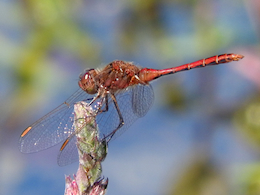
Band-winged Meadowhawk

Although technically still considered summer until the equinox, the month of September ushers in the beginning of fall, the season most associated with change and impermanence, with encroaching darkness, with death and transition and the melancholy appreciation of the last burst of colour before the inevitable bleakness of winter. I can’t help but be reminded that this is the season of endings every time I go outside: the robins are gone from the neighbourhood, the songbirds in the woods have stopped singing, trees are changing colour, and the asters and goldenrods have replaced all the other wildflowers along roadsides and in conservation areas. In the dragonfly world, it is the season of the meadowhawk, the glider, and the darner, as these types of dragonflies are by far the most numerous. The goal now is to search out any others that may still be flying, and see how long into the season they last. Part of the reason is purely scientific – to get a better grasp of the flight seasons of local odonates. However, another part of the reason is purely emotional – I never know if a sighting will be the last of the year, and hope to put off the final goodbyes as long as possible.

Continue reading “Odonates on the wing: September 2023 Summary”

The Odes of Late Summer

Green-striped Darner (male)

By mid-August most dragonfly species are on the wane. A few families are still quite abundant, particularly the darners and meadowhawks, while small numbers of other skimmers and a few clubtails often linger into September. Forktails, bluets, and some spreadwings are also still common in the appropriate habitats in August and September. This makes it worth going out to good dragonfly habitats such as large rivers, lakes and marshes to see a decent variety of species.

Large dragonflies this time of year are particularly interesting; while Common Green Darners are the most frequently encountered large dragonflies of late summer, you might come across a Black-shouldered Spinyleg basking on the rocks along the river, a Wandering Glider zipping over a meadow, a Twelve-spotted Skimmer flying above a pond, or a group of mosaic darners swarming through the air late in the afternoon. The mosaic darners are a particular favourite of mine; they are large brownish-black dragonflies with mottled spots of blue, green or yellow depending on the sex. While they spend most of their time flying through the air hunting for small insects, I often come across them perching vertically on thick stalks of vegetation below knee-height in open grassy areas early in the morning. We have several different species in Ottawa, and trying to find something other than the ubiquitous Canada and Lance-tipped Darners is a fun exercise.

Continue reading “The Odes of Late Summer”

Amber and Saffron Wings

Saffron-winged Meadowhawk

It’s been a good season for hard-to-find dragonflies at the Eagleson Ponds. Ever since I discovered both Eastern Amberwings and Saffron-winged Meadowhawks here in 2017 I’ve been spending more time here later in the day looking for odes, rather than doing a quick search for birds first thing in the morning before heading elsewhere. The Covid-19 pandemic has made that even easier for me, as I am still working from home and can get out at lunch time for a quick check when the temperature has warmed up enough for many odes to be flying.

Mid-summer seems to be the best time for seeing a variety of odes at the ponds. While I have seen a few early-season species here, such as the Taiga Bluet and Spiny Baskettail, most odes that breed here don’t emerge until later in the summer. I’m not sure if the late start to spring had anything to do with it, but up until the end of June I found very few dragonflies here – skimmers are usually abundant throughout the season, but on June 30th I recorded a single Dot-tailed Whiteface and a single Twelve-spotted Skimmer along with a couple of Common Green Darners and Prince Baskettails that refused to land. Even the Eastern Forktails seemed down in numbers.

Continue reading “Amber and Saffron Wings”

September Odes – A Summary

Shadow Darner

By the time September rolls around, most odonate species are done for the year in the Ottawa region – gone are the Aurora Damsels and Elegant Spreawings, the Spiny Baskettails and Ebony Boghaunters, the Arrowhead Spiketails and Horned Clubtails, the Chalk-fronted Corporals and Four-spotted Skimmers. This is the time of year when the number of meadowhawks and darners begin to peak, and southern species such as Spot-winged and Wandering Gliders may blow into our region with the warm south winds. A few bluet and spreadwing species may persist, as well as the common and widespread Eastern Forktail, though each day sees fewer and fewer individuals. This is a summary of species I saw and photographed around Ottawa during September 2019 – due to my trip to Edmonton and some cool, cloudy weekends, I didn’t visit as many places as I had hoped and missed a few common species.

Continue reading “September Odes – A Summary”

The Odes of Edmonton

Saffron-winged Meadowhawk

On September 18th I flew to Edmonton to visit my sister for a few days. Alberta is not a new province for me; my family had lived on an acreage outside of Ardrossan, which is east of Edmonton and Sherwood Park, for seven years from 1989 to 1996. As I was just teenager at the time, enduring all the drama and angst of high school, I had had no interest in nature back then – which is really too bad, as we’d lived on a small lot with a forest behind our house and a slough (a vegetated pond) across the road. When my parents and I moved back in 1996 – they to southern Ontario, via Tweed, and me and my fiancé to Ottawa – my sister remained behind, although it wasn’t until 2012 when I returned to attend her wedding.

My sister has since divorced and now lives in the north part of Edmonton, in a brand new development called Crystallina Nera. It is so new that there are no trees or gardens yet, several houses have not yet put down any sod, and houses are still being built nearby. This developments boasts a 4.8 hectare urban forest and a naturalized storm water pond, both of which I spent a lot of time exploring.

Continue reading “The Odes of Edmonton”

Late Summer Dragons at the Ponds

Eastern Amberwing

August isn’t my favourite month to go dragon-hunting; in our region, a number of species have already vanished for the year, including several of my favourite clubtails and emeralds, cruisers and spiketails. August, then, is a season of skimmers and darners, and as such, places like the Eagleson storm water ponds are good places to go dragon-hunting, as these are the most common families of dragonflies that breed here (of the other families mentioned above, only the emeralds are present, and only members of the genus Epitheca, the baskettails). I’ve spent much of my free time this month at the storm water ponds, not just looking for butterflies, but also for new species of odes. It was only two years ago that I discovered new populations of Eastern Amberwings and Saffron-winged Meadowhawks breeding here, and as a number of common species are still scarce or still missing, it is worth checking to see if any have made their way here yet. For a habitat that is quite similar to that of Mud Lake or the ponds at Andrew Haydon Park, it is curious to me that there are no Powdered Dancers, no Horned or Lancet Clubtails, no Halloween or Calico Pennants, no Blue Dashers, and very few Widow Skimmers, Dot-tailed Whitefaces, Eastern Pondhawks, and Common Whitetails. Even spreadwings and dragonflies as abundant as the Autumn Meadowhawk are difficult to find. This is why it is such a surprise that uncommon species such as Eastern Amberwing and Saffron-winged Meadowhawk have become quite common here in late summer.

Continue reading “Late Summer Dragons at the Ponds”

Kristina Kiss Park

Saffron-winged Meadowhawk

Late this past winter I discovered a new place for birding in my own neighbourhood: Kristina Kiss Park. It really isn’t much of a park; there’s a soccer field at the northern end (Kristina Kiss is a famous Canadian soccer player from Ottawa), a playground at the southern end, and the two are connected by a footpath that runs next to what I consider its most interesting feature: a channel of water that eventually drains into the Eagleson storm water ponds. Last winter I was driving through the area one day when I noticed what looked like an ice-covered pond behind the soccer field. Sure enough, there is a pond in the northeastern corner of the park according to Google maps. When March came and the ice melted, I found my first Killdeer of the year here, and I thought it could be interesting for shorebirds later in migration. However, as the spring progressed, the pond dried up and revealed itself as a large square patch of gravel with no apparent purpose but to collect the run-off from rainwater and snow-melt. The water channel that runs between the footpath and the houses on the next street over turned out to be more interesting, though it was choked with cattails in most places – there were muskrat push-ups scattered throughout, and when the spring returned, I found many of the more common city birds nesting within the vicinity: House Finches, robins, grackles, Red-winged Blackbirds, even a pair of Tree Swallows nesting in a nest box in one of the backyards!

Continue reading “Kristina Kiss Park”

Dragon-hunting at the Ponds

Eastern Amberwing (female)

I have never really spent much time looking for odes at the Eagleson storm water ponds, as most of my outings start there first thing in the morning when it isn’t hot enough for many dragonflies to be flying. However, after seeing the unidentified female spreadwing there on Saturday morning, I decided to head over on Sunday after my visit to the Old Quarry Trail. While I’ve seen Common Green Darners, Twelve-spotted Skimmers, Autumn Meadowhawks, Eastern Forktails, Tule Bluets, and Familiar Bluets there since the reconstruction, the arrival of the unidentified spreadwing and even the Delaware Skipper made me wonder whether other species had taken up residence recently. I wasn’t expecting anything too exciting or unusual, but I figured I might at least see some of the common pond skimmers found nearby at places like Bruce Pit and Stony Swamp. Perhaps I should have raised my expectations a bit, for what I found there surprised me!

Continue reading “Dragon-hunting at the Ponds”

Dragon-hunting at the Bill Mason Center

Azure Bluet
Azure Bluet

On August 7th I met up with Chris Lewis at Shirley’s Bay for a morning of birding and dragon-hunting. The morning got off to a great start when I saw a group of Wild Turkeys along Rifle Road even before I met Chris at the parking lot; there were two adults and a couple of baby turkeys. At Shirley’s Bay Chris and I tallied 44 species altogether, including a juvenile Osprey which landed in the Osprey nest down the road, five Common Terns and 11 Caspian Terns flying about, a Pectoral Sandpiper, a Semipalmated Sandpiper, a Solitary Sandpiper, and a single American Wigeon in the bay with the usual dabbling ducks, and a flock of migrating songbirds in the woods. The flock included a Yellow Warbler, a Chestnut-sided Warbler, a Black-and-white Warbler, and a couple of Gray Catbirds, and a Rose-breasted Grosbeak.

Continue reading “Dragon-hunting at the Bill Mason Center”

Marvelous Meadowhawks

Saffron-winged Meadowhawk

On August 16th Chris Lewis and I went to the Bill Mason Center to do some dragon-hunting. As the weatherman was predicting a steamy high of 30°C with 100% humidity, we met at 7:30 in the morning in order to beat the heat. For the second day in a row, a thick early-morning fog hung low over Ottawa, but once we arrived at the sand pit we found a bright, sunny morning with no trace of fog. It was really starting to warm up by then, but as it was still early in the day, all we saw at first were a couple of darners we accidentally scared up from the vegetation along the northwestern side of the pond. None were cooperative; instead of settling back down in a spot where we could see them, they zoomed off altogether.

Continue reading “Marvelous Meadowhawks”