The Odes of Late Summer

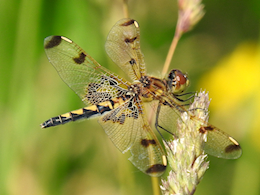
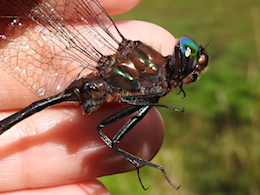
Green-striped Darner (male)

By mid-August most dragonfly species are on the wane. A few families are still quite abundant, particularly the darners and meadowhawks, while small numbers of other skimmers and a few clubtails often linger into September. Forktails, bluets, and some spreadwings are also still common in the appropriate habitats in August and September. This makes it worth going out to good dragonfly habitats such as large rivers, lakes and marshes to see a decent variety of species.

Large dragonflies this time of year are particularly interesting; while Common Green Darners are the most frequently encountered large dragonflies of late summer, you might come across a Black-shouldered Spinyleg basking on the rocks along the river, a Wandering Glider zipping over a meadow, a Twelve-spotted Skimmer flying above a pond, or a group of mosaic darners swarming through the air late in the afternoon. The mosaic darners are a particular favourite of mine; they are large brownish-black dragonflies with mottled spots of blue, green or yellow depending on the sex. While they spend most of their time flying through the air hunting for small insects, I often come across them perching vertically on thick stalks of vegetation below knee-height in open grassy areas early in the morning. We have several different species in Ottawa, and trying to find something other than the ubiquitous Canada and Lance-tipped Darners is a fun exercise.

Continue reading “The Odes of Late Summer”

Ode-Hunting in Early July

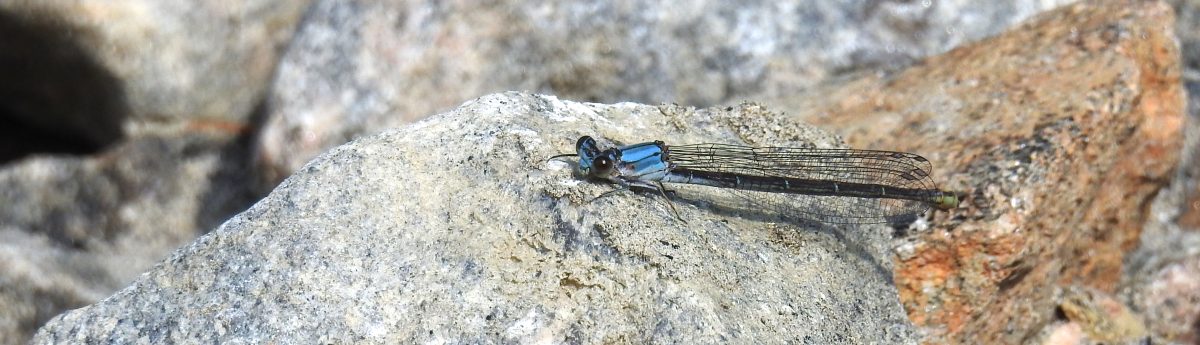
Taiga Bluet
Taiga Bluet

By early July a variety of dragonflies and damselflies are on the wing, although some of the early species – such as the Beaverpond and Spiny Baskettails – have already finished flying for the year. This is usually the time of year when I start focusing on odes on afternoon outings in addition to enjoying them as distractions on morning birding outings. While some of the best ode-hunting can be found along the Ottawa River (including Mud Lake, Andrew Haydon Park, Petrie Island, and Morris Island) there are some great spots in my own backyard, including Bruce Pit, Stony Swamp, and the Eagleson storm water ponds (which will be the focus of a separate post of its own). Bruce Pit is a particularly great spot for odes, and some unusual ones have turned up there including Swift River Cruiser, Black Meadowhawk and Black Saddlebags. Eastern Red Damsels used to breed there prior to 2010, and I decided to spend the afternoon of July 4th wading around the edges of Bruce Pit to see if I could find any. Unfortunately, the area where we used to see them (and odes such as Amber-winged Spreadwing and Saffron-winged Meadowhawk) has become overgrown with cattails and phragmites over the year, so I wasn’t sure it was possible to walk along the shore where we used to go a decade ago (I can’t believe it has been so long …. apologies to those who have never visited my old LiveJournal site, back in the days when I used to host my images on Photobucket which no longer allows free hosting and has hidden many of my images).

Continue reading “Ode-Hunting in Early July”

A trip to Morris Island with the McNamara Field Naturalists

Slaty Skimmer
Slaty Skimmer

On Saturday, July 3rd I accompanied the McNamara Field Naturalists on their first in-person outing since the latest Stay-at-Home Order ended on June 2nd. Ontario entered Stage 2 of its reopening plan on July 2nd, which raised the number of people who could attend outdoor social gatherings and organized public events to 25 people (as well as allowing haircuts and personal care services again). Although I am not a member of the McNamara Field Naturalists Club, which calls Arnprior home but whose explorations include a large swath of the Ottawa Valley, one of my friends happens to be in charge of putting field trips together, and asked if I wanted to help lead a dragonfly walk. I said yes, and suggested Morris Island as it’s a great place to find all sorts of odes, including several flashy skimmers and clubtails that can be found perching in the vegetation and along the trails. I was thrilled when my mentor Chris Lewis joined us, as it would be easier to find some more of the unique species with a couple of knowledgeable people looking.

Continue reading “A trip to Morris Island with the McNamara Field Naturalists”

New Dragonflies at Marlborough Forest

Kennedy's Emerald
Kennedy’s Emerald

The beginning of June arrived with plenty of warmth and sunshine, and I couldn’t wait to go back to Marlborough Forest at the peak of butterfly and dragonfly season to look for new species living there. Last year when I started going to Marlborough Forest in mid-June, I kept seeing large, dark dragonflies – almost certainly emeralds of some sort – zipping down the shadowy trail before the sun had fully risen above the trees. I never had my net on me when I saw them on my early-morning birding walks, so I was unable to catch one to verify their identity. This time I was prepared for these dawn-flying dragons, and brought my net with me. I had already added one dragonfly to my life list, the Ocellated Emerald at Trail E4 last year; was it possible that there were other species of interest here?

My first summer visit to Trail E4 occurred on June 6th. Although the morning started out cool, it quickly warmed up. The usual birds were singing along the trail, including all the Red-eyed Vireos, Eastern Wood-pewees, Eastern Kingbirds, Veeries, and the Tree Swallows that were missing from my mid-May visit. I heard seven warblers (Ovenbirds, Northern Waterthrushes, Black-and-whites, Nashvilles, Common Yellowthroats, Black-throated Greens, and a single Magnolia Warbler), two Chipping Sparrows, a Field Sparrow, and a Blue-headed Vireo singing in its usual spot in the large open area devastated by motor bikes and ATVs.

Continue reading “New Dragonflies at Marlborough Forest”

September Odes – A Summary

Shadow Darner

By the time September rolls around, most odonate species are done for the year in the Ottawa region – gone are the Aurora Damsels and Elegant Spreawings, the Spiny Baskettails and Ebony Boghaunters, the Arrowhead Spiketails and Horned Clubtails, the Chalk-fronted Corporals and Four-spotted Skimmers. This is the time of year when the number of meadowhawks and darners begin to peak, and southern species such as Spot-winged and Wandering Gliders may blow into our region with the warm south winds. A few bluet and spreadwing species may persist, as well as the common and widespread Eastern Forktail, though each day sees fewer and fewer individuals. This is a summary of species I saw and photographed around Ottawa during September 2019 – due to my trip to Edmonton and some cool, cloudy weekends, I didn’t visit as many places as I had hoped and missed a few common species.

Continue reading “September Odes – A Summary”

The Odes of Edmonton

Saffron-winged Meadowhawk

On September 18th I flew to Edmonton to visit my sister for a few days. Alberta is not a new province for me; my family had lived on an acreage outside of Ardrossan, which is east of Edmonton and Sherwood Park, for seven years from 1989 to 1996. As I was just teenager at the time, enduring all the drama and angst of high school, I had had no interest in nature back then – which is really too bad, as we’d lived on a small lot with a forest behind our house and a slough (a vegetated pond) across the road. When my parents and I moved back in 1996 – they to southern Ontario, via Tweed, and me and my fiancé to Ottawa – my sister remained behind, although it wasn’t until 2012 when I returned to attend her wedding.

My sister has since divorced and now lives in the north part of Edmonton, in a brand new development called Crystallina Nera. It is so new that there are no trees or gardens yet, several houses have not yet put down any sod, and houses are still being built nearby. This developments boasts a 4.8 hectare urban forest and a naturalized storm water pond, both of which I spent a lot of time exploring.

Continue reading “The Odes of Edmonton”

Late Summer Dragons at the Ponds

Eastern Amberwing

August isn’t my favourite month to go dragon-hunting; in our region, a number of species have already vanished for the year, including several of my favourite clubtails and emeralds, cruisers and spiketails. August, then, is a season of skimmers and darners, and as such, places like the Eagleson storm water ponds are good places to go dragon-hunting, as these are the most common families of dragonflies that breed here (of the other families mentioned above, only the emeralds are present, and only members of the genus Epitheca, the baskettails). I’ve spent much of my free time this month at the storm water ponds, not just looking for butterflies, but also for new species of odes. It was only two years ago that I discovered new populations of Eastern Amberwings and Saffron-winged Meadowhawks breeding here, and as a number of common species are still scarce or still missing, it is worth checking to see if any have made their way here yet. For a habitat that is quite similar to that of Mud Lake or the ponds at Andrew Haydon Park, it is curious to me that there are no Powdered Dancers, no Horned or Lancet Clubtails, no Halloween or Calico Pennants, no Blue Dashers, and very few Widow Skimmers, Dot-tailed Whitefaces, Eastern Pondhawks, and Common Whitetails. Even spreadwings and dragonflies as abundant as the Autumn Meadowhawk are difficult to find. This is why it is such a surprise that uncommon species such as Eastern Amberwing and Saffron-winged Meadowhawk have become quite common here in late summer.

Continue reading “Late Summer Dragons at the Ponds”

Ode-hunting in Prince Edward County

Calico Pennant

During the first week of July my fiancé and I spent some time in Prince Edward County with my dad’s family. We rented a cottage on Loves Lane on Prince Edward Bay, a nice three-bedroom place with 8 acres of land only 20 minutes away from both Sandbanks and Picton. The weather was beautiful, and I spent most of my time getting to know the local residents. On our first full day at the cottage (Monday, July 1st), I went for an afternoon walk on the property to see what I could find. It seemed to be a good spot for odonates; every now and then a couple of Prince and Common Baskettails flew in and started swooping above the deck. There were some other dragonflies present too, so I brought my net out in the hopes of catching one.

Continue reading “Ode-hunting in Prince Edward County”

Annual Trip to Pinehurst Lake CA

Williamson’s Emerald

In late August I took my usual trip to southern Ontario to see my Dad. As usual, we spent a few days at his trailer in the Pinehurst Lake Conservation Area. The birding was fine, although this time there were no flocks of migrants moving through; instead the birds still seemed busy with raising and feeding their young, even this late in the summer. For example, I saw a Red-eyed Vireo feeding a Brown-headed Cowbird, a young Indigo Bunting following its parent around, and a House Wren carrying food. We didn’t see the Broad-winged Hawk family this year either, which was disappointing. However, the insects were fascinating, and I found a lot to photograph.

Continue reading “Annual Trip to Pinehurst Lake CA”

A Shadow at Last

Shadow Darner

The Equinox fell on Thursday, and by then the winds were blowing down from the north, putting an abrupt end to summer. Although I quite love the crisp, cool days of fall, I hate the cold early mornings which require hats and gloves to stay warm. This morning I headed out to Jack Pine Trail, leaving at 8:15 – the sun is visibly lower in the sky now – and I wished I had brought gloves as my hands were so cold. A Blue Jay and some chickadees were feeding on seeds left on the ground in the parking lot, and it seemed strange not to hear any Red-eyed Vireos or Eastern Wood-pewees singing.

Continue reading “A Shadow at Last”

Searching for Darners

I spent some time today at Bruce Pit with the hope of seeing some darners there – ever since my trip to my Dad’s trailer in southern Ontario I’d been hoping to spend more time with some of these large, lovely dragonflies in Ottawa. Mud Lake can be a good place to find them, but I’d seen none earlier this morning, so I was thinking about other places where I might find them. I recalled that Chris Traynor had found a Variable Darner late in the season last year (September 18, 2015) along the hydro cut at Bruce Pit, and decided to head there next. My plan was to spend some time near the water looking for spreadwings and skimmers, then check out the hydro cut for darners. I didn’t find much around the water other than an abundance of Lyre-tipped Spreadwings, so I headed up into the grassy area at the edge of the toboggan slope.

Continue reading “Searching for Darners”

A Lifer Dragonfly at Pinehurst Lake

Green-striped Darner

During the third week of August I spent some time at my Dad’s trailer in the Pinehurst Lake Conservation Area near Glen Morris, Ontario. Although more of a campground/recreation area than a conservation area, it is nevertheless a great spot to spend a few days and see some “southern” wildlife. The last time I was here (August 2014) I was treated to the antics of a couple of juvenile Broad-winged Hawks, found a small pond where female Black-tipped Darners laid their eggs in the late afternoon, observed a Blue-winged Warbler on a morning walk, saw my first Red-spotted Purple butterfly, and even saw a bat near one of the washroom lights after dark. I didn’t see any Broad-winged Hawks or cool southern bird species this time, but I still ended up with 28 bird species over three days – the same number I saw in 2014 – and saw several interesting odes, including a lifer!

Continue reading “A Lifer Dragonfly at Pinehurst Lake”

The “Wild Ode West” Dragon-hunting Adventure

Widow Skimmer
Widow Skimmer

Chris Lewis and I had such a great time dragon-hunting in Gatineau last weekend that on June 25th we decided to hit several spots west of Ottawa to search for several local and unique species. On our list of locations were the Quyon Ferry Dock near Fitzroy to look for big river species, Morris Island for clubtails and skimmers, and Pakenham, Blakeney and Almonte for Rapids Clubtail. Before heading out to the Quyon Ferry Dock we stopped in at the fields near Constance Bay to look for Upland Sandpipers. We got lucky and found four. Not only did we see a couple of them flying over the fields, giving their distinctive call, we found one standing right on the shoulder of the road! Unfortunately we caused it to flush before I could get a photo of this bird; I still have yet to photograph this species. Indeed, this was the closest I’ve ever come to one of an Upland Sandpiper, which are difficult to find as they breed and feed in dry grasslands rather than muddy shorelines.

Continue reading “The “Wild Ode West” Dragon-hunting Adventure”

An OFNC outing at Petrie Island

Eastern Amberwing
Eastern Amberwing

On August 2nd, 2015 I led a dragonfly outing at Petrie Island for the Ottawa Field-Naturalists’ Club. Because I would be leading it on my own, and because the small size of dragonflies and damselflies makes it difficult to point them out to large groups, I decided to limit the group to ten people. Fellow dragon-hunters and Birds Committee members Chris Traynor and Lorraine Elworthy signed up for the outing, as did Jakob Mueller, who led the reptile and amphibian outing at Sheila McKee Park earlier in the year. I recognized Lynne Ovenden from the OFNC; the others were all unknown to me.

I started our outing by talking about the differences between dragonflies and damselflies, as well as the different groups belonging to each family. We would be looking for spreadwing damselflies, which hold their wings out at a 45° angle instead of parallel to their back; emeralds and darners, which are most commonly found flying through the air searching for aerial prey; and skimmers, which tend to hunt from a perch and are usually the most approachable types of dragonflies for photography. As I was speaking, a bright green female Eastern Pondhawk was hunting from a perch in the vegetation, often flying out to snatch an insect from the air. At one point it even landed on one of the group members!

Continue reading “An OFNC outing at Petrie Island”

Mid-summer

It’s hard to believe that it’s mid-summer now; July is over, August is here, and songbird migration is only a few weeks away. When it comes to insects, I’m not thinking as much about seeing the first species of the season as I am wondering whether each individual (except for the darners and meadowhawks) is my last of the season. There are some species I seem to have missed completely this year, such as Emerald Spreadwing (which has a flight season from mid-June to mid-August), Horned Clubtail (mid-May to early July), Stream Cruiser (late May to mid-July), and any of the hairstreak butterflies (the peak of their flight season occurs in the first half of July). This is the result of a combination of bad luck and bad weather; I missed most of these bugs when I went looking in places where I have seen them before, and when I wanted to return later, the cold, overcast and/or rainy weather on the weekends prevented me.

Continue reading “Mid-summer”