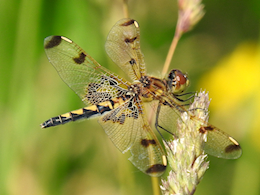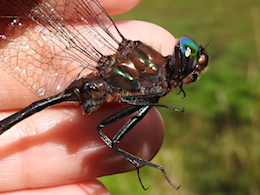
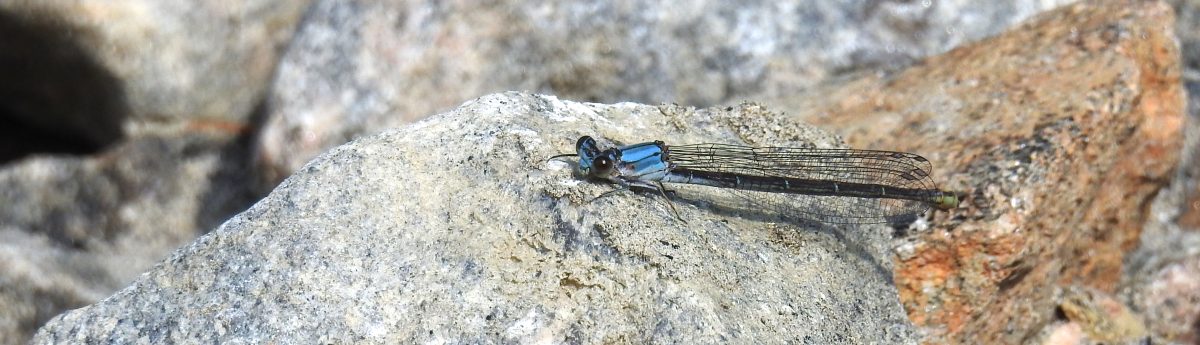

If the first half of June is great for seeing all kinds of pond damsels (Family Coenagrionidae), the latter half is great for seeing all sorts of spreadwings (Family Lestidae). They may not have the bright colours or the variety of hues of the pond damsels, but what the spreadwings lack in colour they make up for with their larger size and the beautiful metallic green colouration of some of the species. Adult male spreadwings are generally one of three colours: metallic green, black, or brown, each developing various amounts of bluish-gray pruinosity on the thorax and tip of the abdomen. They can be easily identified in the hand or in a photograph that clearly shows the tip of the abdomen viewed from above, as each species has paraprocts that are distinctly different in size and/or shape. On the other hand, females and tenerals are generally duller, browner, or sometimes even bronze or orange in colour. Much like female bluets, these spreadwings are difficult to identify in the field; though some can be examined and identified in the hand, others require a microscope. As such, I have never really delved into the difficulties of identifying female spreadwings.
Continue reading “‘Tis the Season for Spreadwings”