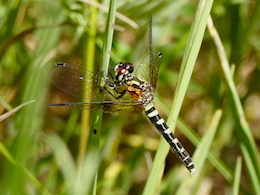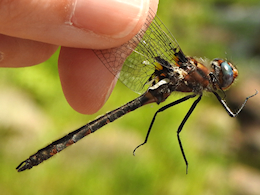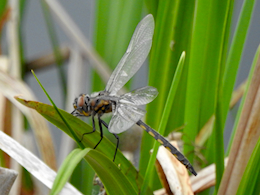
Odonata Highlights 2024

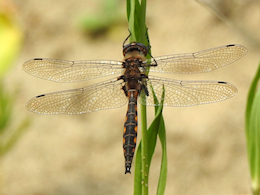
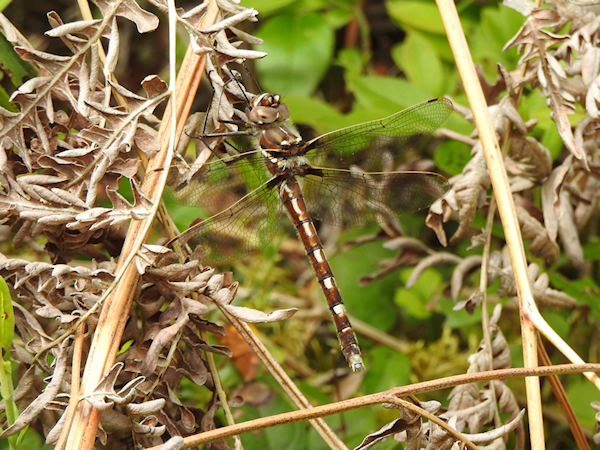
Mottled Darner

This year has been a good one for odonates. I have enjoyed ode-hunting in a few new provinces, discovered new parks and ponds right here in Ottawa, found lifers in three different provinces, re-discovered species I hadn’t seen in years, and added quite a few new species to places I thought I knew well. Despite the changing climate and weather systems that are occasionally severe enough to damage vulnerable ecosystems, odonates continue to survive and thrive in many parts of eastern Canada. Here are my top ten odonata highlights of the year.

Continue reading “Odonata Highlights 2024”

Last Odes on the Wing: October and November 2024

Spotted Spreadwing (Lestes congener)

Another ode season is over. Ottawa had some beautiful warm weather during the month of October – there were 26 consecutive days where the daytime high reached 9°C or above (between October 1st and 26th), tying for the 5th longest streak on record. As a result of the warm weather, I thought this would be the year I’d find more species flying later. Our first frost of the season occurred on October 16th with an overnight low of -1°C; this is a week later than the average first frost date. Then a warm spell hit late in the month – October 30th reached a ridiculous high of 22.2°C and October 31st hit 23.9°C, the warmest such days since records began in 1872. The month was mostly dry, with very little rain until the 29th.

November was cooler, though daytime temperatures remained above zero throughout the entire month. It’s not the day-time high that limits the dragonfly season in Ottawa, however; rather, it’s the nighttime lows falling below freezing. While the latest-flying dragonfly, the Autumn Meadowhawk, can withstand a few light frosts, a hard frost will kill both it and the flying insects it feeds on even if subsequent days reach double-digits. November 2nd and 3rd were both below -3°C, while November 9th and 10th were both below -2°C. A string of subzero nights after November 11th followed by warmer but cloudy, windy or wet days after November 20th ended the dragonfly season for good.

Continue reading “Last Odes on the Wing: October and November 2024”

A Darner Kind of Day

Variable Darner (Aeshna interrupta)

Today I went to Bruce Pit to see if anything was still flying around the edges of the pond and the field at the back. When I was here last weekend, there had still been three meadowhawk species and six damselfly species (Slender Spreadwing, Spotted Spreadwing, Azure Bluet, Familiar Bluet, Fragile Forktail and Eastern Forktail) still present, as well as an unidentified darner in flight over the water. With only two days left in the month I wasn’t expecting much, and indeed the wet vegetation at the edge of the pond yielded only three damselflies on this visit: Slender Spreadwing, Spotted Spreadwing, and Familiar Bluet. I also saw White-faced and Autumn Meadowhawks, but the Band-winged Meadowhawk from last weekend was gone.

I was pleasantly surprised when I saw at least two large darners zipping along the edge of the shore, especially when one flew low to investigate the reeds close to where I was standing. My net shot out, and the next thing I knew there was an angry buzzing sound coming from inside. I had caught a darner, and I was not really surprised to find a male Canada Darner inside.

Continue reading “A Darner Kind of Day”

Hunting the Elusive

Elusive Clubtail

Yesterday at 10:30 pm I received a message from Chris Traynor – he had been perusing iNaturalist and noticed that a few Elusive Clubtail observations had been reported on iNaturalist just that day and the day before! They were bright black and yellow adults, too, not the translucent beige tenerals we had seen emerging at Sheila McKee Park back in July. As a result, he decided to scour Petrie Island and perhaps Macoun Marsh for these elusive dragonflies – he had never seen the mature adult Elusive Clubtail and was eager to see one. Both Petrie Island and Macoun Marsh are repeat sites for this species.

His message fired my imagination. Elusive Clubtails have two noticeable mass emergences in Ottawa: once around Canada Day, and once around the fall equinox. Fresh adults may be seen around those times before dispersing into the tree tops where they apparently live, though it is more common to see tenerals fresh from emergence along the shoreline. I thought it sounded fun to look for mature Elusive Clubtails along the Ottawa River, though my initial plan was to check out the Carp River restoration ponds and see what bluets might be flying…I was keen to find another spot for Azure Bluets, and thought that I might see some gliders there.

Continue reading “Hunting the Elusive”

The 2024 Summer Odolympics

Autumn Meadowhawk (Sympetrum vicinum)

The 2024 North American edition of the Summer Odolympics were held between September 7-15, giving ode enthusiasts two weekends and as much time as a regular working week would allow to collect observations. I had hoped to find 19 or 20 species based on the same period spent collecting observations last year, but as most species are on the decline by this time, I knew I needed both good weather and good luck to come up with a respectful number. Unfortunately, neither luck nor weather were in my favour that first crucial weekend when I hoped to find a few species whose season ended around the beginning of September; it rained most of Saturday, and the temperature never rose above 15°C. Although it didn’t rain nearly as much on Sunday, the weather was worse: it was cloudy, windy, and the temperature never rose above 14°C. In fact, it was the coldest September 8th in more than 70 years (since 1949) and the windiest since records began in 1953 with a mean wind of 21 km/h. With a 1:00am windchill of 1.6 it was almost (within 0.1) the lowest windchill ever recorded on September 7th. Cold, wet, windy nights are even more of an obstacle, as many late-lingering species may not survive the low temperatures. When the sun began peeking out from the thick, fast-moving clouds around 4:30 I headed out despite the wind as to have zero species recorded on the first weekend was unthinkable. I didn’t expect much, and found only two species at the Eagleson ponds: an Eastern Forktail and a Slender Spreadwing.

Continue reading “The 2024 Summer Odolympics”

Preparing for the 2024 Odolympics

Shadow Darner

Last year I participated in my first Odolympics and had so much fun that I planned to do it again this year. The Odolympics is a special bioblitz hosted by the Dragonfly Society of the AmericasOdonata Central, and Sociedad de Odonatología Latinoamericana in order to record as many odonata species from as many places in the Western Hemisphere as possible. This specialized bioblitz is only three years old, and there are usually two Odolympics each year: one falling during the North American summer, and one falling during the South American summer in order generate a snapshot of odonate distribution throughout both hemispheres. The 2023 Summer Odolympics ran from August 19-27, giving observers two weekends to collect observations. Although late August is well past the peak of dragonfly diversity, I ended up counting 27 species, and photographed all but three. Even with the less-than perfect weather last year, I thought that 27 species for the end of August is pretty good, providing a much better snapshot of the odes on wing in Ottawa than I had anticipated. 

Continue reading “Preparing for the 2024 Odolympics”

Cherry-Faced Meadowhawks

Cherry-faced Meadowhawk

Cherry-faced Meadowhawks are much more common in Kings County, Nova Scotia than Ottawa. While I usually see several when I’m visiting the East Coast (in season), I hardly see them in Ottawa anymore. In my early days of ode-hunting I used to turn up males with deep red faces fairly regularly among the multitude of White-faced Meadowhawks, and I’d discovered a reliable population near the Hurdman transit station that persisted for several years. I don’t get there often anymore because it takes too long to get there from work now to make a leisurely lunch-time visit, so for all I know they are still there. It’s been a long time since I have even seen any potential candidates when I’m out ode-hunting in the west end; I think my last was a male in the ditch near near the Eagleson ponds several years ago.

Continue reading “Cherry-Faced Meadowhawks”

Road Trip: Odes in Nova Scotia

Familiar Bluet

We left P.E.I. via ferry, crossing from Wood Islands to Caribou after dinner. It was dark by the time we arrived at Seabank House in Pictou, a beautiful Victorian bed-and-breakfast overlooking the harbour that looked like something out of a Stephen King movie. In reality this 1854 building was quite charming inside, featuring spacious rooms, stained glass windows, and a grand staircase. This was our favourite accommodation of the trip (not including the AirBnB we stayed at in the Annapolis Valley). We stayed in the Hummingbird Suite with its two canopy beds, and enjoyed a breakfast of Eggs Benedict and fruit and yogurt the following morning. I was hoping to go for a walk along the harbour and look for sea and water birds for my county list before we left, but it was quite foggy outside and I couldn’t see much so I skipped it.

Continue reading “Road Trip: Odes in Nova Scotia”

Road Trip: Odes in P.E.I.

We only had one night on P.E.I. (which we spent at a hotel in Summerside across from the harbour) so we didn’t do a lot of hiking or exploring. We spent the day we arrived touring the western side of the island, where I thoroughly enjoyed the birds and views of North Cape, and the day of our departure exploring the eastern half. It wasn’t until the second day that I saw any odonates – we visited the Anne of Green Gables Museum and the birthplace of L.M. Montgomery, had lunch in Charlottetown, then drove across the island to East Point before catching the ferry at Wood Islands to Nova Scotia. When we reached the museum I immediately decided not to join my dad and step-mom on the tour: there was a pond on one side of the driveway, and a small marshy wet spot on the other. I could finally do some ode-hunting!

Marshy area at the Anne of Green Gables Museum
Continue reading “Road Trip: Odes in P.E.I.”

Road Trip: Odes in New Brunswick

Autumn Meadowhawk

My dad, who is almost 75, has always loved to drive. He’s been talking about a road trip to the east coast for a few years now, but in August 2024 we finally did it: he, my step-mother and I left Ottawa on August 10th for a two-week road trip covering Quebec, New Brunswick, P.E.I., and Nova Scotia. We had done a similar trip when I was 12, but that trip included a ferry ride to Newfoundland to visit family on my mother’s side as well. Newfoundland is still very much in my father’s plans, and he hopes (as do I) to visit it in a year or two.

As usual, it was my goal to get some nature study and photography in, too, but I knew this trip would feature lots of time spent driving and visiting tourist attractions – my Dad wanted to revisit his previous trips there, including his time in the Navy when he was a youth stationed in Nova Scotia, while my step-mother had never been east before. And with neither of them in peak health anymore, we would have to limit our time on the trails, though there were plenty of national and provincial parks I was interested in visiting.

Continue reading “Road Trip: Odes in New Brunswick”

A Rare Mottled Darner

Mottled Darner

Sheila McKee Memorial Park has been such an amazing spot for odes this year that when the weekend called for not one, but TWO clear days, I decided it was worth going back for a few hours and looking for more clubtails. I arrived around 10:00, and as usual a dragonfly had claimed the first sunny opening in the woods as its territory – however, unlike the Common Whitetail, Racket-tailed Emerald, and Black-shouldered Spinyleg of my previous visits, this one was a brilliant green Eastern Pondhawk actively darting around and landing on different leaves. I took one terrible photo of it sitting on a leaf above head-height, facing me. This was the only pondhawk I saw, so I’m glad I got a photo for iNaturalist.

Continue reading “A Rare Mottled Darner”

Finding Amberwings

Eastern Amberwing

The Amber-winged Spreadwing at Bruce Pit wasn’t the only good find there on July 14th. Back on July 6th I’d found a different sort of amber-wing: an Eastern Amberwing, one of our smallest dragonflies. I’d also found and photographed a Halloween Pennant, a species I’d seen flying over the water last year but hadn’t managed to find perching. I observed both species on the slope between the fence and the edge of the pond, and both were new for my Bruce Pit list. I asked Chris Lewis if she had seen either species there before, and she told me she had seen Halloween Pennant there in the past, but not Eastern Amberwing – no surprise there, since this is a relatively new addition to the Ottawa area. When I headed over to Bruce Pit after finding the Amber-winged Spreadwing at Bill Teron Park on July 14th, it was to see if I could find any more Eastern Amberwings or Halloween Pennants and get some better photos.

Continue reading “Finding Amberwings”

Of Sanddragons and Snaketails

Boreal Snaketail

Last year on August 5th Chris Traynor and I headed up to La Vérendrye Wildlife Reserve just beyond Grand-Remous, Quebec to look for the Common Sanddragons that had been discovered along the Desert River (Rivière Désert) in 2016. We were too late in the season to find any, but had a marvelous time watching dragonhunters and catching darners. We made a pact to return the following year earlier in the season, and on July 21st Chris, Sophie Roy and I finally fulfilled that pact. The sky was spattered with more puffy, white clouds than I would have liked, showing little blue at first, but the further north we drove the clearer the sky became. The temperature was perfect, about 24 or 25°C, with only a slight amount of humidity that really only made the temperature start to feel too warm later in the afternoon, but a fresh breeze kept us cool enough. We were in high spirits because even if we missed out on the sanddragons again there were sure to be enough interesting birds and bugs to make the journey worthwhile. And of course, the rushing rivers and waterfalls of Quebec are beautiful in their own right.

Continue reading “Of Sanddragons and Snaketails”

Second Sightings

Skimming Bluet

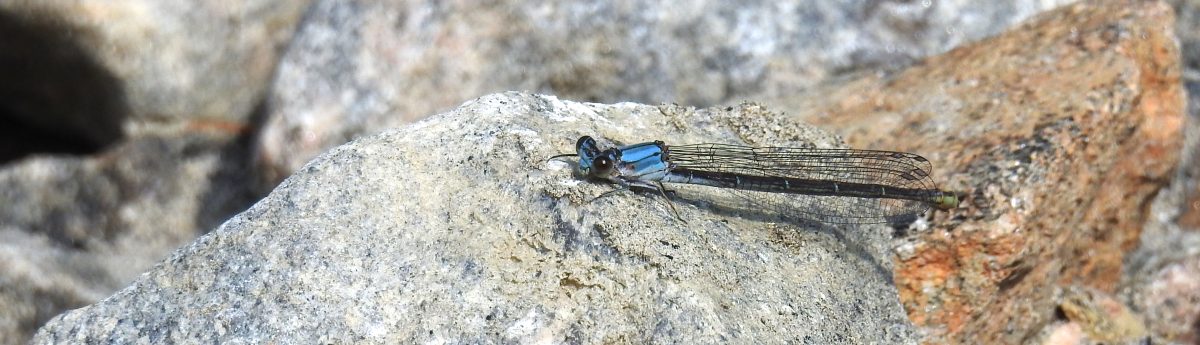
On August 4, 2020 I was surprised to find a Violet Dancer on a dirt trail at the Eagleson ponds. The closest place I’ve ever seen this species to home is out near Morris Island, so it was a shock to find one practically in my own backyard. Then in 2022 I found a few near the Jock River behind the former Richmond sewage lagoons. This suggested where the one at Eagleson might have come from – still a fair distance for a tiny damselfly, but not insurmountable if the winds are blowing the right way. I didn’t expect to see another one there any time soon; if anything, Powdered Dancer was next on my list of species I expected to show up there, because they are much more abundant and widespread along the Ottawa and Rideau Rivers than the Violet Dancer, and breed at the same location on the Jock River behind the former Richmond sewage lagoons. However, when I took a walk there on July 16 after work, it was the first odonate I found, resting on the rocks near the bridge.

Continue reading “Second Sightings”

A New Dragonfly at Roger’s Pond

Halloween Pennant

Marlborough Forest is always a fun place to visit, and after failing to find any Brush-tipped Emeralds at Jack Pine Trail earlier this week I decided to go to the E6 trail and Roger’s Pond this morning to see if I could find any of these unique Somatochlora emeralds there. Unfortunately that was not to be the case, but I had a great time and found a nice selection of odes while I was there. At Trail E6 I found many of the usual species, including Racket-tailed Emeralds, Frosted Whitefaces, and White-faced Meadowhawks.

Continue reading “A New Dragonfly at Roger’s Pond”