Damselflies in New Places

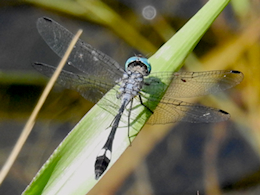
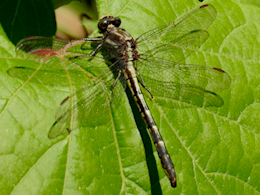
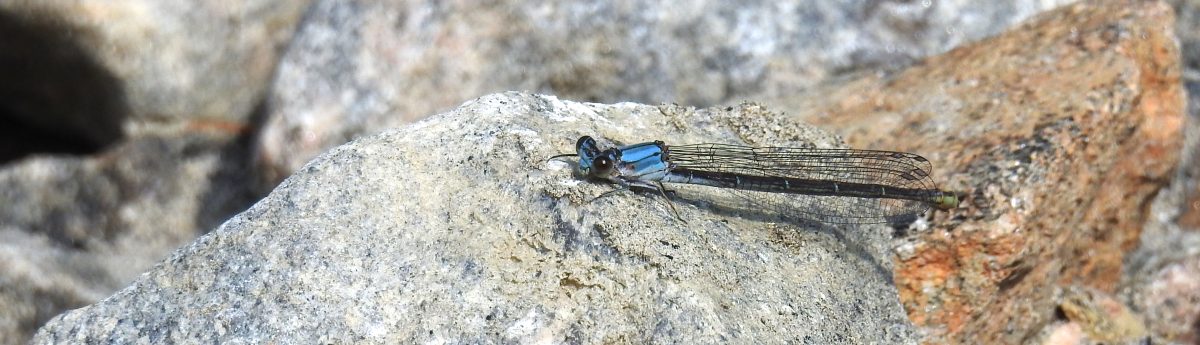
Violet Dancer
Violet Dancer

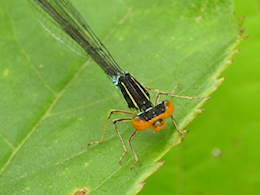
Damselflies are small odonates related to dragonflies, but belong to Order Zygoptera instead of Order Anisoptera. Unlike dragonflies, damselflies have very slender abdomens, and the forewing and hindwing are similar size and shape. Two of the three families found in eastern North America – the broad-winged damsels and pond damsels – hold their wings above the body, parallel to the abdomen, while perching. The third family – the spreadwings – do not perch horizontally with their wings parallel to the body, but typically “hang” from a perch, with the wings slightly spread at an angle. Adult damselflies are not strong fliers, and generally do not travel far from water. They are most often found in vegetation or on the ground near ponds, streams, and other bodies of water. Because of their small size they can be difficult to see, but the dark wings of the jewelwings and brightly coloured abdomens of some of the pond damsels help aid in observation.

Continue reading “Damselflies in New Places”

Terry Carisse Park in the Summer

Rainbow Bluet

Most naturalists who have heard of Terry Carisse Park along the Jock River associate it with birds – particularly the Hooded Warbler that spent a few days there in May 2014. As a rare bird for Ottawa, this discovery put this small riparian park on the map for many Ottawa birders. Other people may associate it with the Osprey nest there, although the Osprey haven’t nested there for a few years now. I myself have returned regularly to this park in the spring and fall to look for the Rusty Blackbirds that often stop over here during migration – in May 2021 I found at least 50 of these declining birds feeding on the lawn and perched in the trees that line the river bank. Because of the thick shoreline vegetation, the wooded swamp to the north, and the open grassy areas dotted with conifers it is a good place to look for birds during migration. I had never been here during the summer breeding season, and it occurred to me this summer that it might be a good spot to look for odonates. I started my summer ode survey on July 2, 2022, continuing through early August, and found more species than I expected – including some species I’ve only seen at Petrie Island or Morris Island Conservation Area!

Continue reading “Terry Carisse Park in the Summer”

A Rare Dragonfly at Bruce Pit

Black Saddlebags

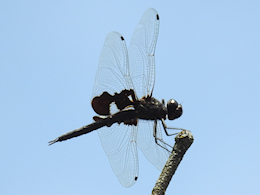
Bruce Pit is under-valued as a great spot to see a variety of insects at the peak of summer. Though I’ve spent a lot of time looking for dragonflies there, it can be quite good for tiger beetles and butterflies as well, including Wild Indigo Duskywing, Gray Comma, Painted Lady, Compton Tortoiseshell, and migrating Monarchs. A visit anytime during the summer can usually turn up a few interesting species, and this year I started visiting on June 17th this year, hoping to find a few different insect species for my life list.

Continue reading “A Rare Dragonfly at Bruce Pit”

Marlborough Forest: Summer 2022

Ashy Clubtail

I did not get out to Marlborough Forest as often as I would have liked this past summer; ongoing medical issues early in the season left me feeling too tired and too sore for the long five-hour outings I enjoyed so much last year. On June 2nd I visited the E6 trail with Rick Collins to look for the Sedge Wrens breeding there. We heard one without too much difficulty, though we weren’t able to spot it. Our other highlight was a female Ruffed Grouse on the trail trying to lure us away from its chicks (none seen) by giving distress calls. It was a gray, drizzly day so I didn’t see any insects worth photographing. Indeed, I didn’t take my camera out of my bag at all.

The weather was much better on June 19th, so Chris Traynor and I went to trail E4 to look for Twin-spotted Spiketails and some different emerald species for his life list. I was also eager to show him the pool below the culvert as this was where I’d seen my one and only Ocellated Emerald hanging out in 2020. It was a bit windy, but the sun was shining and the weather was warm, and the breeze made the usual biting insects less of a distraction.

Continue reading “Marlborough Forest: Summer 2022”

Identifying the Small Baskettails of Ottawa

Common Baskettail
Common Baskettail

On May 14th I wrote about a mass emergence of Spiny Baskettails at Mud Lake but didn’t explain much about how I identified them except to say my identification was based on the shape of the male claspers. Emerging dragonflies are pale and translucent, showing little to no colour of the mature adults they will become, but fortunately identification of the three small baskettail species in Ottawa does not depend the pattern of colours on its body (a fourth species, the Prince Baskettail, is much larger and has distinctive black spots at the base, tip and center of its wings). This post provides more detail about how to distinguish between the Common Baskettail, the Spiny Baskettail, and the Beaverpond Baskettail, three similar-looking species of the emerald family. While they are most likely to be found patrolling sunny woodland openings or grassy spaces next to water, they often perch on tree branches and plant stems at an angle, allowing good views or photographs.

Continue reading “Identifying the Small Baskettails of Ottawa”

Mass Emergence: Spiny Baskettails

Spiny Baskettail emergence

By May 14th Ottawa had seen a string of six days with temperatures above 20°C, with the last three above 30°C. The warmth signaled the beginning of ode season, with my first dragonflies of the season – both Common Green Darners – seen at the Richmond Conservation Area (May 10) and Sarsaparilla Trail (May 11, 2022). Common Green Darners are migrants, however, arriving on the warm winds flowing from further south. The true ode season begins once it is warm enough for local dragonflies and damselflies to emerge from the rivers and wetlands in which their life cycle began. All odonates lay their eggs in water, and it takes time – from a few months to a few years – for the larvae to go through the individual stages of molting until they are large enough to begin the transformation from nymph to adult. When the nymph is ready, it crawls out of the water onto rocks, emergent vegetation, or nearby tree trunks or plant stems, and then bursts out of the larval shell through a hole in its back, using gravity to pull itself free. I have seen various dragonflies in the middle of this process a few times; I had never witnessed the full transformation as it takes a few hours for the dragonfly to become ready for its first flight. However, when I arrived at Mud Lake on a sunny day in mid-May hoping to find some warblers, it was a mass emergence of at least 50 individual dragonflies that engaged my attention, and I was able to observe many individuals at different points of the process.

Continue reading “Mass Emergence: Spiny Baskettails”

The Last Dragonfly

By the time November arrives, all but the hardiest of insects have vanished, leaving only those few species that are adapted to the cold temperatures of mid-autumn in Canada. The last dragonfly on the wing here in Ottawa is the Autumn Meadowhawk, a small red or brownish dragonfly with very little black along the abdomen and yellow or brown legs. It is these two traits that make them easy to distinguish from other local meadowhawks – the other common species have distinct black markings on the abdomen and black legs. The most similar dragonfly in our area is the Saffron-winged Meadowhawk, which also lacks distinct black abdominal markings. However, the Saffron-winged Meadowhawk is larger, usually has a noticeable amber-coloured tint to the leading edge of its wings, and has black legs with brown stripes. In addition, most of the other meadowhawk species are gone by mid-October.

Continue reading “The Last Dragonfly”

The Odes of Late Summer

Green-striped Darner (male)

By mid-August most dragonfly species are on the wane. A few families are still quite abundant, particularly the darners and meadowhawks, while small numbers of other skimmers and a few clubtails often linger into September. Forktails, bluets, and some spreadwings are also still common in the appropriate habitats in August and September. This makes it worth going out to good dragonfly habitats such as large rivers, lakes and marshes to see a decent variety of species.

Large dragonflies this time of year are particularly interesting; while Common Green Darners are the most frequently encountered large dragonflies of late summer, you might come across a Black-shouldered Spinyleg basking on the rocks along the river, a Wandering Glider zipping over a meadow, a Twelve-spotted Skimmer flying above a pond, or a group of mosaic darners swarming through the air late in the afternoon. The mosaic darners are a particular favourite of mine; they are large brownish-black dragonflies with mottled spots of blue, green or yellow depending on the sex. While they spend most of their time flying through the air hunting for small insects, I often come across them perching vertically on thick stalks of vegetation below knee-height in open grassy areas early in the morning. We have several different species in Ottawa, and trying to find something other than the ubiquitous Canada and Lance-tipped Darners is a fun exercise.

Continue reading “The Odes of Late Summer”

Ode-hunting along the River

Shadow Darner
Shadow Darner

Mud Lake and Andrew Haydon Park are usually excellent places to find different species of dragons and damsels throughout the summer months. In both 2015 and 2019 I had a good number of species at Andrew Haydon Park in late July, and an OFNC dragonfly outing at Mud Lake on July 21, 2013 also netted some fantastic species. I was hoping for some similar luck on an ode-hunting trip on July 24th, but this time I found fewer species and fewer individuals overall. I am not sure why there seem to be so few dragonflies around good pond habitat these past two years (such as the Eagleson ponds), but the trend is concerning.

My first stop was the shoreline at Mud Lake where I hoped to find some large river clubtails perching on the rocks in the channel behind the filtration plant. When I arrived I was happy to find two dragonflies perching on the rocks right away, and managed only to photograph one before a couple of people came along and scared them both – while I’m certain one of them was a clubtail, the one I photographed turned out o be an Eastern Pondhawk. The clubtail did not return, although I saw a couple flying out over the water several times on my visit.

Continue reading “Ode-hunting along the River”

Ode-Hunting in Early July

Taiga Bluet
Taiga Bluet

By early July a variety of dragonflies and damselflies are on the wing, although some of the early species – such as the Beaverpond and Spiny Baskettails – have already finished flying for the year. This is usually the time of year when I start focusing on odes on afternoon outings in addition to enjoying them as distractions on morning birding outings. While some of the best ode-hunting can be found along the Ottawa River (including Mud Lake, Andrew Haydon Park, Petrie Island, and Morris Island) there are some great spots in my own backyard, including Bruce Pit, Stony Swamp, and the Eagleson storm water ponds (which will be the focus of a separate post of its own). Bruce Pit is a particularly great spot for odes, and some unusual ones have turned up there including Swift River Cruiser, Black Meadowhawk and Black Saddlebags. Eastern Red Damsels used to breed there prior to 2010, and I decided to spend the afternoon of July 4th wading around the edges of Bruce Pit to see if I could find any. Unfortunately, the area where we used to see them (and odes such as Amber-winged Spreadwing and Saffron-winged Meadowhawk) has become overgrown with cattails and phragmites over the year, so I wasn’t sure it was possible to walk along the shore where we used to go a decade ago (I can’t believe it has been so long …. apologies to those who have never visited my old LiveJournal site, back in the days when I used to host my images on Photobucket which no longer allows free hosting and has hidden many of my images).

Continue reading “Ode-Hunting in Early July”

A trip to Morris Island with the McNamara Field Naturalists

Slaty Skimmer
Slaty Skimmer

On Saturday, July 3rd I accompanied the McNamara Field Naturalists on their first in-person outing since the latest Stay-at-Home Order ended on June 2nd. Ontario entered Stage 2 of its reopening plan on July 2nd, which raised the number of people who could attend outdoor social gatherings and organized public events to 25 people (as well as allowing haircuts and personal care services again). Although I am not a member of the McNamara Field Naturalists Club, which calls Arnprior home but whose explorations include a large swath of the Ottawa Valley, one of my friends happens to be in charge of putting field trips together, and asked if I wanted to help lead a dragonfly walk. I said yes, and suggested Morris Island as it’s a great place to find all sorts of odes, including several flashy skimmers and clubtails that can be found perching in the vegetation and along the trails. I was thrilled when my mentor Chris Lewis joined us, as it would be easier to find some more of the unique species with a couple of knowledgeable people looking.

Continue reading “A trip to Morris Island with the McNamara Field Naturalists”

Dragon-hunting in the Carp Hills

Marsh Bluet

On June 20, 2021 I accompanied fellow OFNC members Derek and Erik to the Carp Barrens Trail off of Thomas Dolan Parkway to assist them in a survey of breeding birds and other wildlife. Because of the sensitivity of the ecosystem and number of at-risk species which breed here, this trail is closed to the public during the summer. In order for us to access the site, Derek had acquired a permit to allow us to look for unique breeding birds such as Black-billed Cuckoo, Eastern Towhee, Common Nighthawks and Whippoorwills. Derek and Erik started around dawn to listen for both nightjars, but heard none. I joined them at 6:00 am while they were still walking along Thomas Dolan Parkway, and together we entered the trail system.

The trail follows a rocky outcrop around a long slough. Many birds were already singing, and we heard the typical open field and woodland edge species: Field Sparrow, White-throated Sparrow, Veery, Scarlet Tanager, Rose-breasted Grosbeak, and many warblers, the best of which (in my humble opinion) included two Pine Warblers, two Yellow-rumped and two Nashville Warblers.

Continue reading “Dragon-hunting in the Carp Hills”

New Dragonflies at Marlborough Forest

Kennedy's Emerald
Kennedy’s Emerald

The beginning of June arrived with plenty of warmth and sunshine, and I couldn’t wait to go back to Marlborough Forest at the peak of butterfly and dragonfly season to look for new species living there. Last year when I started going to Marlborough Forest in mid-June, I kept seeing large, dark dragonflies – almost certainly emeralds of some sort – zipping down the shadowy trail before the sun had fully risen above the trees. I never had my net on me when I saw them on my early-morning birding walks, so I was unable to catch one to verify their identity. This time I was prepared for these dawn-flying dragons, and brought my net with me. I had already added one dragonfly to my life list, the Ocellated Emerald at Trail E4 last year; was it possible that there were other species of interest here?

My first summer visit to Trail E4 occurred on June 6th. Although the morning started out cool, it quickly warmed up. The usual birds were singing along the trail, including all the Red-eyed Vireos, Eastern Wood-pewees, Eastern Kingbirds, Veeries, and the Tree Swallows that were missing from my mid-May visit. I heard seven warblers (Ovenbirds, Northern Waterthrushes, Black-and-whites, Nashvilles, Common Yellowthroats, Black-throated Greens, and a single Magnolia Warbler), two Chipping Sparrows, a Field Sparrow, and a Blue-headed Vireo singing in its usual spot in the large open area devastated by motor bikes and ATVs.

Continue reading “New Dragonflies at Marlborough Forest”

Dragonfly Emergence

Freshly emerged dragonfly

My first real dragonfly outing of the year occurred on May 24, 2021, and as usual, took place at Roger’s Pond in Marlborough Forest. I invited a few friends to join me now that outdoor gatherings can include up to 5 people, and fellow OFNC members Derek and Gerald decided to join me. It was a warm, sunny day, and I hoped to find the usual common skimmers and clubtails, as well as a few uncommon species that I’d seen previously at Marlborough Forest such as the elusive Ebony Boghaunter and Harlequin Darner. I’ve already seen one boghaunter this season, but it’s been a few years since I’ve seen a Harlequin Darner, and the Cedar Grove Nature Trail has been a repeat site for this ode.

We met at 9:30 am, just early enough to get some birding in while waiting for the sun to rise higher in the sky. We had the usual Nashville Warblers, Black-throated Green Warblers, Great Crested Flycatchers, White-throated Sparrows, Veeries, and Yellow-bellied Sapsuckers on the walk in. At the pond itself we had Eastern Kingbirds, a Pied-billed Grebe, Common Yellowthroats and four Ring-necked Ducks. Many dragonflies were already flying along the open trail through the cedar forest, including a few teneral whitefaces and emeralds.

Continue reading “Dragonfly Emergence”

Another Ebony Boghaunter in Marlborough Forest

Ebony Boghaunter

On May 15th I decided to try a new trail in Marlborough Forest. I was mainly looking for butterflies, as dragonflies weren’t all that numerous yet. Dreaming more of elfins and commas than dragons and damsels, I parked on Kettles Road near the Black-billed Cuckoo site from last year. I headed south, and almost immediately found myself in an area with four species flying: Mourning Cloak, Northern Spring Azure, Henry’s Elfin, and Gray Comma. The sunny day was perfect for looking for butterflies, and I ended up finding quite a few, especially in the open cedar woods where they were resting on the trail.

Continue reading “Another Ebony Boghaunter in Marlborough Forest”