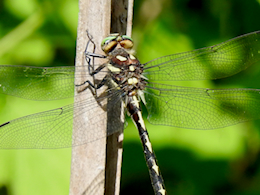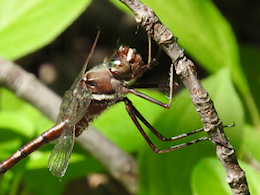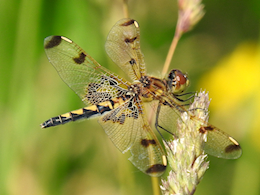
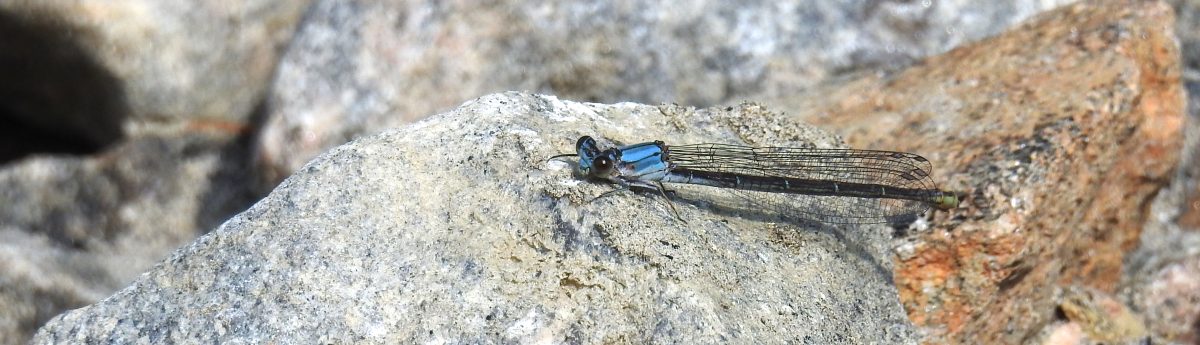
Amber and Saffron Wings

Saffron-winged Meadowhawk

It’s been a good season for hard-to-find dragonflies at the Eagleson Ponds. Ever since I discovered both Eastern Amberwings and Saffron-winged Meadowhawks here in 2017 I’ve been spending more time here later in the day looking for odes, rather than doing a quick search for birds first thing in the morning before heading elsewhere. The Covid-19 pandemic has made that even easier for me, as I am still working from home and can get out at lunch time for a quick check when the temperature has warmed up enough for many odes to be flying.

Mid-summer seems to be the best time for seeing a variety of odes at the ponds. While I have seen a few early-season species here, such as the Taiga Bluet and Spiny Baskettail, most odes that breed here don’t emerge until later in the summer. I’m not sure if the late start to spring had anything to do with it, but up until the end of June I found very few dragonflies here – skimmers are usually abundant throughout the season, but on June 30th I recorded a single Dot-tailed Whiteface and a single Twelve-spotted Skimmer along with a couple of Common Green Darners and Prince Baskettails that refused to land. Even the Eastern Forktails seemed down in numbers.

Continue reading “Amber and Saffron Wings”
Gatineau Park: Specialty Dragon-hunting

Zebra Clubtail

Gatineau Park is a special place for dragonflies – many species of the National Capital Region can be found there that aren’t found on the Ontario side of the Ottawa River, while others seem to be much more common there than in Ottawa. Chris Traynor has been exploring the park quite a bit these past couple of years, searching for dragonflies that breed in the quiet lakes, sluggish streams, and fast-flowing creeks of the Gatineau Hills. Not surprisingly, he has found a good number of species that have not been reported in Ottawa, such as Eastern Least Clubtail, Mustached Clubtail, Beaverpond and Harpoon Clubtails, and even a couple of snaketails. Many of these species prefer clear, swift-moving streams with rocky bottoms, which might be the reason for their absence in Ottawa; the Ontario side of the National Capital Region is relatively flat, with more marshes and slow-moving, mucky streams winding through suburbs and forest rather than down the foothills and escarpments which form the Canadian Shield. One of Chris’s best finds was a portion of Meech Creek where Zebra Clubtails and Fawn Darners are quite common, with the occasional Dragonhunter and Violet Dancer. I accompanied him twice to this magical spot, once during the August long weekend last year, and once again this year. As I never did get around to posting those photos last year (remember I mentioned I’d fallen behind?), I will incorporate both sets of photos in this post.

Continue reading “Gatineau Park: Specialty Dragon-hunting”

A Lifer Dragonfly: Ocellated Emerald

Ocellated Emerald

Marlborough Forest has been long known to me as a special place to find some of the more unusual species of the Ottawa area – various trips to the Cedar Grove Nature Trail over the past ten years have turned up Mink Frogs, Eastern Newts and Red Efts, Blue-spotted Salamanders, Bronze Coppers, Silvery Checkerspots, Harvesters, Calico Pennants, Brush-tipped Emeralds, Lake Darners, Twin-Spotted Spiketails, Ebony Jewelwings, and Aurora Damsels. The one “specialty” of Marlborough Forest that I had not yet found, and search for every time I go, is the Smooth Green Snake – it has managed to elude me every single visit.

Continue reading “A Lifer Dragonfly: Ocellated Emerald”

Arrowhead Spiketails in Stony Swamp

Arrowhead Spiketail

Perhaps more than Mud Lake, the one place I enjoy visiting most during migration and the summer breeding season is Stony Swamp. Pre-Covid it was always less busy than Mud Lake, especially early in the morning; however, after the pandemic hit the trails have become really popular and the parking lots are getting full before 10:00 on the weekend. If my goal is to look for birds, I try to get there before 7:00 am; but if it’s insects I’m looking for it doesn’t matter so much, as insects are not as likely to be disturbed by people, and I arrive whenever it’s convenient for me. It’s still quieter during the week than on the weekend, so I arrived at the Beaver Trail at 8:15 hoping to find some good birds as well some interesting insects as the day warmed up.

Continue reading “Arrowhead Spiketails in Stony Swamp”

The Dragonflies of Mud Lake

Stream Cruiser

Once migration winds down, many birders stop visiting Mud Lake while they look for breeding birds elsewhere. Although birds such as Wood Duck, American Redstart, Yellow Warbler and Common Ravens are abundant and easy to find at the city’s premier migration hotspot during the breeding season, many of Ottawa’s summer specialties – such as Grasshopper Sparrow, Lincoln’s Sparrow, Golden-winged Warbler, Mourning Warbler, and Sedge Wren – are found elsewhere, and so most birders switch their focus from looking for migrating transients to chasing these summer residents down just as soon as the last Blackpoll Warblers and Arctic Terns disappear in early June. This is about the same time my attention to dragonflies and butterflies intensifies – and Mud Lake is a great place to find a good variety of both these insects.

Continue reading “The Dragonflies of Mud Lake”

The Baskettails of Spring

Beaverpond Baskettail

In most years dragonfly season begins around the Victoria Day weekend (which always falls on the third Monday of May). I remember visiting Mud Lake on the long weekend in years past and seeing up to a hundred freshly emerged dragonflies perching in the trees there. However, in the last few years it seems that dragonfly season has started later than normal – the long-lingering cooler spring weather has played a large part in this, as emergence depends chiefly on the temperature of the water the dragonfly nymphs are living in. By the second weekend of May I’d go out eagerly hoping to see the first dragonflies of the year, and by the end of May I’d still be looking for them. Even when I eventually found some, such as last year, numbers would be low, and it would take time for the season to get back on track. Numbers remained low in Ottawa all summer last year for some reason, though we think that the unprecedented spring flooding might have been the cause, either washing away the small nymphs or dumping unhealthy amounts of debris, sediment, and chemical-laden runoff in areas where they breed.

Continue reading “The Baskettails of Spring”

Adventure in Dunrobin

Snowshoe Hare

On June 5th I headed out to Dunrobin to spend some time looking for odes and birds. My first stop was the Crazy Horse Trail on March Road at the end of Huntmar Road. This is a relatively new pedestrian-only trail for hikers, skiers, and snowshoers that was developed by the Friends of the Carp Hills under an agreement with the City of Ottawa. It is named for an old tavern that used to stand adjacent to the trailhead but has long since been demolished. The goal of the trail is to provide recreational access to the the Carp Hills on City-owned property while keeping impact on the environment to a minimum. The trail is narrow, and as there is no intention to groom or widen the trail, people are asked to respect the natural areas by staying on the trail, keeping dogs under control at all times (which means using a leash if necessary), leaving no waste, and respecting property boundaries. There are some rough, volunteer-built boardwalks in places too wet to cross which adds to its charm. In fact, all trail maintenance and improvement depends on volunteers, rather than the City, which makes it doubly important to respect the work they have done in creating this trail.

Continue reading “Adventure in Dunrobin”

September Odes – A Summary

Shadow Darner

By the time September rolls around, most odonate species are done for the year in the Ottawa region – gone are the Aurora Damsels and Elegant Spreawings, the Spiny Baskettails and Ebony Boghaunters, the Arrowhead Spiketails and Horned Clubtails, the Chalk-fronted Corporals and Four-spotted Skimmers. This is the time of year when the number of meadowhawks and darners begin to peak, and southern species such as Spot-winged and Wandering Gliders may blow into our region with the warm south winds. A few bluet and spreadwing species may persist, as well as the common and widespread Eastern Forktail, though each day sees fewer and fewer individuals. This is a summary of species I saw and photographed around Ottawa during September 2019 – due to my trip to Edmonton and some cool, cloudy weekends, I didn’t visit as many places as I had hoped and missed a few common species.

Continue reading “September Odes – A Summary”

The Odes of Edmonton

Saffron-winged Meadowhawk

On September 18th I flew to Edmonton to visit my sister for a few days. Alberta is not a new province for me; my family had lived on an acreage outside of Ardrossan, which is east of Edmonton and Sherwood Park, for seven years from 1989 to 1996. As I was just teenager at the time, enduring all the drama and angst of high school, I had had no interest in nature back then – which is really too bad, as we’d lived on a small lot with a forest behind our house and a slough (a vegetated pond) across the road. When my parents and I moved back in 1996 – they to southern Ontario, via Tweed, and me and my fiancé to Ottawa – my sister remained behind, although it wasn’t until 2012 when I returned to attend her wedding.

My sister has since divorced and now lives in the north part of Edmonton, in a brand new development called Crystallina Nera. It is so new that there are no trees or gardens yet, several houses have not yet put down any sod, and houses are still being built nearby. This developments boasts a 4.8 hectare urban forest and a naturalized storm water pond, both of which I spent a lot of time exploring.

Continue reading “The Odes of Edmonton”

Late Summer Dragons at the Ponds

Eastern Amberwing

August isn’t my favourite month to go dragon-hunting; in our region, a number of species have already vanished for the year, including several of my favourite clubtails and emeralds, cruisers and spiketails. August, then, is a season of skimmers and darners, and as such, places like the Eagleson storm water ponds are good places to go dragon-hunting, as these are the most common families of dragonflies that breed here (of the other families mentioned above, only the emeralds are present, and only members of the genus Epitheca, the baskettails). I’ve spent much of my free time this month at the storm water ponds, not just looking for butterflies, but also for new species of odes. It was only two years ago that I discovered new populations of Eastern Amberwings and Saffron-winged Meadowhawks breeding here, and as a number of common species are still scarce or still missing, it is worth checking to see if any have made their way here yet. For a habitat that is quite similar to that of Mud Lake or the ponds at Andrew Haydon Park, it is curious to me that there are no Powdered Dancers, no Horned or Lancet Clubtails, no Halloween or Calico Pennants, no Blue Dashers, and very few Widow Skimmers, Dot-tailed Whitefaces, Eastern Pondhawks, and Common Whitetails. Even spreadwings and dragonflies as abundant as the Autumn Meadowhawk are difficult to find. This is why it is such a surprise that uncommon species such as Eastern Amberwing and Saffron-winged Meadowhawk have become quite common here in late summer.

Continue reading “Late Summer Dragons at the Ponds”

Clubtails at Sheila McKee Park

Cobra Clubtail

On July 22nd I received an email from Chris Lewis about a new dragonfly spot along the Ottawa River. I’d been to Shelia McKee Park out near Dunrobin just once, on an OFNC trip in 2015 to look for herps; it has a network of woodland trails and a steep staircase that leads down from the top of the cliff to the rocky beach at the bottom. Chris said she found evidence of a very recent dragonfly emergence of in the form of both exuviae and teneral dragonflies; she recognized exuviae of both clubtails and emeralds, though she was not able to identify them to species. She saw an unidentified darner and several teneral meadowhawks in the woods, and several Powdered Dancers and a pair of Stream Bluets in tandem near the water. However, it was her clubtail report that intrigued me: she mentioned one Lancet Clubtail, both mature and teneral Black-shouldered Spinylegs, several Midland Clubtails, and one Cobra Clubtail which had become the unfortunate meal of a Midland Clubtail. It is amazing that I’ve never considered going back to this park for odes before – the shoreline here is quite rocky, with little or no emergent vegetation, reminiscent of Britannia Point at Mud Lake or the causeway at Morris Island, both of which are great spots for clubtails. Curious to see these clubtails for myself, I headed out the following Sunday (July 28th) and brought my net in case there was anything worth catching.

Continue reading “Clubtails at Sheila McKee Park”

The Odes of Andrew Haydon Park – 2019 edition

Halloween Pennant

Back in 2015 I wrote a blog post about the odonates I found at Andrew Haydon Park one weekday afternoon near the end of July. Since discovering the colony of Halloween Pennants at AHP in 2014, I’ve made it a point to visit this park each year during mid-summer; it’s much closer than travelling all the way to Morris Island to see this stunning dragonfly! So far I’ve only made it out to Morris Island once this year, and when I found no Halloween Pennants flying along the causeway I decided to visit Andrew Haydon Park specifically to search for this species. With the strange, slow start to the season I was bit apprehensive about whether these odes would even be around at AHP, but thankfully I found a few on each of my visits, and in good numbers, too.

Continue reading “The Odes of Andrew Haydon Park – 2019 edition”

Brush-tipped Emeralds at Jack Pine Trail

I spent some time at Jack Pine Trail this morning. It was a good walk, if not terribly productive. My best bird sighting was that of a Broad-winged Hawk – or rather, a family of Broad-winged Hawks, as I heard two birds calling incessantly in the woods and saw another soaring in the sky. I was wondering if the two calling birds were youngsters, as the calls were shortened – “chick-ee!” rather than the longer, drawn out whistled “chick-eeeeeee”. The one in flight gave the full call, which made me think it was an adult responding. I tried to get a look at the two birds, as they weren’t too far off the trail; however, the thick brush prevented me from seeing where they were perched. Other good birds there that were still singing included Alder Flycatcher, Winter Wren, Eastern Towhee, Black-and-white Warbler, and Black-throated Green Warbler.

There weren’t too many dragonflies on the wing, but I was happy when an emerald I found patrolling along the boardwalk turned out to be a male Brush-tipped Emerald. This one was much fresher in appearance than the one I had caught at Roger’s Pond, with much brighter markings on the thorax.

Brush-tipped Emerald

As you can tell from the above image, this dragonfly is small with bright green eyes and a metallic bronze and green thorax. The second yellow spot on the thorax is oval-shaped, while the first spot is a longer and thinner – more of an irregular dash. The hairy claspers for which it is name are distinctive among the other emeralds in the same family. In this image you can see the “brush-tip”, as well as the yellow markings along the side of the abdomen which help to differentiate it from the Racket-tailed Emerald:

Brush-tipped Emerald

It is great seeing this species so close to home instead of travelling all the way to Marlborough Forest to look for it, which is the only other place in our area where I know it is found. I’ve been seeing them here for a few years now, indicating the population is relatively stable; for such a small creature, I think these dragonflies hold a lot of charm!

Eastern Amberwings

Eastern Amberwing

On July 18th I headed over to the Cedar Grove Nature Trail in Marlborough Forest, as a summer visit was long overdue.  After a disappointing visit in June, when a lot of odes and butterflies seemed to be late due to the prolonged cold weather, I was hoping to find some of the early species still flying.  To be honest, I had no idea whether insect emergence was still late or back on track, or whether I would even see some of the specialties I was hoping for – such as Calico Pennant, Brush-tipped Emerald, Aurora Damsel, Silvery Checkerspot, fritillaries and more.  Regardless, I was looking forward to a change of scenery, and would be happy with whatever I saw.

There weren’t many birds of note, although I was surprised to hear both a Blue-headed Vireo and a Black-throated Green Warbler still singing.  It was after 1:00 p.m. by the time I arrived, so not only was it late in the season, but also late in the day. A pair of female or immature Hooded Mergansers near the bridge was a surprise; this was the first time I had seen this species on the pond. 

Continue reading “Eastern Amberwings”

Ode-hunting in Prince Edward County

Calico Pennant

During the first week of July my fiancé and I spent some time in Prince Edward County with my dad’s family. We rented a cottage on Loves Lane on Prince Edward Bay, a nice three-bedroom place with 8 acres of land only 20 minutes away from both Sandbanks and Picton. The weather was beautiful, and I spent most of my time getting to know the local residents. On our first full day at the cottage (Monday, July 1st), I went for an afternoon walk on the property to see what I could find. It seemed to be a good spot for odonates; every now and then a couple of Prince and Common Baskettails flew in and started swooping above the deck. There were some other dragonflies present too, so I brought my net out in the hopes of catching one.

Continue reading “Ode-hunting in Prince Edward County”