In late August I took my usual trip to southern Ontario to see my Dad. As usual, we spent a few days at his trailer in the Pinehurst Lake Conservation Area. The birding was fine, although this time there were no flocks of migrants moving through; instead the birds still seemed busy with raising and feeding their young, even this late in the summer. For example, I saw a Red-eyed Vireo feeding a Brown-headed Cowbird, a young Indigo Bunting following its parent around, and a House Wren carrying food. We didn’t see the Broad-winged Hawk family this year either, which was disappointing. However, the insects were fascinating, and I found a lot to photograph.
After discovering the Saffron-winged Meadowhawks and Eastern Amberwings at the Eagleson Ponds on Sunday, July 30th, I returned again Friday after work, as well as on Saturday and Sunday. I checked the small crescent-shaped bay near the small building each time for the meadowhawks, to no avail; in fact, I didn’t see any meadowhawks on any of my visits at all. I got lucky and found one of the male Eastern Amberwings on the same mat of vegetation on Friday after work, but didn’t see any females.
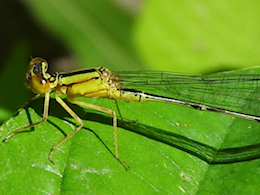
I returned to the peninsula on the edge of the central pond where I had found the female spreadwing on a previous visit, but found no spreadwings on this visit. I did, however, find a tiny Fragile Forktail gliding low among the weeds, confirming this species’ presence at the ponds. I had seen one several years ago prior to the reconstruction, so I was happy to see that the population had either survived or re-established itself.
Fragile Forktail
This is a male, based on the green thorax and lack of ovipositor at the tip of the abdomen – young females are typically blue instead of green, and become bluish-gray with pruinosity as they age. Both sexes have exclamation points on top of the thorax, which distinguishes them from the more common Eastern Forktail. Male Fragile Forktails also lack the two blue spots at the tip of the male Eastern Forktail’s abdomen….the abdomen is entirely black, which makes it difficult to see flying in shaded areas.
Fragile Forktail
I stopped by again early on Saturday morning, which was sunnier and windier, so I didn’t see many dragonflies. There were, however, plenty of Eastern Forktails sheltering in the tall vegetation. I think this orange female is one of our prettier damselflies. Like the male Fragile Forktail, the tip of the abdomen is black when viewed from the top – it is often pale orange below. The immature Eastern Forktail is confusable only with the male Orange Bluet, which has an orange-tipped abdomen with noticeably long cerci at the end.
Eastern Forktail
My best find on Sunday was a fresh Wild Indigo Duskywing. Although I’ve been looking for them, this was my first confirmed sighting of the 2017 season. The caterpillars feed on Crown Vetch, of which there is an abundance here, particularly on the point on the east side of the pond.
I was glad to confirm that both Wild Indigo Duskywings and Fragile Forktails were still present in the area, and to see another Eastern Amberwing. The ponds have become one of my favourite birding and nature spots, and with plenty of time left in the ode season, it will be a great place for studying wildlife for the next few months!
I have never really spent much time looking for odes at the Eagleson storm water ponds, as most of my outings start there first thing in the morning when it isn’t hot enough for many dragonflies to be flying. However, after seeing the unidentified female spreadwing there on Saturday morning, I decided to head over on Sunday after my visit to the Old Quarry Trail. While I’ve seen Common Green Darners, Twelve-spotted Skimmers, Autumn Meadowhawks, Eastern Forktails, Tule Bluets, and Familiar Bluets there since the reconstruction, the arrival of the unidentified spreadwing and even the Delaware Skipper made me wonder whether other species had taken up residence recently. I wasn’t expecting anything too exciting or unusual, but I figured I might at least see some of the common pond skimmers found nearby at places like Bruce Pit and Stony Swamp. Perhaps I should have raised my expectations a bit, for what I found there surprised me!
My last day off was Tuesday, and the forecast finally called for a decent amount of sun during the morning and afternoon. I invited a friend, Jon, to go dragon-hunting with me at Morris Island since he was eager to become re-acquainted with odonates after a long absence. There were a few particular species on his must-see list, including Cobra Clubtail, Cyrano Darner and Dragonhunter; I’d seen all of these at Morris Island before, though I wasn’t optimistic about our chances of seeing the Cyrano. Although it is considered to be a widespread species, inhabiting swamps, small lakes, and slow-moving rivers of the eastern half of the continent, adults are rarely seen. It is thought that once they emerge they immediately fly up into the tree-tops where they spend most of their time. Adult males can sometimes be found patrolling their territory, and this appeared to be just such a case with the one that I caught in the parking lot of the Morris Island Conservation Area last year. That was on June 25th, however, I was worried that we might be too late to see them.
June is one of my favourite months. Normally the weather is hot and sunny by the time the solstice rolls around, the birds are all in full song, and newly-emerged butterflies and dragonflies are returning to woodlands, fields and wetlands. However, the weather this month has not been great. The rain from May continued on and off this month, keeping water levels of the rivers and ponds higher than normal, and likely delaying the emergence of many insects. The weekends have been nice, at least; I’ve been able to get out early in the day in order to look for new birds for my year list and any butterflies and dragonflies that may have emerged. While my enthusiasm has certainly declined since our amazing trip to Costa Rica, I’ve found myself regaining interest in visiting trails and conservation areas close to home, hoping to find some species I haven’t seen since the previous summer.
The day after my trip to the Bill Mason Center, I made plans with Chris Lewis and Chris Traynor to head out to the Cedar Grove Nature Trail in Marlborough Forest to look for odes around Roger’s Pond. I would be co-leading an OFNC outing there the following weekend with Jakob Mueller, a reptiles and amphibians guy, and wanted to get an idea of the dragonflies and damselflies that were flying. As we weren’t meeting at the parking lot there until 8:30, I headed out to Sarsaparilla Trail first, then the Rideau Trail for a quick look around.
When I got back from Costa Rica I didn’t much feel like doing any birding back here in Ottawa. I’d been spoiled by all the colourful, tropical birds and exotic species that I’d seen – Costa Rica was a dream come true for me, and it was hard to return to reality. As soon as I got back I started thinking about a return trip there, wanting to spend more time in the rainforest so I could see birds such as Cotingas, Jacamars and Bellbirds. And oh, the hummingbirds and tanagers there!
It was difficult to get excited about birding in Ottawa, and the weather didn’t help. It was cold and rainy when we left and still cold (only 16°C) when I returned. The thought of going dragon-hunting stirred my interest somewhat, and when the weather warmed up the weekend after we got back, I decided it was time to take my net out of hibernation.
Doran and I spent a week in Costa Rica from May 27 to June 3rd. We’d been planning this trip since February, and it was a thrill when we finally landed in Costa Rica after a 4:00am start that took us first to Toronto, then to Liberia after a five-hour flight down through Florida and across the Caribbean Sea. When we left Ottawa it had been cool and rainy, but the moment we stepped outside of the airport we were engulfed by the heat and humidity of the tropics. Although the humidity of the 30°C days seemed unbearable at first, we grew used to it by the end of the week – although any sort of exertion (such as hiking up the slopes of the volcanoes in the rainforest) was uncomfortably sticky. Still, we were thankful for the air-conditioning of the van that drove us to our resort, the Occidental Papagayo located on the Gulf of Papagayo in Guanacaste, about a 25-minute drive from the airport.
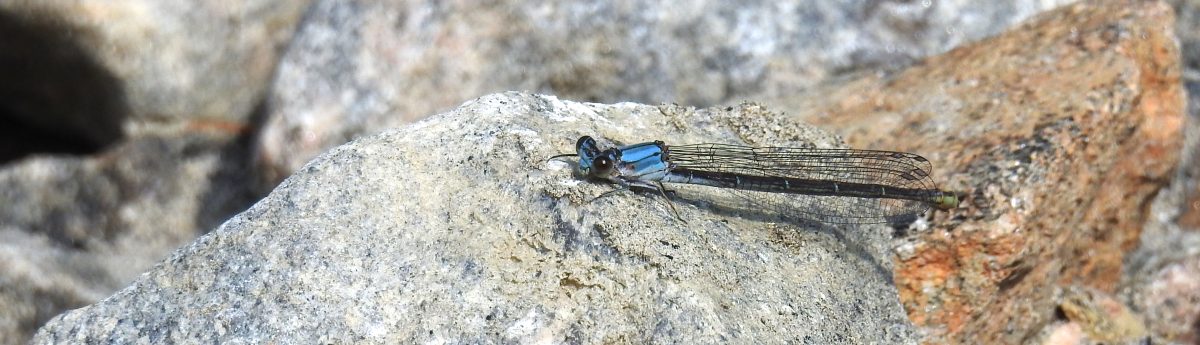
I was intrigued by the small blue damselflies I saw lurking in the vegetation at the Eagleson storm water ponds earlier on Sunday, so I returned later that afternoon with my net in order to catch them and identify them. The blue-type bluets are among the most difficult damselflies to identify, requiring a hand lens to see the male’s terminal appendages in order to distinguish between several similar-looking species. Fortunately there are fewer species flying this time of the year than in June and July, narrowing down the tricky possibilities to only a handful: Northern Bluet flies until mid-September, while both Familiar Bluet and Tule Bluet fly into October. Other blue-type bluets are already gone for the year, including Hagen’s Bluet (which flies until mid-August) and Marsh Bluet (which flies until early September).
The Equinox fell on Thursday, and by then the winds were blowing down from the north, putting an abrupt end to summer. Although I quite love the crisp, cool days of fall, I hate the cold early mornings which require hats and gloves to stay warm. This morning I headed out to Jack Pine Trail, leaving at 8:15 – the sun is visibly lower in the sky now – and I wished I had brought gloves as my hands were so cold. A Blue Jay and some chickadees were feeding on seeds left on the ground in the parking lot, and it seemed strange not to hear any Red-eyed Vireos or Eastern Wood-pewees singing.
On Sunday of the Labour Day weekend Chris Lewis and I spent the morning and early afternoon looking for birds and bugs. We met at Mud Lake at 7:00 am to check out the warbler action, then headed over to Trail 10 once the day warmed up and the trails started becoming busy. Once we were finished there, we returned to Mud Lake to look for odes. It was a good morning with a lot of walking, and we saw a lot of different things.
Our first visit to Mud Lake lasted just over an hour. We started out at the ridge, where the sun was just hitting the highest branches of the trees. The warmth of the sun stirs the insects into activity, which then attracts all sorts of insectivores looking for food. We did see a good number of birds in the tree tops, including a couple of Nashville and Cape May Warblers, several Tennessee and Yellow-rumped Warblers, and at least three Eastern Phoebes. Warbling Vireos were still singing, and a couple of Red-eyed Vireos were foraging low enough in the trees to identify them without hearing their familiar song.
On August 27th, the last Saturday of the month, I headed out to a spot I normally don’t visit so late in the summer – Roger’s Pond along the Cedar Grove Nature Trail. I usually go in May and June when early-season dragonflies are flying, such as the locally rare Ebony Boghaunter, the uncommon Harlequin Darner and Brush-tipped Emerald, as well as the usual whitefaces, Racket-tailed Emeralds, Spiny and Beaverpond Baskettails, and Aurora Damsels. I had two reasons for wanting to go: the first was the Band-winged Meadowhawk, a species I had seen in good numbers here on one late-summer visit several years ago but have had trouble finding recently, and the second was a yearning to find some Aeshna darners. After seeing such a good variety at my Dad’s trailer and failing to find the Variable Darner at Bruce Pit, I thought that Roger’s Pond might be a good spot to look for Ottawa’s common and uncommon species.
I spent some time today at Bruce Pit with the hope of seeing some darners there – ever since my trip to my Dad’s trailer in southern Ontario I’d been hoping to spend more time with some of these large, lovely dragonflies in Ottawa. Mud Lake can be a good place to find them, but I’d seen none earlier this morning, so I was thinking about other places where I might find them. I recalled that Chris Traynor had found a Variable Darner late in the season last year (September 18, 2015) along the hydro cut at Bruce Pit, and decided to head there next. My plan was to spend some time near the water looking for spreadwings and skimmers, then check out the hydro cut for darners. I didn’t find much around the water other than an abundance of Lyre-tipped Spreadwings, so I headed up into the grassy area at the edge of the toboggan slope.
During the third week of August I spent some time at my Dad’s trailer in the Pinehurst Lake Conservation Area near Glen Morris, Ontario. Although more of a campground/recreation area than a conservation area, it is nevertheless a great spot to spend a few days and see some “southern” wildlife. The last time I was here (August 2014) I was treated to the antics of a couple of juvenile Broad-winged Hawks, found a small pond where female Black-tipped Darners laid their eggs in the late afternoon, observed a Blue-winged Warbler on a morning walk, saw my first Red-spotted Purple butterfly, and even saw a bat near one of the washroom lights after dark. I didn’t see any Broad-winged Hawks or cool southern bird species this time, but I still ended up with 28 bird species over three days – the same number I saw in 2014 – and saw several interesting odes, including a lifer!
On August 7th I met up with Chris Lewis at Shirley’s Bay for a morning of birding and dragon-hunting. The morning got off to a great start when I saw a group of Wild Turkeys along Rifle Road even before I met Chris at the parking lot; there were two adults and a couple of baby turkeys. At Shirley’s Bay Chris and I tallied 44 species altogether, including a juvenile Osprey which landed in the Osprey nest down the road, five Common Terns and 11 Caspian Terns flying about, a Pectoral Sandpiper, a Semipalmated Sandpiper, a Solitary Sandpiper, and a single American Wigeon in the bay with the usual dabbling ducks, and a flock of migrating songbirds in the woods. The flock included a Yellow Warbler, a Chestnut-sided Warbler, a Black-and-white Warbler, and a couple of Gray Catbirds, and a Rose-breasted Grosbeak.
On July 17th, Chris Lewis and a few other friends and I went dragon-hunting at Petrie Island. Although the morning started out cool, it quickly warmed up, and as a result we saw lots of great bugs. We started our outing by searching the vegetation between the parking lot and the first small bay, usually a productive area for some of the smaller dragonflies and damselflies. This is the only spot at Petrie Island where I’ve seen Vesper Bluet and Orange Bluet, and we spent a good half hour examining the shrubs for these small damselflies. Although both species are considered common in the Northeast, Petrie Island is the only place where I’ve seen them. However, both species are more active later in the day, and since I usually do my birding and ode-hunting in the morning and early afternoon, it is possible I’ve missed them in other places.







 OdoNotations