
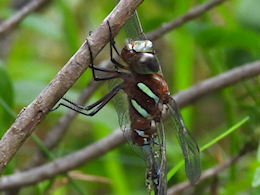
I spent some time searching for odes this afternoon at Jack Pine Tail. My primary purpose was to check the “emerald corridor” at the back of the trail for the Brush-tipped, Williamson’s and Kennedy’s Emeralds I’d seen there last year, though I was concerned that it was getting too late in the season for many dragonflies to be flying. I’d seen the Kennedy’s Emerald on June 28 and July 4, 2025, while the Williamson’s Emerald was found on July 18, 2025. Brush-tipped Emeralds were still flying as of July 16, 2025, though in much smaller numbers – that was the last date I saw them there in 2025. Still, it was worth a try, especially after the rainy season we’ve had – I was hoping their flight seasons had been delayed after receiving over 12 cm of rain in June, with over 17 cm more falling so far this month. In 2018 I’d had one on August 6th, so seeing one in mid-July wasn’t completely out of the question!
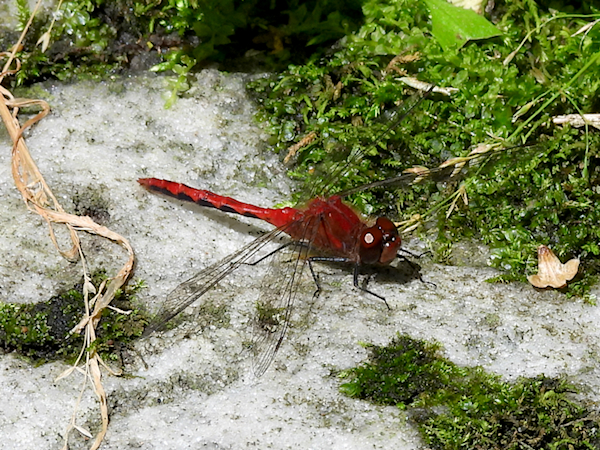
The trails were quiet, so I was not surprised to find only a few meadowhawks flying in the sunny openings of the woods on the north side of the trail system. However, one struck me as being more reddish than normal. I tried to catch it with my net, but it evaded me and flew up high into the vegetation. It was actively hunting and chasing another meadowhawk, so when it landed on a rock I attempted to capture it with my camera instead of my net. This time I was successful, and confirmed that I had found a Cherry-faced Meadowhawk – the first for Jack Pine trail and Stony Swamp (excluding Bruce Pit)! Although I did not get a photo of the secondary genitalia, this dragonfly had a bright red face, thick black triangles along the sides of the abdomen, and black legs. This ruled out White-faced Meadowhawk, and as Ruby Meadowhawk is not found in this area, there was no possibility other than Cherry-faced. Its identity was confirmed on iNaturalist by Colin Jones, one of the authors of the Field Guide to the Dragonflies and Damselflies of Algonquin.
My walk turned up two other meadowhawk species – White-faced and Band-winged – as well as a Black-tipped Darner, but no emeralds. It seems the season is already waning here at Jack Pine Trail, though I have noticed an overall reduction in odes here in recent years.
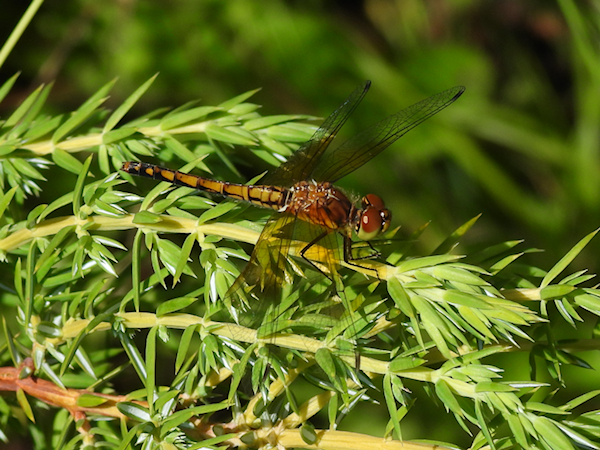
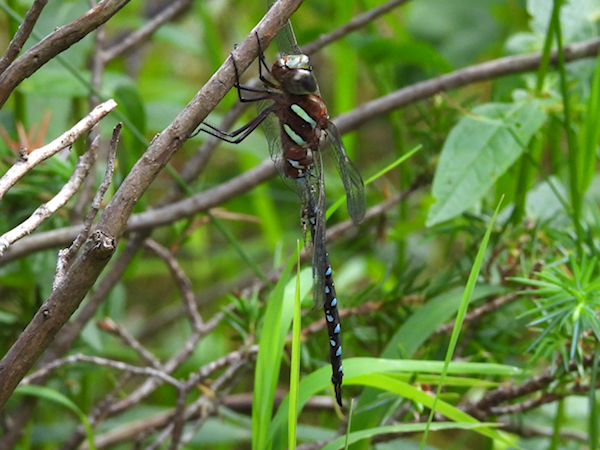
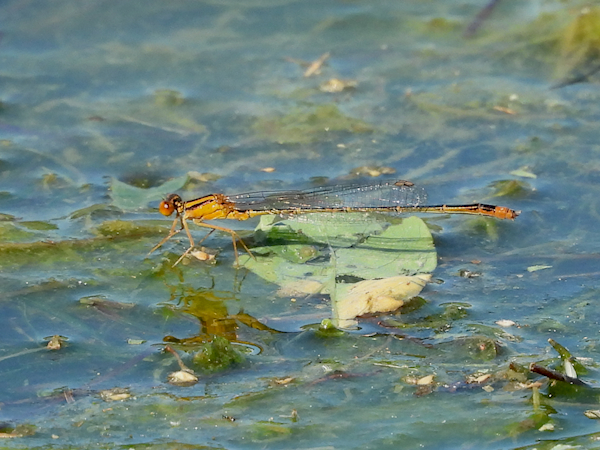
From there I went to the Eagleson Ponds, hoping to see some Eastern Amberwings and Orange Bluets. I had not yet seen any amberwings this year, and was hoping that the Orange Bluets were still present on the lily pads of the central pond. When I arrived I scanned the area near the rock bridge for the amberwings – there were none there, but a black and blue damselfly on a lily pad turned out to be a Skimming Bluet. I crossed the bridge and walked over to the small ramp on the western shore of the pond and found a few Orange Bluets and a couple of Eastern Amberwings out in the vegetation.
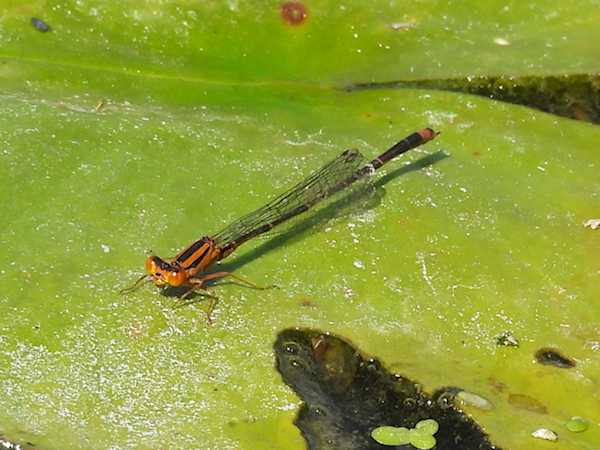
The lily pads were so thick and abundant that it was difficult to see any odes further out, so I headed back to the eastern edge of the pond and checked the water below the small building. While scanning the lily pads there I got lucky and found a pair of Eastern Amberwings in a mating wheel!
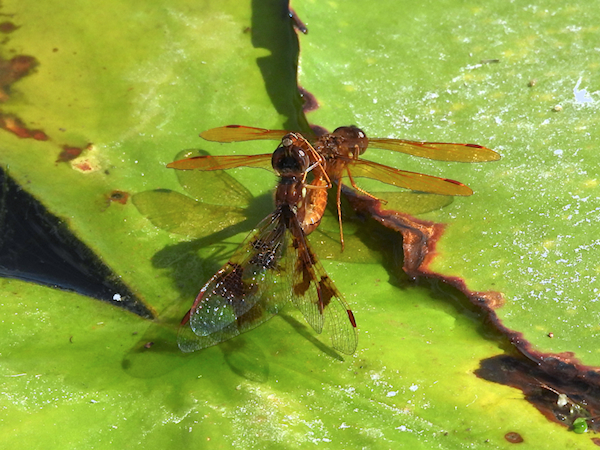
This was only the second time I’ve seen this species mating; both times the mating had occurred right at the water. Females are more difficult to find than males as they hunt away from the water; I have only seen one perching in the vegetation next to the path on my visits here over the past ten years, and that was the first amberwing I found here.
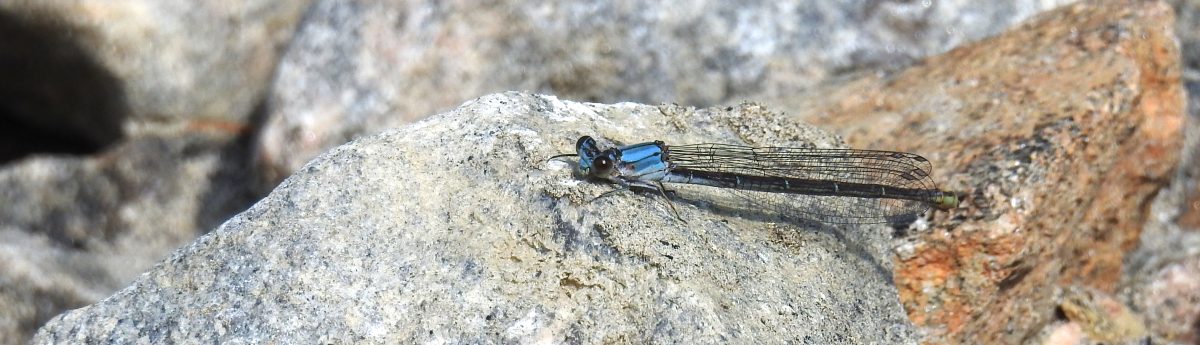
There were more Orange Bluets in the lily pads in this area, and two more black and blue bluets. A closer examination revealed these to be Skimming Bluets as well. That was when I realized that I had never seen this species here before – and yet I had found three of them! Another new species for the ponds, and not an entirely unexpected one! They prefer ponds and sluggish rivers with lots of aquatic vegetation, making the ponds prime habitat.
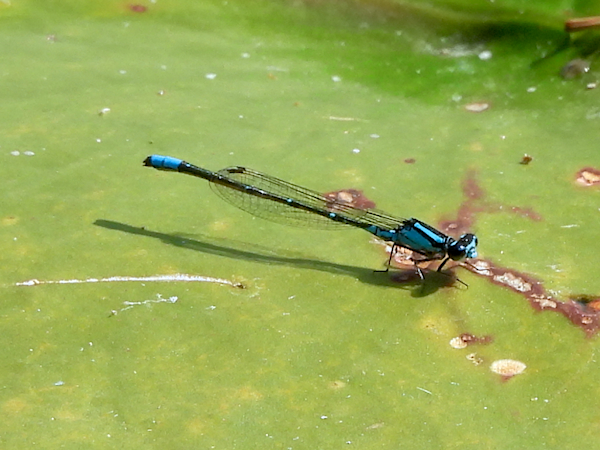
Not yet ready to call it a day, I drove over to the northern pond in the Blackstone subdivision on Terry Fox Drive. The two Blackstone ponds are connected to the Eagleson Ponds via the channel that runs through Kristina Kiss Park toward the Monaghan Drain, and in 2024 I’d found some of the same species there, namely Blue Dasher and Eastern Amberwing. I was curious as to whether they were still around, and found a Blue Dasher and an Orange Bluet, the latter of which was a new species for this pond. I also found a male spreadwing which I couldn’t catch or photograph at the right angle to help me identify it, but as it was the first spreadwing for me at these ponds I included the photo on iNaturalist anyway.
It’s not every day I get a new species at either Stony Swamp or the Eagleson Ponds, yet today I had one at each! Neither one of these new species is uncommon in our area, and each breeds close enough nearby that they weren’t altogether unexpected: the Cherry-faced Meadowhawk at Bruce Pit and the Skimming Bluet at Terry Carisse Park. If only I had more time and more sunny weekends in which to explore I’m sure I could discover a lot more!


