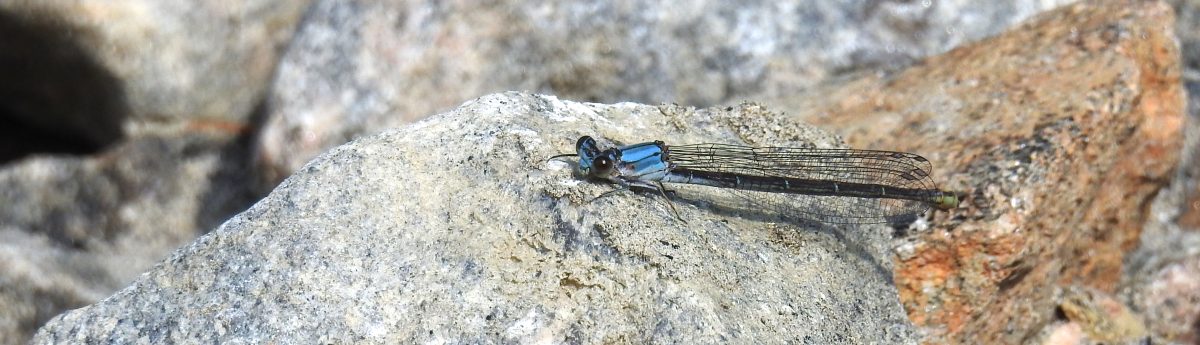
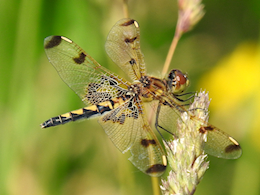
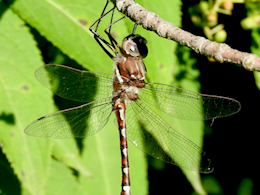
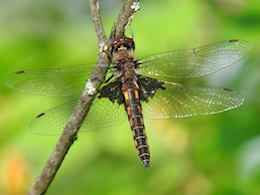
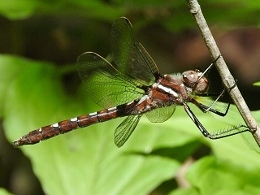
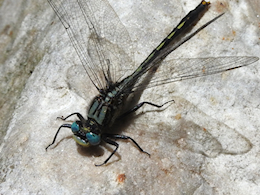
By the time September rolls around, most odonate species are done for the year in the Ottawa region – gone are the Aurora Damsels and Elegant Spreawings, the Spiny Baskettails and Ebony Boghaunters, the Arrowhead Spiketails and Horned Clubtails, the Chalk-fronted Corporals and Four-spotted Skimmers. This is the time of year when the number of meadowhawks and darners begin to peak, and southern species such as Spot-winged and Wandering Gliders may blow into our region with the warm south winds. A few bluet and spreadwing species may persist, as well as the common and widespread Eastern Forktail, though each day sees fewer and fewer individuals. This is a summary of species I saw and photographed around Ottawa during September 2019 – due to my trip to Edmonton and some cool, cloudy weekends, I didn’t visit as many places as I had hoped and missed a few common species.
On July 22nd I received an email from Chris Lewis about a new dragonfly spot along the Ottawa River. I’d been to Shelia McKee Park out near Dunrobin just once, on an OFNC trip in 2015 to look for herps; it has a network of woodland trails and a steep staircase that leads down from the top of the cliff to the rocky beach at the bottom. Chris said she found evidence of a very recent dragonfly emergence of in the form of both exuviae and teneral dragonflies; she recognized exuviae of both clubtails and emeralds, though she was not able to identify them to species. She saw an unidentified darner and several teneral meadowhawks in the woods, and several Powdered Dancers and a pair of Stream Bluets in tandem near the water. However, it was her clubtail report that intrigued me: she mentioned one Lancet Clubtail, both mature and teneral Black-shouldered Spinylegs, several Midland Clubtails, and one Cobra Clubtail which had become the unfortunate meal of a Midland Clubtail. It is amazing that I’ve never considered going back to this park for odes before – the shoreline here is quite rocky, with little or no emergent vegetation, reminiscent of Britannia Point at Mud Lake or the causeway at Morris Island, both of which are great spots for clubtails. Curious to see these clubtails for myself, I headed out the following Sunday (July 28th) and brought my net in case there was anything worth catching.
Back in 2015 I wrote a blog post about the odonates I found at Andrew Haydon Park one weekday afternoon near the end of July. Since discovering the colony of Halloween Pennants at AHP in 2014, I’ve made it a point to visit this park each year during mid-summer; it’s much closer than travelling all the way to Morris Island to see this stunning dragonfly! So far I’ve only made it out to Morris Island once this year, and when I found no Halloween Pennants flying along the causeway I decided to visit Andrew Haydon Park specifically to search for this species. With the strange, slow start to the season I was bit apprehensive about whether these odes would even be around at AHP, but thankfully I found a few on each of my visits, and in good numbers, too.
During the first week of July my fiancé and I spent some time in Prince Edward County with my dad’s family. We rented a cottage on Loves Lane on Prince Edward Bay, a nice three-bedroom place with 8 acres of land only 20 minutes away from both Sandbanks and Picton. The weather was beautiful, and I spent most of my time getting to know the local residents. On our first full day at the cottage (Monday, July 1st), I went for an afternoon walk on the property to see what I could find. It seemed to be a good spot for odonates; every now and then a couple of Prince and Common Baskettails flew in and started swooping above the deck. There were some other dragonflies present too, so I brought my net out in the hopes of catching one.
By the end of June it seemed that summer had finally arrived and the weather had returned to normal: the temperature had reached a consistent near 30°C, the state of emergency caused by the unprecedented spring flood had ended on June 12th, water levels were returning to normal, and the sun had finally come out! I was hoping that this meant that the dragonflies were also emerging on schedule again, and decided to head to Mud Lake on the last Saturday of June. Mud Lake is a fantastic place to see dragonflies in mid-summer, as all the dragonfly families except for Cordulegastridae – the spiketails – can be found there. Among the damselfly families both the spreadwings and pond damsels are well-represented; the broad-winged damselflies, mainly Ebony Jewelwings, are seen there from time to time. I had high hopes for my visit.
Usually by the time the Victoria Day long weekend arrives the first odes have emerged – in the past I’ve seen baskettails in large numbers at Mud Lake and whitefaces and emeralds in Stony Swamp. This year has been different. A persistent wind from the north has prevented the daytime temperatures from rising much above 20°C; nighttime temperatures are still in the single digits. As dragonfly emergence depends largely on water temperature, it isn’t surprising that I had only seen one dragonfly before the May long weekend, a Common Green Darner at Parliament Hill on May 6th. This is usually one of the first species I see, as they migrate north from the warm south where they emerge. Temperatures had risen from 10°C on May 3rd to 20°C on the 6th, although the morning had started out as a chilly 5°C – perhaps an influx of warm air brought this gorgeous dragonfly up from somewhere where the north wind and flooding weren’t wreaking havoc on the wildlife.
My last day off was Tuesday, and the forecast finally called for a decent amount of sun during the morning and afternoon. I invited a friend, Jon, to go dragon-hunting with me at Morris Island since he was eager to become re-acquainted with odonates after a long absence. There were a few particular species on his must-see list, including Cobra Clubtail, Cyrano Darner and Dragonhunter; I’d seen all of these at Morris Island before, though I wasn’t optimistic about our chances of seeing the Cyrano. Although it is considered to be a widespread species, inhabiting swamps, small lakes, and slow-moving rivers of the eastern half of the continent, adults are rarely seen. It is thought that once they emerge they immediately fly up into the tree-tops where they spend most of their time. Adult males can sometimes be found patrolling their territory, and this appeared to be just such a case with the one that I caught in the parking lot of the Morris Island Conservation Area last year. That was on June 25th, however, I was worried that we might be too late to see them.
June is one of my favourite months. Normally the weather is hot and sunny by the time the solstice rolls around, the birds are all in full song, and newly-emerged butterflies and dragonflies are returning to woodlands, fields and wetlands. However, the weather this month has not been great. The rain from May continued on and off this month, keeping water levels of the rivers and ponds higher than normal, and likely delaying the emergence of many insects. The weekends have been nice, at least; I’ve been able to get out early in the day in order to look for new birds for my year list and any butterflies and dragonflies that may have emerged. While my enthusiasm has certainly declined since our amazing trip to Costa Rica, I’ve found myself regaining interest in visiting trails and conservation areas close to home, hoping to find some species I haven’t seen since the previous summer.
The day after my trip to the Bill Mason Center, I made plans with Chris Lewis and Chris Traynor to head out to the Cedar Grove Nature Trail in Marlborough Forest to look for odes around Roger’s Pond. I would be co-leading an OFNC outing there the following weekend with Jakob Mueller, a reptiles and amphibians guy, and wanted to get an idea of the dragonflies and damselflies that were flying. As we weren’t meeting at the parking lot there until 8:30, I headed out to Sarsaparilla Trail first, then the Rideau Trail for a quick look around.
Chris Lewis and I had such a great time dragon-hunting in Gatineau last weekend that on June 25th we decided to hit several spots west of Ottawa to search for several local and unique species. On our list of locations were the Quyon Ferry Dock near Fitzroy to look for big river species, Morris Island for clubtails and skimmers, and Pakenham, Blakeney and Almonte for Rapids Clubtail. Before heading out to the Quyon Ferry Dock we stopped in at the fields near Constance Bay to look for Upland Sandpipers. We got lucky and found four. Not only did we see a couple of them flying over the fields, giving their distinctive call, we found one standing right on the shoulder of the road! Unfortunately we caused it to flush before I could get a photo of this bird; I still have yet to photograph this species. Indeed, this was the closest I’ve ever come to one of an Upland Sandpiper, which are difficult to find as they breed and feed in dry grasslands rather than muddy shorelines.
While at the Dunlop Picnic area, Chris and I got a call from Chris Traynor saying that he was on his way up to Meech Lake. Chris Lewis and I were on our way there next, and it didn’t take him long to catch up with us as we were walking down the large hill to the lake, listening to the vireos and a Blackburnian Warbler singing. Our destination was the waterfall at the old Carbide Wilson ruins where we hoped to find the snaketails Chris T. had reported seeing earlier in the week. However, first we spent some time exploring the shore of the lake where we found Powdered Dancers, a Chalk-fronted Corporal, and a couple of clubtails on logs too far from shore to identify. It was too early for the Slaty Skimmers to be flying; these dark blue dragonflies are one of my personal favourites, but we saw more than enough other species to make up for their absence.
When Chris Lewis suggested a dragon-hunting excursion on Saturday, I was eager to go. We had to make the extremely difficult choice between Morris Island/Fitzroy Harbour and Gatineau Park, but as Chris Traynor had recently found all sorts of amazing odes at Gatineau Park (including Maine Snaketail, Riffle Snaketail, Mustached Clubtail, Dragonhunter, Horned Clubtail, Dusky Clubtail, Lancet Clubtail, Beaverpond Clubtail and Eastern Least Clubtail) earlier in the week, we decided that a morning in Quebec sounded much more appealing. I met her at her place, and with the assistance of Siri, we navigated the Gatineau Park road closures up to the Sugarbush Trail with none of the frustration I encountered the previous week.
When I decided to take today off it wasn’t my intention, in the beginning, to embark on an all-out “dragon blitz” and search for as many odonate species as possible (or at least as many as I could find until my stamina began to falter); the forecast for the weekend looked terrible, so I wanted to go out while the weather was nice to look for birds in the morning and odes as soon as it warmed up. However, that’s exactly what it became as I started finding some good dragonflies early in the morning and decided to keep visiting different trails where I knew I could find different species.
My morning began with a visit to Lime Kiln Trail, which isn’t a place I visit very often. However, a Mourning Warbler has been heard singing away there for a couple of days now, and I thought I would try to find it. My walk started out fairly quiet, but I saw a Veery on the ground and a Common Raven flying overhead right near the beginning of the trail, and heard a couple of Red-eyed Vireos and a Brown Creeper in the woods.
On the first Saturday in June I made plans to meet Chris Traynor at the parking lot of the Sugarbush Trail in Gatineau Park to look for dragonflies. He has re-named this trail the “Clubtail Trail” due to the large number of clubtails that breed there, and I was eager to find some new species for my life list. Unfortunately our last visit there wasn’t terribly productive due to the overcast skies; the weather on Saturday was much nicer, sunny and warm even in the morning.
As we weren’t planning to meet until 9:00 am, I stopped by Sarsaparilla Trail first to check out the birds there. This turned out to be a fantastic idea as I heard a Least Bittern calling somewhere in the reeds to the north of the boardwalk and a Virginia Rail grunting somewhere on the south side. Other species included Brown Creeper, Eastern Wood-Pewee, Great Crested Flycatcher, Eastern Kingbird, a couple of Tree Swallows, a Marsh Wren singing in the reeds at the end of the boardwalk (the same one from last year?), a couple of Yellow Warblers, a White-throated Sparrow, and two Purple Finches.
In July 2011, I photographed a large Arigomphus dragonfly at Petrie Island. It had greenish eyes, a dark abdomen with rusty-coloured spots on the bottom of the last couple of segments, and an entirely yellow tenth segment. I only got two photos of the clubtail before it flew off, but the two angles showed that there was no black on the sides of the final abdominal segment. According to my research, only one species in Ontario has an entirely yellow tenth segment – the Unicorn Clubtail, a southern species that wasn’t even on the Ottawa checklist. Based on my photographs, which show the completely yellow tenth segment, a few of Ottawa’s most knowledgeable students of the odonata concluded that it could only be a Unicorn Clubtail – a new record for the region, and the 123rd species observed in the Ottawa area.
Unicorn Clubtail
Unicorn Clubtail
In July 2012, I was part of a team of dragon-hunters which went looking for this species at Petrie Island. The team included Bob Bracken, Chris Lewis, and Mike Tate. Bob and I spotted a large Arigomphus dragonfly, and I took one quick photo before he tried to net it. His attempt failed, and this photo is the only record we have of that 2012 clubtail. Again the image shows an entirely yellow tenth segment.
Unicorn Clubtail
In June 2015, Chris Traynor and another member of the OFNC Facebook group photographed Arigomphus dragonflies with what appeared to be entirely yellow tenth abdominal segments west of Ottawa. It seemed strange for the Unicorn Clubtails to pop up suddenly in the west end, especially since there had been no Unicorn Clubtail sightings anywhere in the region since 2012. Chris Lewis, Chris Traynor and I decided to post our photos to the Northeast Odonata Faceboook Group, which includes many prominent members of the Dragonfly Society of the Americas, several professional writers, bloggers, and authors, and other really knowledgeable dragonfly enthusiasts who have been studying these insects a lot longer than Chris, Chris, and I have.
After studying the images I posted, Ed Lam, the author of Damselflies of the Northeast: A Guide to the Species of Eastern Canada & the Northeastern United States (2004), noted that the cerci (upper claspers of the terminal appendages) appear shorter than the epiproct (the lower appendage) in the photos, which supports the similar-looking Lilypad Clubtail (A. furcifer) rather than Unicorn Clubtail (A. villosipes). He then took the time to photograph these two species with the appendages in the exact same position as the ones in my photos. The resulting diagram he put together was conclusive:
Arigomphus appendages (by Ed Lam)
Not only are the upper claspers shorter than the lower clasper, they are even the same shape with a heavy downward arch.
In the Facebook discussion, Chris Lewis responded with the comment that “structure rules again” – that is, structure is more important than colour or pattern when it comes to identifying odes. She also asked about the extensive pale yellow colour on the tenth segment of the two dragonflies I photographed. According to the Algonquin field guide and other online resources, the Lilypad Clubtail has only an elongated yellow spot on top of the tenth segment- the sides of the segment are very dark. She asked Ed if the extent of the paleness down the sides was variable in both species. Ed answered that in his experience, the amount of darkness on those last segments is variable on both Lilypad and Unicorn Clubtails.
So there it is – there are no Unicorn Clubtails in Ottawa (that we know of), and the next time someone spots a clubtail with an entirely yellow tenth segment, it’s best to check the shape and size of the claspers, as these are the most reliable field marks for identifying an odonate to species.
Author’s Note: Many thanks go to Ed Lam for the use of the image comparing the claspers of each species, and for his helpful comments on Northeast Odonata. Even though I lost a lifer, I gained a lot of knowledge about these two species and how to differentiate them. This knowledge will hopefully serve me well in the years to come, and is worth more than a tick on a checklist. Though it was kind of cool having a first Ottawa record while it lasted…! 🙂
It’s been a long time since I’ve been dragon-hunting in Gatineau Park – well over a year, in fact. Even though the park is quite close to Ottawa and has great dragonfly diversity, I rarely venture across the provincial border. This is mostly because I’m wary about going alone, but also because the main roads in the park are closed on Sundays (my preferred day for travelling due to lighter traffic) as a result of the NCC Sunday bike-days. However, I’ve been really impressed with all the species Chris Traynor has been finding there, and so we decided to venture up there together one Sunday. Fortunately Chris knew a few alternate routes to get us to our destination, the Sugarbush Trail (which Chris calls “Clubtail Trail” after all of his great finds) near the Chelsea Visitor Center and Meech Creek.