Last Odes on the Wing: October and November 2024

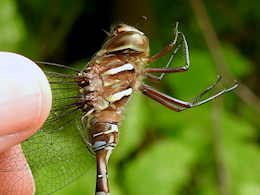
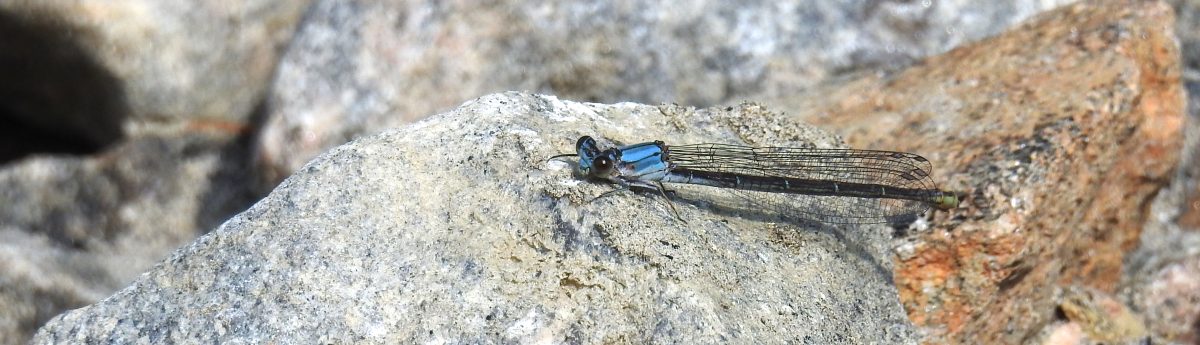
Spotted Spreadwing (Lestes congener)

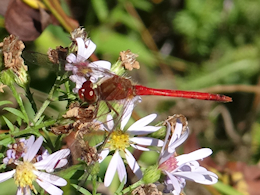
Another ode season is over. Ottawa had some beautiful warm weather during the month of October – there were 26 consecutive days where the daytime high reached 9°C or above (between October 1st and 26th), tying for the 5th longest streak on record. As a result of the warm weather, I thought this would be the year I’d find more species flying later. Our first frost of the season occurred on October 16th with an overnight low of -1°C; this is a week later than the average first frost date. Then a warm spell hit late in the month – October 30th reached a ridiculous high of 22.2°C and October 31st hit 23.9°C, the warmest such days since records began in 1872. The month was mostly dry, with very little rain until the 29th.

November was cooler, though daytime temperatures remained above zero throughout the entire month. It’s not the day-time high that limits the dragonfly season in Ottawa, however; rather, it’s the nighttime lows falling below freezing. While the latest-flying dragonfly, the Autumn Meadowhawk, can withstand a few light frosts, a hard frost will kill both it and the flying insects it feeds on even if subsequent days reach double-digits. November 2nd and 3rd were both below -3°C, while November 9th and 10th were both below -2°C. A string of subzero nights after November 11th followed by warmer but cloudy, windy or wet days after November 20th ended the dragonfly season for good.

Continue reading “Last Odes on the Wing: October and November 2024”

A Darner Kind of Day

Variable Darner (Aeshna interrupta)

Today I went to Bruce Pit to see if anything was still flying around the edges of the pond and the field at the back. When I was here last weekend, there had still been three meadowhawk species and six damselfly species (Slender Spreadwing, Spotted Spreadwing, Azure Bluet, Familiar Bluet, Fragile Forktail and Eastern Forktail) still present, as well as an unidentified darner in flight over the water. With only two days left in the month I wasn’t expecting much, and indeed the wet vegetation at the edge of the pond yielded only three damselflies on this visit: Slender Spreadwing, Spotted Spreadwing, and Familiar Bluet. I also saw White-faced and Autumn Meadowhawks, but the Band-winged Meadowhawk from last weekend was gone.

I was pleasantly surprised when I saw at least two large darners zipping along the edge of the shore, especially when one flew low to investigate the reeds close to where I was standing. My net shot out, and the next thing I knew there was an angry buzzing sound coming from inside. I had caught a darner, and I was not really surprised to find a male Canada Darner inside.

Continue reading “A Darner Kind of Day”

The 2024 Summer Odolympics

Autumn Meadowhawk (Sympetrum vicinum)

The 2024 North American edition of the Summer Odolympics were held between September 7-15, giving ode enthusiasts two weekends and as much time as a regular working week would allow to collect observations. I had hoped to find 19 or 20 species based on the same period spent collecting observations last year, but as most species are on the decline by this time, I knew I needed both good weather and good luck to come up with a respectful number. Unfortunately, neither luck nor weather were in my favour that first crucial weekend when I hoped to find a few species whose season ended around the beginning of September; it rained most of Saturday, and the temperature never rose above 15°C. Although it didn’t rain nearly as much on Sunday, the weather was worse: it was cloudy, windy, and the temperature never rose above 14°C. In fact, it was the coldest September 8th in more than 70 years (since 1949) and the windiest since records began in 1953 with a mean wind of 21 km/h. With a 1:00am windchill of 1.6 it was almost (within 0.1) the lowest windchill ever recorded on September 7th. Cold, wet, windy nights are even more of an obstacle, as many late-lingering species may not survive the low temperatures. When the sun began peeking out from the thick, fast-moving clouds around 4:30 I headed out despite the wind as to have zero species recorded on the first weekend was unthinkable. I didn’t expect much, and found only two species at the Eagleson ponds: an Eastern Forktail and a Slender Spreadwing.

Continue reading “The 2024 Summer Odolympics”

A Three-Darner Day

Black-tipped Darner

On July 15th I went to Jack Pine Trail at lunch to look for dragonflies. I was hoping to find some Brush-tipped Emeralds, a species I hadn’t seen there since 2019. I have not visited Jack Pine Trail much in the past five years for a variety of reasons, including closures during the pandemic lockdowns and after the derecho of May 2022. However, the main reason is that I stopped looking for them there after I began visiting Marlborough Forest during the pandemic and saw how common the Brush-tipped Emeralds were on all the trails there. Unfortunately Marlborough Forest is a little bit too far to visit on a lunch hour, but Jack Pine Trail is nice and close. It can be good for baskettails, and it’s the most reliable spot in the area for Arrowhead Spiketails in mid-June. I’ve also had Slaty Skimmer there and two unidentified clubtails that I never got a good look at before they flew off. I usually find something interesting there when I visit, and was hoping to do so again today.

Continue reading “A Three-Darner Day”

Odonates on the Wing: October and November 2023

Autumn Meadowhawk

By October I’m thinking about putting the net away for the season. If it is still warm at the beginning of the month, I will usually take the net out as long as I’m still seeing darners and small bluets around. Once I’m seeing nothing but meadowhawks, however, it’s time for me to declare an end to the season and put my gear away until the spring. This year the first week of October was very warm, with temperatures reaching 30°C; they then returned to seasonal for the next week with temperatures in the mid-teens. By the end of the month temperatures were in the single digits during the day and falling to below zero overnight, bringing an end to all but the hardiest of dragonflies. That title belongs to the meadowhawks, in particular the Autumn Meadowhawk (Sympetrum vicinum). It is no coincidence that it is the latest-flying dragonfly in many areas of the northeast….sometimes by several weeks. Once called the Yellow-legged Meadowhawk, it was renamed in 2004 by the Dragonfly Society of the Americas because mature individuals often have brown legs instead of yellow and because it persists so long into the fall. It is the only dragonfly in our area with entirely brown or yellow legs (never black), making identification relatively easy. And it is the only species you are likely to see in Ottawa in November!

Continue reading “Odonates on the Wing: October and November 2023”

Odonates on the wing: September 2023 Summary

Band-winged Meadowhawk

Although technically still considered summer until the equinox, the month of September ushers in the beginning of fall, the season most associated with change and impermanence, with encroaching darkness, with death and transition and the melancholy appreciation of the last burst of colour before the inevitable bleakness of winter. I can’t help but be reminded that this is the season of endings every time I go outside: the robins are gone from the neighbourhood, the songbirds in the woods have stopped singing, trees are changing colour, and the asters and goldenrods have replaced all the other wildflowers along roadsides and in conservation areas. In the dragonfly world, it is the season of the meadowhawk, the glider, and the darner, as these types of dragonflies are by far the most numerous. The goal now is to search out any others that may still be flying, and see how long into the season they last. Part of the reason is purely scientific – to get a better grasp of the flight seasons of local odonates. However, another part of the reason is purely emotional – I never know if a sighting will be the last of the year, and hope to put off the final goodbyes as long as possible.

Continue reading “Odonates on the wing: September 2023 Summary”

The 2023 Summer Odolympics

Dragonhunter
Dragonhunter

When I first heard about the Odolympics – a special bioblitz hosted by the Dragonfly Society of the Americas, Sociedad de Odonatología Latinoamericana, and Odonata Central in order to record as many odonata species from as many places in the Western Hemisphere as possible – I knew I had to participate. This specialized bioblitz is only two years old, and there are usually two Odolympics each year: one falling during the North American summer, and one falling during the South American summer in order generate a snapshot of odonate distribution throughout both hemispheres.

Dragonflies and damselflies, collectively known as odonates, are valuable indicators of a wetland’s environmental health and biodiversity. Simply put, the more odonates that use a wetland for breeding and feeding purposes, the healthier the ecosystem. Naturalists were encouraged to submit their observations during the bioblitz via one of two platforms: iNaturalist, or Odonata Central. While I love iNaturalist and have been using it for a few years now to record my non-avian observations, I began submitting my observations to Odonata Central last year when it developed a checklist-based phone app similar to eBird. iNaturalist also has a phone-based app for submitting observations, but it is intended to be used in conjunction with the phone’s camera which I only use as a backup camera when my Nikon Coolpix’s battery decides to take a nap. Although I love the ease of searching for data in iNaturalist’s projects, I chose to record my Odolympic observations in Odonata Central as it allowed me to include observations of species for which I am usually unable to get a photo (yes, I’m looking at you, Prince Baskettail and Wandering Glider!)

Continue reading “The 2023 Summer Odolympics”

Ode-hunting along the River

Shadow Darner
Shadow Darner

Mud Lake and Andrew Haydon Park are usually excellent places to find different species of dragons and damsels throughout the summer months. In both 2015 and 2019 I had a good number of species at Andrew Haydon Park in late July, and an OFNC dragonfly outing at Mud Lake on July 21, 2013 also netted some fantastic species. I was hoping for some similar luck on an ode-hunting trip on July 24th, but this time I found fewer species and fewer individuals overall. I am not sure why there seem to be so few dragonflies around good pond habitat these past two years (such as the Eagleson ponds), but the trend is concerning.

My first stop was the shoreline at Mud Lake where I hoped to find some large river clubtails perching on the rocks in the channel behind the filtration plant. When I arrived I was happy to find two dragonflies perching on the rocks right away, and managed only to photograph one before a couple of people came along and scared them both – while I’m certain one of them was a clubtail, the one I photographed turned out o be an Eastern Pondhawk. The clubtail did not return, although I saw a couple flying out over the water several times on my visit.

Continue reading “Ode-hunting along the River”

September Odes – A Summary

Shadow Darner

By the time September rolls around, most odonate species are done for the year in the Ottawa region – gone are the Aurora Damsels and Elegant Spreawings, the Spiny Baskettails and Ebony Boghaunters, the Arrowhead Spiketails and Horned Clubtails, the Chalk-fronted Corporals and Four-spotted Skimmers. This is the time of year when the number of meadowhawks and darners begin to peak, and southern species such as Spot-winged and Wandering Gliders may blow into our region with the warm south winds. A few bluet and spreadwing species may persist, as well as the common and widespread Eastern Forktail, though each day sees fewer and fewer individuals. This is a summary of species I saw and photographed around Ottawa during September 2019 – due to my trip to Edmonton and some cool, cloudy weekends, I didn’t visit as many places as I had hoped and missed a few common species.

Continue reading “September Odes – A Summary”

A Shadow at Last

Shadow Darner

The Equinox fell on Thursday, and by then the winds were blowing down from the north, putting an abrupt end to summer. Although I quite love the crisp, cool days of fall, I hate the cold early mornings which require hats and gloves to stay warm. This morning I headed out to Jack Pine Trail, leaving at 8:15 – the sun is visibly lower in the sky now – and I wished I had brought gloves as my hands were so cold. A Blue Jay and some chickadees were feeding on seeds left on the ground in the parking lot, and it seemed strange not to hear any Red-eyed Vireos or Eastern Wood-pewees singing.

Continue reading “A Shadow at Last”

The Last Dragons of Summer

Autumn Meadowhawk

The end of September is a good time to see a variety of hover flies (also known as flower flies, syrphid flies, or syrphids). It is also the end of dragonfly season. Most odonates are already done for the season – only a handful of species will continue flying into October, with the last species, Autumn Meadowhawk, flying into November if the weather cooperates.

As the last week of September was still quite warm, I was able to find and photograph a few different species of both insects – even in my own backyard! I finally added Autumn Meadowhawk to my official yard list on September 19th. I’ve seen a few meadowhawks in my yard over the years, but have only identified White-faced Meadowhawk and Band-winged Meadowhawk so far. I found it on the asters at the back of the yard, although it flew up onto the fence when I tried to get closer for a photo. Given how abundant and widespread it is, the Autumn Meadowhawk was the most likely species to be added to my yard list. Now that it has shown up in my yard, I’m not sure what the next likeliest species is – Common Green Darner? Twelve-spotted Skimmer?

Continue reading “The Last Dragons of Summer”