Sarsaparilla Trail is always worth a quick visit in the warmer months, even with the limited access to the water. The pond is fairly large, and I’ve often wondered just how many species actually live and breed here away from the boardwalk – the only point of access to the water. On June 18, 2025 I added a new species here to the list of Stony Swamp odes, a female Horned Clubtail that landed on the boardwalk and stayed long enough for some photos. After seeing that magnificent dragonfly I wasn’t expecting to add another new species to the list anytime soon, but that is what happened on one of my visits this month.
The circular trail through the woods is short – the inner loop is only about 0.5 km – so most times I only stop by for a quick walk on my lunch break while working from home, or a short visit after returning from somewhere else. My July 8 visit was a lunchtime visit, and although there were lots of clouds in the sky, the odes were flying around the pond as usual.
Burritt’s Rapids has been on my radar as a low-priority place to visit for about a year now, and if I hadn’t missed a turn on my way to the southwestern corner of Marlborough Forest I wouldn’t have ended up there on a nice warm day in mid-July. I had been curious about what species I might find at the rapids there, and was hoping to find a few new species to add to iNaturalist as it didn’t have many when I first started thinking about going there. One species I was curious about was Swamp Spreadwing, which had been found a short distance east at Rideau River Provincial Park back in 2022. The only place I’ve seen this species in Ottawa is Petrie Island, and it would be fantastic to find another one closer to home. I was also wondering if the river and rocky rapids might host some of our common clubtails, such as Dragonhunter or Black-shouldered Spinyleg.
A day without seeing a dragonfly is like a day without chocolate – sure, it’s completely survivable, but utterly lacking in joy. I had to work downtown on both the Wednesday and Thursday after Canada Day, and decided to go for a lunchtime walk along the canal to the river on Wednesday to see if I could find any weekday odes. I’d seen Prince Baskettails and Common Green Darners flying up and down the canal, and a Midland Clubtail on the rocky shore behind Parliament Hill many moons ago, so the downtown core is not completely devoid of odonates. Still, I wasn’t expecting much, and got lucky on Wednesday when I saw first a Common Green Darner flying by, then a Prince Baskettail. Then something small fluttering above one of the mats of vegetation caught my eye – a female Eastern Amberwing ovipositing in some floating vegetation! After a few more minutes of watching, I saw a pair of males fly by. I waited for several minutes for one to land but they never did.
I haven’t spent much time at Terry Carisse Park this year, as I’ve had other projects and priorities demanding my attention and limited ode-hunting time. However, in May I received an email from a blog reader in Montreal named Pierre who was interested in trying to find a particular damselfly species – the Rainbow Bluet – which he and his wife had tried to find last year, without any luck, in known areas of Ottawa. He was interested in visiting Terry Carisse Park after reading my blog posts and messaged me in late May for the details, hoping these small, colourful damselflies would be easier to find this time around. I told him the best places to find them in the park (at the canoe/boat launch at the north end of the park and in the sunny vegetation at the top of the river bank along the south end) and told him to let me know how it went. I didn’t expect to hear from him until after his visit, but received another message on June 12th asking if I had been there recently. I hadn’t – I’d spent the previous two weekends in Nova Scotia, and the weather on my remote-work days has been too lousy to go look for odes. But when I saw the forecast for the following day – sunny and warm – I decided to head on over to see if I could do some pre-scouting for him ahead of his weekend trip.
I usually see my first dragonfly of the year in April, which is not surprising given that the first dragonflies migrate here from further south during the first prolonged warm spell of the month. They are always Common Green Darners, heading north to find new ponds and lakes in which to breed. It isn’t until later in May, usually the second week when temperatures are consistently in the 15-20°C range, that the local species emerge, chiefly skimmers and emeralds and, of course, damselflies. However, this season it didn’t warm up to 20°C until the very end of the month of April. It was still warm by the time the first weekend of May arrived, and on May 4th I finally saw my first Common Green Darners at a small pond in Stony Swamp – three males, it appeared.
We only had one night on P.E.I. (which we spent at a hotel in Summerside across from the harbour) so we didn’t do a lot of hiking or exploring. We spent the day we arrived touring the western side of the island, where I thoroughly enjoyed the birds and views of North Cape, and the day of our departure exploring the eastern half. It wasn’t until the second day that I saw any odonates – we visited the Anne of Green Gables Museum and the birthplace of L.M. Montgomery, had lunch in Charlottetown, then drove across the island to East Point before catching the ferry at Wood Islands to Nova Scotia. When we reached the museum I immediately decided not to join my dad and step-mom on the tour: there was a pond on one side of the driveway, and a small marshy wet spot on the other. I could finally do some ode-hunting!
On June 15th I visited Mud Lake for a morning of birding and ode-hunting. It was about 13°C when I arrived at 8:30, and although it was sunny, the persistent breeze made it feel cooler. Still, there were more odes about than I had hoped for, although at first I saw only a few damselflies (Eastern Forktails, Fragile Forktails and Powdered Dancers) and Dot-tailed Whitefaces. It wasn’t until about an hour into my walk that I came across my first interesting odonate observation of the day: a lilac bush with several dragonflies perching on its branches. It was the Spiny Baskettail landing on an exposed twig that caught my attention, and while I was trying to photograph it a few more dragonflies landed nearby: first a Blue Dasher and then a Prince Baskettail! These large emeralds are the least likely of the baskettails to land, so seeing one perching is always a treat.
My fiancé Doran and I spent two weeks in the Maritimes in late May/early June: first we spent some time in Yarmouth, Nova Scotia, where Doran (a comic book creator) had a booth for all three days of the Y-Con Gaming & Comics Convention, followed by three days in the Annapolis Valley to visit family, and finishing with a few days in Moncton, New Brunswick where Doran had a booth at East Coast Comic Expo for a day and a half. These are places I never would have planned to visit for birds and dragonflies on my own, so it was a great opportunity to explore some places completely off my radar! I prepared for the trip the same way any contemporary naturalist would prepare: I investigated iNaturalist, explored eBird, and goggled over Google maps looking for places that had an intriguing variety of birds, odonates, and habitats in order to come up with a short list of places to visit around each of our AirBnBs. I wanted to see (or hear) and document as many species as possible with three main goals in mind: (1) to find some East Coast lifers whose range is limited to the Maritimes (White Corporal and Mantled Baskettail being at the top of my list); (2) to find some species that live in the Ottawa-Gatineau region but are difficult to find, mainly due to the inaccessibility of habitat (such as emeralds in bogs or clubtails and snaketails in rushing creeks); and (3) add as many ode records as possible to Nova Scotia and Moncton in order to increase the general knowledge of the species that live there.
By October I’m thinking about putting the net away for the season. If it is still warm at the beginning of the month, I will usually take the net out as long as I’m still seeing darners and small bluets around. Once I’m seeing nothing but meadowhawks, however, it’s time for me to declare an end to the season and put my gear away until the spring. This year the first week of October was very warm, with temperatures reaching 30°C; they then returned to seasonal for the next week with temperatures in the mid-teens. By the end of the month temperatures were in the single digits during the day and falling to below zero overnight, bringing an end to all but the hardiest of dragonflies. That title belongs to the meadowhawks, in particular the Autumn Meadowhawk (Sympetrum vicinum). It is no coincidence that it is the latest-flying dragonfly in many areas of the northeast….sometimes by several weeks. Once called the Yellow-legged Meadowhawk, it was renamed in 2004 by the Dragonfly Society of the Americas because mature individuals often have brown legs instead of yellow and because it persists so long into the fall. It is the only dragonfly in our area with entirely brown or yellow legs (never black), making identification relatively easy. And it is the only species you are likely to see in Ottawa in November!
When I first heard about the Odolympics – a special bioblitz hosted by the Dragonfly Society of the Americas, Sociedad de Odonatología Latinoamericana, and Odonata Central in order to record as many odonata species from as many places in the Western Hemisphere as possible – I knew I had to participate. This specialized bioblitz is only two years old, and there are usually two Odolympics each year: one falling during the North American summer, and one falling during the South American summer in order generate a snapshot of odonate distribution throughout both hemispheres.
Dragonflies and damselflies, collectively known as odonates, are valuable indicators of a wetland’s environmental health and biodiversity. Simply put, the more odonates that use a wetland for breeding and feeding purposes, the healthier the ecosystem. Naturalists were encouraged to submit their observations during the bioblitz via one of two platforms: iNaturalist, or Odonata Central. While I love iNaturalist and have been using it for a few years now to record my non-avian observations, I began submitting my observations to Odonata Central last year when it developed a checklist-based phone app similar to eBird. iNaturalist also has a phone-based app for submitting observations, but it is intended to be used in conjunction with the phone’s camera which I only use as a backup camera when my Nikon Coolpix’s battery decides to take a nap. Although I love the ease of searching for data in iNaturalist’s projects, I chose to record my Odolympic observations in Odonata Central as it allowed me to include observations of species for which I am usually unable to get a photo (yes, I’m looking at you, Prince Baskettail and Wandering Glider!)
July is usually the start of the best three months of ode-hunting at Andrew Haydon Park. Although I often visit the park in the spring and fall for birds, my time here in the summer is devoted to dragonflies. This park is reliable for Halloween Pennants, Blue Dashers, Eastern Pondhawks, Common Green Darners, Prince Baskettails, and the usual King Skimmers, and I’ve had Cobra Clubtail and Elusive Clubtail here as well. I visited on July 29th with the hope of seeing another Cobra Clubtail, as it was on July 21, 2019 that I saw one fly into a tree on a windy day, eating what looked to be a male Orange Bluet. Though I’ve looked for both species here in July in subsequent years, I only had luck with one female Orange Bluet on July 24, 2021.
When I went out searching for Rainbow Bluets at the Eagleson Ponds on June 10th I photographed all damselflies that had the characteristically pale thorax, orange eyes, and blue markings at the tip of the abdomen as I expected that many individuals that had recently emerged would not have developed their full colouration yet…when most teneral bluets emerge, they are a colourless pale beige with black markings, and it takes time for their colours to deepen. When I found this particular individual damselfly in the grass along the southern-most pond, I assumed it was Rainbow Bluet still developing, snapped a quick photo…then realized the field marks didn’t add up. For one thing, the green shoulder stripes were too wide, and for another, it lacked the narrow blue bar connecting the two eyespots.
The thorax was pale green, and the legs and parts of the eyes appeared orange, but the tip of the abdomen showed two irregular blue markings on top of segments 8 and 9. It had an ovipositor, so it was a female – but what species? When it flew a short distance to a blade of grass close by, I followed in order to get some photographs from the top. The eyespots looked more like those of a forktail which started to make me think: could this be a rare andromorph female Eastern Forktail?
An andromorph damselfly is a female which looks like a male. Female forktails (genus Ischnura) in the northeast can be quite confusing as they have two more colour forms: most have an immature form and a mature form (which, if different from the male, are both considered heterochromatic), and some have a male-like andromorph, or homeochromatic, form as well.
Of the three forktail species found in Ontario, the Fragile Forktail (Ischnura posita) is the easiest to identify as the female has only an immature and mature form, both of which have the same broken shoulder stripes (resembling double exclamation marks) as the male and the same black abdomen with no blue markings on any of the final segments. Both forms are considered homeochromatic. A little further south, and once upon a Burnt Lands alvar, the female Citrine Forktail (Ischnura hastata) has only an immature and mature form as well, both of which are heterochromatic. Nothing about the three forms suggests they are all the same species: the male is primarily green and yellow with small black markings on top of the first seven abdominal segments, the immature female is primarily orange with black markings on top of segments 6-8, and the mature female is almost entirely black with brownish or olive markings on the thorax.
Similarly, none of the three common forms of the Eastern Forktail (Ischnura verticalis) suggest they are all the same species, either: the male is primarily green and black with blue markings on segments 8 and 9; the immature female is primarily black and orange; and the mature female is a pruinose grayish purple.
Eastern Forktail (Ischnura verticalis), male
Homeochromatic females are rare and look quite similar to the males, but may also show some variation. The thorax is typically greenish-blue, and the blue spots on top of segments 8 and 9 are variable. Some females may show an orange blush on segments 1-3, with the most orange showing on segment 3. In the photo below showing the profile it looks as though there is a hint of orange on the underside of segments 2 and 3. The thorax is also paler than that of the male, the green colour showing more yellow than blue.
Eastern Forktail, andromorph female
Finding one of these unusual colour morphs is akin to finding a four-leaf clover. This is only the second time I’ve ever seen a homeochromatic, or andromorph female; I saw my first at Hurdman Park many, many moons ago. It, too, had unusual blue markings at the tip of its abdomen. It just goes to show that these damselflies – quite possibly the most common, the most widespread, and most abundant odonate in the northeast due to its ability to colonize just about any still or slow-moving body of water – are worth a second glance as you never know if their own version of the four-leaf clover is lurking among the rest of them.
Damselflies are small odonates related to dragonflies, but belong to Order Zygoptera instead of Order Anisoptera. Unlike dragonflies, damselflies have very slender abdomens, and the forewing and hindwing are similar size and shape. Two of the three families found in eastern North America – the broad-winged damsels and pond damsels – hold their wings above the body, parallel to the abdomen, while perching. The third family – the spreadwings – do not perch horizontally with their wings parallel to the body, but typically “hang” from a perch, with the wings slightly spread at an angle. Adult damselflies are not strong fliers, and generally do not travel far from water. They are most often found in vegetation or on the ground near ponds, streams, and other bodies of water. Because of their small size they can be difficult to see, but the dark wings of the jewelwings and brightly coloured abdomens of some of the pond damsels help aid in observation.
Most naturalists who have heard of Terry Carisse Park along the Jock River associate it with birds – particularly the Hooded Warbler that spent a few days there in May 2014. As a rare bird for Ottawa, this discovery put this small riparian park on the map for many Ottawa birders. Other people may associate it with the Osprey nest there, although the Osprey haven’t nested there for a few years now. I myself have returned regularly to this park in the spring and fall to look for the Rusty Blackbirds that often stop over here during migration – in May 2021 I found at least 50 of these declining birds feeding on the lawn and perched in the trees that line the river bank. Because of the thick shoreline vegetation, the wooded swamp to the north, and the open grassy areas dotted with conifers it is a good place to look for birds during migration. I had never been here during the summer breeding season, and it occurred to me this summer that it might be a good spot to look for odonates. I started my summer ode survey on July 2, 2022, continuing through early August, and found more species than I expected – including some species I’ve only seen at Petrie Island or Morris Island Conservation Area!
After discovering the Saffron-winged Meadowhawks and Eastern Amberwings at the Eagleson Ponds on Sunday, July 30th, I returned again Friday after work, as well as on Saturday and Sunday. I checked the small crescent-shaped bay near the small building each time for the meadowhawks, to no avail; in fact, I didn’t see any meadowhawks on any of my visits at all. I got lucky and found one of the male Eastern Amberwings on the same mat of vegetation on Friday after work, but didn’t see any females.
I returned to the peninsula on the edge of the central pond where I had found the female spreadwing on a previous visit, but found no spreadwings on this visit. I did, however, find a tiny Fragile Forktail gliding low among the weeds, confirming this species’ presence at the ponds. I had seen one several years ago prior to the reconstruction, so I was happy to see that the population had either survived or re-established itself.
Fragile Forktail
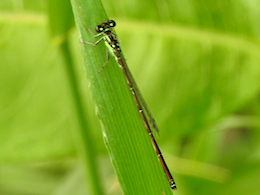
This is a male, based on the green thorax and lack of ovipositor at the tip of the abdomen – young females are typically blue instead of green, and become bluish-gray with pruinosity as they age. Both sexes have exclamation points on top of the thorax, which distinguishes them from the more common Eastern Forktail. Male Fragile Forktails also lack the two blue spots at the tip of the male Eastern Forktail’s abdomen….the abdomen is entirely black, which makes it difficult to see flying in shaded areas.
Fragile Forktail
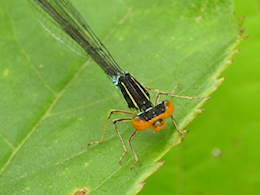
I stopped by again early on Saturday morning, which was sunnier and windier, so I didn’t see many dragonflies. There were, however, plenty of Eastern Forktails sheltering in the tall vegetation. I think this orange female is one of our prettier damselflies. Like the male Fragile Forktail, the tip of the abdomen is black when viewed from the top – it is often pale orange below. The immature Eastern Forktail is confusable only with the male Orange Bluet, which has an orange-tipped abdomen with noticeably long cerci at the end.
Eastern Forktail
My best find on Sunday was a fresh Wild Indigo Duskywing. Although I’ve been looking for them, this was my first confirmed sighting of the 2017 season. The caterpillars feed on Crown Vetch, of which there is an abundance here, particularly on the point on the east side of the pond.
I was glad to confirm that both Wild Indigo Duskywings and Fragile Forktails were still present in the area, and to see another Eastern Amberwing. The ponds have become one of my favourite birding and nature spots, and with plenty of time left in the ode season, it will be a great place for studying wildlife for the next few months!







 OdoNotations