Odonata of the Rideau Canal

Eastern Amberwing

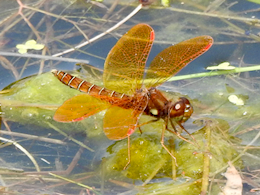
A day without seeing a dragonfly is like a day without chocolate – sure, it’s completely survivable, but utterly lacking in joy. I had to work downtown on both the Wednesday and Thursday after Canada Day, and decided to go for a lunchtime walk along the canal to the river on Wednesday to see if I could find any weekday odes. I’d seen Prince Baskettails and Common Green Darners flying up and down the canal, and a Midland Clubtail on the rocky shore behind Parliament Hill many moons ago, so the downtown core is not completely devoid of odonates. Still, I wasn’t expecting much, and got lucky on Wednesday when I saw first a Common Green Darner flying by, then a Prince Baskettail. Then something small fluttering above one of the mats of vegetation caught my eye – a female Eastern Amberwing ovipositing in some floating vegetation! After a few more minutes of watching, I saw a pair of males fly by. I waited for several minutes for one to land but they never did.

Continue reading “Odonata of the Rideau Canal”

Next Gen Dragon-hunters

Canada Darner
Canada Darner

After I returned from my visit to southern Ontario I still had bugs on the brain, specifically odonates. Now that September has arrived the days will be getting shorter and the nights cooler, which spells the end of the season for a number of different species. It is, however, prime time for darners, and I still had yet to find a Lake Darner or Green-striped Darner this year. I also haven’t seen any Saffron-winged Meadowhawks either, another species that peaks in August and early September, despite searching known locations at the Eagleson storm water ponds. While I knew that bird migration was heating up, my brain hasn’t yet made the switch from odes to birds. I am having trouble getting up early enough to get out for my regular birding walks before work, and I won’t even consider putting my net away while the weather is still nice – I want to wring every last sunny moment looking for dragonflies and damselflies before taking the mandatory six-month winter hiatus. This has never happened to me before, and while I still am using eBird to keep track of what I see, most of my checklists are incidental ones noting only a few species that caught my attention while out later in the day dragonfly-hunting.

Continue reading “Next Gen Dragon-hunters”

Ode-hunting in Chatham-Kent: Peers Wetland

Probable Ruby Meadowhawk

My mother lives in Wallaceburg in Chatham-Kent, which is about a 7.5 hour drive from Ottawa, or a full day train adventure with a transfer in Toronto (my advice for anyone travelling economy on Via: take your own sandwiches and snacks, as the menu was somewhat unpalatable…and chocolate bars/chips alone were $3.00). Being so far south she gets a variety of birds, bugs and plants that we do not get here in eastern Ontario, so I’ve been meaning to visit in the summer when I might see some new southern butterflies and dragonflies for my life list. I took an extra two days off at the end of August so I could spend the Labour Day long weekend with her, though two of the days were lost to travel. As my mother and her husband both enjoyed birds and nature, I knew they’d be interested in taking a few nature walks with me, even if the idea of looking for dragonflies didn’t exactly fill them with delight.

Continue reading “Ode-hunting in Chatham-Kent: Peers Wetland”

The 2023 Summer Odolympics

Dragonhunter
Dragonhunter

When I first heard about the Odolympics – a special bioblitz hosted by the Dragonfly Society of the Americas, Sociedad de Odonatología Latinoamericana, and Odonata Central in order to record as many odonata species from as many places in the Western Hemisphere as possible – I knew I had to participate. This specialized bioblitz is only two years old, and there are usually two Odolympics each year: one falling during the North American summer, and one falling during the South American summer in order generate a snapshot of odonate distribution throughout both hemispheres.

Dragonflies and damselflies, collectively known as odonates, are valuable indicators of a wetland’s environmental health and biodiversity. Simply put, the more odonates that use a wetland for breeding and feeding purposes, the healthier the ecosystem. Naturalists were encouraged to submit their observations during the bioblitz via one of two platforms: iNaturalist, or Odonata Central. While I love iNaturalist and have been using it for a few years now to record my non-avian observations, I began submitting my observations to Odonata Central last year when it developed a checklist-based phone app similar to eBird. iNaturalist also has a phone-based app for submitting observations, but it is intended to be used in conjunction with the phone’s camera which I only use as a backup camera when my Nikon Coolpix’s battery decides to take a nap. Although I love the ease of searching for data in iNaturalist’s projects, I chose to record my Odolympic observations in Odonata Central as it allowed me to include observations of species for which I am usually unable to get a photo (yes, I’m looking at you, Prince Baskettail and Wandering Glider!)

Continue reading “The 2023 Summer Odolympics”

Orange Bluets at Andrew Haydon Park

Orange Bluet
Orange Bluet

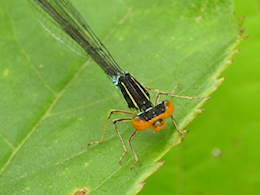
After my successful outing at Andrew Haydon Park on July 29th, I couldn’t wait to return to see the Vesper Bluets again and to look for the elusive Orange Bluet. The two successfully share the same habitat at Petrie Island, so why not in the ponds at AHP? While Vesper Bluet habitat includes the edges of woodland lakes, ponds, and slow rivers rich with emergent vegetation, Orange Bluets are present in those habitats as well as in swamp edges, bogs, slow streams, and degraded wetlands containing varying levels of pollution. I knew they were already on the wing, as I had first seen them at the Eagleson Ponds on July 3rd and have been seeing them there on and off ever since. It was just a matter of returning to Andrew Haydon Park later in the afternoon when they would be at the water, as they spend the early part of the day in the vegetation or trees nearby.

Continue reading “Orange Bluets at Andrew Haydon Park”

Damselflies in New Places

Violet Dancer
Violet Dancer

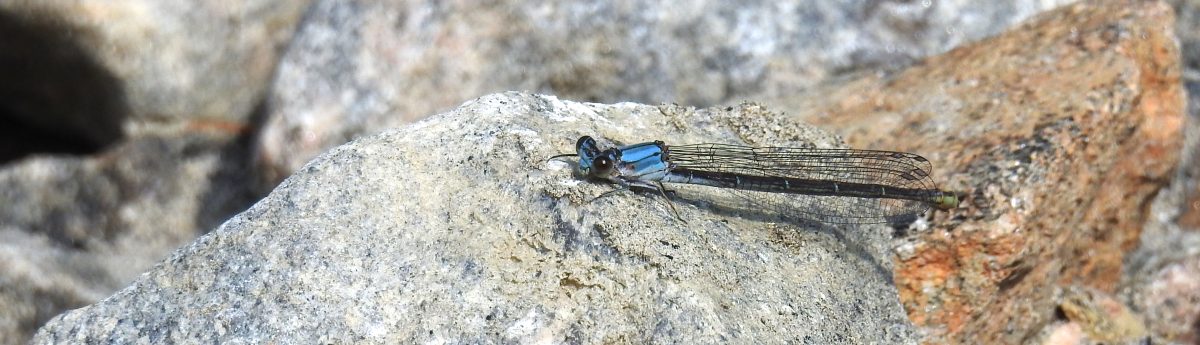
Damselflies are small odonates related to dragonflies, but belong to Order Zygoptera instead of Order Anisoptera. Unlike dragonflies, damselflies have very slender abdomens, and the forewing and hindwing are similar size and shape. Two of the three families found in eastern North America – the broad-winged damsels and pond damsels – hold their wings above the body, parallel to the abdomen, while perching. The third family – the spreadwings – do not perch horizontally with their wings parallel to the body, but typically “hang” from a perch, with the wings slightly spread at an angle. Adult damselflies are not strong fliers, and generally do not travel far from water. They are most often found in vegetation or on the ground near ponds, streams, and other bodies of water. Because of their small size they can be difficult to see, but the dark wings of the jewelwings and brightly coloured abdomens of some of the pond damsels help aid in observation.

Continue reading “Damselflies in New Places”

Terry Carisse Park in the Summer

Rainbow Bluet

Most naturalists who have heard of Terry Carisse Park along the Jock River associate it with birds – particularly the Hooded Warbler that spent a few days there in May 2014. As a rare bird for Ottawa, this discovery put this small riparian park on the map for many Ottawa birders. Other people may associate it with the Osprey nest there, although the Osprey haven’t nested there for a few years now. I myself have returned regularly to this park in the spring and fall to look for the Rusty Blackbirds that often stop over here during migration – in May 2021 I found at least 50 of these declining birds feeding on the lawn and perched in the trees that line the river bank. Because of the thick shoreline vegetation, the wooded swamp to the north, and the open grassy areas dotted with conifers it is a good place to look for birds during migration. I had never been here during the summer breeding season, and it occurred to me this summer that it might be a good spot to look for odonates. I started my summer ode survey on July 2, 2022, continuing through early August, and found more species than I expected – including some species I’ve only seen at Petrie Island or Morris Island Conservation Area!

Continue reading “Terry Carisse Park in the Summer”

Ode-hunting in Prince Edward County

Calico Pennant

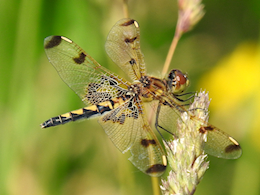
During the first week of July my fiancé and I spent some time in Prince Edward County with my dad’s family. We rented a cottage on Loves Lane on Prince Edward Bay, a nice three-bedroom place with 8 acres of land only 20 minutes away from both Sandbanks and Picton. The weather was beautiful, and I spent most of my time getting to know the local residents. On our first full day at the cottage (Monday, July 1st), I went for an afternoon walk on the property to see what I could find. It seemed to be a good spot for odonates; every now and then a couple of Prince and Common Baskettails flew in and started swooping above the deck. There were some other dragonflies present too, so I brought my net out in the hopes of catching one.

Continue reading “Ode-hunting in Prince Edward County”