Last Odes on the Wing: October and November 2024

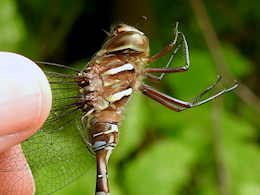
Spotted Spreadwing (Lestes congener)

Another ode season is over. Ottawa had some beautiful warm weather during the month of October – there were 26 consecutive days where the daytime high reached 9°C or above (between October 1st and 26th), tying for the 5th longest streak on record. As a result of the warm weather, I thought this would be the year I’d find more species flying later. Our first frost of the season occurred on October 16th with an overnight low of -1°C; this is a week later than the average first frost date. Then a warm spell hit late in the month – October 30th reached a ridiculous high of 22.2°C and October 31st hit 23.9°C, the warmest such days since records began in 1872. The month was mostly dry, with very little rain until the 29th.

November was cooler, though daytime temperatures remained above zero throughout the entire month. It’s not the day-time high that limits the dragonfly season in Ottawa, however; rather, it’s the nighttime lows falling below freezing. While the latest-flying dragonfly, the Autumn Meadowhawk, can withstand a few light frosts, a hard frost will kill both it and the flying insects it feeds on even if subsequent days reach double-digits. November 2nd and 3rd were both below -3°C, while November 9th and 10th were both below -2°C. A string of subzero nights after November 11th followed by warmer but cloudy, windy or wet days after November 20th ended the dragonfly season for good.

Continue reading “Last Odes on the Wing: October and November 2024”
The 2024 Summer Odolympics

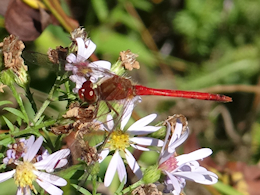
Autumn Meadowhawk (Sympetrum vicinum)

The 2024 North American edition of the Summer Odolympics were held between September 7-15, giving ode enthusiasts two weekends and as much time as a regular working week would allow to collect observations. I had hoped to find 19 or 20 species based on the same period spent collecting observations last year, but as most species are on the decline by this time, I knew I needed both good weather and good luck to come up with a respectful number. Unfortunately, neither luck nor weather were in my favour that first crucial weekend when I hoped to find a few species whose season ended around the beginning of September; it rained most of Saturday, and the temperature never rose above 15°C. Although it didn’t rain nearly as much on Sunday, the weather was worse: it was cloudy, windy, and the temperature never rose above 14°C. In fact, it was the coldest September 8th in more than 70 years (since 1949) and the windiest since records began in 1953 with a mean wind of 21 km/h. With a 1:00am windchill of 1.6 it was almost (within 0.1) the lowest windchill ever recorded on September 7th. Cold, wet, windy nights are even more of an obstacle, as many late-lingering species may not survive the low temperatures. When the sun began peeking out from the thick, fast-moving clouds around 4:30 I headed out despite the wind as to have zero species recorded on the first weekend was unthinkable. I didn’t expect much, and found only two species at the Eagleson ponds: an Eastern Forktail and a Slender Spreadwing.

Continue reading “The 2024 Summer Odolympics”

Road Trip: Odes in New Brunswick

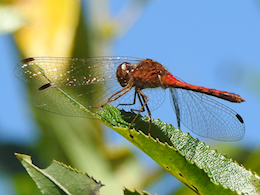
Autumn Meadowhawk

My dad, who is almost 75, has always loved to drive. He’s been talking about a road trip to the east coast for a few years now, but in August 2024 we finally did it: he, my step-mother and I left Ottawa on August 10th for a two-week road trip covering Quebec, New Brunswick, P.E.I., and Nova Scotia. We had done a similar trip when I was 12, but that trip included a ferry ride to Newfoundland to visit family on my mother’s side as well. Newfoundland is still very much in my father’s plans, and he hopes (as do I) to visit it in a year or two.

As usual, it was my goal to get some nature study and photography in, too, but I knew this trip would feature lots of time spent driving and visiting tourist attractions – my Dad wanted to revisit his previous trips there, including his time in the Navy when he was a youth stationed in Nova Scotia, while my step-mother had never been east before. And with neither of them in peak health anymore, we would have to limit our time on the trails, though there were plenty of national and provincial parks I was interested in visiting.

Continue reading “Road Trip: Odes in New Brunswick”

Odonates on the Wing: October and November 2023

Autumn Meadowhawk

By October I’m thinking about putting the net away for the season. If it is still warm at the beginning of the month, I will usually take the net out as long as I’m still seeing darners and small bluets around. Once I’m seeing nothing but meadowhawks, however, it’s time for me to declare an end to the season and put my gear away until the spring. This year the first week of October was very warm, with temperatures reaching 30°C; they then returned to seasonal for the next week with temperatures in the mid-teens. By the end of the month temperatures were in the single digits during the day and falling to below zero overnight, bringing an end to all but the hardiest of dragonflies. That title belongs to the meadowhawks, in particular the Autumn Meadowhawk (Sympetrum vicinum). It is no coincidence that it is the latest-flying dragonfly in many areas of the northeast….sometimes by several weeks. Once called the Yellow-legged Meadowhawk, it was renamed in 2004 by the Dragonfly Society of the Americas because mature individuals often have brown legs instead of yellow and because it persists so long into the fall. It is the only dragonfly in our area with entirely brown or yellow legs (never black), making identification relatively easy. And it is the only species you are likely to see in Ottawa in November!

Continue reading “Odonates on the Wing: October and November 2023”

The 2023 Summer Odolympics

Dragonhunter
Dragonhunter

When I first heard about the Odolympics – a special bioblitz hosted by the Dragonfly Society of the Americas, Sociedad de Odonatología Latinoamericana, and Odonata Central in order to record as many odonata species from as many places in the Western Hemisphere as possible – I knew I had to participate. This specialized bioblitz is only two years old, and there are usually two Odolympics each year: one falling during the North American summer, and one falling during the South American summer in order generate a snapshot of odonate distribution throughout both hemispheres.

Dragonflies and damselflies, collectively known as odonates, are valuable indicators of a wetland’s environmental health and biodiversity. Simply put, the more odonates that use a wetland for breeding and feeding purposes, the healthier the ecosystem. Naturalists were encouraged to submit their observations during the bioblitz via one of two platforms: iNaturalist, or Odonata Central. While I love iNaturalist and have been using it for a few years now to record my non-avian observations, I began submitting my observations to Odonata Central last year when it developed a checklist-based phone app similar to eBird. iNaturalist also has a phone-based app for submitting observations, but it is intended to be used in conjunction with the phone’s camera which I only use as a backup camera when my Nikon Coolpix’s battery decides to take a nap. Although I love the ease of searching for data in iNaturalist’s projects, I chose to record my Odolympic observations in Odonata Central as it allowed me to include observations of species for which I am usually unable to get a photo (yes, I’m looking at you, Prince Baskettail and Wandering Glider!)

Continue reading “The 2023 Summer Odolympics”

A Bluet of a Different Colour

Eastern Forktail

July is usually the start of the best three months of ode-hunting at Andrew Haydon Park. Although I often visit the park in the spring and fall for birds, my time here in the summer is devoted to dragonflies. This park is reliable for Halloween Pennants, Blue Dashers, Eastern Pondhawks, Common Green Darners, Prince Baskettails, and the usual King Skimmers, and I’ve had Cobra Clubtail and Elusive Clubtail here as well. I visited on July 29th with the hope of seeing another Cobra Clubtail, as it was on July 21, 2019 that I saw one fly into a tree on a windy day, eating what looked to be a male Orange Bluet. Though I’ve looked for both species here in July in subsequent years, I only had luck with one female Orange Bluet on July 24, 2021.

Continue reading “A Bluet of a Different Colour”

Nova Scotia 2023: Odes of Marsh and Pond

River Jewelwing

The weather played a big part in our trip this year. Rainclouds blew in and blew out all week long, bringing rain on most of the days we were there.  Fortunately the sun came out long enough to get in a few hikes at the various waterfalls and for me to take some long walks while Doran was out with the car. I spent quite a few hours looking for odonates and other critters around the ponds and the Annapolis Rail Trail, mostly in the afternoons when the sky cleared up. Although they are maybe half as long as the Eagleson storm water ponds by my house and much less diverse in terms of wildlife species, I still managed to find an interesting variety of creatures.

The afternoon after our waterfall search was particularly productive. I found my first Band-winged Meadowhawk and Familiar Bluet of the trip, which are also my first observations in iNaturalist for Nova Scotia for these species.

Continue reading “Nova Scotia 2023: Odes of Marsh and Pond”

The Last Dragonfly

By the time November arrives, all but the hardiest of insects have vanished, leaving only those few species that are adapted to the cold temperatures of mid-autumn in Canada. The last dragonfly on the wing here in Ottawa is the Autumn Meadowhawk, a small red or brownish dragonfly with very little black along the abdomen and yellow or brown legs. It is these two traits that make them easy to distinguish from other local meadowhawks – the other common species have distinct black markings on the abdomen and black legs. The most similar dragonfly in our area is the Saffron-winged Meadowhawk, which also lacks distinct black abdominal markings. However, the Saffron-winged Meadowhawk is larger, usually has a noticeable amber-coloured tint to the leading edge of its wings, and has black legs with brown stripes. In addition, most of the other meadowhawk species are gone by mid-October.

Continue reading “The Last Dragonfly”

The Odes of Late Summer

Green-striped Darner (male)

By mid-August most dragonfly species are on the wane. A few families are still quite abundant, particularly the darners and meadowhawks, while small numbers of other skimmers and a few clubtails often linger into September. Forktails, bluets, and some spreadwings are also still common in the appropriate habitats in August and September. This makes it worth going out to good dragonfly habitats such as large rivers, lakes and marshes to see a decent variety of species.

Large dragonflies this time of year are particularly interesting; while Common Green Darners are the most frequently encountered large dragonflies of late summer, you might come across a Black-shouldered Spinyleg basking on the rocks along the river, a Wandering Glider zipping over a meadow, a Twelve-spotted Skimmer flying above a pond, or a group of mosaic darners swarming through the air late in the afternoon. The mosaic darners are a particular favourite of mine; they are large brownish-black dragonflies with mottled spots of blue, green or yellow depending on the sex. While they spend most of their time flying through the air hunting for small insects, I often come across them perching vertically on thick stalks of vegetation below knee-height in open grassy areas early in the morning. We have several different species in Ottawa, and trying to find something other than the ubiquitous Canada and Lance-tipped Darners is a fun exercise.

Continue reading “The Odes of Late Summer”

Ode-hunting along the River

Shadow Darner
Shadow Darner

Mud Lake and Andrew Haydon Park are usually excellent places to find different species of dragons and damsels throughout the summer months. In both 2015 and 2019 I had a good number of species at Andrew Haydon Park in late July, and an OFNC dragonfly outing at Mud Lake on July 21, 2013 also netted some fantastic species. I was hoping for some similar luck on an ode-hunting trip on July 24th, but this time I found fewer species and fewer individuals overall. I am not sure why there seem to be so few dragonflies around good pond habitat these past two years (such as the Eagleson ponds), but the trend is concerning.

My first stop was the shoreline at Mud Lake where I hoped to find some large river clubtails perching on the rocks in the channel behind the filtration plant. When I arrived I was happy to find two dragonflies perching on the rocks right away, and managed only to photograph one before a couple of people came along and scared them both – while I’m certain one of them was a clubtail, the one I photographed turned out o be an Eastern Pondhawk. The clubtail did not return, although I saw a couple flying out over the water several times on my visit.

Continue reading “Ode-hunting along the River”

September Odes – A Summary

Shadow Darner

By the time September rolls around, most odonate species are done for the year in the Ottawa region – gone are the Aurora Damsels and Elegant Spreawings, the Spiny Baskettails and Ebony Boghaunters, the Arrowhead Spiketails and Horned Clubtails, the Chalk-fronted Corporals and Four-spotted Skimmers. This is the time of year when the number of meadowhawks and darners begin to peak, and southern species such as Spot-winged and Wandering Gliders may blow into our region with the warm south winds. A few bluet and spreadwing species may persist, as well as the common and widespread Eastern Forktail, though each day sees fewer and fewer individuals. This is a summary of species I saw and photographed around Ottawa during September 2019 – due to my trip to Edmonton and some cool, cloudy weekends, I didn’t visit as many places as I had hoped and missed a few common species.

Continue reading “September Odes – A Summary”

The Last Dragons of Summer

Autumn Meadowhawk

The end of September is a good time to see a variety of hover flies (also known as flower flies, syrphid flies, or syrphids). It is also the end of dragonfly season. Most odonates are already done for the season – only a handful of species will continue flying into October, with the last species, Autumn Meadowhawk, flying into November if the weather cooperates.

As the last week of September was still quite warm, I was able to find and photograph a few different species of both insects – even in my own backyard! I finally added Autumn Meadowhawk to my official yard list on September 19th. I’ve seen a few meadowhawks in my yard over the years, but have only identified White-faced Meadowhawk and Band-winged Meadowhawk so far. I found it on the asters at the back of the yard, although it flew up onto the fence when I tried to get closer for a photo. Given how abundant and widespread it is, the Autumn Meadowhawk was the most likely species to be added to my yard list. Now that it has shown up in my yard, I’m not sure what the next likeliest species is – Common Green Darner? Twelve-spotted Skimmer?

Continue reading “The Last Dragons of Summer”

An OFNC outing at Petrie Island

Eastern Amberwing
Eastern Amberwing

On August 2nd, 2015 I led a dragonfly outing at Petrie Island for the Ottawa Field-Naturalists’ Club. Because I would be leading it on my own, and because the small size of dragonflies and damselflies makes it difficult to point them out to large groups, I decided to limit the group to ten people. Fellow dragon-hunters and Birds Committee members Chris Traynor and Lorraine Elworthy signed up for the outing, as did Jakob Mueller, who led the reptile and amphibian outing at Sheila McKee Park earlier in the year. I recognized Lynne Ovenden from the OFNC; the others were all unknown to me.

I started our outing by talking about the differences between dragonflies and damselflies, as well as the different groups belonging to each family. We would be looking for spreadwing damselflies, which hold their wings out at a 45° angle instead of parallel to their back; emeralds and darners, which are most commonly found flying through the air searching for aerial prey; and skimmers, which tend to hunt from a perch and are usually the most approachable types of dragonflies for photography. As I was speaking, a bright green female Eastern Pondhawk was hunting from a perch in the vegetation, often flying out to snatch an insect from the air. At one point it even landed on one of the group members!

Continue reading “An OFNC outing at Petrie Island”