On June 15th I visited Mud Lake for a morning of birding and ode-hunting. It was about 13°C when I arrived at 8:30, and although it was sunny, the persistent breeze made it feel cooler. Still, there were more odes about than I had hoped for, although at first I saw only a few damselflies (Eastern Forktails, Fragile Forktails and Powdered Dancers) and Dot-tailed Whitefaces. It wasn’t until about an hour into my walk that I came across my first interesting odonate observation of the day: a lilac bush with several dragonflies perching on its branches. It was the Spiny Baskettail landing on an exposed twig that caught my attention, and while I was trying to photograph it a few more dragonflies landed nearby: first a Blue Dasher and then a Prince Baskettail! These large emeralds are the least likely of the baskettails to land, so seeing one perching is always a treat.
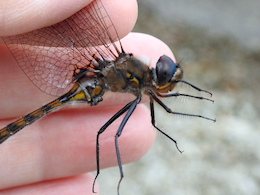
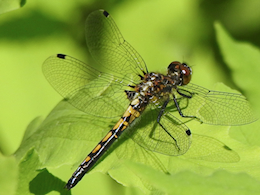
Late spring is a wonderful time to visit Sarsaparilla Trail. I usually start visiting in May to look for early dragonflies such as Spiny Baskettails and Chalk-fronted Corporals, both of which emerge in good numbers in mid- to late May. It is also a good place to look for Taiga Bluets, often my first damselfly of the year. Friday, May 24th was a beautiful, sunny day despite a cool north wind blowing, so I spent my lunch hour there searching for signs of spring. I began my walk by scanning the shrubs bordering the clearing near the outhouse for dragonflies perching in the vegetation and baskettails flying in the open…there were no emeralds flying on my visit, although there had been over a dozen Spiny Baskettails present only eight days earlier. I did scare up a dragonfly perching close to the ground – it turned out to be a Four-spotted Skimmer.
We arrived in Moncton late on Wednesday, June 5th. Our AirBNB for this stay was a basement unit in Riverview, the small town situated on the south side of the Petitcodiac River and a short drive from both downtown Moncton and the Moncton Coliseum, home of East Coast Comic Expo. I had already scouted a few places that looked good for both birding and and ode-hunting; these included Riverview Marsh contained within a bend of the Petitcodiac River for Nelson’s Sparrow, Mill Creek Nature Park for forest birds and stream dragonflies, Bell Street Marsh for marsh birds and odes, and a small stream in a hydro corridor near Mill Creek for Superb Jewelwing, a potential lifer for me.
After leaving Yarmouth we drove to our next stop on the tour, a cottage on Trout Lake south of Middleton in Annapolis County. The lake was nice, but quiet: there was a small sandy beach with several rocks protruding from the water at either edge of the property. A little bit of emergent vegetation made for some great perches for skimmers and damselflies, but I didn’t see either during our short stay. The weather was cool and cloudy for most of our time there, which, combined with the early season – there were no Slaty Skimmers or Calico Pennants flying yet – likely had a lot to do with a lack of odes at the water.
Both of the days we were there dawned with the sky completely covered in cloud. It was cold our first morning there, so cold that I didn’t even want to go for a walk along the gravel road. Instead we went into Greenwood to get breakfast, pick up some groceries, and check out a few rocky creeks and waterfalls that we had visited on past trips. The thick blanket of clouds covering the sky showed signs of breaking up by the time we finished our errands, so we headed to a small trail on Rock Notch Road that looked over Fales River and a medium-sized waterfall that once powered a water mill from 1857 to 2002.
On our final day in Yarmouth I was ready for a change of scenery. It was a bright, sunny day, but once again the wind made it feel much cooler so I gave up on the idea of driving down Cape Forchu to the lighthouse. I knew it was my last chance to see the ocean and find some ocean birds before leaving for the Valley, but I also knew the wind blowing off the ocean would be cold, and I didn’t have any winter gear with me. I consulted Google, and found a few spots that looked interesting – the Yarmouth County Rail Trail near Arcadia, a tiny community just down the road from the Y-Con Comics convention, and Tusket Falls, which is a little further away and has an interesting walking trail close by. I liked the idea of visiting Tusket Falls for river-loving dragonflies, while the Yarmouth Rail Trail passed by the Chebogue river, which might be good for looking for odes in the vegetation nearby. The Yarmouth Rail Trail actually becomes the Tusket Falls Walking Trail a little further east, too long of a hike from where I planned to access it in Arcadia, but easy enough to drive to once I’d seen enough of the Chebogue River.
On my second day in Yarmouth I headed out to the Chebogue Meadows Wilderness Trail not far from the Hebron Recreation Complex. I had wanted to drive down to the Cape Forchu lighthouse to look for seabirds, but the chilly north wind was uncomfortable and I figured it would only be worse by the ocean so I decided to head inland instead. Chebogue Meadows sounded like a great spot to look for birds and bugs; it was an eBird hotspot, with a whopping 33 species listed before my visit, including many northern-type warblers and thrushes. Interesting to me was the river at the back of the loop visible on Google maps, but what made it especially appealing was an online description of a trail that takes you through 12 distinct habitats via footpaths and boardwalks including softwood forest, a black spruce swamp, a meadow, a hardwood upland, and wetlands.
My fiancé Doran and I spent two weeks in the Maritimes in late May/early June: first we spent some time in Yarmouth, Nova Scotia, where Doran (a comic book creator) had a booth for all three days of the Y-Con Gaming & Comics Convention, followed by three days in the Annapolis Valley to visit family, and finishing with a few days in Moncton, New Brunswick where Doran had a booth at East Coast Comic Expo for a day and a half. These are places I never would have planned to visit for birds and dragonflies on my own, so it was a great opportunity to explore some places completely off my radar! I prepared for the trip the same way any contemporary naturalist would prepare: I investigated iNaturalist, explored eBird, and goggled over Google maps looking for places that had an intriguing variety of birds, odonates, and habitats in order to come up with a short list of places to visit around each of our AirBnBs. I wanted to see (or hear) and document as many species as possible with three main goals in mind: (1) to find some East Coast lifers whose range is limited to the Maritimes (White Corporal and Mantled Baskettail being at the top of my list); (2) to find some species that live in the Ottawa-Gatineau region but are difficult to find, mainly due to the inaccessibility of habitat (such as emeralds in bogs or clubtails and snaketails in rushing creeks); and (3) add as many ode records as possible to Nova Scotia and Moncton in order to increase the general knowledge of the species that live there.
Sheila McKee Memorial Park has been on my mind all winter. I haven’t been there since 2020, and when thinking of good spots to look for clubtails close to home, I remembered seeing Cobra Clubtails, Lancet Clubtails, and Black-shouldered Spinylegs there later in the summer on my previous visits. The open, rocky shoreline makes it a better spot to see them perching than Mud Lake, and as it isn’t as far as Gatineau Park it was high on my list of places to explore. I started poring over iNaturalist sightings over the winter and was delighted by the additional clubtail species that had been observed there – not only the Midland Clubtail my mentor Chris mentioned seeing back in 2019, but also two rarities: Mustached Clubtail and Arrow Clubtail. I’ve seen Mustached Clubtail once at Sugarbush trail in Gatineau Park, but Arrow Clubtail (Stylurus spiniceps) is so rare that it’s not even on my mental dashboard, let alone my radar. This clubtail is one of the hanging clubtails referred to in a previous post; it perches by hanging vertically from a leaf or branch instead of horizontally on the ground. Perhaps that’s the reason I’ve never seen one, then: I don’t spend too much time looking in trees for odes, unless I happen to see one fly in and land!
Although it’s been warming up nicely, I haven’t seen many dragonflies since witnessing the wonderful mass emergence of Spiny Baskettails at Mud Lake on May 12th. So when Chris T. told me he was thinking about going to Mer Bleue on the weekend, I decided to join him. Mer Bleue is ecologically significant as one of the few accessible bogs in eastern Ontario, hosting many different species not found in typical forests or wetlands. There were a couple of butterflies in particular I was hoping to see, the Brown Elfin and Jutta Arctic which I last saw in 2012, as well as the aptly-named day-flying Black-banded Orange Moth (Epelis truncataria). Several bog-loving odes were high on my list, chiefly Sphagnum Sprite, Ebony Boghaunter, Harlequin Darner, and Hudsonian Whiteface, all of which I’d seen here in my early ode-hunting days with Bob Bracken and Chris Lewis. I was also secretly hoping to stumble upon a Somatochlora emerald or two, as they are more likely to be found in the Mer Bleue bog than on the side of a random house in Nepean….or so I hoped!
The Common Green Darner is the first dragonfly I see most years, but its appearance doesn’t truly herald the start of the dragonfly season for me. Common Green Darners are migrants, usually showing up on the first warm winds of April. Spring is fickle here in Ottawa, however, and those warm southerly winds may be followed by blustery cold north winds the following week, or even worse, snow. As such it might be a long time before the next odonata sighting.
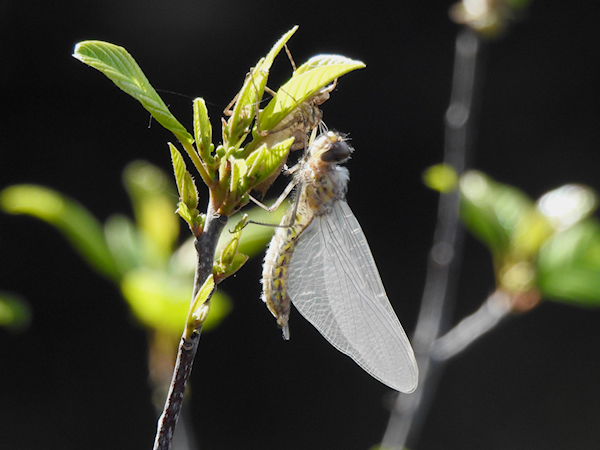
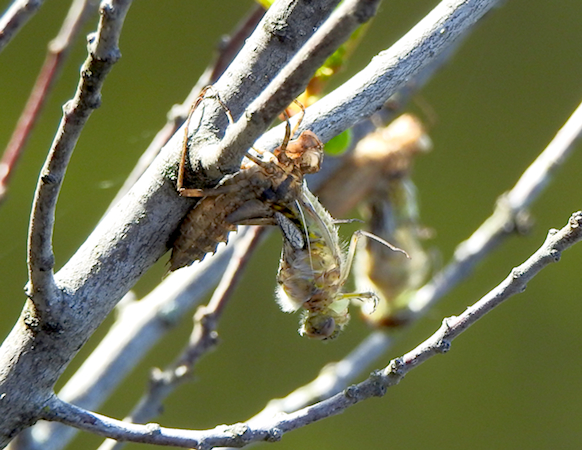
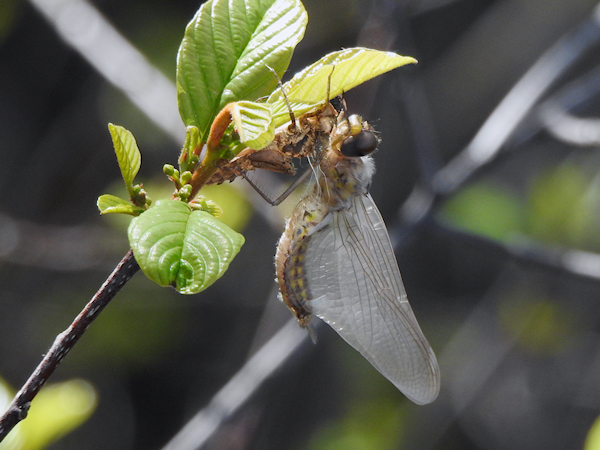
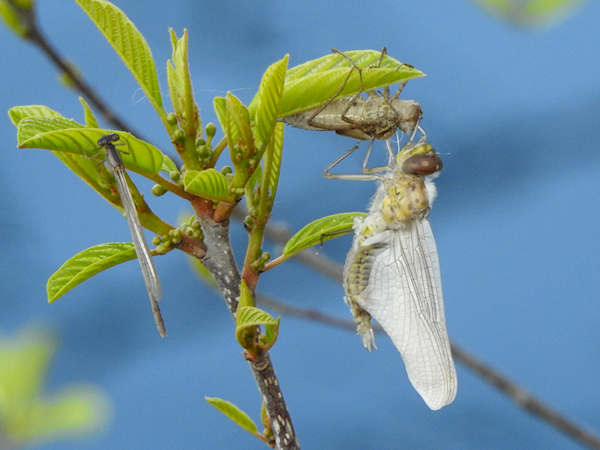
A more reliable sign for me is the emergence of the first dragonflies from local ponds and wetlands. So even though I saw my first Common Green Darners – a pair in a mating wheel at the Eagleson ponds – on April 28, I didn’t see the first local dragonflies until May 12 when a visit to Mud Lake produced several emerging Spiny Baskettails and a few teneral damselflies too colourless to identify. I took a few photos from the new observation platform; most still had milky-white wings while a few were still in the process of shedding their larval skin.
Spiny Baskettail (Epitheca spinigera)
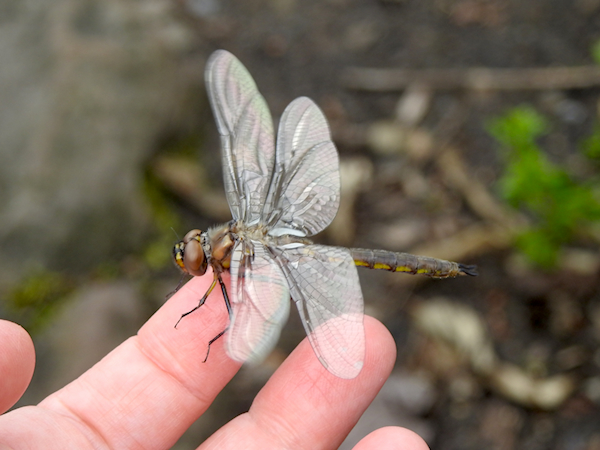
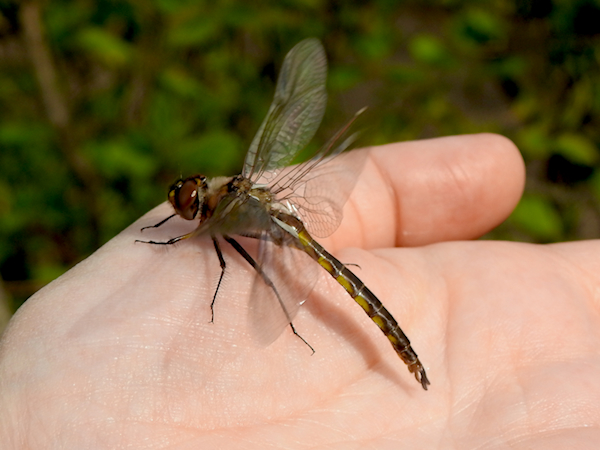
After that I went over to the rocks on the south shore where I’d photographed a large number of Spiny Baskettails emerging in 2022. Sure enough, there I found a few fully-winged tenerals perching in the trees or on the side of the boulders waiting for their muscles to become strong enough for their first flight. Out of the corner of my eye I could see these fresh teneral dragonflies lifting off from their perches all around me and heading for the trees. In the meantime, I was able to prompt a few that were hanging precariously from the rocks above the water to crawl onto my hand where I identified them as Spiny Baskettails before placing them on the branch of a shrub in a safer position
Spiny Baskettail (Epitheca spinigera) Emerging
One fell into the water before I could lift it off of the rock face, and I was able to fish it out with my hand – I had no net with me as I had been birding with a friend and didn’t expect to see any dragonflies.
Seeing all these baskettails in various stages of emergence on such a beautiful, warm afternoon after a week of rain and cooler temperatures left me with a feeling of joy and wonder. Dragonfly season has finally begun – I’m hoping that they will bring the sun and nice weather with it!
Spiny Baskettail (Epitheca spinigera) emerging – note the exuvia
Spiny Baskettail (Epitheca spinigera) with its exuvia and a teneral damselfly
Teneral Spiny Baskettail (Epitheca spinigera) fluttering its wings before flight
Teneral Spiny Baskettail (Epitheca spinigera)
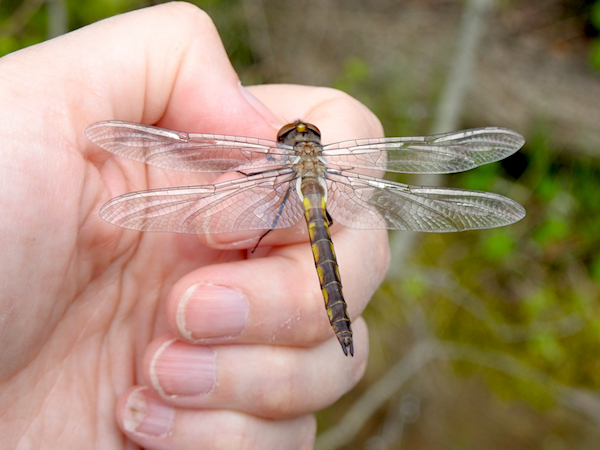
Male Spiny Baskettail (Epitheca spinigera) – note the curving claspers
By October I’m thinking about putting the net away for the season. If it is still warm at the beginning of the month, I will usually take the net out as long as I’m still seeing darners and small bluets around. Once I’m seeing nothing but meadowhawks, however, it’s time for me to declare an end to the season and put my gear away until the spring. This year the first week of October was very warm, with temperatures reaching 30°C; they then returned to seasonal for the next week with temperatures in the mid-teens. By the end of the month temperatures were in the single digits during the day and falling to below zero overnight, bringing an end to all but the hardiest of dragonflies. That title belongs to the meadowhawks, in particular the Autumn Meadowhawk (Sympetrum vicinum). It is no coincidence that it is the latest-flying dragonfly in many areas of the northeast….sometimes by several weeks. Once called the Yellow-legged Meadowhawk, it was renamed in 2004 by the Dragonfly Society of the Americas because mature individuals often have brown legs instead of yellow and because it persists so long into the fall. It is the only dragonfly in our area with entirely brown or yellow legs (never black), making identification relatively easy. And it is the only species you are likely to see in Ottawa in November!
Although technically still considered summer until the equinox, the month of September ushers in the beginning of fall, the season most associated with change and impermanence, with encroaching darkness, with death and transition and the melancholy appreciation of the last burst of colour before the inevitable bleakness of winter. I can’t help but be reminded that this is the season of endings every time I go outside: the robins are gone from the neighbourhood, the songbirds in the woods have stopped singing, trees are changing colour, and the asters and goldenrods have replaced all the other wildflowers along roadsides and in conservation areas. In the dragonfly world, it is the season of the meadowhawk, the glider, and the darner, as these types of dragonflies are by far the most numerous. The goal now is to search out any others that may still be flying, and see how long into the season they last. Part of the reason is purely scientific – to get a better grasp of the flight seasons of local odonates. However, another part of the reason is purely emotional – I never know if a sighting will be the last of the year, and hope to put off the final goodbyes as long as possible.
After I returned from my visit to southern Ontario I still had bugs on the brain, specifically odonates. Now that September has arrived the days will be getting shorter and the nights cooler, which spells the end of the season for a number of different species. It is, however, prime time for darners, and I still had yet to find a Lake Darner or Green-striped Darner this year. I also haven’t seen any Saffron-winged Meadowhawks either, another species that peaks in August and early September, despite searching known locations at the Eagleson storm water ponds. While I knew that bird migration was heating up, my brain hasn’t yet made the switch from odes to birds. I am having trouble getting up early enough to get out for my regular birding walks before work, and I won’t even consider putting my net away while the weather is still nice – I want to wring every last sunny moment looking for dragonflies and damselflies before taking the mandatory six-month winter hiatus. This has never happened to me before, and while I still am using eBird to keep track of what I see, most of my checklists are incidental ones noting only a few species that caught my attention while out later in the day dragonfly-hunting.
Although I could have spent most of my time in Chatham-Kent at Peers Wetland, we visited a few other places in my quest to find odonates around Wallaceburg. After a productive morning at Peer’s Wetland on August 31st, we went home for lunch, then took a walk at Crothers Conservation Area only a few blocks from my mom’s house in the north end of Wallaceburg. This little slice of green space runs alongside Running Creek, a small muddy stream which flows into the North Sydenham River. Although this small conservation area consists mostly of neatly manicured lawn, and more rightly ought to be called a park than a conservation area, the riverbank has some natural growth of riparian shrubs and cattails that prevent it from looking too obviously landscaped. Wild green space is scant in the southwestern corner of the province – a bird’s eye view shows it to be entirely dominated by the patchwork of farms vital to the province’s agricultural industry. The few remaining patches of forest, wetlands, and untamed thickets along the riverine corridors are precious; it seems that in this part of the province, every square inch has been assessed and tallied with almost all of it given over to human management, whether for production, recreation, residential, or commercial purposes.
My mother lives in Wallaceburg in Chatham-Kent, which is about a 7.5 hour drive from Ottawa, or a full day train adventure with a transfer in Toronto (my advice for anyone travelling economy on Via: take your own sandwiches and snacks, as the menu was somewhat unpalatable…and chocolate bars/chips alone were $3.00). Being so far south she gets a variety of birds, bugs and plants that we do not get here in eastern Ontario, so I’ve been meaning to visit in the summer when I might see some new southern butterflies and dragonflies for my life list. I took an extra two days off at the end of August so I could spend the Labour Day long weekend with her, though two of the days were lost to travel. As my mother and her husband both enjoyed birds and nature, I knew they’d be interested in taking a few nature walks with me, even if the idea of looking for dragonflies didn’t exactly fill them with delight.





 OdoNotations