New Dragonflies at Marlborough Forest

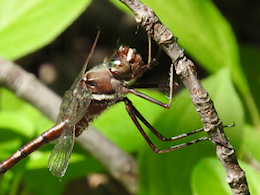
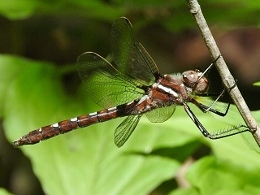
Kennedy's Emerald
Kennedy’s Emerald

The beginning of June arrived with plenty of warmth and sunshine, and I couldn’t wait to go back to Marlborough Forest at the peak of butterfly and dragonfly season to look for new species living there. Last year when I started going to Marlborough Forest in mid-June, I kept seeing large, dark dragonflies – almost certainly emeralds of some sort – zipping down the shadowy trail before the sun had fully risen above the trees. I never had my net on me when I saw them on my early-morning birding walks, so I was unable to catch one to verify their identity. This time I was prepared for these dawn-flying dragons, and brought my net with me. I had already added one dragonfly to my life list, the Ocellated Emerald at Trail E4 last year; was it possible that there were other species of interest here?

My first summer visit to Trail E4 occurred on June 6th. Although the morning started out cool, it quickly warmed up. The usual birds were singing along the trail, including all the Red-eyed Vireos, Eastern Wood-pewees, Eastern Kingbirds, Veeries, and the Tree Swallows that were missing from my mid-May visit. I heard seven warblers (Ovenbirds, Northern Waterthrushes, Black-and-whites, Nashvilles, Common Yellowthroats, Black-throated Greens, and a single Magnolia Warbler), two Chipping Sparrows, a Field Sparrow, and a Blue-headed Vireo singing in its usual spot in the large open area devastated by motor bikes and ATVs.

Continue reading “New Dragonflies at Marlborough Forest”

Dragonfly Emergence

Freshly emerged dragonfly

My first real dragonfly outing of the year occurred on May 24, 2021, and as usual, took place at Roger’s Pond in Marlborough Forest. I invited a few friends to join me now that outdoor gatherings can include up to 5 people, and fellow OFNC members Derek and Gerald decided to join me. It was a warm, sunny day, and I hoped to find the usual common skimmers and clubtails, as well as a few uncommon species that I’d seen previously at Marlborough Forest such as the elusive Ebony Boghaunter and Harlequin Darner. I’ve already seen one boghaunter this season, but it’s been a few years since I’ve seen a Harlequin Darner, and the Cedar Grove Nature Trail has been a repeat site for this ode.

We met at 9:30 am, just early enough to get some birding in while waiting for the sun to rise higher in the sky. We had the usual Nashville Warblers, Black-throated Green Warblers, Great Crested Flycatchers, White-throated Sparrows, Veeries, and Yellow-bellied Sapsuckers on the walk in. At the pond itself we had Eastern Kingbirds, a Pied-billed Grebe, Common Yellowthroats and four Ring-necked Ducks. Many dragonflies were already flying along the open trail through the cedar forest, including a few teneral whitefaces and emeralds.

Continue reading “Dragonfly Emergence”

Gatineau Park: Specialty Dragon-hunting

Zebra Clubtail

Gatineau Park is a special place for dragonflies – many species of the National Capital Region can be found there that aren’t found on the Ontario side of the Ottawa River, while others seem to be much more common there than in Ottawa. Chris Traynor has been exploring the park quite a bit these past couple of years, searching for dragonflies that breed in the quiet lakes, sluggish streams, and fast-flowing creeks of the Gatineau Hills. Not surprisingly, he has found a good number of species that have not been reported in Ottawa, such as Eastern Least Clubtail, Mustached Clubtail, Beaverpond and Harpoon Clubtails, and even a couple of snaketails. Many of these species prefer clear, swift-moving streams with rocky bottoms, which might be the reason for their absence in Ottawa; the Ontario side of the National Capital Region is relatively flat, with more marshes and slow-moving, mucky streams winding through suburbs and forest rather than down the foothills and escarpments which form the Canadian Shield. One of Chris’s best finds was a portion of Meech Creek where Zebra Clubtails and Fawn Darners are quite common, with the occasional Dragonhunter and Violet Dancer. I accompanied him twice to this magical spot, once during the August long weekend last year, and once again this year. As I never did get around to posting those photos last year (remember I mentioned I’d fallen behind?), I will incorporate both sets of photos in this post.

Continue reading “Gatineau Park: Specialty Dragon-hunting”

The Dragonflies of Mud Lake

Stream Cruiser

Once migration winds down, many birders stop visiting Mud Lake while they look for breeding birds elsewhere. Although birds such as Wood Duck, American Redstart, Yellow Warbler and Common Ravens are abundant and easy to find at the city’s premier migration hotspot during the breeding season, many of Ottawa’s summer specialties – such as Grasshopper Sparrow, Lincoln’s Sparrow, Golden-winged Warbler, Mourning Warbler, and Sedge Wren – are found elsewhere, and so most birders switch their focus from looking for migrating transients to chasing these summer residents down just as soon as the last Blackpoll Warblers and Arctic Terns disappear in early June. This is about the same time my attention to dragonflies and butterflies intensifies – and Mud Lake is a great place to find a good variety of both these insects.

Continue reading “The Dragonflies of Mud Lake”

Adventure in Dunrobin

Snowshoe Hare

On June 5th I headed out to Dunrobin to spend some time looking for odes and birds. My first stop was the Crazy Horse Trail on March Road at the end of Huntmar Road. This is a relatively new pedestrian-only trail for hikers, skiers, and snowshoers that was developed by the Friends of the Carp Hills under an agreement with the City of Ottawa. It is named for an old tavern that used to stand adjacent to the trailhead but has long since been demolished. The goal of the trail is to provide recreational access to the the Carp Hills on City-owned property while keeping impact on the environment to a minimum. The trail is narrow, and as there is no intention to groom or widen the trail, people are asked to respect the natural areas by staying on the trail, keeping dogs under control at all times (which means using a leash if necessary), leaving no waste, and respecting property boundaries. There are some rough, volunteer-built boardwalks in places too wet to cross which adds to its charm. In fact, all trail maintenance and improvement depends on volunteers, rather than the City, which makes it doubly important to respect the work they have done in creating this trail.

Continue reading “Adventure in Dunrobin”

September Odes – A Summary

Shadow Darner

By the time September rolls around, most odonate species are done for the year in the Ottawa region – gone are the Aurora Damsels and Elegant Spreawings, the Spiny Baskettails and Ebony Boghaunters, the Arrowhead Spiketails and Horned Clubtails, the Chalk-fronted Corporals and Four-spotted Skimmers. This is the time of year when the number of meadowhawks and darners begin to peak, and southern species such as Spot-winged and Wandering Gliders may blow into our region with the warm south winds. A few bluet and spreadwing species may persist, as well as the common and widespread Eastern Forktail, though each day sees fewer and fewer individuals. This is a summary of species I saw and photographed around Ottawa during September 2019 – due to my trip to Edmonton and some cool, cloudy weekends, I didn’t visit as many places as I had hoped and missed a few common species.

Continue reading “September Odes – A Summary”

Clubtails at Sheila McKee Park

Cobra Clubtail

On July 22nd I received an email from Chris Lewis about a new dragonfly spot along the Ottawa River. I’d been to Shelia McKee Park out near Dunrobin just once, on an OFNC trip in 2015 to look for herps; it has a network of woodland trails and a steep staircase that leads down from the top of the cliff to the rocky beach at the bottom. Chris said she found evidence of a very recent dragonfly emergence of in the form of both exuviae and teneral dragonflies; she recognized exuviae of both clubtails and emeralds, though she was not able to identify them to species. She saw an unidentified darner and several teneral meadowhawks in the woods, and several Powdered Dancers and a pair of Stream Bluets in tandem near the water. However, it was her clubtail report that intrigued me: she mentioned one Lancet Clubtail, both mature and teneral Black-shouldered Spinylegs, several Midland Clubtails, and one Cobra Clubtail which had become the unfortunate meal of a Midland Clubtail. It is amazing that I’ve never considered going back to this park for odes before – the shoreline here is quite rocky, with little or no emergent vegetation, reminiscent of Britannia Point at Mud Lake or the causeway at Morris Island, both of which are great spots for clubtails. Curious to see these clubtails for myself, I headed out the following Sunday (July 28th) and brought my net in case there was anything worth catching.

Continue reading “Clubtails at Sheila McKee Park”

The Odes of Andrew Haydon Park – 2019 edition

Halloween Pennant

Back in 2015 I wrote a blog post about the odonates I found at Andrew Haydon Park one weekday afternoon near the end of July. Since discovering the colony of Halloween Pennants at AHP in 2014, I’ve made it a point to visit this park each year during mid-summer; it’s much closer than travelling all the way to Morris Island to see this stunning dragonfly! So far I’ve only made it out to Morris Island once this year, and when I found no Halloween Pennants flying along the causeway I decided to visit Andrew Haydon Park specifically to search for this species. With the strange, slow start to the season I was bit apprehensive about whether these odes would even be around at AHP, but thankfully I found a few on each of my visits, and in good numbers, too.

Continue reading “The Odes of Andrew Haydon Park – 2019 edition”

Ode-hunting in Prince Edward County

Calico Pennant

During the first week of July my fiancé and I spent some time in Prince Edward County with my dad’s family. We rented a cottage on Loves Lane on Prince Edward Bay, a nice three-bedroom place with 8 acres of land only 20 minutes away from both Sandbanks and Picton. The weather was beautiful, and I spent most of my time getting to know the local residents. On our first full day at the cottage (Monday, July 1st), I went for an afternoon walk on the property to see what I could find. It seemed to be a good spot for odonates; every now and then a couple of Prince and Common Baskettails flew in and started swooping above the deck. There were some other dragonflies present too, so I brought my net out in the hopes of catching one.

Continue reading “Ode-hunting in Prince Edward County”

Dragonflies at Mud Lake

Stream Cruiser

By the end of June it seemed that summer had finally arrived and the weather had returned to normal: the temperature had reached a consistent near 30°C, the state of emergency caused by the unprecedented spring flood had ended on June 12th, water levels were returning to normal, and the sun had finally come out! I was hoping that this meant that the dragonflies were also emerging on schedule again, and decided to head to Mud Lake on the last Saturday of June. Mud Lake is a fantastic place to see dragonflies in mid-summer, as all the dragonfly families except for Cordulegastridae – the spiketails – can be found there. Among the damselfly families both the spreadwings and pond damsels are well-represented; the broad-winged damselflies, mainly Ebony Jewelwings, are seen there from time to time. I had high hopes for my visit.

Continue reading “Dragonflies at Mud Lake”

The Beginning of Dragonfly Season

Dusky Clubtail

Usually by the time the Victoria Day long weekend arrives the first odes have emerged – in the past I’ve seen baskettails in large numbers at Mud Lake and whitefaces and emeralds in Stony Swamp. This year has been different. A persistent wind from the north has prevented the daytime temperatures from rising much above 20°C; nighttime temperatures are still in the single digits. As dragonfly emergence depends largely on water temperature, it isn’t surprising that I had only seen one dragonfly before the May long weekend, a Common Green Darner at Parliament Hill on May 6th. This is usually one of the first species I see, as they migrate north from the warm south where they emerge. Temperatures had risen from 10°C on May 3rd to 20°C on the 6th, although the morning had started out as a chilly 5°C – perhaps an influx of warm air brought this gorgeous dragonfly up from somewhere where the north wind and flooding weren’t wreaking havoc on the wildlife.

Continue reading “The Beginning of Dragonfly Season”

Morris Island

Halloween Pennant

My last day off was Tuesday, and the forecast finally called for a decent amount of sun during the morning and afternoon. I invited a friend, Jon, to go dragon-hunting with me at Morris Island since he was eager to become re-acquainted with odonates after a long absence. There were a few particular species on his must-see list, including Cobra Clubtail, Cyrano Darner and Dragonhunter; I’d seen all of these at Morris Island before, though I wasn’t optimistic about our chances of seeing the Cyrano. Although it is considered to be a widespread species, inhabiting swamps, small lakes, and slow-moving rivers of the eastern half of the continent, adults are rarely seen. It is thought that once they emerge they immediately fly up into the tree-tops where they spend most of their time. Adult males can sometimes be found patrolling their territory, and this appeared to be just such a case with the one that I caught in the parking lot of the Morris Island Conservation Area last year. That was on June 25th, however, I was worried that we might be too late to see them.

Continue reading “Morris Island”

Dragonflies in June

Common Baskettail

June is one of my favourite months. Normally the weather is hot and sunny by the time the solstice rolls around, the birds are all in full song, and newly-emerged butterflies and dragonflies are returning to woodlands, fields and wetlands. However, the weather this month has not been great. The rain from May continued on and off this month, keeping water levels of the rivers and ponds higher than normal, and likely delaying the emergence of many insects. The weekends have been nice, at least; I’ve been able to get out early in the day in order to look for new birds for my year list and any butterflies and dragonflies that may have emerged. While my enthusiasm has certainly declined since our amazing trip to Costa Rica, I’ve found myself regaining interest in visiting trails and conservation areas close to home, hoping to find some species I haven’t seen since the previous summer.

The day after my trip to the Bill Mason Center, I made plans with Chris Lewis and Chris Traynor to head out to the Cedar Grove Nature Trail in Marlborough Forest to look for odes around Roger’s Pond. I would be co-leading an OFNC outing there the following weekend with Jakob Mueller, a reptiles and amphibians guy, and wanted to get an idea of the dragonflies and damselflies that were flying. As we weren’t meeting at the parking lot there until 8:30, I headed out to Sarsaparilla Trail first, then the Rideau Trail for a quick look around.

Continue reading “Dragonflies in June”

The “Wild Ode West” Dragon-hunting Adventure

Widow Skimmer
Widow Skimmer

Chris Lewis and I had such a great time dragon-hunting in Gatineau last weekend that on June 25th we decided to hit several spots west of Ottawa to search for several local and unique species. On our list of locations were the Quyon Ferry Dock near Fitzroy to look for big river species, Morris Island for clubtails and skimmers, and Pakenham, Blakeney and Almonte for Rapids Clubtail. Before heading out to the Quyon Ferry Dock we stopped in at the fields near Constance Bay to look for Upland Sandpipers. We got lucky and found four. Not only did we see a couple of them flying over the fields, giving their distinctive call, we found one standing right on the shoulder of the road! Unfortunately we caused it to flush before I could get a photo of this bird; I still have yet to photograph this species. Indeed, this was the closest I’ve ever come to one of an Upland Sandpiper, which are difficult to find as they breed and feed in dry grasslands rather than muddy shorelines.

Continue reading “The “Wild Ode West” Dragon-hunting Adventure”

Back to Gatineau Park: A Snaketail Adventure

Stream Cruiser
Stream Cruiser

While at the Dunlop Picnic area, Chris and I got a call from Chris Traynor saying that he was on his way up to Meech Lake. Chris Lewis and I were on our way there next, and it didn’t take him long to catch up with us as we were walking down the large hill to the lake, listening to the vireos and a Blackburnian Warbler singing. Our destination was the waterfall at the old Carbide Wilson ruins where we hoped to find the snaketails Chris T. had reported seeing earlier in the week. However, first we spent some time exploring the shore of the lake where we found Powdered Dancers, a Chalk-fronted Corporal, and a couple of clubtails on logs too far from shore to identify. It was too early for the Slaty Skimmers to be flying; these dark blue dragonflies are one of my personal favourites, but we saw more than enough other species to make up for their absence.

Continue reading “Back to Gatineau Park: A Snaketail Adventure”