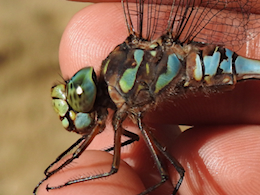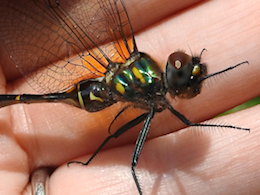
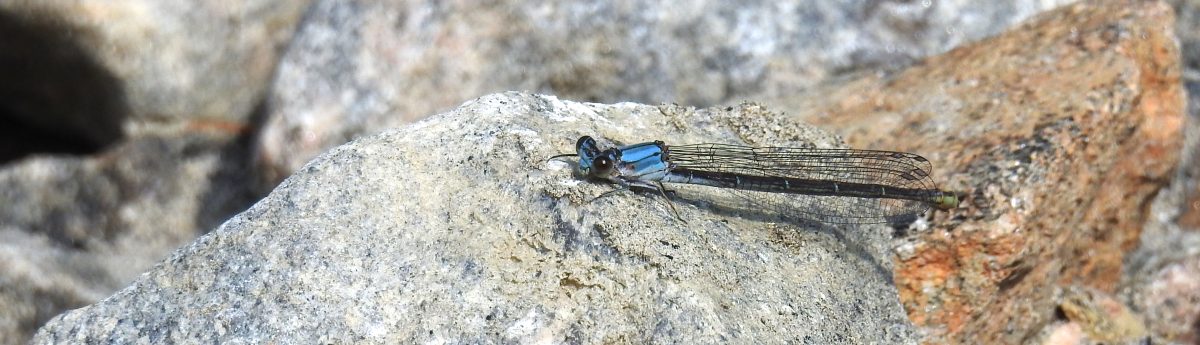
Next Gen Dragon-hunters

Canada Darner
Canada Darner

After I returned from my visit to southern Ontario I still had bugs on the brain, specifically odonates. Now that September has arrived the days will be getting shorter and the nights cooler, which spells the end of the season for a number of different species. It is, however, prime time for darners, and I still had yet to find a Lake Darner or Green-striped Darner this year. I also haven’t seen any Saffron-winged Meadowhawks either, another species that peaks in August and early September, despite searching known locations at the Eagleson storm water ponds. While I knew that bird migration was heating up, my brain hasn’t yet made the switch from odes to birds. I am having trouble getting up early enough to get out for my regular birding walks before work, and I won’t even consider putting my net away while the weather is still nice – I want to wring every last sunny moment looking for dragonflies and damselflies before taking the mandatory six-month winter hiatus. This has never happened to me before, and while I still am using eBird to keep track of what I see, most of my checklists are incidental ones noting only a few species that caught my attention while out later in the day dragonfly-hunting.

Continue reading “Next Gen Dragon-hunters”

The 2023 Summer Odolympics

Dragonhunter
Dragonhunter

When I first heard about the Odolympics – a special bioblitz hosted by the Dragonfly Society of the Americas, Sociedad de Odonatología Latinoamericana, and Odonata Central in order to record as many odonata species from as many places in the Western Hemisphere as possible – I knew I had to participate. This specialized bioblitz is only two years old, and there are usually two Odolympics each year: one falling during the North American summer, and one falling during the South American summer in order generate a snapshot of odonate distribution throughout both hemispheres.

Dragonflies and damselflies, collectively known as odonates, are valuable indicators of a wetland’s environmental health and biodiversity. Simply put, the more odonates that use a wetland for breeding and feeding purposes, the healthier the ecosystem. Naturalists were encouraged to submit their observations during the bioblitz via one of two platforms: iNaturalist, or Odonata Central. While I love iNaturalist and have been using it for a few years now to record my non-avian observations, I began submitting my observations to Odonata Central last year when it developed a checklist-based phone app similar to eBird. iNaturalist also has a phone-based app for submitting observations, but it is intended to be used in conjunction with the phone’s camera which I only use as a backup camera when my Nikon Coolpix’s battery decides to take a nap. Although I love the ease of searching for data in iNaturalist’s projects, I chose to record my Odolympic observations in Odonata Central as it allowed me to include observations of species for which I am usually unable to get a photo (yes, I’m looking at you, Prince Baskettail and Wandering Glider!)

Continue reading “The 2023 Summer Odolympics”

Quebec: Kazabazua and Beyond

Black-tipped Darner

The Common Sanddragon is one of the dragonfly species in the Algonquin Park field that is not found in the Ottawa-Gatineau region. A member of the clubtail family, it is well-marked with a mottled green and brown thorax reminiscent of a Harlequin Darner and uniquely-shaped markings down the length of the abdomen to segment 7: they look like goblets in the male, and start out as goblet-shaped in the female but gradually lose the stem. Their legs are very short for a dragonfly, and mature males have green eyes while females have gray or brown eyes. The appendages in both sexes are pale, and they are the only dragonfly in our region which has pale appendages, a mottled thorax, and brown spots at the base of each wing. Its larvae live in rivers, lakes, and streams with sandy bottoms, and due to its short legs, the adults perch horizontally on the sandy beaches and banks of its rivers rather than hanging from trees or in the vegetation. At the time of the printing of the first edition of the Algonquin field guide, it had not been recorded within the park and was only known from a few sites in Peterborough County and a single record from Windsor in Ontario’s deep south.

Continue reading “Quebec: Kazabazua and Beyond”

Identifying Green-striped and Lake Darners

Lake Darner
Lake Darner

Darner (genus Aeshna) season typically begins in July in the Ottawa-Gatineau region. The two most common mosaic darners, Lance-tipped and Canada, emerge early in the month, along with the slightly less common Shadow Darner. These three species are the most widespread members of this group, and if you see a mosaic darner flying along a forest trail or in an open clearing in the greenbelt it is most likely to be one of these. Lake Darner, Variable Darner, and Black-tipped Darner are considered “uncommon” in the Ottawa-Gatineau region, with the first being a localized species and the latter two species considered to be widespread. I suspect they may be easier to find on the Quebec side of the region, as there are more lakes and suitable bodies of water in Gatineau Park, and Black-tipped Darner has been relatively easy to find there. Finally, the Mottled Darner and Green-striped Darner are both considered “very rare”, with only a handful of records of each. I’ve been lucky to see a few Green-striped Darners in Stony Swamp in recent years, with one individual at Bruce Pit in September 2019 and two individuals at the Beaver Trail in September 2021. I’ve never seen a Mottled Darner, and hope to catch up with this species one day.

Continue reading “Identifying Green-striped and Lake Darners”

September Odes – A Summary

Shadow Darner

By the time September rolls around, most odonate species are done for the year in the Ottawa region – gone are the Aurora Damsels and Elegant Spreawings, the Spiny Baskettails and Ebony Boghaunters, the Arrowhead Spiketails and Horned Clubtails, the Chalk-fronted Corporals and Four-spotted Skimmers. This is the time of year when the number of meadowhawks and darners begin to peak, and southern species such as Spot-winged and Wandering Gliders may blow into our region with the warm south winds. A few bluet and spreadwing species may persist, as well as the common and widespread Eastern Forktail, though each day sees fewer and fewer individuals. This is a summary of species I saw and photographed around Ottawa during September 2019 – due to my trip to Edmonton and some cool, cloudy weekends, I didn’t visit as many places as I had hoped and missed a few common species.

Continue reading “September Odes – A Summary”

Jack Pine Specialties

Brush-tipped Emerald

The day after the excellent snaketail adventure in Gatineau Park, I headed over to Jack Pine Trail to see if any of its unique dragonflies were on the wing. Two years ago I found a healthy population of Brush-tipped and Williamson’s Emeralds, and Arrowhead Spiketails are regularly seen along the stream at the back. Although I’d heard that it takes four years for Williamson’s Emerald larvae to mature, I had hopes of at least finding the Brush-tipped Emerald; I still think it’s amazing that all these wonderful dragonflies live and breed so close to home. I was also hoping to find some spreadwings, as I’ve seen both Northern and Emerald Spreadwings along the trails here in the past – though none in the past couple of years.

Continue reading “Jack Pine Specialties”

An OFNC outing at Petrie Island

Eastern Amberwing
Eastern Amberwing

On August 2nd, 2015 I led a dragonfly outing at Petrie Island for the Ottawa Field-Naturalists’ Club. Because I would be leading it on my own, and because the small size of dragonflies and damselflies makes it difficult to point them out to large groups, I decided to limit the group to ten people. Fellow dragon-hunters and Birds Committee members Chris Traynor and Lorraine Elworthy signed up for the outing, as did Jakob Mueller, who led the reptile and amphibian outing at Sheila McKee Park earlier in the year. I recognized Lynne Ovenden from the OFNC; the others were all unknown to me.

I started our outing by talking about the differences between dragonflies and damselflies, as well as the different groups belonging to each family. We would be looking for spreadwing damselflies, which hold their wings out at a 45° angle instead of parallel to their back; emeralds and darners, which are most commonly found flying through the air searching for aerial prey; and skimmers, which tend to hunt from a perch and are usually the most approachable types of dragonflies for photography. As I was speaking, a bright green female Eastern Pondhawk was hunting from a perch in the vegetation, often flying out to snatch an insect from the air. At one point it even landed on one of the group members!

Continue reading “An OFNC outing at Petrie Island”

Gatineau Park Odes

River Jewelwing
River Jewelwing

It’s been a long time since I’ve been dragon-hunting in Gatineau Park – well over a year, in fact. Even though the park is quite close to Ottawa and has great dragonfly diversity, I rarely venture across the provincial border. This is mostly because I’m wary about going alone, but also because the main roads in the park are closed on Sundays (my preferred day for travelling due to lighter traffic) as a result of the NCC Sunday bike-days. However, I’ve been really impressed with all the species Chris Traynor has been finding there, and so we decided to venture up there together one Sunday. Fortunately Chris knew a few alternate routes to get us to our destination, the Sugarbush Trail (which Chris calls “Clubtail Trail” after all of his great finds) near the Chelsea Visitor Center and Meech Creek.

Continue reading “Gatineau Park Odes”