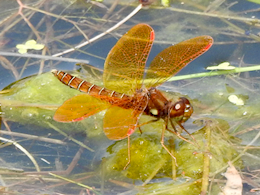
A day without seeing a dragonfly is like a day without chocolate – sure, it’s completely survivable, but utterly lacking in joy. I had to work downtown on both the Wednesday and Thursday after Canada Day, and decided to go for a lunchtime walk along the canal to the river on Wednesday to see if I could find any weekday odes. I’d seen Prince Baskettails and Common Green Darners flying up and down the canal, and a Midland Clubtail on the rocky shore behind Parliament Hill many moons ago, so the downtown core is not completely devoid of odonates. Still, I wasn’t expecting much, and got lucky on Wednesday when I saw first a Common Green Darner flying by, then a Prince Baskettail. Then something small fluttering above one of the mats of vegetation caught my eye – a female Eastern Amberwing ovipositing in some floating vegetation! After a few more minutes of watching, I saw a pair of males fly by. I waited for several minutes for one to land but they never did.
I haven’t spent much time at Terry Carisse Park this year, as I’ve had other projects and priorities demanding my attention and limited ode-hunting time. However, in May I received an email from a blog reader in Montreal named Pierre who was interested in trying to find a particular damselfly species – the Rainbow Bluet – which he and his wife had tried to find last year, without any luck, in known areas of Ottawa. He was interested in visiting Terry Carisse Park after reading my blog posts and messaged me in late May for the details, hoping these small, colourful damselflies would be easier to find this time around. I told him the best places to find them in the park (at the canoe/boat launch at the north end of the park and in the sunny vegetation at the top of the river bank along the south end) and told him to let me know how it went. I didn’t expect to hear from him until after his visit, but received another message on June 12th asking if I had been there recently. I hadn’t – I’d spent the previous two weekends in Nova Scotia, and the weather on my remote-work days has been too lousy to go look for odes. But when I saw the forecast for the following day – sunny and warm – I decided to head on over to see if I could do some pre-scouting for him ahead of his weekend trip.
Today I went to Bruce Pit to see if anything was still flying around the edges of the pond and the field at the back. When I was here last weekend, there had still been three meadowhawk species and six damselfly species (Slender Spreadwing, Spotted Spreadwing, Azure Bluet, Familiar Bluet, Fragile Forktail and Eastern Forktail) still present, as well as an unidentified darner in flight over the water. With only two days left in the month I wasn’t expecting much, and indeed the wet vegetation at the edge of the pond yielded only three damselflies on this visit: Slender Spreadwing, Spotted Spreadwing, and Familiar Bluet. I also saw White-faced and Autumn Meadowhawks, but the Band-winged Meadowhawk from last weekend was gone.
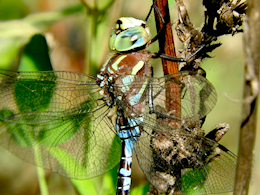
I was pleasantly surprised when I saw at least two large darners zipping along the edge of the shore, especially when one flew low to investigate the reeds close to where I was standing. My net shot out, and the next thing I knew there was an angry buzzing sound coming from inside. I had caught a darner, and I was not really surprised to find a male Canada Darner inside.
The 2024 North American edition of the Summer Odolympics were held between September 7-15, giving ode enthusiasts two weekends and as much time as a regular working week would allow to collect observations. I had hoped to find 19 or 20 species based on the same period spent collecting observations last year, but as most species are on the decline by this time, I knew I needed both good weather and good luck to come up with a respectful number. Unfortunately, neither luck nor weather were in my favour that first crucial weekend when I hoped to find a few species whose season ended around the beginning of September; it rained most of Saturday, and the temperature never rose above 15°C. Although it didn’t rain nearly as much on Sunday, the weather was worse: it was cloudy, windy, and the temperature never rose above 14°C. In fact, it was the coldest September 8th in more than 70 years (since 1949) and the windiest since records began in 1953 with a mean wind of 21 km/h. With a 1:00am windchill of 1.6 it was almost (within 0.1) the lowest windchill ever recorded on September 7th. Cold, wet, windy nights are even more of an obstacle, as many late-lingering species may not survive the low temperatures. When the sun began peeking out from the thick, fast-moving clouds around 4:30 I headed out despite the wind as to have zero species recorded on the first weekend was unthinkable. I didn’t expect much, and found only two species at the Eagleson ponds: an Eastern Forktail and a Slender Spreadwing.
Marlborough Forest is always a fun place to visit, and after failing to find any Brush-tipped Emeralds at Jack Pine Trail earlier this week I decided to go to the E6 trail and Roger’s Pond this morning to see if I could find any of these unique Somatochlora emeralds there. Unfortunately that was not to be the case, but I had a great time and found a nice selection of odes while I was there. At Trail E6 I found many of the usual species, including Racket-tailed Emeralds, Frosted Whitefaces, and White-faced Meadowhawks.
On June 15th I visited Mud Lake for a morning of birding and ode-hunting. It was about 13°C when I arrived at 8:30, and although it was sunny, the persistent breeze made it feel cooler. Still, there were more odes about than I had hoped for, although at first I saw only a few damselflies (Eastern Forktails, Fragile Forktails and Powdered Dancers) and Dot-tailed Whitefaces. It wasn’t until about an hour into my walk that I came across my first interesting odonate observation of the day: a lilac bush with several dragonflies perching on its branches. It was the Spiny Baskettail landing on an exposed twig that caught my attention, and while I was trying to photograph it a few more dragonflies landed nearby: first a Blue Dasher and then a Prince Baskettail! These large emeralds are the least likely of the baskettails to land, so seeing one perching is always a treat.
After I returned from my visit to southern Ontario I still had bugs on the brain, specifically odonates. Now that September has arrived the days will be getting shorter and the nights cooler, which spells the end of the season for a number of different species. It is, however, prime time for darners, and I still had yet to find a Lake Darner or Green-striped Darner this year. I also haven’t seen any Saffron-winged Meadowhawks either, another species that peaks in August and early September, despite searching known locations at the Eagleson storm water ponds. While I knew that bird migration was heating up, my brain hasn’t yet made the switch from odes to birds. I am having trouble getting up early enough to get out for my regular birding walks before work, and I won’t even consider putting my net away while the weather is still nice – I want to wring every last sunny moment looking for dragonflies and damselflies before taking the mandatory six-month winter hiatus. This has never happened to me before, and while I still am using eBird to keep track of what I see, most of my checklists are incidental ones noting only a few species that caught my attention while out later in the day dragonfly-hunting.
When I first heard about the Odolympics – a special bioblitz hosted by the Dragonfly Society of the Americas, Sociedad de Odonatología Latinoamericana, and Odonata Central in order to record as many odonata species from as many places in the Western Hemisphere as possible – I knew I had to participate. This specialized bioblitz is only two years old, and there are usually two Odolympics each year: one falling during the North American summer, and one falling during the South American summer in order generate a snapshot of odonate distribution throughout both hemispheres.
Dragonflies and damselflies, collectively known as odonates, are valuable indicators of a wetland’s environmental health and biodiversity. Simply put, the more odonates that use a wetland for breeding and feeding purposes, the healthier the ecosystem. Naturalists were encouraged to submit their observations during the bioblitz via one of two platforms: iNaturalist, or Odonata Central. While I love iNaturalist and have been using it for a few years now to record my non-avian observations, I began submitting my observations to Odonata Central last year when it developed a checklist-based phone app similar to eBird. iNaturalist also has a phone-based app for submitting observations, but it is intended to be used in conjunction with the phone’s camera which I only use as a backup camera when my Nikon Coolpix’s battery decides to take a nap. Although I love the ease of searching for data in iNaturalist’s projects, I chose to record my Odolympic observations in Odonata Central as it allowed me to include observations of species for which I am usually unable to get a photo (yes, I’m looking at you, Prince Baskettail and Wandering Glider!)
July is usually the start of the best three months of ode-hunting at Andrew Haydon Park. Although I often visit the park in the spring and fall for birds, my time here in the summer is devoted to dragonflies. This park is reliable for Halloween Pennants, Blue Dashers, Eastern Pondhawks, Common Green Darners, Prince Baskettails, and the usual King Skimmers, and I’ve had Cobra Clubtail and Elusive Clubtail here as well. I visited on July 29th with the hope of seeing another Cobra Clubtail, as it was on July 21, 2019 that I saw one fly into a tree on a windy day, eating what looked to be a male Orange Bluet. Though I’ve looked for both species here in July in subsequent years, I only had luck with one female Orange Bluet on July 24, 2021.
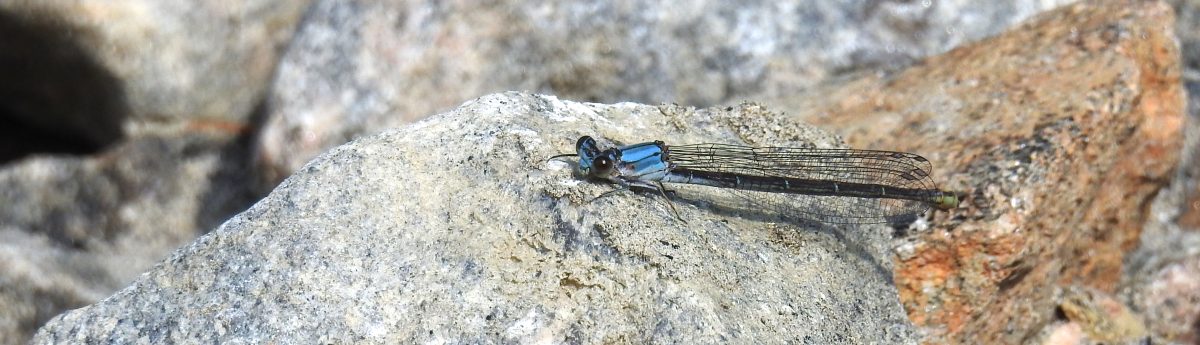
I wasn’t expecting to find a new species for the Eagleson storm water ponds when I went there this morning, let alone two; my main goal was to look for some Rainbow Bluets in the vegetation around the southern-most pond. My walk started normally enough, with the usual odonates perching in the vegetation: Taiga Bluets, Eastern Forktails, Sedge Sprites, and even a Fragile Forktail. I headed out onto the small spit of land where I used to see Saffron-winged Meadowhawks and Eastern Amberwings perching over the water before the sparse planting of cattails became a solid, impenetrable wall of vegetation. There was one dragonfly here, and I caught a glimpse of the black and white colours as it landed on the ground ahead of me. It was Chalk-fronted Corporal, and at first I thought nothing of it as I snapped a few photos for my iNaturalist project. After all, these dragons were not only common, but also abundant where they happened to emerge. It took me a moment to realize that although I see them quite regularly at Sarsaparilla Trail and in Marlborough Forest, I had never seen one here at the ponds before. It was a new species for my project!
Chalk-fronted Corporal (Ladona julia)
I only saw one as I made my way around the southern-most pond, but then I didn’t have time to check any of the others. Would it be a one-time visitor, like the Racket-tailed Emerald of 2022 or the Violet Dancer of 2020? Or would more follow? I’d seen a noticeable decline in skimmer numbers over the last year or two, so new additions were definitely welcome. There are fewer Common Whitetails, Twelve-spotted Skimmers, Widow Skimmers, Eastern Pondhawks and Dot-tailed Whitefaces around the edges of the ponds than there used to be. While none of these had ever been truly abundant, I would usually see a few on most visits in appropriate weather. I suspect the large number of fish – particularly carp, which feed by disturbing the wetland floor and stirring up sediment containing dragonfly larvae – and growing number of frogs and toads are likely responsible for this decline, but have no evidence to support this theory.
I found some Rainbow Bluets in the vegetation right where I expected them – they seem to prefer the western side of the southern pond – and was reassured when I saw a Common Whitetail a little later, flying over the small J-shaped pond next to the rock bridge before landing on a bare patch of ground sloping down to the water. I was making my way around the pond back to my car, looking for pondhawks basking on the rocks when something black fluttered in the vegetation below me. When I identified it as a male River Jewelwing I was astonished, as this was a species I never expected to find here at the ponds.
River Jewelwing (Calopteryx aequabilis)
River Jewelwings live along medium-sized streams and small rivers with a slow to moderate current and plenty of submergent vegetation. They prefer more open waterways with more sunlight than Ebony Jewelwings, though the two species are often found together along wooded streams. The closest places I’ve seen River Jewelwings are the stream at the back of Jack Pine Trail in Stony Swamp (which I call Spiketail Creek), and Stillwater Creek at Corkstown Road just east of Moodie Drive. The former was a one-time visitor, while the latter was seen during an exploratory excursion in 2015 with Chris Traynor after I saw one away from the water across the road in 2011.
There is a small channel of water that runs south from the Eagleson storm water pond system through farmland before reaching the Jock River at Terry Carisse Park. It has enough of a current to keep it open during mild winters, and I suppose it is just as likely that the River Jewelwing flew up the channel as it is that it flew or was blown south from Stillwater Creek. It’s a mystery as to where it came from and where it was going when it found the ponds, and I expect this to be a one-time visit rather than the harbinger of a new population of River Jewelwings at the ponds.
As I was photographing the jewelwing I saw two Common Green Darners fly by in tandem. This species is common at the ponds, and I usually see one or two patrolling the shoreline every visit in the first couple of months of the season. The pair stopped so the female could lay her eggs, inserting the tip of her abdomen into the water while still connected to the male:
Common Green Darners (Anax junius)
It is always fun adding new species to my project, especially if they become permanent residents: the larger the number of residents, the healthier the ecosystem. Dragonflies and damselflies in particular are good bioindicators of water quality and the health of a wetland, as they require clean water in which to grow as larvae and survive to adulthood. Given that the purpose of the storm water ponds is to collect poor-quality runoff from the surface of the city streets, which often contains road salt, vehicle fluids, bacteria, fertilizers, pesticides and other pollutants, I had my doubts whether these ponds could support a vibrant population of dragonflies. However, with recent additions such as the Orange Bluet, Eastern Amberwing and Band-winged Meadowhawks, whose populations seem to be stable, it seems that the water quality is in fact high enough to allow these species to thrive.
My informal list stands at 35 species as of June 2023, which is the same number as the species recorded on the iNaturalist project, though with two differences: I don’t count the single record of Hagen’s Bluet which shows up there, as the photos do not show sufficient detail for me to identify it; and I do count Prince Baskettail which is not in iNaturalist, as I have seen many but have not been able to photograph or catch one. I don’t count the Northern/Sweetflag Spreadwings which I’ve seen but haven’t been able to catch, either, since identification requires a close view of the male’s claspers….all goals for future visits!
So what species will turn up here next? I’m thinking Powdered Dancer or Halloween Pennant are most likely, but with dragons and damsels one just never knows. As my mentor says, odes – just like birds! – have wings and can turn up anywhere!
Dragonfly season (usually from mid-May to early November) is my favourite time of year. If the Victoria Day long weekend in May is warm and sunny, I’ll be out looking for the first emerging baskettails, whitefaces, and emeralds at some of my favourite spots in Stony Swamp or Mud Lake. I don’t usually see dragonflies before then since I’m busy working during the week, and weekend weather earlier in the month is not always conducive to dragon-hunting. Any dragonflies that I do see prior to the middle of the month are usually Common Green Darners that migrate here from further south. There was one year I found a migrant Common Green Darner at Hurdman Park in mid-April (April 19, 2011), but that is the exception rather than the rule. So when I visited a small pond along on NCC Trail 24 in Stony Swamp I wasn’t expecting to see anything other than the Wood Frogs I could hear calling from around the edges, and certainly not the tiny Spring Peepers with calls so loud you would swear they were right in front of you.
By mid-August most dragonfly species are on the wane. A few families are still quite abundant, particularly the darners and meadowhawks, while small numbers of other skimmers and a few clubtails often linger into September. Forktails, bluets, and some spreadwings are also still common in the appropriate habitats in August and September. This makes it worth going out to good dragonfly habitats such as large rivers, lakes and marshes to see a decent variety of species.
Large dragonflies this time of year are particularly interesting; while Common Green Darners are the most frequently encountered large dragonflies of late summer, you might come across a Black-shouldered Spinyleg basking on the rocks along the river, a Wandering Glider zipping over a meadow, a Twelve-spotted Skimmer flying above a pond, or a group of mosaic darners swarming through the air late in the afternoon. The mosaic darners are a particular favourite of mine; they are large brownish-black dragonflies with mottled spots of blue, green or yellow depending on the sex. While they spend most of their time flying through the air hunting for small insects, I often come across them perching vertically on thick stalks of vegetation below knee-height in open grassy areas early in the morning. We have several different species in Ottawa, and trying to find something other than the ubiquitous Canada and Lance-tipped Darners is a fun exercise.
My first real dragonfly outing of the year occurred on May 24, 2021, and as usual, took place at Roger’s Pond in Marlborough Forest. I invited a few friends to join me now that outdoor gatherings can include up to 5 people, and fellow OFNC members Derek and Gerald decided to join me. It was a warm, sunny day, and I hoped to find the usual common skimmers and clubtails, as well as a few uncommon species that I’d seen previously at Marlborough Forest such as the elusive Ebony Boghaunter and Harlequin Darner. I’ve already seen one boghaunter this season, but it’s been a few years since I’ve seen a Harlequin Darner, and the Cedar Grove Nature Trail has been a repeat site for this ode.
We met at 9:30 am, just early enough to get some birding in while waiting for the sun to rise higher in the sky. We had the usual Nashville Warblers, Black-throated Green Warblers, Great Crested Flycatchers, White-throated Sparrows, Veeries, and Yellow-bellied Sapsuckers on the walk in. At the pond itself we had Eastern Kingbirds, a Pied-billed Grebe, Common Yellowthroats and four Ring-necked Ducks. Many dragonflies were already flying along the open trail through the cedar forest, including a few teneral whitefaces and emeralds.
By the time September rolls around, most odonate species are done for the year in the Ottawa region – gone are the Aurora Damsels and Elegant Spreawings, the Spiny Baskettails and Ebony Boghaunters, the Arrowhead Spiketails and Horned Clubtails, the Chalk-fronted Corporals and Four-spotted Skimmers. This is the time of year when the number of meadowhawks and darners begin to peak, and southern species such as Spot-winged and Wandering Gliders may blow into our region with the warm south winds. A few bluet and spreadwing species may persist, as well as the common and widespread Eastern Forktail, though each day sees fewer and fewer individuals. This is a summary of species I saw and photographed around Ottawa during September 2019 – due to my trip to Edmonton and some cool, cloudy weekends, I didn’t visit as many places as I had hoped and missed a few common species.
On Sunday of the Labour Day weekend Chris Lewis and I spent the morning and early afternoon looking for birds and bugs. We met at Mud Lake at 7:00 am to check out the warbler action, then headed over to Trail 10 once the day warmed up and the trails started becoming busy. Once we were finished there, we returned to Mud Lake to look for odes. It was a good morning with a lot of walking, and we saw a lot of different things.
Our first visit to Mud Lake lasted just over an hour. We started out at the ridge, where the sun was just hitting the highest branches of the trees. The warmth of the sun stirs the insects into activity, which then attracts all sorts of insectivores looking for food. We did see a good number of birds in the tree tops, including a couple of Nashville and Cape May Warblers, several Tennessee and Yellow-rumped Warblers, and at least three Eastern Phoebes. Warbling Vireos were still singing, and a couple of Red-eyed Vireos were foraging low enough in the trees to identify them without hearing their familiar song.



 OdoNotations