The 2024 Summer Odolympics

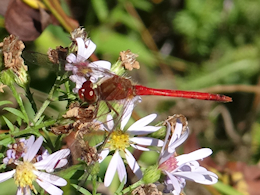
Autumn Meadowhawk (Sympetrum vicinum)

The 2024 North American edition of the Summer Odolympics were held between September 7-15, giving ode enthusiasts two weekends and as much time as a regular working week would allow to collect observations. I had hoped to find 19 or 20 species based on the same period spent collecting observations last year, but as most species are on the decline by this time, I knew I needed both good weather and good luck to come up with a respectful number. Unfortunately, neither luck nor weather were in my favour that first crucial weekend when I hoped to find a few species whose season ended around the beginning of September; it rained most of Saturday, and the temperature never rose above 15°C. Although it didn’t rain nearly as much on Sunday, the weather was worse: it was cloudy, windy, and the temperature never rose above 14°C. In fact, it was the coldest September 8th in more than 70 years (since 1949) and the windiest since records began in 1953 with a mean wind of 21 km/h. With a 1:00am windchill of 1.6 it was almost (within 0.1) the lowest windchill ever recorded on September 7th. Cold, wet, windy nights are even more of an obstacle, as many late-lingering species may not survive the low temperatures. When the sun began peeking out from the thick, fast-moving clouds around 4:30 I headed out despite the wind as to have zero species recorded on the first weekend was unthinkable. I didn’t expect much, and found only two species at the Eagleson ponds: an Eastern Forktail and a Slender Spreadwing.

Continue reading “The 2024 Summer Odolympics”

A New Dragonfly at Roger’s Pond

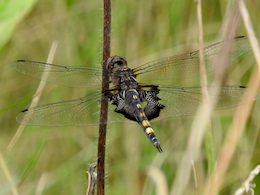
Halloween Pennant

Marlborough Forest is always a fun place to visit, and after failing to find any Brush-tipped Emeralds at Jack Pine Trail earlier this week I decided to go to the E6 trail and Roger’s Pond this morning to see if I could find any of these unique Somatochlora emeralds there. Unfortunately that was not to be the case, but I had a great time and found a nice selection of odes while I was there. At Trail E6 I found many of the usual species, including Racket-tailed Emeralds, Frosted Whitefaces, and White-faced Meadowhawks.

Continue reading “A New Dragonfly at Roger’s Pond”

A Three-Darner Day

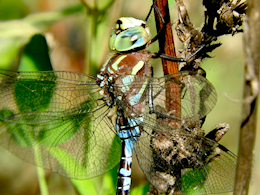
Black-tipped Darner

On July 15th I went to Jack Pine Trail at lunch to look for dragonflies. I was hoping to find some Brush-tipped Emeralds, a species I hadn’t seen there since 2019. I have not visited Jack Pine Trail much in the past five years for a variety of reasons, including closures during the pandemic lockdowns and after the derecho of May 2022. However, the main reason is that I stopped looking for them there after I began visiting Marlborough Forest during the pandemic and saw how common the Brush-tipped Emeralds were on all the trails there. Unfortunately Marlborough Forest is a little bit too far to visit on a lunch hour, but Jack Pine Trail is nice and close. It can be good for baskettails, and it’s the most reliable spot in the area for Arrowhead Spiketails in mid-June. I’ve also had Slaty Skimmer there and two unidentified clubtails that I never got a good look at before they flew off. I usually find something interesting there when I visit, and was hoping to do so again today.

Continue reading “A Three-Darner Day”

Finding Amber-wings

Amber-winged Spreadwing

I have been spending time on iNaturalist lately, looking at historical records of various odonate species and checking what species have been seen around Ottawa recently. This search stemmed from an interest in seeing whether there were any new locations or new records for the Eastern Red Damsel and Amber-winged Spreadwing, two species that used to be common at Bruce Pit but aren’t any longer. The Amber-winged Spreadwing is a relatively hefty species that inhabits various bogs, lakes and ponds, preferably those which do not contain fish. It’s been a good ten years since I’ve seen one at Bruce Pit, and the only other place I’ve seen one in Ottawa is at the Mississippi Snye in 2021. To my surprise one had been reported in Kanata not too far from home: Bill Teron Park in Kanata North. Named for the developer who initially designed Kanata to be a garden city existing in harmony with nature – no straight roads or cookie-cutter houses, while preserving rock outcroppings and areas for parks – it is a delightful pocket of the same rocky, wooded ecosystem found at South March Highlands hidden within an urban setting. There is a small pond here, with the usual dragonflies being seen at the water or along the nearby trails: Chalk-fronted Corporals, Dot-tailed Whitefaces, Common Whitetails, Autumn Meadowhawks, Common Green Darners.

Continue reading “Finding Amber-wings”

Odonates on the Wing: October and November 2023

Autumn Meadowhawk

By October I’m thinking about putting the net away for the season. If it is still warm at the beginning of the month, I will usually take the net out as long as I’m still seeing darners and small bluets around. Once I’m seeing nothing but meadowhawks, however, it’s time for me to declare an end to the season and put my gear away until the spring. This year the first week of October was very warm, with temperatures reaching 30°C; they then returned to seasonal for the next week with temperatures in the mid-teens. By the end of the month temperatures were in the single digits during the day and falling to below zero overnight, bringing an end to all but the hardiest of dragonflies. That title belongs to the meadowhawks, in particular the Autumn Meadowhawk (Sympetrum vicinum). It is no coincidence that it is the latest-flying dragonfly in many areas of the northeast….sometimes by several weeks. Once called the Yellow-legged Meadowhawk, it was renamed in 2004 by the Dragonfly Society of the Americas because mature individuals often have brown legs instead of yellow and because it persists so long into the fall. It is the only dragonfly in our area with entirely brown or yellow legs (never black), making identification relatively easy. And it is the only species you are likely to see in Ottawa in November!

Continue reading “Odonates on the Wing: October and November 2023”

Next Gen Dragon-hunters

Canada Darner
Canada Darner

After I returned from my visit to southern Ontario I still had bugs on the brain, specifically odonates. Now that September has arrived the days will be getting shorter and the nights cooler, which spells the end of the season for a number of different species. It is, however, prime time for darners, and I still had yet to find a Lake Darner or Green-striped Darner this year. I also haven’t seen any Saffron-winged Meadowhawks either, another species that peaks in August and early September, despite searching known locations at the Eagleson storm water ponds. While I knew that bird migration was heating up, my brain hasn’t yet made the switch from odes to birds. I am having trouble getting up early enough to get out for my regular birding walks before work, and I won’t even consider putting my net away while the weather is still nice – I want to wring every last sunny moment looking for dragonflies and damselflies before taking the mandatory six-month winter hiatus. This has never happened to me before, and while I still am using eBird to keep track of what I see, most of my checklists are incidental ones noting only a few species that caught my attention while out later in the day dragonfly-hunting.

Continue reading “Next Gen Dragon-hunters”

The 2023 Summer Odolympics

Dragonhunter
Dragonhunter

When I first heard about the Odolympics – a special bioblitz hosted by the Dragonfly Society of the Americas, Sociedad de Odonatología Latinoamericana, and Odonata Central in order to record as many odonata species from as many places in the Western Hemisphere as possible – I knew I had to participate. This specialized bioblitz is only two years old, and there are usually two Odolympics each year: one falling during the North American summer, and one falling during the South American summer in order generate a snapshot of odonate distribution throughout both hemispheres.

Dragonflies and damselflies, collectively known as odonates, are valuable indicators of a wetland’s environmental health and biodiversity. Simply put, the more odonates that use a wetland for breeding and feeding purposes, the healthier the ecosystem. Naturalists were encouraged to submit their observations during the bioblitz via one of two platforms: iNaturalist, or Odonata Central. While I love iNaturalist and have been using it for a few years now to record my non-avian observations, I began submitting my observations to Odonata Central last year when it developed a checklist-based phone app similar to eBird. iNaturalist also has a phone-based app for submitting observations, but it is intended to be used in conjunction with the phone’s camera which I only use as a backup camera when my Nikon Coolpix’s battery decides to take a nap. Although I love the ease of searching for data in iNaturalist’s projects, I chose to record my Odolympic observations in Odonata Central as it allowed me to include observations of species for which I am usually unable to get a photo (yes, I’m looking at you, Prince Baskettail and Wandering Glider!)

Continue reading “The 2023 Summer Odolympics”

The Odes of Late Summer

Green-striped Darner (male)

By mid-August most dragonfly species are on the wane. A few families are still quite abundant, particularly the darners and meadowhawks, while small numbers of other skimmers and a few clubtails often linger into September. Forktails, bluets, and some spreadwings are also still common in the appropriate habitats in August and September. This makes it worth going out to good dragonfly habitats such as large rivers, lakes and marshes to see a decent variety of species.

Large dragonflies this time of year are particularly interesting; while Common Green Darners are the most frequently encountered large dragonflies of late summer, you might come across a Black-shouldered Spinyleg basking on the rocks along the river, a Wandering Glider zipping over a meadow, a Twelve-spotted Skimmer flying above a pond, or a group of mosaic darners swarming through the air late in the afternoon. The mosaic darners are a particular favourite of mine; they are large brownish-black dragonflies with mottled spots of blue, green or yellow depending on the sex. While they spend most of their time flying through the air hunting for small insects, I often come across them perching vertically on thick stalks of vegetation below knee-height in open grassy areas early in the morning. We have several different species in Ottawa, and trying to find something other than the ubiquitous Canada and Lance-tipped Darners is a fun exercise.

Continue reading “The Odes of Late Summer”

Late Summer Dragons at the Ponds

Eastern Amberwing

August isn’t my favourite month to go dragon-hunting; in our region, a number of species have already vanished for the year, including several of my favourite clubtails and emeralds, cruisers and spiketails. August, then, is a season of skimmers and darners, and as such, places like the Eagleson storm water ponds are good places to go dragon-hunting, as these are the most common families of dragonflies that breed here (of the other families mentioned above, only the emeralds are present, and only members of the genus Epitheca, the baskettails). I’ve spent much of my free time this month at the storm water ponds, not just looking for butterflies, but also for new species of odes. It was only two years ago that I discovered new populations of Eastern Amberwings and Saffron-winged Meadowhawks breeding here, and as a number of common species are still scarce or still missing, it is worth checking to see if any have made their way here yet. For a habitat that is quite similar to that of Mud Lake or the ponds at Andrew Haydon Park, it is curious to me that there are no Powdered Dancers, no Horned or Lancet Clubtails, no Halloween or Calico Pennants, no Blue Dashers, and very few Widow Skimmers, Dot-tailed Whitefaces, Eastern Pondhawks, and Common Whitetails. Even spreadwings and dragonflies as abundant as the Autumn Meadowhawk are difficult to find. This is why it is such a surprise that uncommon species such as Eastern Amberwing and Saffron-winged Meadowhawk have become quite common here in late summer.

Continue reading “Late Summer Dragons at the Ponds”

Black Saddlebags at Presqu’ile PP

Black Saddlebags (Tramea lacerata)

On August 26th I joined Eastern Ontario Birding’s trip to Presqu’ile Provincial Park. The owner of EOB, Jon, is a friend of mine and got more than he bargained for when he agreed to pick me up at 5:30 am – as soon as he pulled up in front of my house a police car pulled up beside him to ask if he knew anything about a complaint that had been called in. Jon told the officer he was there to pick up a friend to go birding, and the police officer told him that he believed him (the eBird sticker on his car probably hadn’t gone unnoticed, and lent credibility to his statement). The police car drove off just as I was heading out the door, but we saw it stop with two other cruisers on Grassy Plains. Emerald Meadows is a quiet neighbourhood, and I certainly didn’t hear anything at 4:30 in the morning, but it made for a strange start to the day.

Continue reading “Black Saddlebags at Presqu’ile PP”

Late Season Dragon-hunting

Lance-tipped Darner

On Sunday of the Labour Day weekend Chris Lewis and I spent the morning and early afternoon looking for birds and bugs. We met at Mud Lake at 7:00 am to check out the warbler action, then headed over to Trail 10 once the day warmed up and the trails started becoming busy. Once we were finished there, we returned to Mud Lake to look for odes. It was a good morning with a lot of walking, and we saw a lot of different things.

Our first visit to Mud Lake lasted just over an hour. We started out at the ridge, where the sun was just hitting the highest branches of the trees. The warmth of the sun stirs the insects into activity, which then attracts all sorts of insectivores looking for food. We did see a good number of birds in the tree tops, including a couple of Nashville and Cape May Warblers, several Tennessee and Yellow-rumped Warblers, and at least three Eastern Phoebes. Warbling Vireos were still singing, and a couple of Red-eyed Vireos were foraging low enough in the trees to identify them without hearing their familiar song.

Continue reading “Late Season Dragon-hunting”

Dragon-hunting at the Bill Mason Center

Azure Bluet
Azure Bluet

On August 7th I met up with Chris Lewis at Shirley’s Bay for a morning of birding and dragon-hunting. The morning got off to a great start when I saw a group of Wild Turkeys along Rifle Road even before I met Chris at the parking lot; there were two adults and a couple of baby turkeys. At Shirley’s Bay Chris and I tallied 44 species altogether, including a juvenile Osprey which landed in the Osprey nest down the road, five Common Terns and 11 Caspian Terns flying about, a Pectoral Sandpiper, a Semipalmated Sandpiper, a Solitary Sandpiper, and a single American Wigeon in the bay with the usual dabbling ducks, and a flock of migrating songbirds in the woods. The flock included a Yellow Warbler, a Chestnut-sided Warbler, a Black-and-white Warbler, and a couple of Gray Catbirds, and a Rose-breasted Grosbeak.

Continue reading “Dragon-hunting at the Bill Mason Center”

The Last Dragons of Summer

Autumn Meadowhawk

The end of September is a good time to see a variety of hover flies (also known as flower flies, syrphid flies, or syrphids). It is also the end of dragonfly season. Most odonates are already done for the season – only a handful of species will continue flying into October, with the last species, Autumn Meadowhawk, flying into November if the weather cooperates.

As the last week of September was still quite warm, I was able to find and photograph a few different species of both insects – even in my own backyard! I finally added Autumn Meadowhawk to my official yard list on September 19th. I’ve seen a few meadowhawks in my yard over the years, but have only identified White-faced Meadowhawk and Band-winged Meadowhawk so far. I found it on the asters at the back of the yard, although it flew up onto the fence when I tried to get closer for a photo. Given how abundant and widespread it is, the Autumn Meadowhawk was the most likely species to be added to my yard list. Now that it has shown up in my yard, I’m not sure what the next likeliest species is – Common Green Darner? Twelve-spotted Skimmer?

Continue reading “The Last Dragons of Summer”

To Catch a Wandering Glider

I had a fabulous outing in Stony Swamp this morning. I started the morning by birding at Sarsaparilla Trail where I found a pair of Pied-billed Grebes and a Merlin perched in one of the dead trees at the north end of the pond; it was so far off that I had to return to the car and get my scope to identify it. I was glad I had brought my scope, for as I was scanning the vegetation along the shoreline I discovered two heron species skulking at the edge of the pond: a tiny Green Heron poised on a log, and an American Bittern that was almost invisible in a gap in the reeds! It made me wonder what other birds were present, going about their lives while remaining hidden from view.

Continue reading “To Catch a Wandering Glider”

Marvelous Meadowhawks

Saffron-winged Meadowhawk

On August 16th Chris Lewis and I went to the Bill Mason Center to do some dragon-hunting. As the weatherman was predicting a steamy high of 30°C with 100% humidity, we met at 7:30 in the morning in order to beat the heat. For the second day in a row, a thick early-morning fog hung low over Ottawa, but once we arrived at the sand pit we found a bright, sunny morning with no trace of fog. It was really starting to warm up by then, but as it was still early in the day, all we saw at first were a couple of darners we accidentally scared up from the vegetation along the northwestern side of the pond. None were cooperative; instead of settling back down in a spot where we could see them, they zoomed off altogether.

Continue reading “Marvelous Meadowhawks”